


Calculate and Optimize Restaurant Table Turnover Rate
 Mika Takahashi
Last updated Mar 4, 2026
 Mika Takahashi
The restaurant table turnover rate tells you how often different groups of customers use the same table in your dining room during a service period. This important number tells you how many visitors your restaurant can serve with its current seating capacity, which in turn tells you how much money you make per shift.
This article talks about how to figure things out, how to make things better, and how to find the right balance between running a restaurant efficiently and keeping customers happy. Here are some useful guidelines for restaurant owners, managers, and operators who want to make as much money as possible without lowering the quality of the food. The main focus is still on table-service restaurants, from fast-casual places to fancy ones.
Most table-service restaurants have an average table turnover rate of three turns during dinner service period, and the best time for a party to turn over is about 45 minutes. Fast-casual restaurants usually get 1.5 to 2.5 turns every hour, whereas fine dining restaurants get 1 to 1.5 turns.
By the time you finish reading this essay, you will have:
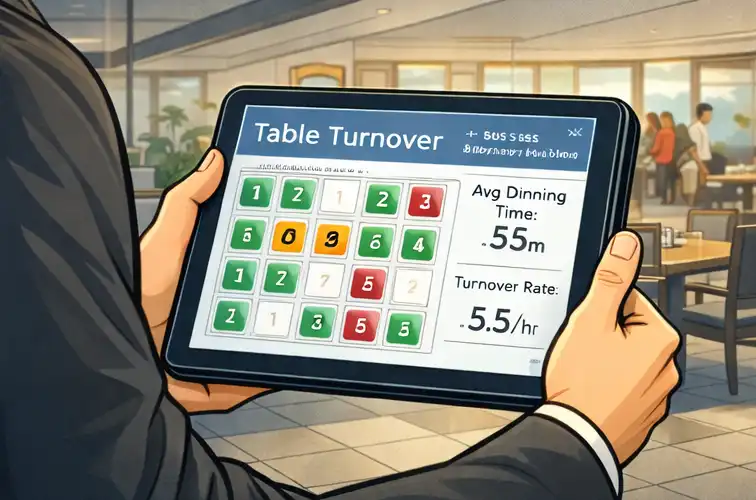
The restaurant table turnover rate measures how well your restaurant uses its physical seating capacity during service times. A higher table turnover rate means that you can serve more customers with the same number of tables, which makes this a very important indicator for maximizing income. If you know these basics, you can make real improvements to how well your business runs.
The table turnover rate is the number of times a table in your dining room hosts a different group of people over a certain amount of time. If your restaurant has 15 tables and serves 45 parties throughout dinner, your turnover rate is 3. This means that each table serviced three distinct groups.
The idea is really different for different types of restaurants. A casual dining restaurant could want to flip tables every 45 minutes to keep guests happy while still serving a lot of people. A fine dining restaurant, on the other hand, might want to shift tables every 2 hours but make up for it by charging more per table. Fast-casual restaurants generally plan for turns of less than 30 minutes.
There is a clear link between turnover rate and seating capacity use. A restaurant with 20 tables that turns tables three times serves 60 parties, but the same restaurant that turns tables four times serves 80 parties, which is a 33% increase in guests served without adding a single seat.
Data from the industry shows that different types of restaurants have different patterns:
These benchmarks are important because they set reasonable goals for your type of restaurant. Trying to emulate fast-casual turnover rates in a fine dining setting would ruin the experience that your customers anticipate. On the other hand, accepting fine-dining turnover rates in a casual setting means losing a lot of money.
Knowing where your restaurant stands in relation to these benchmarks will help you understand the following calculation procedures.
With these basic ideas in mind, accurate calculation lets you find exactly where your restaurant operations could be better. The algorithms are simple, but you need to be very careful when gathering clean data and choosing the right time periods.
The basic formula for figuring out the table turnover rate is:
Number of Parties Served ÷ Number of Tables = Table Turnover Rate
Here’s a real-world example: Your restaurant has 25 tables. During Friday dinner service (5:00 PM to 10:00 PM), you served 87 parties.
Calculation: 87 ÷ 25 = 3.48 turns
This means that each table served an average of 3.48 separate groups of people over the 5-hour dinner session.
To find out how long it takes for each party to leave a table, do this:
Time per Table Turn = Service Hours ÷ Turnover Rate
Using the example above, 5 hours divided by 3.48 equals 1.44 hours, which is about 86 minutes each party.
Your POS system probably keeps track of the time between when an order is placed and when the table pays its bill. This might give you useful information about how many people are actually sitting at the table.
The turnover rate changes a lot over time, hence strategic analysis is quite important:
Tracking every day shows overall trends, but it hides critical changes. On Saturdays, a restaurant might have four turns, but on Tuesdays, it might only have two and a half.
There are clear patterns when you look at the service period (lunch vs. dinner). Lunch service frequently has greater turnover rates since customers have less time, but dinner service lets diners stay longer.
Peak hours analysis finds the times when you have the most customers. You can find out where your optimization efforts will pay off the most by keeping track of turnover during your busiest 2-hour windows and your off-peak times.
Tracking station by station shows where there are problems with various server parts or table locations. A station close to the kitchen might spin faster than one in a far-off corner of the dining area.
In order to get people to act, raw turnover data need context. A turnover rate of 2.5 can mean that a fine dining restaurant is doing very well, whereas a casual restaurant is not doing very well at all.
Look at your results next to:
When turnover rates are low, it means there are chances to make ordering, meal preparation, service flow, and resetting tables more efficient. High turnover rates mean that you should look at customer satisfaction indicators to make sure that speed isn't ruining the eating experience.
The link between these measurements and making more money is clear: the example of a downtown restaurant that saw a 20% boost in nightly income when it cut the average table turnover time from 90 to 75 minutes shows how tiny changes may have a big effect on finances.
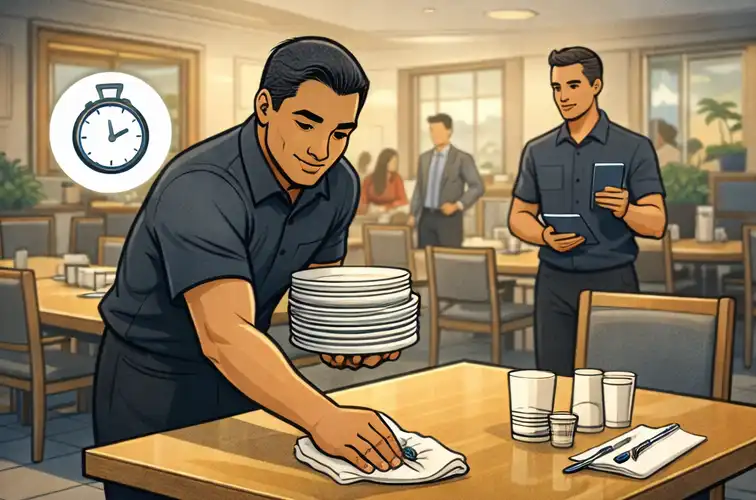
To get the most out of table turnover, you need to find a balance between making things more efficient and keeping customers happy. The best tactics lower friction during the meal without making guests feel rushed. These useful tips will help you service more customers while keeping them happy.
Use these methods at busy times when they will have the biggest effect on turnover:
More operational enhancements include training servers to schedule their check-ins, getting staff ready to serve dessert quickly (or know when guests will say no to dessert), and getting the whole team ready to meet visitors' needs before they ask for help.
Technology solutions provide quantifiable enhancements to turnover rates:
| Technology Solution | Implementation Cost | Turnover Impact | ROI Timeline |
|---|---|---|---|
| Handheld POS Systems | Medium | 5-10 minutes saved per table | 3-6 months |
| QR Code Ordering/Digital Menus | Low | 8-15 minutes saved per table | 2-4 months |
| Contactless Payment Options | Low | 3-7 minutes saved per table | 1-3 months |
| Online Payment Systems | Low | 5-8 minutes saved per table | 2-3 months |
Restaurant management should look at these possibilities based on the problems they are having right now. Contactless payment methods have an immediate effect if guests often have to wait for checks. Digital menus and QR code ordering can help with this problem if the ordering process takes too long.
To get the most out of these technology implementations, staff training must be done at the same time. Bringing in handheld POS systems without sufficient training makes things more frustrating instead of more efficient.
Even the best plans to improve turnover run across problems. Restaurant owners can keep things moving during implementation if they know about these problems ahead of time.
There is a true conflict between faster turnover and the quality of the eating experience. Guests who stay longer help the mood, yet fast service ruins the hospitality that keeps people coming back.
Instead of blatant rushes, use subtle contextual clues. Studies suggest that turning up the music and lights during busy times can naturally speed up table turns without making visitors feel rushed. Teach your workers how to tell the difference between tables that demand fast service and those that want a more relaxed meal. Keep up the courteous service standards, but change your approach as needed.
Servers may not want to make adjustments that they think would make their jobs harder or more stressful, especially if they don't understand how serving more tables might lead to greater tips.
Get your team involved in creating goals and make sure they understand how higher revenue leads to higher earnings. When servers realize that moving more tables means serving more clients and getting higher tips, they often go from being resistant to becoming excited. Give personnel thorough training on new procedures and technology so they don't feel overwhelmed but rather capable.
During peak hours, flaws that aren't obvious during slower times come to light. Kitchen backups, host stand mix-ups, and server station overload all have a big effect on turnover during your busiest times.
Make special plans for busy times, such as reservation systems that spread out arrivals, waitlist systems that get customers ready for instant seating, and kitchen coordination that puts food orders at the top of the list during busy times. Cross-train people so that service stays high-quality during busy times. For example, hosts who can run food, servers who can seat tables, and managers who can step in when there are problems.
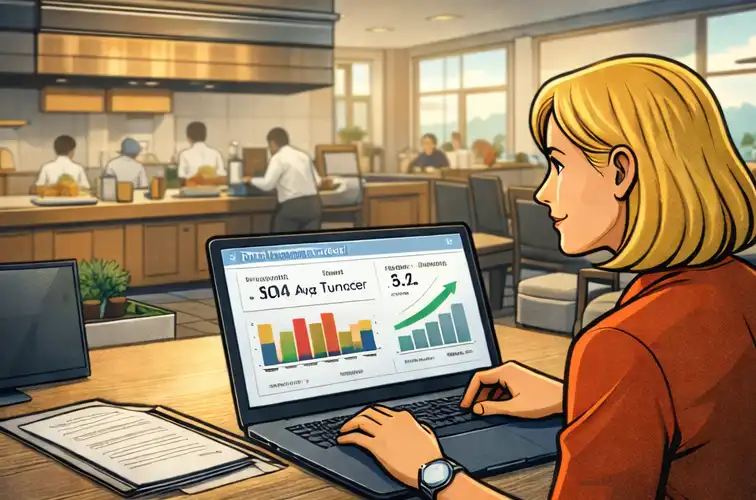
When done strategically, optimizing table turnover can boost overall income while keeping customers happy. The goal isn't just to turn tables faster; it's to serve more customers quickly while giving them a dining experience that makes them want to come back.
What you need to do right now:
The restaurant business is always changing, and optimizing table turnover is related to bigger issues like training programs for staff to make them more efficient, optimizing restaurant layouts for flow, and managing the customer experience to find the right balance between speed and friendliness.
These resources may help you manage turnover on an ongoing basis:
These resources help the cycle of continuous improvement that turns optimizing table turnover from a one-time initiative into an ongoing operational discipline.
Our sales, marketing and custom support stand ready 24/7 worldwide.