


What is a Stock Keeping Unit (SKU)? How it Works
 Mika Takahashi
Last updated Feb 7, 2026
 Mika Takahashi
What is stock keeping unit? Businesses use a stock keeping unit (SKU), which is a unique alphanumeric code, to keep track of each item in their inventory. For hotels that handle thousands of items, from sheets and toiletries to restaurant supplies and maintenance tools, knowing SKUs turns messy stockrooms into well-organized, efficient operations.
This article goes over the basics of stock keeping units, how they may be used in the hospitality industry, how to put them into effect, and the best ways to manage hotel and restaurant inventory. This content talks about the main problems you face when trying to keep accurate inventory records across several departments, whether you're a hotel manager dealing with supply shortages, a restaurant manager looking for more accurate inventory records, or a hospitality operator trying to cut costs.
A stock keeping unit (SKU) is a unique code that you provide to each item in your inventory system. This lets you keep track of and manage every item your hotel uses every day. Each SKU stands for a different version of a product. This lets you keep track of how much stock you have, properly predict how much you'll need, and avoid running out of stock or having too much.
By the end of this guide, you will:
A stock keeping unit is like a digital fingerprint for every thing your hotel buys, stores, or uses. It helps you keep track of what you have. Businesses don't use global standards; instead, they make their own SKU system that is tailored to their individual needs. They encode information about products, such as category, brand, size, and specs, into codes that can be scanned.
This internal coding system is quite helpful for running hotels. You need different ways to keep track of your housekeeping supplies, guest amenities, food and drink inventory, and maintenance materials. With a strong SKU system, you can keep track of your inventory in all of these categories, see how much stock you have in real time, and keep accurate inventory records without making mistakes when you count.
SKU formats use letters and numbers ordered in a logical order to encode the features of a product. For example, "LIN-BATH-WHT-KNG" could be a good SKU structure for white king-size bath linens, while "AMN-SOAP-LUX-50" could be a good structure for 50-count luxury soap amenities.
Sku codes usually include important information about a product, such as its category, brand or quality level, size or color, and the number of items in the package. Anyone who scans stock keeping units will know right away what product they are handling, where it belongs, and how many of that item are still in stock thanks to this organized method.
This organized method makes it possible to easily keep track of everything going on in the warehouse. Your restaurant inventory system can keep track of products far more accurately than manual techniques when every towel type, toiletry size, and cleaning supply has its own SKU.
Stock keeping units (SKUs) are unique to your firm and are used to identify items. The universal product code (UPC), on the other hand, works differently. A UPC is a 12-digit barcode that manufacturers provide to products and that all retail outlets and supply chain partners can read. If you buy the same product from a distributor in New York or Los Angeles, it will have the same UPC.
Your hotel's inventory management skus, on the other hand, can be changed in any way you like. You might give skus that have location codes, department prefixes, or reorder thresholds. A universal product code can't give you this information. Two hotels that buy the same product from the same source would probably create skus with very different structures to meet their own operational demands.
Knowing the difference makes it clear why restaurants and hotels need both: UPCs allow you place orders with suppliers and check deliveries, while your own SKU system keeps track of your inventory and analyzes sales data. This two-pronged strategy lets you keep inventory tracking of all your sales and manage your inventory across your location.
In practice, hotels have inventory problems that generic retail solutions don't solve. Guests want consistent quality, demand changes with the seasons in ways that are hard to predict, and different departments compete for limited warehouse space while still needing different supplies.
In hotel operations, the housekeeping department usually has the most inventory items to keep track of. You might need to keep track of dozens of different items in a single guest room, such as bed sheets in different sizes, bath towels, washcloths, toiletries, paper products, and cleaning supplies. If you don't give each item a unique SKU, it becomes hard to keep track of which ones need to be reordered.
Think about a hotel with 200 rooms, some of which are king and queen rooms. You need different fitted sheets for each bed size, and each quality level of sheet (standard, premium, luxury) is a separate item in your inventory management system. Giving each variety a unique identification, such "SHT-FIT-KNG-PRM" for premium king fitted sheets, lets you keep track of your inventory levels and change them based on occupancy projections.
This detailed SKU data stops the typical problem of having too many queen linens and not enough king sheets, or having too many ordinary amenities and not enough premium toiletries in luxury suites.
When you run a restaurant or bar, you have to deal with perishable supplies, tracking portions, and items that sell quickly. Good sku management in food and beverage goes beyond just putting labels on things. It also includes tracking sales, waste, and menu costs.
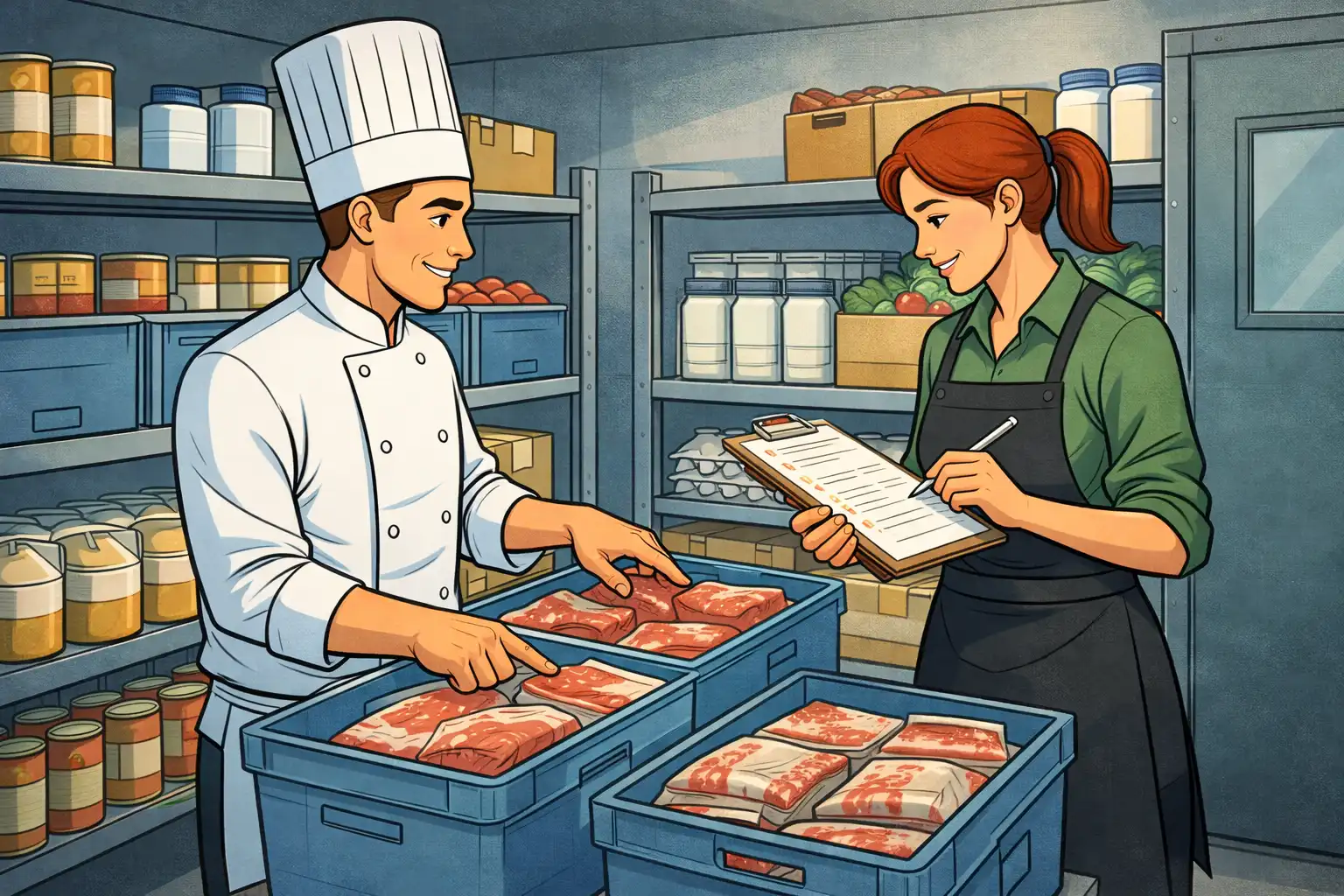
A hotel restaurant might make skus that include the supplier, the type of food, and the size of the container. For example, "MEAT-BEEF-TEND-10LB" means beef tenderloin in ten-pound pieces. This method lets kitchen managers keep an eye on stock levels compared to past sales data, spot sales trends for certain commodities, and plan inventory for events or menu adjustments that happen every season.
When both departments utilize the same inventory management software platform, it becomes evident how they are connected to housekeeping inventory. Having the same SKU format across departments makes it possible to report on the whole property, plan inventory accurately, and place orders from shared vendors all at once.
The engineering and maintenance departments of a hotel usually have the most extensive product lines. They handle anything from HVAC filters and light bulbs to unique parts for kitchen equipment. Many maintenance goods are ordered less often than consumable supplies, but they are very important when they are needed.
Creating SKUs for maintenance inventory makes sure that when an elevator part breaks or a refrigeration unit has to be fixed, personnel can check availability right away instead of placing emergency orders. For maintenance, an SKU may be an equipment identifier like "HVAC-FLT-20x25-MRV8" for a certain size and efficiency rating of a filter.
Across all departments, sku level data makes operations run more smoothly by cutting down on the time spent looking for products, lowering the cost of emergency orders, and allowing proactive restocking based on consumption trends instead of reactive responses to stockouts.

Once you know how stock keeping systems work in hotels and restaurants, the next step is to put them into action. You need to plan carefully when making stock keeping units. A poorly designed system can cause problems, while a good sku system can help your business run smoothly.
Before making skus, hotels should look at all of their inventory goods and put them into logical groups. The following steps will help you put this into action:
Restaurants have to choose between manual and automated ways to manage their inventory. This choice is heavily influenced by the size of the property, the budget, and the plans for growth.
| Criterion | Manual Management | Automated Systems |
|---|---|---|
| Accuracy | Prone to human error; requires verification | Real-time validation prevents duplicates |
| Time Efficiency | Staff-intensive for updates and audits | Automatic syncing across sales channels |
| Scalability | Difficult as product lines expand | Handles thousands of skus without degradation |
| Cost | Lower initial investment | Higher upfront; lower long-term labor costs |
| Integration | Limited connection to other systems | Direct links to PMS, POS, and suppliers |
For small boutique hotels with few rooms, employing spreadsheets and other manual approaches may be enough at first. Automated inventory management systems that keep track of inventory levels across locations, create skus for new products, and provide sales forecasts based on past data are very helpful for larger hotels or those that want to grow.
Ultimately, the answer depends on how many skus your property has and how often the inventory changes. Properties with stable, limited catalogs don't need to act as quickly as those with dynamic F&B operations or several outlets that need to maintain track of stock between locations.
Even well-planned SKU systems have trouble being put into action. Hotels and restaurants can come up with ways to stop problems before they happen instead of fixing them after they happen if they know they will happen.
When housekeeping, F&B, and maintenance each make their own sku forms without talking to each other, it leads to confusion and data that doesn't work together. various departments might give the same product various sku codes, which would mess up inventory statistics and make it harder to analyze the supply chain.
The answer is to have a centralized stock keeping unit governance, which is a single authority (usually the operations or purchasing leadership) that approves all new sku numbers, keeps the master coding system reference up to date, and makes sure that other departments follow the same procedures. This centralization makes it possible to keep accurate inventory data without having separate departments.
When identical products get the same SKU, when personnel make new entries without checking existing codes, or when the same product comes in with different packaging, duplicate stock keeping units appear. These duplicates mess up sales monitoring, make inventory levels look wrong, and make it harder to get the right number of items to restock.
Most duplicates are automatically stopped when you use unique identifier checking in your inventory management software. Regular system audits, which compare physical inventory to system records every three months, uncover mistakes that go past other checks. Many current systems warn workers about possible duplicates when they try to assign SKUs that are already in the system.
Without worker support, implementing new technology doesn't work. Workers who are used to informal ways of keeping track of inventory may not like organized SKU systems because they see them as extra red tape instead than a way to improve operations.
This opposition can be overcome with thorough training sessions that show how they can help with efficiency. Tell the housekeeping crew how scanning stock keeping units might help them find things faster in stockrooms. Show kitchen managers how sku data can help them figure out how much to charge for each menu item. When employees know that the system meets their needs and not simply management reports, it becomes much easier for them to use.
Ongoing support after initial training is needed for successful deployment. Quick-reference guides, department champions that help their coworkers, and IT support that is quick to respond all help with continued use and proper use.
Stock keeping units are the most important part of managing restaurant inventory well. SKUs provide you the accuracy you need to keep track of linens and amenities, restaurant supplies, and maintenance components. This is what sets well-run properties apart from those that are often running out of stock or having too much.
These quick steps will change how your hotel's inventory works:
To keep optimizing, look at related topics like inventory automation systems that cut down on human work, property management system connectors that bring together all of your operations data, and marketing tactics that use sku-level data to plan targeted promotions and manage revenue.
SKU Template Examples for Hotel Departments:
Integration Considerations:
Best Practices for Ongoing Management:
Our sales, marketing and custom support stand ready 24/7 worldwide.