
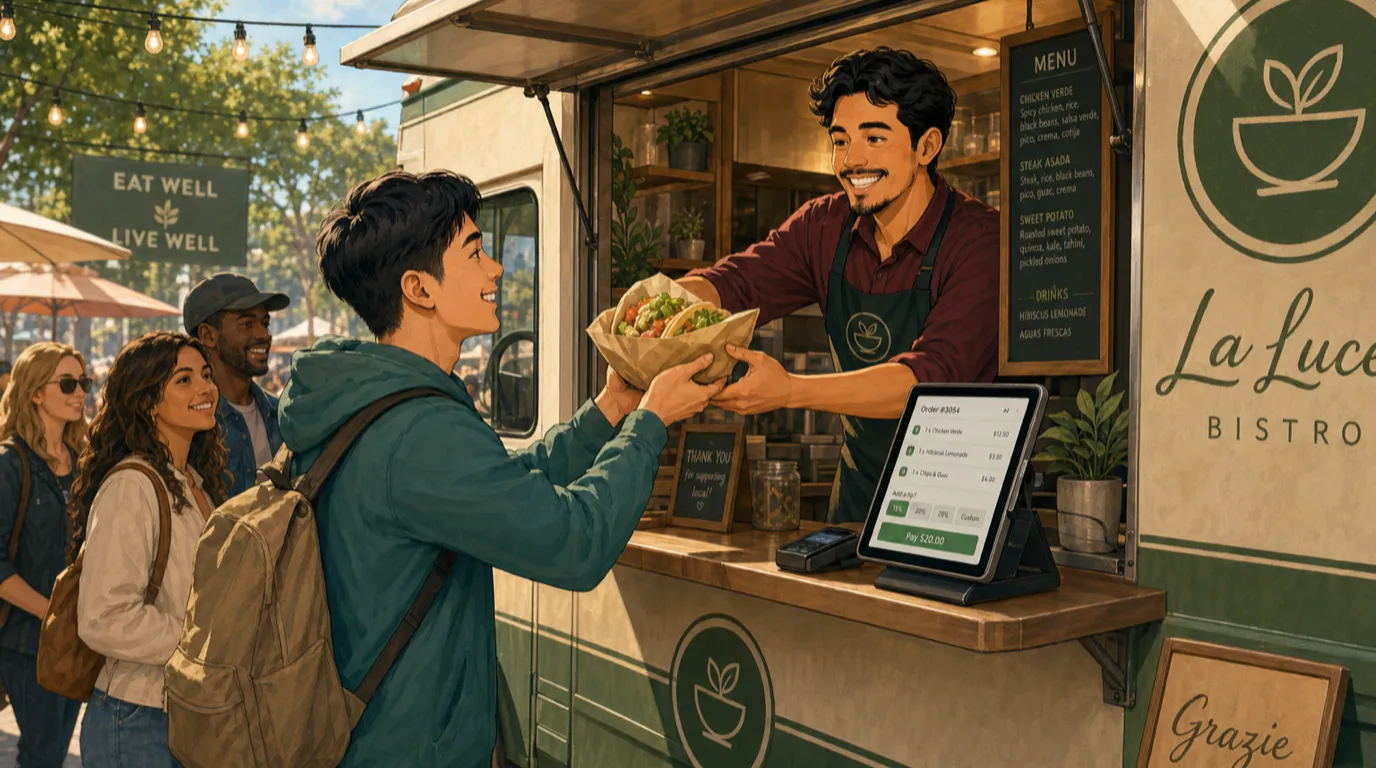
A food truck is one of the most accessible ways into the food business, which is exactly why so many people dream about it and why so many get the numbers wrong. The pitch is real: far less money than a restaurant, the freedom to drive your kitchen to wherever the customers are, and a low-risk way to test a concept before you ever sign a lease. The reality is that a truck is still a serious business with long hours, strict health rules, and margins you have to manage closely. Getting the operations right from day one matters more than the logo, and most successful owners run their service on a purpose-built food truck POS rather than improvising with tools meant for a sit-down dining room.
Think of a truck as a tiny restaurant on wheels with all the same obligations and none of the spare space. You still need permits, a health inspection, a way to take payment when the cell signal drops, and a plan for where you will actually sell. Because so much of a truck's revenue happens in a short, frantic lunch rush or at a packed event, the speed of your line decides your day, and a good takeaway and order system that handles a queue and online orders is the difference between turning the crowd and watching it walk off. Nail the unglamorous parts and the freedom the truck promises actually shows up.
This guide walks through the whole thing in the order you should tackle it: deciding if a truck is right for you, locking the concept and menu, the real startup and running costs, the licenses and the commissary requirement, buying or building the truck, the tech you need, where to sell, how to market with no fixed address, and a step-by-step launch timeline. By the end you will know what you are signing up for and how to give it a real shot.
Is a food truck actually right for you?
Before the fun parts, a gut check. A food truck is cheaper to start than a restaurant, but it is not easy money, and the people who thrive go in clear-eyed. You will work long, physical days in a hot, cramped space. Some shifts you are the cook, the cashier, the driver, and the person fixing a generator at 6 am. The income can be seasonal and weather-dependent. If that sounds miserable, the dream is not for you, and better to know now than after spending 80,000 dollars.
For the right person, though, the upside is genuine. You get to build a brand and a following with a fraction of a restaurant's capital. You can change locations chasing the best crowds instead of being stuck with whatever foot traffic your lease gave you. And a truck is a proving ground: a concept that crushes it on wheels is a far safer bet to expand into a permanent spot later. Plenty of well-known restaurants started as a single truck. Go in knowing it is hard work, and the flexibility and low entry cost make it one of the best deals in the industry.
Lock the concept and the menu first
Everything downstream flows from your concept, so settle it before you price trucks. What do you sell, who is it for, and why would someone cross a parking lot for it? The trucks that work tend to have a clear, memorable identity and a tight menu, not a sprawling one. A short menu is not a limitation on a truck; it is survival. Limited space, limited equipment, and a line out the door mean you want a handful of things you can execute fast and consistently.
Choose food that holds up to the format. It has to cook quickly in a small kitchen, travel well in a hand or a container, and stay good while someone walks back to the office. Tacos, loaded fries, gourmet sandwiches, bowls, barbecue, and handhelds of every kind are truck staples for a reason. A delicate plated dish that needs five components and a calm pass is a poor fit. Pick a focused menu of items with healthy margins that your kitchen can pump out at speed, and resist the urge to add more. Every extra item slows your line and complicates your prep.
The numbers: what it really costs
Money is where food truck dreams meet reality, so be honest with the math. Total startup commonly runs from around 40,000 dollars on the low end to 200,000 or more for a new custom build, with the truck itself as the single biggest line. But the truck is only part of it, and underbudgeting the rest is the classic rookie error.
Plan for the full picture. The vehicle, new or used, is the headline cost. Then kitchen equipment and smallwares, a generator, and a water system. A vehicle wrap and branding, which is your rolling billboard and worth doing well. Permits, licenses, and inspections. Insurance, which a truck genuinely needs across several types. Your first inventory and ingredients. A commissary deposit and first month. A POS and payment processing setup. And, the one people skip, a cash cushion to cover the slow weeks while you build a following. A truck that launches with zero working capital is one bad-weather month from folding.
Do not forget the ongoing costs once you are rolling, because those decide whether you stay open. Fuel and truck maintenance, the recurring commissary rent, food and packaging, any staff wages, permit renewals, payment processing fees, and fuel for the generator. Trucks live and die on tight cost control, so know your numbers per item and per shift, not just the big launch figure.
A quick example shows why the per-shift math matters. Say you sell tacos at an 8 dollar average ticket and serve 120 people on a good lunch and dinner day, that is 960 dollars in sales. Knock off roughly 30 percent for food and packaging, a share of your commissary rent and fuel for the day, the payment processing fees, and a helper's wages, and a strong day might net you a few hundred dollars. A slow, rainy Tuesday with 40 covers can lose money once fixed costs are counted. That swing is the whole game, and it is why owners obsess over reliable high-volume spots and guaranteed catering rather than hoping for walk-up crowds.
Funding your food truck
Few people start a truck entirely out of pocket, so know your options before you commit. Personal savings is the cleanest source, since it keeps you debt-free, but draining every dollar leaves you no cushion, which is dangerous in a seasonal business. Many owners combine savings with a small business loan or a specialized equipment loan, where the truck itself often serves as collateral, which can make approval easier than an unsecured loan. Some lenders and dealers offer financing tailored to food trucks specifically.
Other routes exist depending on where you are and who you know. Friends-and-family investment is common at this scale, as long as you treat it formally and put the terms in writing. Microloans and grants aimed at small or first-time food businesses show up in many regions and are worth researching. A few owners pre-sell catering packages or run a crowdfunding campaign to raise launch money and build an audience at the same time. Whatever mix you choose, borrow against a realistic revenue plan, not the best-case one, and keep enough back to survive the slow opening stretch.
Licenses, permits, and the commissary rule
This is the least exciting section and the one that sinks the most launches, so give it real attention. The exact requirements depend entirely on your city, county, and country, and they vary more than first-timers expect, so your first move is to call your local health department and licensing office and get the actual list before you spend money. Two cities an hour apart can have completely different rules about where you can park and what you must carry.
The usual set includes a business license, a mobile food vendor or food service permit, a health department permit with regular inspections, a food handler or manager certification, vehicle registration and the right driver's licensing, fire safety approval for your cooking and gas setup, and several kinds of insurance. Many cities also limit where and when trucks can operate, with no-vending zones, distance rules near restaurants, and permit-only event spots, and those rules directly shape your location strategy.
The big one to plan around is the commissary. Most health departments require food trucks to be based out of a licensed commissary or commercial kitchen, a fixed facility where you prep and store food, refill fresh water, dump waste water, and clean the truck. Operating purely out of a home kitchen is generally not legal. A commissary is a recurring monthly cost and a logistical anchor for your day, so factor it into both your budget and your routine from the start. Our guide on commissary kitchens covers how shared and private options work if you want to weigh them.
Buying or building the truck
The truck is your kitchen, your brand, and your biggest asset, so choose it carefully. The first decision is new versus used. A used truck costs less and lowers the capital you need to start, which is real money in your pocket, but you are buying someone else's wear and tear, and a breakdown means both lost sales and a repair bill. If you go used, pay a mechanic to inspect the vehicle and a technician to check the kitchen equipment before you hand over anything. A surprise transmission or a dead refrigeration unit can erase the savings overnight.
A new or custom-built truck costs more but arrives laid out for your exact menu, with new equipment under warranty and far fewer first-year surprises. For a complex concept that needs specific equipment, the custom route can be worth it. Many owners split the difference: a sound used truck with a targeted refit of the equipment that matters most for what they cook. Whichever way you go, obsess over the kitchen layout more than the paint job. You will work that cramped workflow every single shift, and a smart layout that lets two people move without colliding is worth more than any decorative touch. The wrap on the outside is your marketing; the layout on the inside is your sanity.
The tech that keeps a truck moving
A truck has less room for hardware than a restaurant and a harder environment to run it in, so the tech you pick has to be tough and simple. The center of it is your point of sale, and a truck has needs a normal restaurant does not. It has to keep working when the mobile signal drops, because you will absolutely park somewhere with no bars during a rush, so an offline mode that still takes orders and cards is essential. It needs to take modern payments fast, since cash-only trucks leave money on the table, and a tap-to-pay setup speeds the line. And it should be compact and rugged enough to live in a moving vehicle.
Online ordering and pickup are quietly the biggest upgrade a truck can make. When customers can order ahead from their phone and skip the line, you turn more covers in the same rush and you stop losing the people who take one look at a 20-deep queue and leave. Pair that with a simple way to post your location so regulars can find you, and you have turned the truck's one weakness, no fixed address, into a feature. The line speed your tech enables is not a nicety on a truck; in a 90-minute lunch window it is the whole business.
Where to actually sell
A truck only makes money where the crowds are, and finding your spots is an ongoing hustle. The strongest operators run a mix rather than relying on a single venue. Weekday lunch in office parks, business districts, and industrial areas gives you a dependable rush of hungry people on a clock. Breweries and bars without their own kitchens are some of the best recurring partnerships you can land, since they want food on site to keep customers drinking and you get a built-in crowd. Festivals, farmers markets, fairs, and sporting events can deliver enormous single days, though they often charge vendor fees and draw competition.
Then there is catering, which is where a lot of trucks make their real margin. Private events, weddings, office lunches, and corporate bookings pay well and, crucially, the sale is locked in before you cook, so there is no risk of a slow day. Building a weekly rhythm of reliable regular stops and layering higher-paying catering on top is the pattern most profitable trucks follow. Track which spots actually make you money, because a location that looks busy but produces low average tickets can be worse than a quieter one with a hungrier crowd.
Marketing a kitchen with no fixed address
Your truck moves, which is a marketing challenge and an opportunity. People cannot just walk past you tomorrow the way they would a storefront, so they need a way to find you, and that makes social media close to essential for a food truck. A simple, regularly updated feed announcing where you will be and when is how regulars track you down. Great photos of your food do a lot of the selling, and the truck's personality is part of the appeal, so lean into it.
Build a following you own alongside the social accounts. Collect customer contacts where you can and let people sign up to hear where you will be parked. Encourage reviews, because a strong reputation travels with you from spot to spot. The wrap on your truck is doing constant work too, so make sure it clearly says what you sell and how to find you online. And do not underestimate showing up consistently at the same prime spots; becoming the Tuesday truck that the whole office block waits for is its own powerful marketing.
Solo or a crew?
How you staff the truck shapes both your margins and your sanity. Plenty of owners start solo or with one helper to keep labor costs near zero while the revenue is still finding its feet. It is doable, and it keeps every dollar in your pocket, but running the cooking, the cash, the prep, and the driving alone is exhausting and it caps how many people you can serve in a rush. There is a ceiling to a one-person line.
As volume grows, a second or third person usually pays for themselves by speeding the line and letting you serve the crowd you are currently turning away. A typical truck runs well with two or three people in the box: one on the cook line, one on assembly and packaging, one on orders and payment. Cross-train everyone so a no-show does not sink your day, and remember that labor is a real recurring cost you have to price into your menu, not an afterthought. The right crew size is the one that lets you clear the lunch rush without burning out or leaving sales on the table.
Common mistakes to avoid
The same handful of errors take down new trucks again and again. Underbudgeting, by sinking everything into the truck and launching with no cash cushion. Ignoring the permits until late, then losing weeks or a whole season to paperwork. A menu that is too big, which slows the line and complicates prep in a space that punishes both. Picking bad locations, or relying on a single venue instead of building a mix. Skimping on the inspection of a used truck and inheriting expensive problems. And treating it as a hobby rather than a business, neglecting the numbers, the marketing, and the consistency that actually build a following. Avoid those and you are already ahead of most of the trucks that fold in year one.
A realistic launch timeline
From decision to first service, a sensible runway is a few months. Here is a workable order.
Months 1 to 2: plan and research. Lock your concept and menu, research your local permit and commissary requirements in detail, write a simple business plan, and nail down your budget and funding. This is also the time to scout where you would sell.
Months 2 to 4: secure the truck and the paperwork. Buy or commission the truck and get the equipment sorted, line up your commissary, and start the permit and license applications in parallel, because they take longer than you expect. Get your insurance in place and your POS and payment setup chosen.
Month 4 to 5: brand, build, and test. Wrap the truck, finalize the menu and pricing, do a few practice runs or a soft launch at a friendly low-pressure spot to shake out the workflow, and set up your social accounts. A soft launch matters more than it sounds: the first time you run a real lunch rush, you will find the bottlenecks in your line and your prep that no amount of planning revealed, and it is far better to find them in front of a forgiving crowd than a paying one. Then launch for real at a strong location, and from there it is consistency, tracking your numbers, and refining your spots.
A food truck rewards people who treat the boring parts, permits, layout, line speed, location math, as seriously as the cooking. Start the paperwork early, keep the menu tight, budget for the slow weeks, pick tech that survives a rush with no signal, and chase the crowds that actually spend. Do that and the freedom a truck promises is real: a profitable little kitchen you can drive straight to your customers. Begin with one call to your local health department this week.
Read next: Commissary Kitchens: How Shared and Private Kitchens Work and Ghost Kitchens: The 2026 Operator's Playbook and How to Write a Restaurant Business Plan.