

Every night your money gets counted. Somebody prints a Z report, counts the drawer, explains the variance and signs something. Nobody would dream of closing without it. Then the same venue hands over the entire operational state of the building, the broken fridge, the guest who threatened a member of staff, the table that is coming back tomorrow expecting an apology, in about ninety seconds at the door, verbally, to somebody who is already tying their apron. The financial close is a protocol. The operational close is a conversation, and it is the one that costs you. Your restaurant POS reconciles the till to the cent and records nothing at all about the state of the room.
Hotels never made this separation. The night audit reconciles the money and the operational picture in one process, and produces a defined set of reports that the incoming duty manager reads. Restaurants split the two, kept the financial half, and let the operational half evaporate at every shift change, twice a day, six or seven days a week. The specific things that fall through are boringly predictable: what is off the menu and why, what broke, what was promised to a guest, what stock did not arrive, and who behaved badly. Some of that is a stock management question with a clean answer. Most of it just needs somebody to write it down in the same place every time.
The evidence that this matters is not from hospitality
Let me be straight about the state of the research before using any of it. There is no published study measuring the frequency, content or quality of shift handover in restaurants or bars. There is no measured figure for how much information is lost at a restaurant shift change, no case study attributing a hospitality incident to handover failure, and no template from any hospitality trade association I could find. Every number in this article comes from healthcare, offshore oil or process industry, because that is where the work has actually been done. If a supplier quotes you a restaurant specific handover statistic, ask them for the source, because I could not find one.
What that borrowed evidence shows, though, is worth your time. It is unusually good evidence, and it converges on a conclusion most operators would not guess.
What Piper Alpha says about your shift change
On 6 July 1988, 167 people died on the Piper Alpha platform in the North Sea. Lord Cullen's public inquiry, published in November 1990, devoted a chapter to the permit to work system and shift handovers. His finding on cause is direct: a pressure safety valve had been removed for overhaul and not replaced, the night shift did not know, and "the lack of awareness of the removal of the valve resulted from failures in the communication of information at shift handover earlier in the evening and failure in the operation of the permit to work system".
Two observations from the same report are the ones I would pin up in an office. First: "It should be noted that there were no written procedures for handovers." Second, on the general state of them: "There was no laid down procedure for carrying them out and little, if any, monitoring of them."
Here is the part that turns this from a dramatic anecdote into something genuinely uncomfortable. Nine months earlier, on 7 September 1987, a rigger named Mr Sutherland was killed on the same installation. The investigator concluded "the fatality was due to poor handover procedure and inadequate supervision", finding that supervisors handed over in one place while tradesmen handed over simultaneously somewhere else, and the night shift supervisor never visited the site or discussed the job before the accident. Cullen recorded that management considered it important that people were properly informed, believed handover procedures were good, and saw no reason to change them. And then: "Handovers were not formally monitored."
A man died. It was investigated. The conclusion was handover. Management felt their handovers were fine and did not measure them. Nine months later the same weakness contributed to 167 deaths.
The transferable lesson is not that handovers matter, which everybody already agrees with in the abstract. It is that believing your handover works is not evidence that it works. Ask any owner whether their closing manager tells the opening manager what happened and they will say yes, of course. Ask them when they last looked at what actually gets passed on and the answer is usually never. The regulator's own guidance, incidentally, cites a 1983 discharge of radioactive liquor to sea at Sellafield as a second accident caused by a failure of communication between shifts.
Structured handover works, and it does not take longer
The strongest measured evidence comes from paediatric medicine. The I-PASS study, published in the New England Journal of Medicine in 2014, introduced a structured handover across nine hospitals covering 10,740 patient admissions and measured what happened.
Medical errors fell 23%, from 24.5 to 18.8 per 100 admissions. Preventable adverse events fell 30%, from 4.7 to 3.3 per 100 admissions. Both results were statistically strong. The detail that makes it credible rather than merely encouraging is the control: non preventable adverse events, the ones a better handover could not have affected, did not change significantly. The improvement landed precisely where the theory said it should.
And now the finding that should change your mind about the whole subject. The oral handover took 2.4 minutes per patient before and 2.5 minutes after. There was no meaningful time cost and no disruption to workflow.
That kills the only real objection to doing this properly. Every operator's instinct is that a structured handover means a form, and a form means ten minutes that nobody has at 4pm. The best measured evidence available says structure makes handover better without making it longer, because a structured handover replaces an unstructured one rather than being added to it. You are not adding a step. You are giving an existing step a shape.
One honest caveat. A 2025 systematic review in BMJ Quality and Safety grades the evidence for I-PASS as moderate certainty and the evidence for SBAR, the other widely used handover tool, as low certainty, and notes that no other structured handover tool has been assessed in more than one study or setting. After decades of work in the highest stakes handover environment there is, exactly two tools have a real evidence base. That should calibrate what you expect from a logbook. It is not magic. It is measurably better than a chat.

Handing out a form is not the same as implementing one
Before you print anything, there is a second pair of studies you should know about, because together they explain why most rollouts of exactly this kind fail.
In 2009 the New England Journal of Medicine published the results of the World Health Organization's surgical safety checklist across eight hospitals in eight countries. Death rates fell from 1.5% to 0.8%. Inpatient complications fell from 11.0% to 7.0%. It became one of the most cited patient safety results ever published, and the origin of the general belief that checklists work.
In 2014 the same journal published what happened when Ontario mandated surgical checklists across 101 hospitals, comparing 109,341 procedures before with 106,370 after. Deaths: no significant change. Complications: no significant change. The conclusion was that implementation "was not associated with significant reductions in operative mortality or complications".
Same instrument, opposite results. The difference was not the checklist, it was what surrounded it. The first was an active implementation with training and local adaptation. The second was a system telling everybody to use a form. I-PASS looks the same on inspection: it was not a mnemonic on its own but a mnemonic plus training plus observation plus a campaign to keep it alive.
The lesson for a restaurant group is exact and slightly deflating. Emailing a handover template to twelve general managers will do nothing measurable. The UK safety regulator's own work on this reached the same place from a different direction, finding that involving the people who use the log in designing it was a crucial factor in the one project that succeeded.
What has to cross the boundary
The most useful published field list for this does not come from hospitality at all. In the late 1990s the UK Health and Safety Executive ran a project to replace shift logs at an oil refinery, and its description of what it found beforehand will be familiar to anybody who has seen a restaurant diary: "most shift log books were found to be unstructured A4 ruled desk diary type format", varying by individual, "largely historical, with little proactive content indicating what should or might happen in the future", with "no specific reference to safety issues".
What they replaced it with was a two tier structure. Mandatory categories that appear on every log, and discretionary ones used only where that role needs them. The mandatory five were safety, maintenance and technical problems, work outstanding, comments and remarks, and the signatures of the log's authors.
Translate that into a restaurant and you get something close to this as the fixed spine:
What is off, and why
The 86 list, with the reason. "No sea bass" is a note. "No sea bass, delivery short, chasing for tomorrow lunch" is a handover. The reason determines whether the incoming manager needs to do something.
What is broken
Equipment faults, with whether anybody has been called and what was promised. This is where money leaks quietly, because a fault that gets mentioned verbally for four days is a fault nobody has reported.
What was promised to a guest
The single most valuable field and the one almost always missing. A comped dessert next visit, a table held, an apology owed, a complaint that is coming back. If it was promised by somebody who is now off for two days, it did not happen. Our piece on voids, comps and discounts covers the money side of the same event.
Money that did not reconcile
Float discrepancies, an unresolved card dispute, a walked table, a large comp and who authorised it. Keep this short and factual and point at the daily close for the detail rather than duplicating it.
People
Who went home sick, who is covering tomorrow, who arrived late for the third time. Be careful and factual here, because this section is a record about identifiable people and is subject to data protection rules like any other. Facts and dates, not opinions about character.
Incidents
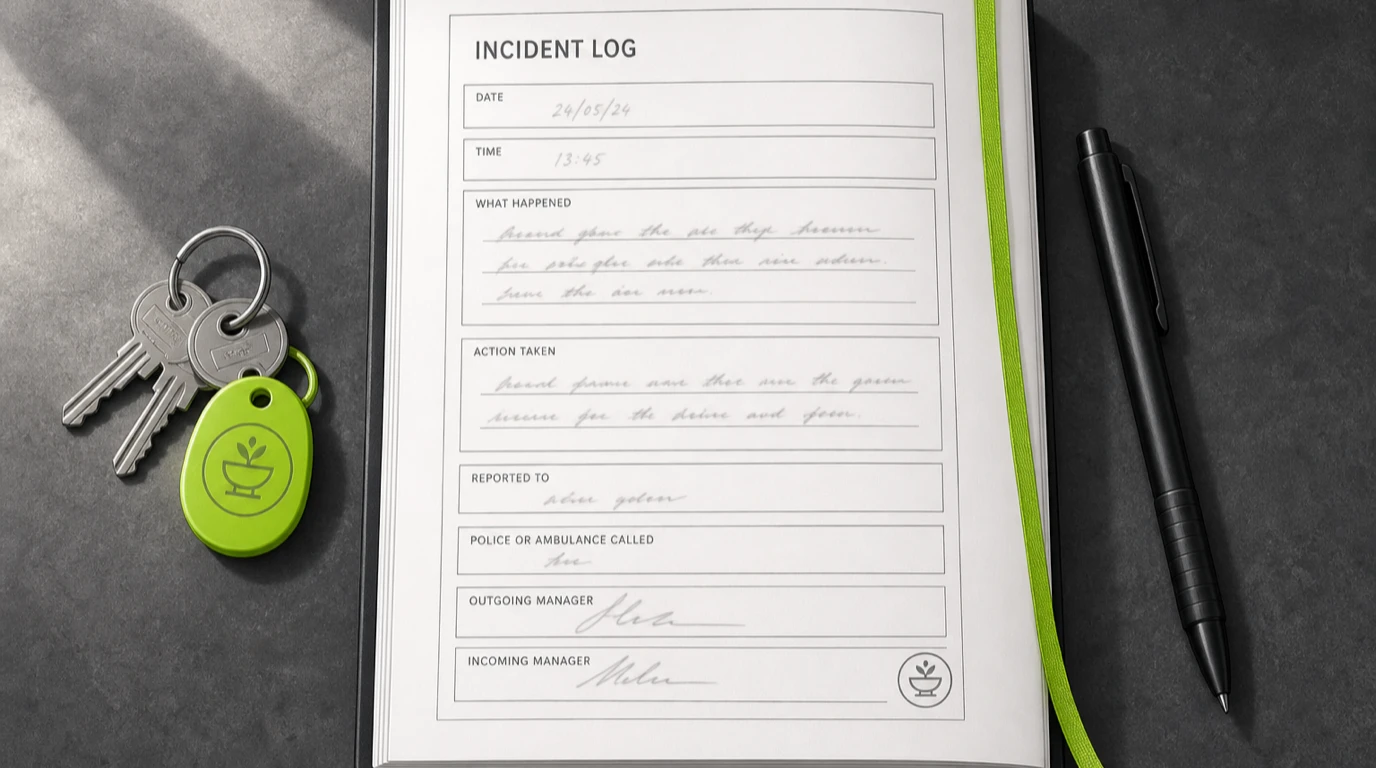
Refusals, ejections, accidents to staff or guests, near misses, aggression, anything involving the police or an ambulance. This is the section with genuine legal weight, discussed below.
Tomorrow
What the incoming shift needs to know before it starts: the party of twenty at 7, the delivery window, the engineer arriving, the inspection you are expecting. The refinery study found the old logs were almost entirely backward looking, and this is the field that fixes it.
Then the thing that makes it a record rather than a note: signed by the person handing over and by the person receiving. Two names, every time.
Fixed fields beat a blank page
The refinery project measured its own results, and about three months after rolling out across the site, from interviews with 38 people, 71% believed structured logs improved how logs were completed and 66% believed they improved how handovers were conducted. Two thirds thought there had been a need to improve beforehand. What changed in practice was that more information on maintenance and technical problems was recorded, safety issues got flagged, and timings were noted consistently.
The mechanism is the same one that makes void reason codes work. A blank page invites whatever the writer happens to remember, which is usually the last thing that annoyed them. A field labelled "equipment" that is sitting empty is a question that has been asked and answered. A blank page asks nothing.
Two design notes from the same study that are easy to get wrong. Users valued the structure specifically for "cutting down on unnecessary detail" and for letting them see at a glance where information was on the page, so more fields is not better. And the regulator's own handover guidance says it should be face to face, two way with both parties taking joint responsibility, based on the incoming staff's information needs, and done using both verbal and written communication, with the receiver cross checking as they take over. Not a form instead of a conversation. A form that gives the conversation an agenda, and a record afterwards.
Worth knowing what bad looks like too. In 20% of handovers the refinery study observed, there was no evidence that anybody had collated information or made notes in preparation, and many happened amid interruptions with other handovers going on nearby. That is a description of most restaurant shift changes.
Records you are already obliged to keep
Here I want to be more careful than most writing on this subject, because operators are routinely told they must keep more than the law requires, and a POS company telling you the law demands a logbook would be exactly the sort of thing you should distrust.
The European food hygiene regulation requires documents and records "commensurate with the nature and size of the food business" to demonstrate that your controls are working. That is the actual wording, and its recitals say plainly that record keeping needs to be flexible "in order to avoid undue burdens for very small businesses". There is no prescribed logbook, and there is no EU wide retention period: the regulation says records should be kept "for an appropriate period". Any article giving you a confident number for that is making it up. The Commission's own guidance, which is explicitly not binding, notes that the regulation does not require good hygiene practice to be documented at all, while observing that it is hard to demonstrate compliance if nothing is written down.
The UK position on temperatures surprises people. Under the Food Standards Agency's small business scheme you must monitor temperatures, but you only need to make a written record when something goes wrong, with routine daily logs treated as good practice rather than a requirement. One local enforcement authority adds the instruction that matters most for log integrity: if you keep daily records and there are gaps, do not fill them in afterwards, record why the check was missed.
Continental duties are real but different, and do not map onto each other. Germany has a specific and easily checked employer duty: staff handling food need instruction before starting and every two years after, attendance must be documented, and the employer has to hold that documentation at the premises for inspection. France sets retention through agriculture ministry guidance rather than the regulation, at shelf life plus six months for routine sanitary plan records and three years for records used for trend analysis. Italy sets food handler training regionally, and at least one region abolished its own training law in 2025, so a rule you learned in one province may not apply in the next. Do not assume symmetry, and get local advice for the market you trade in. Our guide to food safety and HACCP goes further into the framework.
One provision is genuinely useful and almost nobody knows it. The UK incident reporting regulations state that a record kept for another purpose satisfies the recording duty, provided it covers the right injuries and contains the required particulars. In other words a single well designed log can discharge a legal duty. You do not need a parallel compliance file if the operational record captures the right fields.
Your licence probably asks for more than the law does
British operators tend to believe the refusals register and the incident log are legal requirements. They generally are not, and the distinction matters.
The mandatory conditions that apply to every premises licence in England and Wales require an age verification policy which, as a minimum, covers people who appear under 18. Home Office guidance is explicit that Challenge 25 is best practice rather than the requirement. The refusals register, the incident log, the Challenge 25 record and a CCTV retention period are conditions that licensing authorities attach to individual licences, drawn from local model condition lists. Those lists genuinely differ. One London borough's model conditions require an incident log completed within 24 hours covering crimes reported, ejections, complaints about crime and disorder, disorder, drug and weapon seizures, equipment faults, refusals and visits by any authority or emergency service, with CCTV kept a minimum of 31 days. Another authority's refusal register asks for a description of the customer. The statutory guidance itself warns that standardised conditions "should be avoided and indeed may be unlawful" where they cannot be justified for the individual premises.
So the correct instruction is not "you must keep a refusals register". It is: read your premises licence, find the records it names, and build those exact fields into your log rather than running a second book you will forget about. And do not assume any of this applies outside the UK, because the premises licence condition model is unusual and I found no evidence of a general equivalent in Spain, Germany, France or Italy.
Two other UK points, since they are commonly stated wrongly. The accident book duty applies to employers who normally employ ten or more people at the same premises, with records kept at least three years, and the regulations have expressly permitted electronic records since 1993, so a bistro with eight staff is outside the duty and nobody is obliged to use paper. And fire safety recording changed on 1 October 2023, when the five employee threshold was removed: every restaurant in England and Wales, however small, now has to record its fire risk assessment in full and its fire safety arrangements.
Hours worked are handover data too
The one record that is unambiguously required across Europe is the one most likely to be sitting in a different system from everything else.
In May 2019 the Court of Justice of the EU held that Member States must require employers to set up an objective, reliable and accessible system measuring the duration of time worked each day by each worker. The Spanish court that referred the case told it that 53.7% of overtime hours worked in Spain go unrecorded.
Spain already requires a daily record with actual start and finish times for each worker, kept four years and available to workers, their representatives and the labour inspectorate. A reform to make that record digital and tamper proof has been stuck for about a year: as at the start of August 2026 it is not law, it has an adverse Council of State opinion and a data protection objection, and the government has said it will go to the Council of Ministers in September 2026. In Germany the Federal Labour Court held in September 2022 that the duty to record working time already exists under health and safety law, and that times must actually be recorded rather than merely collected. A draft amendment writing an electronic duty into the working time act was still in ministerial coordination in June 2026, with reported staged transition periods and an exemption from the electronic requirement for the smallest employers, though the underlying duty applies regardless. France requires daily recording of start and end times, or a count of hours worked, wherever staff do not all work the same posted collective schedule, which describes essentially every restaurant.
Anything you read about the Spanish or German reforms needs a date attached to it, including this. Both were still pending when this was written. Our guide to staff scheduling covers the rota side.
Reading five logs in ten minutes
For multi site operators I have to be honest that there is nothing to cite. Every source I found on consolidating daily reports across venues was a software vendor or an audit firm's case study. Treat what follows as reasoning rather than evidence.
The pull between standardisation and local ownership is real, and the refinery evidence sits on both sides of it. The same study that proved structure works also found that involving the users in designing the log was crucial to it being used. Those two things fight each other in a group: head office wants identical fields across twelve sites so it can read them quickly, and the evidence says a log designed elsewhere and handed down gets filled in badly, exactly as the Ontario checklist result predicts.
The resolution that seems most defensible is the refinery's own two tier structure. Fix the mandatory categories centrally, because those are what head office reads and what any legal duty attaches to. Let each site add its own discretionary fields, because those are what makes the log theirs. And read them, visibly, so that the people filling them in know somebody does. A log nobody ever refers to becomes a formality within a month.
Ten minutes at the shift change
If you want to start on Monday, this is the whole protocol.
Write down the seven fields. What is off and why, what is broken, what was promised to a guest, what did not reconcile, people, incidents, tomorrow. Add whatever your premises licence specifically names. Do not add anything else yet, because the evidence says fewer fields used properly beats more fields used partially.
Make it a handover rather than a message. Face to face, both parties present, the outgoing manager having spent two minutes preparing rather than recalling on the spot, the incoming manager reading it back and asking about anything unclear. Both sign. That is the piece with the most evidence behind it and the piece most often skipped.
Then do the thing that Piper Alpha's management did not do. Once a month, read a week of logs cold and ask whether you could actually run a shift from them. Look for the gaps, the blank incident fields on nights you know something happened, the equipment fault mentioned three times and never resolved. That review is the whole difference between having a log and having a handover, and it costs you twenty minutes.
Start with one field if seven feels like too much. Make it what was promised to a guest, because it is the one nobody records, the one that costs you a regular when it gets dropped, and the one that will demonstrate the value of the other six inside a fortnight.
Read next: the daily close and Z reports, opening and closing checklists, and voids, comps and discounts.