Walk into any professional kitchen an hour before service and you will see the same ritual, whether the menu is tasting-course French or smash burgers: cooks moving with quiet urgency, filling containers, wiping cutting boards, tasting sauces, arranging their stations with the precision of a surgeon laying out instruments. This is mise en place, the French phrase that professional cooking treats as something between a checklist and a religion. It is the reason a three-person line can serve two hundred people in a night without collapsing, and the reason tickets scrolling across a kitchen display system get answered in minutes rather than in apologies.
This guide covers the term completely: what mise en place means and how to pronounce it, where it came from, and, most usefully, how working kitchens actually build it, from prep lists and par levels to container systems, labeling discipline, and the procurement rhythm that keeps tomorrow's setup possible. Whether you run a restaurant, cook on a line, or just want your home dinners to stop feeling like a hostage situation, the system underneath the phrase is the same, and it is learnable.
What does mise en place mean?
Mise en place is French for putting in place, or more loosely, everything in its place. Pronounce it MEEZ ahn plahs; on a working line it usually gets shortened to meez. The term names two things at once, and professionals rarely bother separating them.
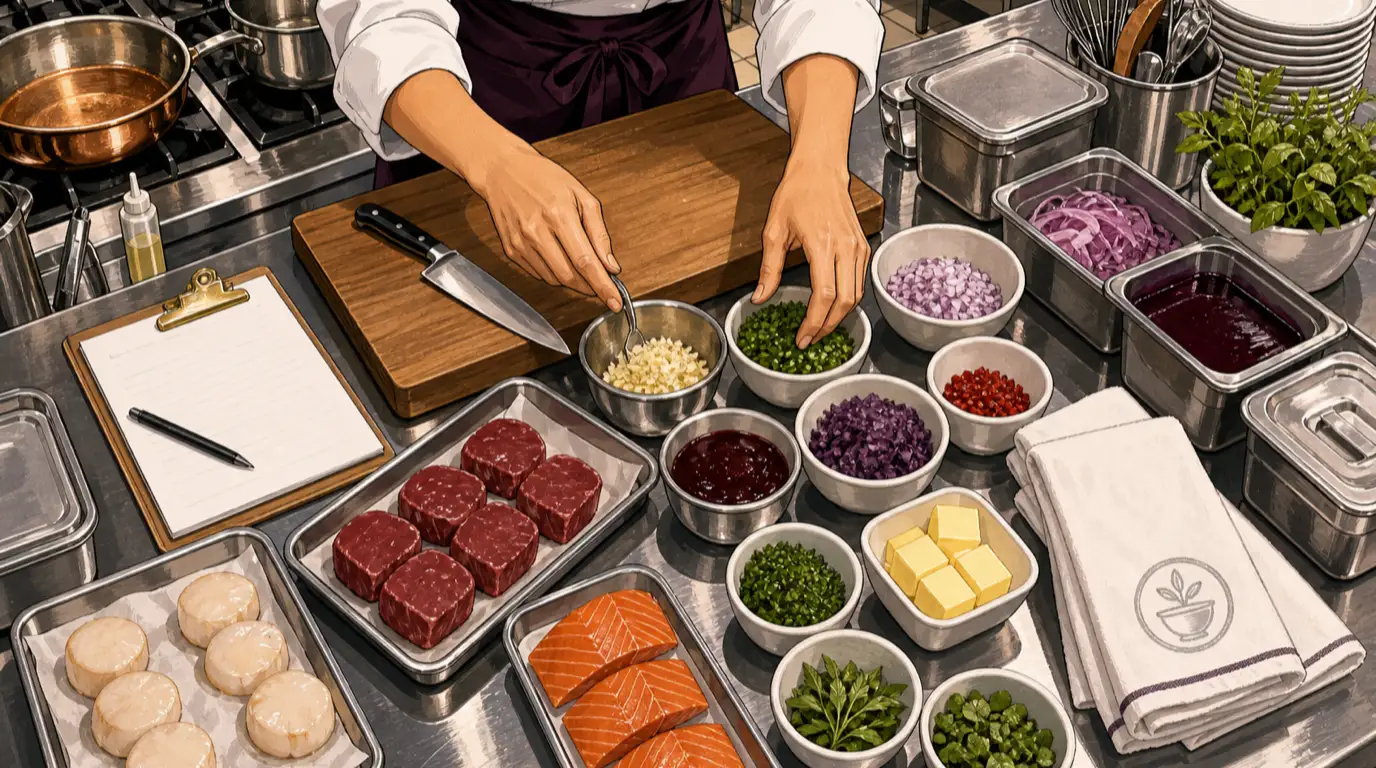
The first meaning is physical: the complete prepared state of a cooking station before service. Every ingredient a cook will need, washed, cut, cooked, portioned, and seasoned as far ahead as quality allows, arranged in labeled containers in fixed positions, with tools, towels, and pans staged within reach. A station with full mise en place can produce any dish on its menu section without the cook taking more than a step in any direction.
The second meaning is mental, and chefs will tell you it is the real one: mise en place as a state of readiness. It is the habit of thinking through everything that will be needed before it is needed, of preparing so thoroughly that execution becomes almost automatic. Cooks call this being set up, dialed, or tight; the culinary instructor's phrase is working clean. The physical station is just the visible evidence of a mind that has already cooked the night's service once, in advance, on paper and in imagination.
Where the term comes from
The phrase belongs to the vocabulary of classical French kitchen organization, codified in the late nineteenth century when Auguste Escoffier reorganized hotel kitchens into the brigade de cuisine: a military-inspired hierarchy where every cook held a defined station with defined responsibilities. That structure demanded a standard state of readiness. If the saucier's station is set up the same way every day, any trained saucier can work it; if every station is fully prepared at the same hour, the kitchen can promise the dining room a level of speed no cook-to-order operation could match.
Escoffier did not invent preparation, of course; every cook who ever fed a crowd prepped ahead. What the French system contributed was the standardization: preparation as a named, teachable, inspectable stage of work rather than a personal habit. A chef could walk the line at five o'clock, look at each station, and know whether the restaurant was ready, the same way an officer inspects equipment. That inspection culture survives today in almost every serious kitchen as the line check, and culinary schools still teach mise en place in the first week, before knife skills, because the discipline is considered more fundamental than the technique.
The term has since escaped the kitchen entirely. Surgeons, pilots, and productivity writers borrow it to describe pre-staged readiness in any craft. The borrowing is fair: the idea was never really about food. It is about respecting the difference between time that is cheap, the afternoon, and time that is catastrophically expensive, the rush.
The two halves: setup and mindset
It is worth dwelling on the split meaning, because people who learn only the physical half plateau quickly. The setup half is procedural and easy to teach: here is your station map, here are your containers, here is the par sheet, fill everything before five. A new cook can learn it in a week.
The mindset half is what separates a prep cook from a professional. It shows up in dozens of small behaviors: reading the reservation book before deciding how much to prep rather than blindly copying yesterday; tasting the sauce that was made this morning instead of assuming it survived the walk-in; noticing at four o'clock that the fryer oil is one service past its best and filtering it now instead of discovering it at seven; mentally rehearsing the plating of a new special so the first real ticket is not a rehearsal. The physical station answers the question what do I need. The mindset answers what could go wrong tonight, and handles it while handling it is still cheap.
Chefs test for the mindset, not the setup. A common line-check question is not is your station full but what are you low on, because the cook with true mise en place knows the answer instantly, with quantities. The cook without it has to look.
Mise en place in a working kitchen: station by station
Every station builds a different setup because every station fights a different battle. A quick tour of a typical full-service line makes the idea concrete.
The saute station carries the most volatile mise en place: minced aromatics that fade within hours, portioned proteins on parchment-lined trays, blanched vegetables ready to finish, sauces held in bain-maries, wine and stock in squeeze bottles or pitchers, finishing butter cubed and cold. Saute mise is built closest to service and replenished constantly, because freshness decays fastest here.
The grill station preps differently: proteins portioned and dry-brined or marinated well ahead, resting racks staged, compound butters rolled and chilled, grill brush and towels positioned, a spotless landing zone for resting meat. Grill mise rewards earlier preparation, since many of its components improve with time rather than degrade.
The garde manger, the cold station, lives on picked herbs, washed greens held on towels, vinaigrettes emulsified and tasted, components for cold plates portioned into small containers, garnishes cut fine and covered with damp paper. It is often the station with the most individual containers, sixty or eighty, which is exactly why its organization is the most rigid.
The fry station keeps breaded items racked and refrigerated, batters mixed at the last responsible moment, seasoning within reach of the landing table, backup oil staged. And the expo or pass, run by the chef or a senior cook, has its own mise: sauce spoons, tasting spoons, wipes, garnishes for finishing, printed specials, and the ticket rail or screen arranged so nothing gets plated without a final check. The point of the tour: mise en place is not one standard setup. It is one standard question, what will this station need tonight, answered differently at every position.
The prep list: deciding what to make
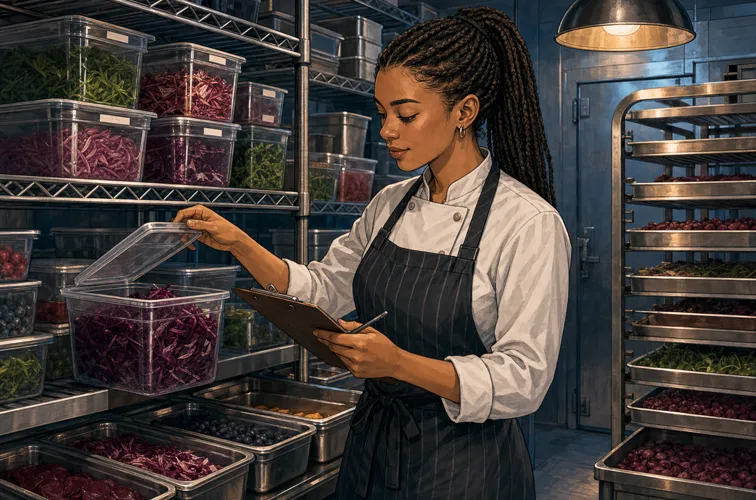
The prep list is where mise en place starts each day, and a good one is built from information, not memory. The opener or sous chef walks the walk-in and the line with yesterday's leftovers in view, compares what survived against the par sheet, checks the reservation count and any large parties or events, and writes a ranked list: what must be made before service, what should be made if time allows, and what can wait until tomorrow.
Ranking matters more than completeness. Kitchens fail not by prepping too little in total but by prepping the wrong things first, spending the calm early hours on low-urgency projects and hitting four o'clock with the fastest-moving item still unmade. The discipline is to rank by what runs out first at tonight's forecast, weighted by how long each item takes. A sauce that needs three hours of reduction gets started at one o'clock regardless of how full the sauce container currently looks, because the container lies: it shows the present, and the prep list's whole job is to see tonight.
Good prep lists are also written down, always, even in small kitchens where one cook does everything. A list in someone's head cannot be handed off when that someone gets slammed, calls in sick, or quits. Written lists become records: compare a month of them against sales and you know your true production rhythm, which days need more hands, and which items are chronically over- or under-prepped. That is the operational gold buried inside a humble clipboard.
Par levels: how much is enough
A par level is the target quantity of a prepped item that a station should hold at the start of service: two quarts of minced shallot, forty portioned chicken breasts, one full hotel pan of blanched broccolini. Pars turn mise en place from opinion into arithmetic. Without them, every cook preps by feel, and feel is systematically wrong in both directions: new cooks over-prep to feel safe, wasting product that dies in the walk-in, while confident cooks under-prep to save afternoon effort and pay for it during service.
Setting pars is straightforward: for each item, look at usage per cover across recent sales, multiply by tonight's forecast covers, add a safety margin that reflects how painful running out is versus how perishable the item is. A five-minute backup, like slicing more bread, deserves a thin margin; a three-hour braise that cannot be remade mid-service deserves a fat one. Items with short lives get prepped to lower pars more often; durable items get batched bigger, less often.
Then, crucially, pars get revisited. A par sheet written two menus ago is a work of fiction. Every menu change, seasonal shift, and noticeable change in sales mix should trigger a review, and the waste log is the feedback loop: an item that hits the bin night after night has a par set too high, and an item that keeps getting 86ed has one set too low. Kitchens that track this with real inventory numbers rather than impressions find that pars quietly become one of their strongest food-cost controls.
A line cook's setup: one afternoon, walked through
Theory becomes muscle memory somewhere around the hundredth setup, but a single walkthrough shows the shape. A saute cook arrives at two for a five-thirty service. First move is not a knife; it is the prep list and the board: read what the opener left, check the reservation count, note the special. Two minutes of reading prevents an afternoon of wrong priorities.
Long-lead items start first: the reduction that needs two hours goes on at two-fifteen, the item that must roast and cool starts right behind it. While those run, the cook builds the station skeleton: clean towels, sanitizer bucket, cutting board anchored, knives out, container hierarchy staged empty in the exact positions they will occupy all night, ninth pans in front for aromatics, sixths behind for vegetables, thirds on the low boy for proteins. Empty but positioned containers are a to-do list you can see.
Then the batch work, ranked: aromatics minced, vegetables blanched and shocked, proteins portioned and trayed, sauces transferred and tasted, every container labeled and dated as it is filled, never later. Around four-thirty comes the self line check: walk the station left to right, touch every container, confirm quantity against par, taste anything that will touch a plate. Five o'clock, family meal, and a last top-up of anything the staff meal consumed. At five-thirty the first ticket prints, and if the afternoon was done right, the night is just execution: no thinking, only cooking. Cooks describe that state with real affection. The setup is the work; the service is the reward.
Containers, labels, and the geography of a station
The physical grammar of mise en place is the container system, and most kitchens converge on the same vocabulary: hotel pans and their fractions, halves, thirds, sixths, ninths, plus round deli containers in pint and quart sizes. The standardization is the point. When every vessel is a known size, pars can be expressed as containers, one sixth of picked parsley, two ninths of minced garlic, and a glance tells a chef whether a station is full without opening a single lid.
Position is the second rule of grammar: everything lives in a fixed place, decided once, defended forever. The garlic is always at the same corner; the tongs always hang on the same hook. Fixed positions are what let a cook work heads-up during the rush, reaching without looking, the way a pianist does not search for middle C. They are also what makes covering a station possible: when setups are standardized, a cook who has never worked Tuesday's shift can step in and find everything, because everything is where the system says it is.
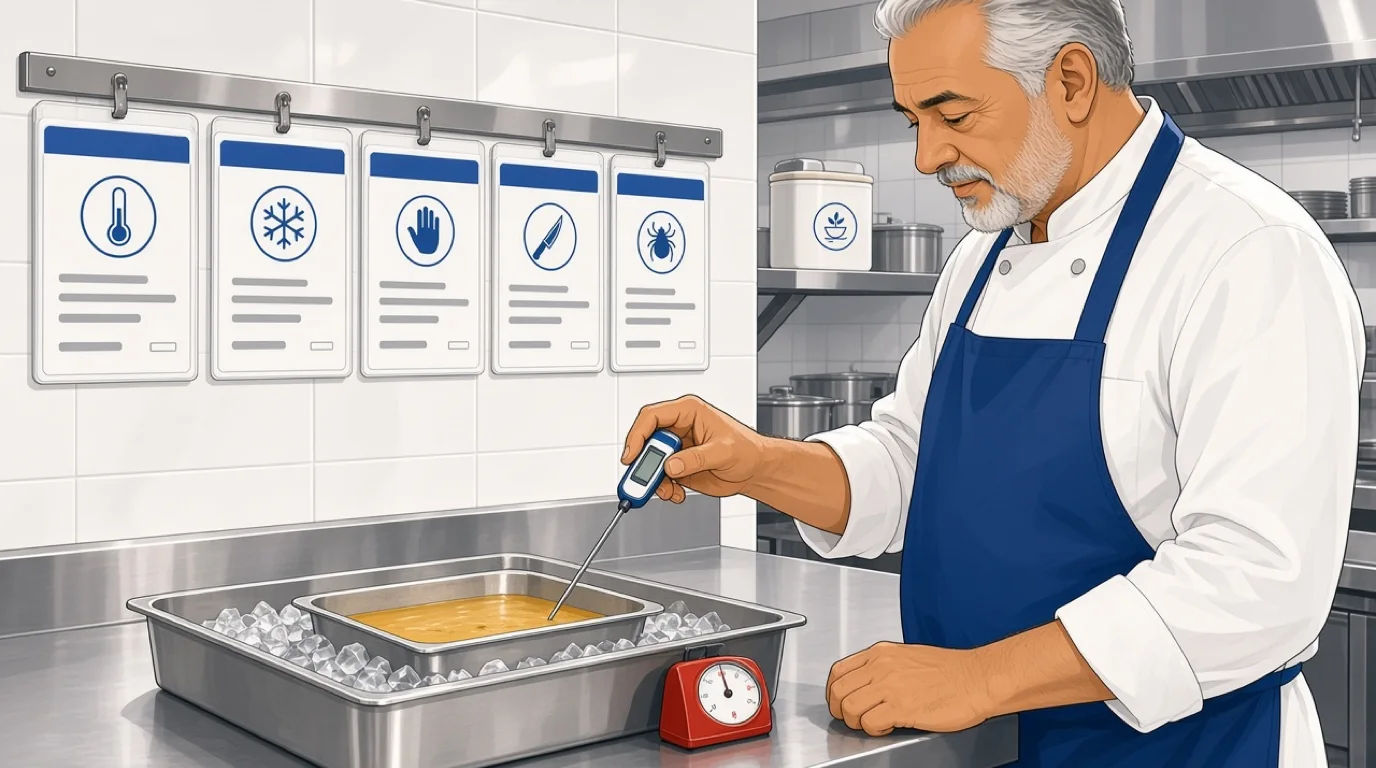
Labeling and dating is the third rule, and it is non-negotiable in a professional kitchen: item name and date on every container, first-in-first-out rotation when refilling, and a hard rule that unlabeled mystery containers get discarded rather than guessed about. This is where mise en place and food safety become the same subject. An inspector who opens a walk-in full of labeled, dated, properly stacked containers has already learned most of what they came to learn about the operation.
Mise en place for the front of house
The phrase was born in the kitchen but the discipline belongs to the whole restaurant. A dining room has its own mise en place, and the restaurants that feel effortless are the ones that treat it with kitchen-grade seriousness. Server stations get stocked to written pars before service: rollups counted against covers, share plates, kid supplies, check presenters, pens that work, backup menus. The host stand preps its own setup: the floor plan marked with reservations and notes, menus counted and wiped, the waitlist tool ready.
The bar might be the most kitchen-like of all: juices squeezed and dated, syrups made, garnishes cut and covered, ice bins full, glassware polished and racked in fixed positions, the well arranged identically every day so a bartender's hands can build a drink while their eyes hold a conversation. A bartender with weak mise dies at eight-fifteen exactly the way a saute cook does.
Even the service itself has a mise en place layer: the pre-shift meeting where the team tastes the special, reviews the 86 list and allergy notes, and hears which tables are celebrating something. That is preparation of information rather than ingredients, and it fails the same way ingredient prep fails: quietly, in the afternoon, and then loudly, at the table.
Working clean: the mindset in practice
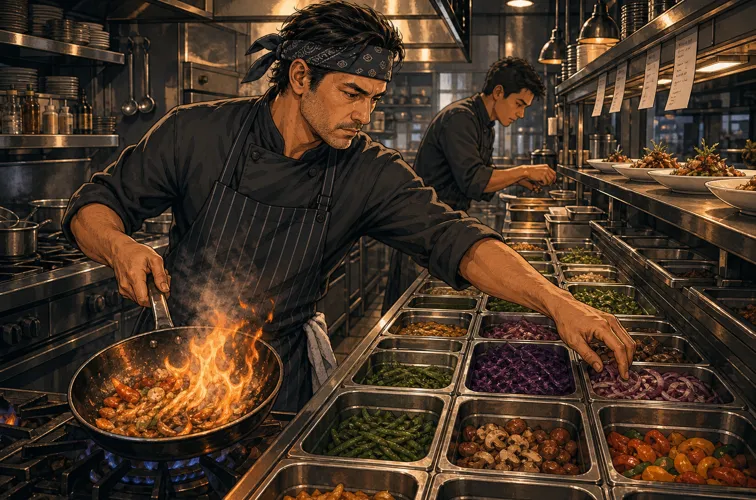
Ask chefs what mise en place really means and the answers drift away from containers almost immediately, toward a cluster of habits usually summarized as working clean. The core habits are learnable and worth naming.
Prepare before starting: read the whole recipe, the whole prep list, the whole ticket before touching anything, so the plan exists before the action. Arrange and stage: gather everything needed for a task before beginning it, so the task runs without interruption. Clean as you go: the board gets wiped between tasks, tools return to their homes the moment they are free, because clutter is both a safety hazard and a cognitive tax; a messy station forces its cook to think about the station instead of the food. Finish actions completely: the container gets its lid and label now, not after the next thing, because now is when memory is accurate.
The last habit is the deepest: slow down to speed up. Kitchens are full of the paradox that the fastest cooks appear unhurried. They move deliberately, without wasted motion, because their preparation removed the need to rush. Panic speed, the flailing, reaching, dropping kind, is almost always the visible symptom of invisible prep failure, an afternoon debt collected at night. Watch any line at full volume and you can diagnose every station's afternoon in about thirty seconds.
What poor mise en place costs
The costs of weak setup hide in categories that rarely get blamed on it. Ticket times stretch, not because cooks are slow but because they are shopping mid-service, walking to the walk-in for the backup that should have been at the station. Quality wobbles: the under-prepped station starts cutting corners at peak, under-seasoned because tasting takes seconds nobody has, over-cooked because attention was elsewhere. Consistency dies first, and consistency is the entire brand of a restaurant.
Waste climbs from both directions: over-prepping kills product in the walk-in, while disorganized storage kills it by burial, the unlabeled container discovered a week late. The 86 board fills up, and every 86 is revenue refused and a small breach of promise to a guest who wanted that dish. Labor leaks, since panic prep during service is the most expensive prep there is, done at full-staff wages under pressure with worse results. And morale erodes in ways operators consistently underestimate: cooks do not burn out from hard nights, they burn out from chaotic ones, and chaos is mostly prep debt. Ask anyone who has worked a line: the worst shifts are almost never the busiest ones. They are the unready ones.
Teaching mise en place to new cooks
Mise en place is the first thing culinary schools teach and the first thing kitchens should train, because every other skill depends on it. The teaching sequence that works is show, copy, own. First the new cook shadows a strong station: they see a full setup, watch the line check, watch the rhythm of replenishment during service. Then they build the station themselves from the written map and par sheet while a veteran verifies, day after day, until the setup is muscle memory. Only then do they own the station solo, with the chef's line check as the safety net.
Two training tools carry most of the weight. The station map, a photograph or diagram of the fully set station with every container labeled, turns a vague standard into an inspectable one; there is no arguing with a picture. And the par sheet turns how much into a number rather than a feel. Together they make the standard portable: the setup stops living in one veteran's head, where it walks out the door with them, and starts living in the operation, where it trains every future hire.
The deeper lesson to instill is the mindset, and it is taught mostly by questions: what are you low on, what dies first tonight, what did you change from yesterday and why. Cooks who get asked those questions daily start asking them of themselves, and that internal voice, more than any container, is mise en place.
Mise en place at home
The professional system scales down beautifully, and home cooks who adopt even a fraction of it usually describe the change as transformative. The core translation: read the whole recipe before starting, then prep every ingredient, cut, measured, arranged in small bowls in usage order, before any heat is applied. Stage the tools too, the whisk you will need in ninety seconds should not be in a drawer. Keep a damp towel and a garbage bowl at the board, wipe as you go, and return things to their places when the dish goes to the oven.
The payoff is identical to the restaurant's, just smaller: recipes stop going wrong at the fast parts, because the fast parts were the only parts left. Stir-fries, pan sauces, and anything with a two-minute window between perfect and burnt become calm instead of frantic. Multi-dish meals become schedulable. And the ten minutes of setup is usually recovered outright, because cooking without searching is simply faster.
There is one honest difference: home cooks prep for one meal, not a hundred, so the par-level and labeling machinery is overkill. Keep the mindset, drop the bureaucracy. Everything in its place before the fire, and clean as you go: those two rules alone carry most of the value.
Bringing it together
Mise en place is the least glamorous idea in cooking and the most load-bearing one: everything in its place, decided in the cheap hours, so the expensive hours can be pure execution. The phrase names a setup, a system of lists, pars, containers, and labels, and above all a habit of mind that thinks ahead of the work. Restaurants that build it run faster, waste less, train new cooks quicker, and feel calmer at full volume; the ones that skip it pay every night, in ticket times, in 86 announcements, and in cooks who quietly stop wanting to come back. Start with a written prep list and honest par levels, standardize the containers and the positions, protect the labeling rule, and inspect it daily. The French got the name right the first time: put everything in its place, and the place will hold when it is tested.