Ask ten operators what it cost to open their restaurant and you will get ten different numbers and one identical answer: more than they planned. The national median for an independent restaurant is around $375,000, and the honest range runs from $50,000 for a lean ghost kitchen to well past $2 million for a chef-driven room in a major metro. The number itself matters less than what it is made of, because the line items you underestimate are the ones that sink you. Some of those line items are one-time construction bills; others, like your restaurant POS and the technology around it, are decisions that shape your operating costs for years after opening day.
This guide breaks the budget down the way a lender or a seasoned operator would: build-out, equipment, permits, people, inventory, marketing, and the working capital reserve that separates restaurants that survive year one from the ones that become statistics. We will also cover how costs differ by concept, where you can safely save, where saving is sabotage, and how items like payment processing setup fit into the opening checklist. Real numbers, current for 2026, with the contingencies built in.
The headline numbers by concept
Startup capital requirements cluster by format, because the format dictates the kitchen, the labor model, and the square footage. Current 2026 ranges, all-in (build-out, equipment, pre-opening costs, and six months of working capital):
Food truck: $60,000 to $225,000. The truck itself, kitchen fit-out, permits, and commissary arrangements. Cheapest entry, hardest consistency.
Ghost kitchen: $50,000 to $250,000. No dining room, industrial rent, delivery-platform dependence. Fast to launch, marketing replaces the storefront.
Counter-service and QSR: $240,000 to $650,000. Smaller kitchens, simpler service, but prime retail rents for the locations that drive volume.
Fast casual: $250,000 to $600,000. The sweet spot for many first-time operators: real kitchen, manageable labor, moderate build-out.
Casual full service (50 to 80 seats): $400,000 to $1.2 million. A full kitchen line, bar infrastructure, dining room furniture, and the deepest staffing bench.
Upscale and fine dining: $1 million to $3 million and beyond. Custom build-outs, premium finishes, extensive smallwares, and a wine cellar that ties up capital before the first cork is pulled.
A useful sanity check across all of them is cost per seat: independent full-service projects commonly land between $3,000 and $4,000 per seat. If your 80-seat plan totals $150,000, the plan is missing entire categories, not being clever.
Build-out: the biggest bill and the biggest variable
Construction typically consumes 25 to 45 percent of the total budget, and the single largest driver is what the space was before you signed.
A raw shell (never a restaurant) means installing everything: grease trap, hood and fire suppression, gas lines, three-phase power, floor drains, ADA-compliant restrooms, HVAC sized for a kitchen. Budget $150 to $400+ per square foot depending on market and finish level.
A second-generation space (previously a restaurant) inherits that infrastructure. Conversions can cost 20 to 40 percent less, which is why experienced operators hunt for failed restaurants the way house flippers hunt foreclosures. The caution: inspect everything. A fifteen-year-old walk-in and a hood that fails its next inspection can erase the savings. Pay a few hundred dollars for a licensed technician to inspect the mechanicals before signing, and ask the health department for the space's last three inspection reports; both cost almost nothing against what they reveal.
Negotiate a tenant improvement (TI) allowance into the lease; landlords in slower markets will fund $20 to $80 per square foot of improvements for a tenant who signs a long term. And write the contingency into the budget from day one: 10 to 20 percent of construction cost, untouched until the surprises arrive. They will. Permits stall, a slab hides bad plumbing, the fire marshal wants another exit. Every operator has this story.
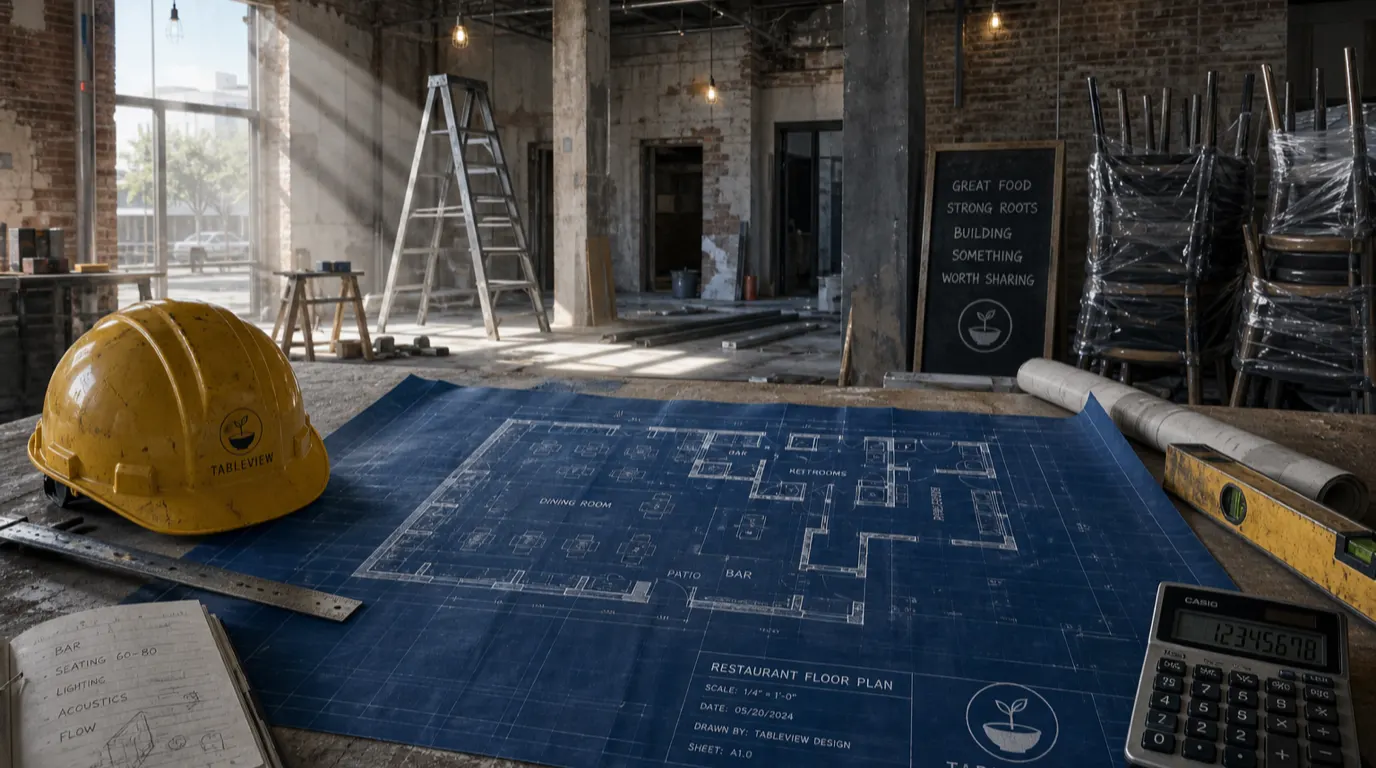
Plan the layout before the architect bills hours: our guide to restaurant floor plans covers how the flow between kitchen, pass, and dining room shapes both the build cost and the labor model you will pay for forever after.
The lease: the decision that outlives every other one
Before a single wall moves, the lease sets the ceiling on your margins for five to ten years. Three numbers to hold onto while negotiating:
Occupancy should stay under 10 percent of projected sales, ideally 6 to 8. A $9,000 monthly rent needs roughly $110,000 to $150,000 in monthly revenue to sit comfortably. Work backwards: if the realistic sales ceiling for the space cannot carry the rent at that ratio, the location is wrong no matter how much you love the foot traffic.
Understand every escalator. Annual increases of 3 percent compound painfully over a ten-year term. Percentage rent clauses (base rent plus a share of sales above a threshold) are common in retail centers; model them at your optimistic projections, because that is exactly when they bite.
Negotiate the exit before the entrance. Assignment rights (can you sell the restaurant with the lease?), early termination options, and the scope of the personal guarantee. Many landlords will cap a personal guarantee at 12 to 24 months of rent if asked; almost none volunteer it. This paragraph is why the lease attorney fee is the best money in the whole budget.
Ask for free rent during build-out (60 to 120 days is normal), and get the landlord's delivery condition in writing: who pays if the promised HVAC turns out to be dead on arrival matters enormously at $30,000 a unit.
The timeline, and what waiting costs
First-time operators budget money and forget to budget time. A typical independent full-service opening runs 6 to 12 months from signed lease to first paying guest: 1 to 3 months of design and permitting, 3 to 6 months of construction, a month of equipment installation and inspections, and 3 to 4 weeks of hiring, training, and soft opening.
Every one of those months costs money with no revenue against it. Rent (after any free-rent period), insurance, loan interest, utilities, and the salaries of managers hired early: carrying costs of $10,000 to $30,000 per month are normal for a full-service project. A three-month permitting delay is not just frustrating, it is a $30,000 to $90,000 budget hit, which is precisely what the contingency exists to absorb.
Two schedule rules pay for themselves. First, do not hire the opening team against an optimistic construction date; staff burn while inspectors reschedule is pure loss. Second, sequence the inspections early with your contractor: health, building, fire, and alcohol authorities each have their own queues, and the restaurant that maps them in month one opens months before the one that discovers them in order.
Kitchen equipment: $50,000 to $200,000, itemized
Equipment is usually the second-largest capital block. For a mid-sized full-service kitchen, current bands look like this:
Cooking line (range, oven, fryers, grill, salamander): $15,000 to $60,000. The heart of the budget.
Refrigeration (walk-in, reach-ins, prep tables, ice machine): $10,000 to $40,000. A walk-in alone runs $8,000 to $20,000.
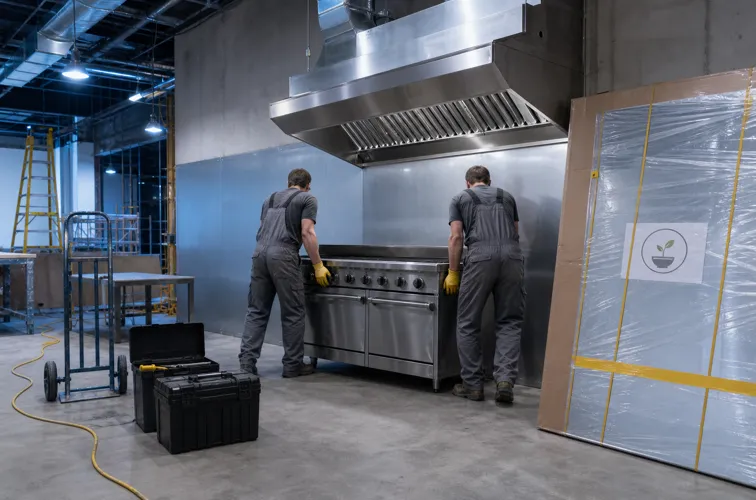
Hood, fire suppression, and makeup air: $10,000 to $65,000 installed. Required by code, brutally expensive to retrofit, and the reason second-generation spaces are gold.
Warewashing (commercial dishmachine, three-compartment sink): $3,000 to $35,000 depending on undercounter versus conveyor.
Prep equipment (mixer, slicer, processor, blenders): $3,000 to $35,000.
Stainless tables, shelving, sinks: $3,000 to $10,000. NSF-certified is non-negotiable.
Smallwares (pans, inserts, utensils, sheet trays): $3,000 to $8,000, and chronically underestimated.
The buy-new versus buy-used rule seasoned operators follow: buy new for anything with a compressor or that touches food directly (refrigeration, prep surfaces), consider used or leased for heavy iron (ranges, fryers, ovens) that a technician can rebuild. Equipment leasing spreads cost over useful life and preserves opening cash, at the price of total cost over time.
Technology: the stack you choose before day one
Budget $8,000 to $28,000 for opening technology: POS hardware and software, payment terminals, a kitchen display, back-office tools, and networking. It is a small slice of the total budget with an outsized effect on daily operations, because the systems you pick now determine whether your sales, labor, and inventory data arrive connected or in silos you will pay to reconcile later.
Think through the full stack once, before opening: order entry, payments, kitchen coordination, accounting, inventory, reservations if you take them. Our restaurant tech stack guide walks the whole map. Two cost notes worth flagging at budget time: processing fees are a permanent 2 to 3 percent of nearly every sale, so the rate you negotiate matters more than the terminal price, and per-month software subscriptions accumulate, so audit what each tool replaces.
Permits, licenses, and professional fees
The paperwork layer runs $5,000 to $50,000+ depending on jurisdiction and whether alcohol is involved:
Business licenses and registrations: a few hundred to a few thousand dollars.
Health permits and food handler certifications: typically $500 to $3,000, plus plan review fees for the kitchen layout.
Building permits: commonly 1 to 3 percent of construction value.
Liquor license: the wild card. A beer-and-wine license might be $500 to $3,000; a full liquor license in a quota state can cost $50,000 to $400,000 on the secondary market. Decide early, because the license question changes the whole financial model. Beverage programs also carry the best margins in the building, so a concept that skips alcohol to save the license fee should have a plan for where those margin points come from instead.
Professional fees: architect, engineer, attorney for the lease, accountant for the entity setup. Budget $10,000 to $40,000 for a full-service project. The lease attorney is the last place to save; a personal guarantee clause you did not catch can follow you for a decade.
Insurance: general liability, property, workers comp, and liquor liability if you pour. First-year premiums commonly land between $5,000 and $25,000.
Opening inventory, smallwares, and the dining room
Initial food and beverage inventory: $5,000 to $25,000 depending on menu complexity and how deep the bar program goes. Wine inventory alone can dwarf the food number in an ambitious program.
Tableware and consumables (plates, glassware, flatware, to-go packaging): $5,000 to $20,000. Order 20 to 30 percent overage on anything breakable; opening months are hard on glassware.
Dining room furniture: $15,000 to $80,000 for tables, chairs, booths, and bar stools. Commercial-grade matters; residential furniture dies in months under restaurant use.
Decor, lighting, signage: $10,000 to $60,000. Exterior signage often needs its own permit and can take longer to approve than to build.
Pre-opening payroll, training, and marketing
The costs that start before revenue does are the ones first-time operators forget most reliably.
Pre-opening labor: managers hired 6 to 12 weeks out, kitchen staff 3 to 4 weeks out for recipe training, front-of-house 2 to 3 weeks out for service training and mock dinners. Budget $20,000 to $60,000 in wages paid before the first paying guest.
Training materials and menu R&D: recipe testing burns real product. $3,000 to $15,000.
Opening marketing: logo and brand identity, website, photography, social presence, local PR, and a soft-opening plan. $5,000 to $20,000 gets an independent restaurant launched credibly. The soft opening deserves budget on purpose: friends-and-family nights surface the failures you want to find before the public does. Run at least two of them at increasing volume, comp the food, and treat every stalled ticket and confused server as a gift received early. The restaurants with disastrous opening-week reviews are almost always the ones that skipped straight to the grand opening.
Working capital: the line that decides survival
Here is the uncomfortable statistic behind most year-one failures: the restaurant did not run out of customers, it ran out of cash. New restaurants take one to two quarters to find their rhythm. Revenue ramps slower than the pro forma promised, while rent, loan payments, insurance, and payroll arrive on schedule from day one.
The industry standard reserve is six months of fixed costs: rent, insurance, debt service, utilities baseline, and a minimum viable payroll. For most independent concepts that is $80,000 to $300,000, and it belongs in the budget as a locked line, not as the flexible remainder that construction overruns get to eat. An operator with a modest build-out and a full reserve is in a fundamentally stronger position than one with a beautiful room and an empty account.
Make the reserve concrete instead of abstract. Suppose your fixed monthly base is $22,000: rent $9,000, debt service $4,500, insurance $1,500, utilities floor $2,000, and a skeleton payroll of $5,000. Six months is $132,000. Now run the pessimistic revenue ramp: 40 percent of projected sales in month one, 60 in month two, 80 by month four. In that scenario the reserve does not sit idle; it bleeds $10,000 to $15,000 a month covering the gap between ramping revenue and full costs, and six months of runway turns out to be exactly enough, not generous. Operators who model this before opening stop treating the reserve as optional.
Before committing to any budget, model your break-even honestly: how many covers at what average check clear the monthly cost base? Our break-even analysis guide walks the calculation, and it should be part of the business plan long before the lease is signed, alongside the full financial story covered in our business plan template.
How restaurants actually get funded
Almost nobody writes one check. A typical independent opening stacks:
Personal savings: lenders want to see the operator's own money at risk, commonly 20 to 30 percent of project cost.
SBA loans: the 7(a) program is the workhorse for restaurant openings, offering longer terms and lower down payments than conventional loans. Expect full documentation: business plan, projections, personal financials, and collateral.
Equipment financing and leasing: spreads the kitchen over its useful life, preserves opening cash, and is often easier to obtain than general-purpose credit because the equipment secures itself.
Landlord TI allowances: negotiated build-out contributions in exchange for lease term. Real money: $20 to $80 per square foot in many markets.
Friends, family, and small investors: common for the equity gap. Paper it properly with an attorney; ambiguous handshake deals with relatives end worse than bank rejections.
Whatever the stack, raise for the whole plan including the reserve, not just the build. Going back to investors mid-construction for money you should have raised at the start is the weakest possible position.
How location moves every number
Identical concepts in different markets produce budgets that barely resemble each other, and the deltas hide in more lines than rent.
Construction labor and materials swing 30 to 50 percent between a coastal metro and a mid-sized inland city. The same $180,000 renovation in Columbus prices near $280,000 in San Francisco before a single upgrade.
Permitting speed is a cost. Some jurisdictions turn permits in three weeks; others take five months and require expediters who bill like attorneys. Ask local operators and your architect for the honest timeline in that specific city, then price the carrying costs of the difference.
Liquor licensing varies from paperwork to auction. In license-quota states, a full liquor license is a six-figure asset you buy on a secondary market; across the state line it might be a $2,000 application. For bar-forward concepts this single line item can decide the state you open in.
Labor markets set your training budget. Tight urban markets mean higher wages and signing incentives to assemble an opening team; smaller markets mean a thinner pool of experienced staff and longer training runways. Both cost money, just on different lines.
The practical move: before falling for a neighborhood, build the same budget spreadsheet twice for two candidate markets. Operators are routinely shocked to find the second-choice city funds a better restaurant with the same capital.
Where to save and where saving is sabotage
Safe savings: second-generation spaces, used heavy iron from restaurant auctions, leased equipment for cash preservation, phased decor (open with the essentials, layer in as revenue allows), negotiated TI allowances, and a menu engineered around fewer ingredients doing more work.
Sabotage disguised as savings: skipping the lease attorney, buying a used walk-in with a dying compressor, undersizing the hood to save $8,000 and capping the menu forever, cutting the training weeks that decide your opening reviews, launching without marketing budget and hoping the neighborhood notices, and, above all, raiding the working capital reserve to cover construction overruns.
A useful discipline: for every cut, write down the operating cost it creates. Cheap chairs that need replacing in eighteen months were not cheap. A missing contingency does not remove the surprises; it just removes your ability to pay for them.
A realistic opening budget, assembled
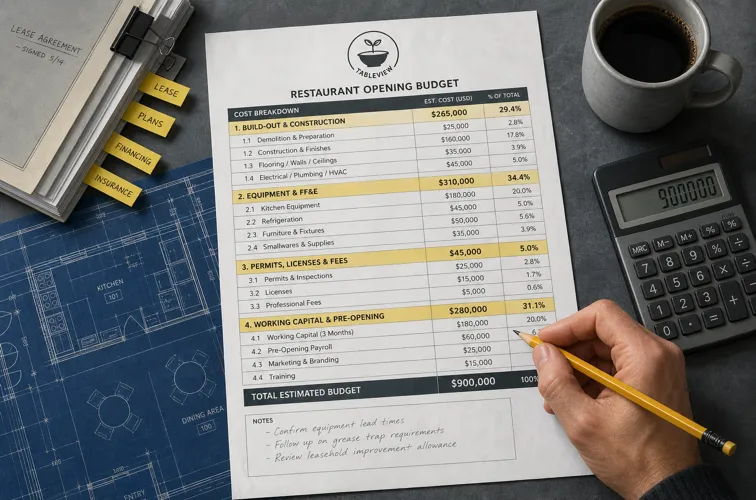
Pulling it together for a 70-seat casual full-service restaurant in a mid-cost US market, second-generation space:
Build-out and renovation: $180,000. Kitchen equipment (mix of new and used): $85,000. Technology stack: $15,000. Permits, licenses, professional fees: $30,000. Furniture, tableware, decor: $60,000. Opening inventory: $15,000. Pre-opening payroll and training: $40,000. Marketing and branding: $15,000. Contingency at 15 percent of construction: $27,000. Working capital reserve (six months fixed costs): $120,000.
Total: $587,000. Right in the middle of the full-service band, and notice how far it sits from the romantic number most first-time operators carry into their first lender meeting. The same concept in a raw shell in a coastal metro clears $900,000 without extravagance.
Build your own version of this list before falling in love with a space. Every line you price honestly now is a crisis you do not have at month four.
The bottom line
Opening a restaurant costs between $175,000 and $750,000 for most independent concepts, with a median around $375,000, and the exact number matters less than its composition: a right-sized build-out, equipment matched to the menu, permits handled early, real training weeks, honest marketing spend, and a six-month reserve that no construction overrun is allowed to touch. Restaurants rarely fail because the food was wrong. They fail because the money ran out before the audience arrived.
Price the whole journey, add the contingency, protect the reserve, and give your concept the runway it deserves. Then the only thing left to get right is everything else.
Read next: How to write a restaurant business plan, Restaurant break-even analysis, and Restaurant profit margins.