Most restaurants spend more on a single weekend of paid social ads than they ever put into local search. That ordering is almost always upside down. The person typing "best ramen near me" at 7pm on a Friday has signalled stronger intent than any audience a Meta lookalike can build, and they are about to either eat at your restaurant or somebody else's based on what shows up in the next twelve seconds.
Local SEO is the work of being the restaurant that shows up. It is the cheapest, most compounding marketing channel an independent operator has, and yet most independents leave it half-finished. A claimed but barely populated Google Business Profile, an outdated website with a PDF menu, and a quiet trickle of unanswered reviews is enough to drop a perfectly good restaurant two or three places down the Map Pack, which on a busy Friday night is the difference between a full dining room and a quiet one.
This guide walks through what local SEO actually means for a restaurant in 2026, the ranking factors that move the needle, and a ninety-day plan you can hand to a manager and have them execute without bringing in an agency.
Why local SEO is the most undervalued marketing channel a restaurant has
Roughly half of all Google searches have local intent, and for the food and hospitality category the share is even higher because the question almost always assumes "where I am right now." "Restaurants near me," "open now," "best pizza in [neighbourhood]," "Italian restaurants downtown," "Sunday brunch near me" are not abstract queries; they are people walking down the street or sitting on a couch deciding within the next half hour where to spend money.
That intent is why the economics of local SEO are completely different from paid advertising. Paid ads cost money every time the meter spins. An optimised Google Business Profile, a fast website with proper schema, a steady stream of recent reviews, and twelve months of consistent practice keep paying out the year after the work is done. The cost-per-cover from a well-run local SEO programme is usually a tenth of what the same operator spends on Meta ads, and the traffic does not stop the day the credit card declines.
The other reason local SEO is undervalued is that nobody owes you the result. There is no dashboard with a "spend more" button that improves your ranking. The work is a hundred small details done well, repeated weekly, which is exactly the kind of work a busy operator pushes to "next month" indefinitely. The restaurants that win are simply the ones that stop pushing it.
How local search actually works in 2026
When somebody searches "best tacos near me" in 2026 they see three distinct types of result competing for the top of the screen. Understanding the difference matters because each one rewards a different kind of work.
The first result, at the top on most queries, is an AI overview: a short generated summary that pulls from across the web and increasingly cites specific restaurants by name. AI overviews reward authoritative content, recent reviews, and structured data on your site that makes you easy for the model to quote.
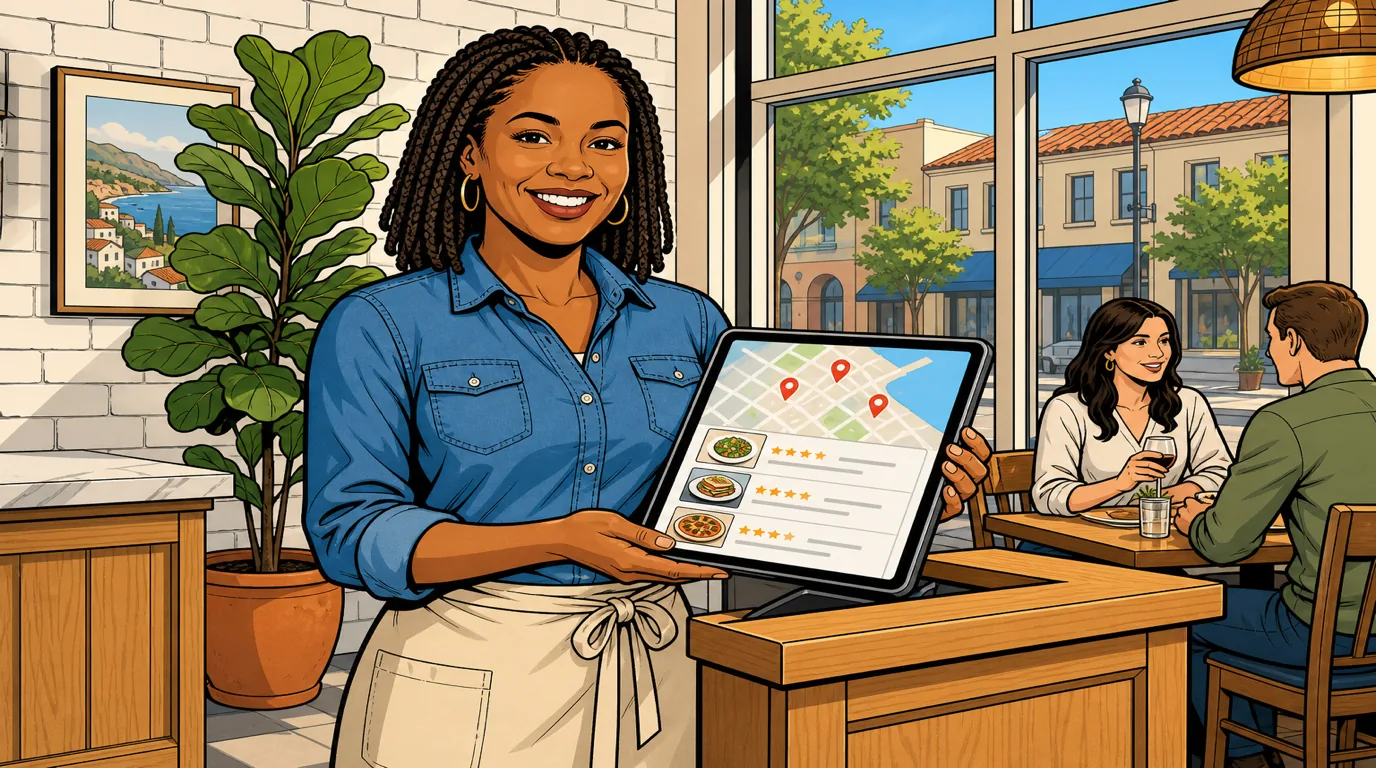
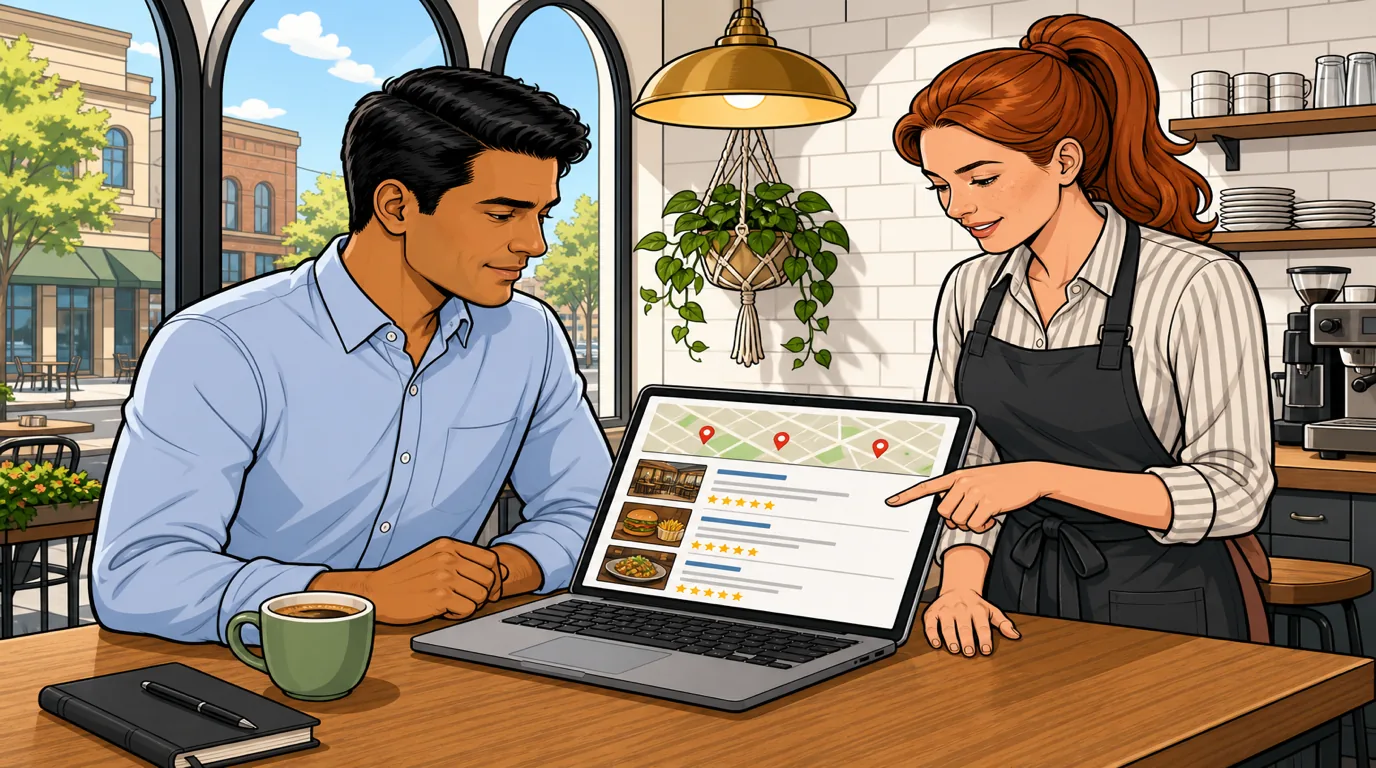
The second result is the Local Map Pack: a map and three business listings pulled from Google Maps. The Map Pack converts at a much higher rate than organic results below it because it answers the question ("where") and the action ("go there") in the same surface. Map Pack rankings are driven almost entirely by your Google Business Profile, proximity to the searcher, review signals, and the consistency of your business information across the web.
Below that sit the standard organic blue links: your website, plus directory listings like Yelp, TripAdvisor and OpenTable. Organic local results are won by traditional on-page SEO sharpened for local intent: title tags that include city and cuisine, menu pages that target dish-level queries, schema markup that tells Google you are a restaurant and not a recipe blog, and backlinks from local sources.
The practical implication is that you are running three campaigns at once, with three different sets of levers. Most operators only run one, and it is usually the wrong one. The order of work, for almost every independent, should be Google Business Profile first, on-page foundations second, reviews and links third.
Google Business Profile: the single highest-impact lever
If you do one thing this quarter, do this one. Your Google Business Profile controls your Map Pack listing, your knowledge panel on branded searches, the photos that show up next to your name, the reviews that sit beneath it, and the call, directions and reservation actions visitors take. A complete, active profile typically outranks a half-finished profile from a better-known restaurant within a few months. The work is unglamorous and entirely free.
The non-negotiable checklist for an optimised restaurant profile in 2026 reads like this. Claim and verify the listing under the account that will own it long term. Fill every field, not just the obvious ones: primary category, three to five secondary categories, full hours including holidays, service area attributes (dine-in, takeaway, delivery), amenities (outdoor seating, wheelchair access, vegan options, kids welcome), payment methods accepted, and dress code where it makes sense.
Photos are the field most owners under-invest in. Google rewards profiles with thirty or more original photos, refreshed regularly, across four categories: exterior shots that help a stranger recognise the storefront, interior shots that set the atmosphere, food photography that shows what people actually order, and team shots that humanise the business. Upload a new batch every month rather than dumping a hundred photos once and never returning.
Use the Posts feature weekly. A short update announcing a new menu item, a holiday opening, a weekend brunch sitting, a private event booking window, or a featured supplier signals to Google that the business is active. Restaurants that post weekly outperform restaurants that post never on every map-pack ranking study published in the past three years.
Connect the profile to the rest of your stack. Hook up reservations so the "Reserve" button works inside Google, link your menu (or upload it so it renders inside the profile) and connect online ordering so takeaway and delivery happen inside the surface where the search started. That last move alone, covered in more depth in our guide to POS with online ordering, can double the conversion rate of your Map Pack visits because it removes the click out to a third-party site. Field by field, that is covered in how to optimize a restaurant Google Business Profile.
Your website's local SEO foundations
Your website is the second pillar. Google needs to be able to read it quickly, parse it correctly, and match its content to the location-aware queries that bring traffic to restaurants. Four foundations matter more than anything else.
The first is NAP consistency: Name, Address and Phone number must be identical across your website, your Google Business Profile, and every directory you appear in. Even small variations (Street vs St., a missing suite number, an old phone line) confuse Google about whether two listings are the same business and dilute the prominence signal. Audit your top twenty citations once a year and fix anything that has drifted.
The second is structured data. Adding LocalBusiness or Restaurant schema to your homepage and contact page tells Google exactly what kind of business you are, your hours, your cuisine, your price range and your accepted payment types. Menu schema on your menu page lets dish-level queries surface specific items. The work takes a developer about two hours total and produces compounding returns for years.
The third is mobile performance. More than seventy percent of restaurant searches happen on a phone, often on a flaky cell connection on the walk over. A site that takes four seconds to render its menu has already lost half of those visitors to the restaurant whose site rendered in one. Core Web Vitals (LCP under 2.5 seconds, CLS under 0.1, INP under 200ms) are explicit Google ranking factors, and the slowest restaurant sites are often the ones still serving full-resolution food photography through ten layers of third-party scripts.
The fourth is on-page basics that crawlers actually read: your address in plain HTML in the footer of every page, an embedded Google Map on the contact page, hours visible without a click, and a phone number that is a tappable tel link rather than an image. None of this is glamorous, and none of it requires a redesign. It does require an afternoon with someone who knows where to look.
On-page restaurant SEO for the pages that matter
Most restaurant websites have four to six pages that genuinely move local search rankings: homepage, menu, location/contact, about, and one or two service pages (private events, online ordering, gift cards). Each one rewards a different on-page treatment.
The homepage title tag is the single most valuable string of text on your site. The formula that consistently works for independent restaurants is "Restaurant Name | Cuisine type in City." A title tag like "Bocca Trattoria | Italian Restaurant in Brooklyn" tells Google what the business is and where, in 56 characters. The meta description below it should summarise the experience in 150 to 160 characters and end with a verb the searcher can act on ("book a table," "view the menu," "see this week's specials").
The menu page is the page operators most often underestimate. A full menu rendered in HTML (not buried in a PDF) wins long-tail "best [dish] in [city]" searches that you will never rank for any other way. Each dish should have a one-line description in real prose, an allergen tag where relevant, and a price. If you serve a specialty that the local food scene actually searches for - the regional pizza style, the wood-fired oven you imported, the off-menu omakase - give it its own short paragraph. A properly maintained menu management system makes this practical because the same content powers your menu on the website, the e-menu, online ordering, and your Google Business Profile.
The contact and location page should treat structured local data with the seriousness an investor relations page treats financial data. Full address, phone, hours including holiday exceptions, embedded map, parking notes, public transport directions, accessibility information, and where relevant a separate paragraph per neighbourhood your venue serves. For a multi-location operator, every venue gets its own page with unique content; never reuse a location template with the address changed.
Reviews and reputation: the prominence signal that matters most
Of every local SEO ranking factor that has been studied seriously in the past five years, reviews and review velocity rank at or near the top. They double-count: review quantity and average rating feed Google's prominence score directly, and the recency and consistency of new reviews signal that the business is actively trading. A restaurant with 800 reviews from five years ago performs worse in 2026 than a restaurant with 80 reviews from the past sixty days.
The right way to get more reviews is unglamorous. Ask at the right moment, which is after a clearly positive experience and before the guest reaches the door. Print a small QR code on the receipt that opens the GBP review form in one tap; servers prompt with a sentence rather than a speech ("if you enjoyed tonight, the kindest thing you can do is leave a quick Google review"). The tap-through rate on a QR-coded receipt prompt is roughly an order of magnitude higher than asking verbally without one.
Responding to every review matters almost as much as collecting them. Reply to positive reviews briefly: a thank-you, an acknowledgement of something specific the guest mentioned, and an invitation back. Reply to negative reviews within twenty-four hours, take ownership without arguing the facts, and move the conversation offline to a phone number or email. Google has confirmed multiple times that response rate is a ranking signal, and human readers absolutely weight a one-star review less if the operator has answered it professionally underneath.
Resist the temptation to game the system. Incentivised reviews ("get a free dessert if you leave us a five-star review") violate Google's policy and are increasingly easy to detect; a single penalty wipes out years of legitimate review work overnight. Buying reviews is worse and risks the listing being suspended outright. Reputation also lives outside Google - TripAdvisor for tourists, Yelp in some markets, OpenTable and Resy through your reservation system - and the same discipline applies on each.
Local link building without paying for spam directories
Backlinks from credible local sources are how Google distinguishes a prominent neighbourhood restaurant from one that nobody has heard of. You do not need a hundred of them; you need ten or twenty good ones, earned over the lifetime of the business, and refreshed when sources go dark.
Citations come first. These are mentions of your name, address and phone number on legitimate directories: Yelp, TripAdvisor, OpenTable, Foursquare, Apple Maps, the Better Business Bureau, your local chamber of commerce, and the major regional food publications. Most are free, all should match your Google Business Profile exactly, and getting listed everywhere takes about an afternoon. Avoid services that promise "submit to 500 directories"; the directories they submit to are mostly spam and Google deliberately ignores or penalises them.
Earned local links are higher quality and harder to fake. Pitch the food columnist at the local paper a story angle that is genuinely useful to their readers: a new menu rooted in a regional ingredient, an unusual chef collaboration, a charitable initiative the kitchen is running. Sponsor the little league team, the school art show, the community theatre's spring production - many of these sponsorships include a website mention with a real backlink. Build relationships with genuine local food bloggers and influencers (real ones, not paid shoutout accounts) and host them when you launch something new.
Local resource pages are the third source: city tourism boards, hotel concierge sites that recommend nearby restaurants, neighbourhood "newcomer's guide" pages run by local realtors, and the dining sections of nearby college and corporate intranets. Spending an hour a quarter adding your venue to these pages is one of the highest-leverage uses of an operator's time.
Local content that earns long-tail traffic
Most local SEO traffic does not come from one big keyword. It comes from hundreds of long-tail queries that each drive a handful of visitors a month: "rooftop bar near [station]," "best fish tacos in [neighbourhood]," "where to watch the cup final in [city]," "private dining for ten in [district]," "dog-friendly brunch [neighbourhood]." A restaurant with thoughtful content addressing the specific intent behind those queries will quietly hoover up the traffic the competition leaves on the table.
The cheapest way to start is the menu itself, treated as content rather than as a price list. Each signature dish gets a short paragraph that mentions the technique, the regional origin, the supplier, or the chef's history with it. That same paragraph quietly targets the long-tail dish search every time it is indexed.
Event pages are the next layer. If you are a sports bar, a page for each major upcoming event ("World Cup at [your venue]," "Six Nations at [your venue]") with the fixture list, the food and drink offer, and a booking link will rank for the relevant fixture-plus-city queries every single time the event approaches. The work compounds: the same template gets rolled forward for the next tournament with a one-line update.
Neighbourhood-aware content is the third layer, and the easiest to get wrong. Thin "10 best things to do in [neighbourhood]" listicles written by a junior intern read as cynically as they are, and Google demotes them within months. Useful neighbourhood content has to come from genuine knowledge of the area: a guide to local suppliers, a piece on the history of the building, a recommended pre-theatre dining itinerary that includes other businesses you are happy to send guests to. Our broader restaurant marketing guide walks through how to plan an editorial calendar that earns trust rather than hits a vanity word-count.
Tracking what actually matters
Local SEO produces an embarrassment of vanity metrics. Total website visits, social media followers, "impressions" in your Google Business Profile dashboard - none of these reliably correlate with revenue. Track the five metrics that do, and ignore the rest.
The first is profile actions: calls, direction taps, website visits and menu views inside your Google Business Profile dashboard. These are explicit signals of purchase intent and they map cleanly to revenue. A healthy independent restaurant should be doing thirty to sixty actions per day from its profile within a year of starting serious local SEO work.
The second is Map Pack rank for your priority queries. Pick five to ten queries that matter (your cuisine + neighbourhood, "near me" variants, your two or three signature dishes) and track where your profile ranks for each on a grid of points across your delivery radius. Free tools like Local Falcon and BrightLocal handle this for under a hundred dollars a month; the data is what tells you whether your latest GBP optimisation actually moved the needle.
The third is organic Search Console traffic to your menu, location and homepage. Watch impressions and clicks for queries that include your city or neighbourhood. A steady upward trend over six to twelve months is the leading indicator that your on-page work is compounding.
The fourth is review velocity and average rating. Two new reviews a week with an average above 4.5 is the rough benchmark a busy independent should aim for. Falling below one new review a fortnight is a leading indicator of declining Map Pack rank and is worth investigating the same week it shows up.
The fifth is conversion: reservations booked from organic search, online orders placed from organic search, calls answered from Map Pack listings. Tie these back to revenue through your POS reporting and payments dashboard so the team can see the dollar value of the work. Local SEO without conversion tracking eventually loses budget arguments it should be winning.

A ninety-day local SEO plan you can actually execute
The work above sounds like a lot. In practice it sequences into a calm ninety-day plan that any operator with a phone, a laptop and a willing manager can run without bringing in an agency.
Days 1 to 30 - Foundation. Claim or verify your Google Business Profile under the right account. Fill every field, add three to five secondary categories, set holiday hours for the next twelve months, list every attribute that applies. Upload thirty photos across exterior, interior, food and team. Audit NAP consistency across your top twenty directories and fix every discrepancy. Add LocalBusiness or Restaurant schema to your homepage and contact page. Run a mobile speed audit and fix anything that drops your Core Web Vitals below seventy-five. Embed a working Google Map on the contact page.
Days 31 to 60 - Activation. Print QR-coded review prompts on receipts and train the closing servers on the one-sentence ask. Start posting weekly to GBP: a menu update, an event, a supplier spotlight, an opening hours change. Rewrite the homepage, menu and contact page title and meta tags to the formulas above. Build out the menu page with one descriptive paragraph for each signature dish and a short note on any specialty that drives discovery searches. Connect reservations and online ordering inside GBP so guests can act without leaving the search.
Days 61 to 90 - Compounding. Pitch ten local journalists, bloggers or community organisations with story angles that genuinely help their readers. Sponsor one local event in exchange for a website mention. Publish one neighbourhood-relevant content piece (a supplier spotlight, an event preview, a local itinerary). Set up rank tracking on five to ten priority queries. Begin a monthly review of the five metrics above with the GM and chef, and decide one or two changes to make in the next thirty days.
After ninety days the foundation is in place. The work that matters from day ninety-one onwards is repetition: a fresh photo batch every month, a new post every week, a review response every day, a new local content piece every month, and the five-metric review every thirty days. Operators who hold the line for a full year typically see their profile actions double and their organic restaurant-related search traffic triple.
Bringing it together
Local SEO is a habit, not a campaign. It rewards the operator who shows up, fills in the field, uploads the photo, answers the review and publishes the post every week for a year, and it punishes nobody so reliably as the operator who plans to "do SEO properly" sometime next quarter. The work is not complicated. There are no secrets. The only real difficulty is the discipline of doing the small things every week when the dining room is busy and the kitchen is short.
Start with your Google Business Profile this Monday. Audit your NAP and add schema next week. Print QR-coded review prompts the week after. Read your profile insights every Monday morning for the rest of the year. By the time the next holiday season arrives, you will be the restaurant that shows up first when somebody types your category into their phone, and the dining room will reflect it.
The bigger context for this work sits inside the broader practice of continuous restaurant improvement and the 2026 industry trends pushing operators toward direct, owned digital channels. A modern restaurant POS and e-menu and mobile ordering platform make the last mile - turning a Map Pack visit into a paying guest - dramatically shorter, which is the entire point of doing the local search work in the first place.
Read next: Restaurant Reviews & Reputation Management: The 2026 Operator's Guide to Google, Yelp & TripAdvisor (with Free Reputation Health Scorecard) and Restaurant CRM: The 2026 Guide to Guest Data, Lifetime Value & Marketing Automation (with Free CLV Calculator) and Restaurant Marketing: 2026 Guide to Growing Your Business.