
Two pizzerias on the same street can run an identical food cost and finish the year with completely different bank balances. One pays its bills with breathing room. The other limps from payroll to payroll, wondering where the profit went. The single number that explains the gap, more than rent, more than marketing, more than the price of cheese, is prime cost.
Prime cost is the line in your P&L that most independent operators underestimate and most successful ones obsess over. It bundles together the two costs you actually control week to week (food and labour) into one percentage you can manage. Push it down by three points and a restaurant that was breaking even starts paying its owner. Let it drift up by three points and the same restaurant quietly becomes a charity for landlords and suppliers.
This guide walks through what prime cost actually is, the formula in plain English, healthy targets for different restaurant formats, a worked example you can drop into a spreadsheet tonight, and a practical playbook for bringing the number down without firing anyone or buying cheaper ingredients.

What is prime cost in a restaurant?
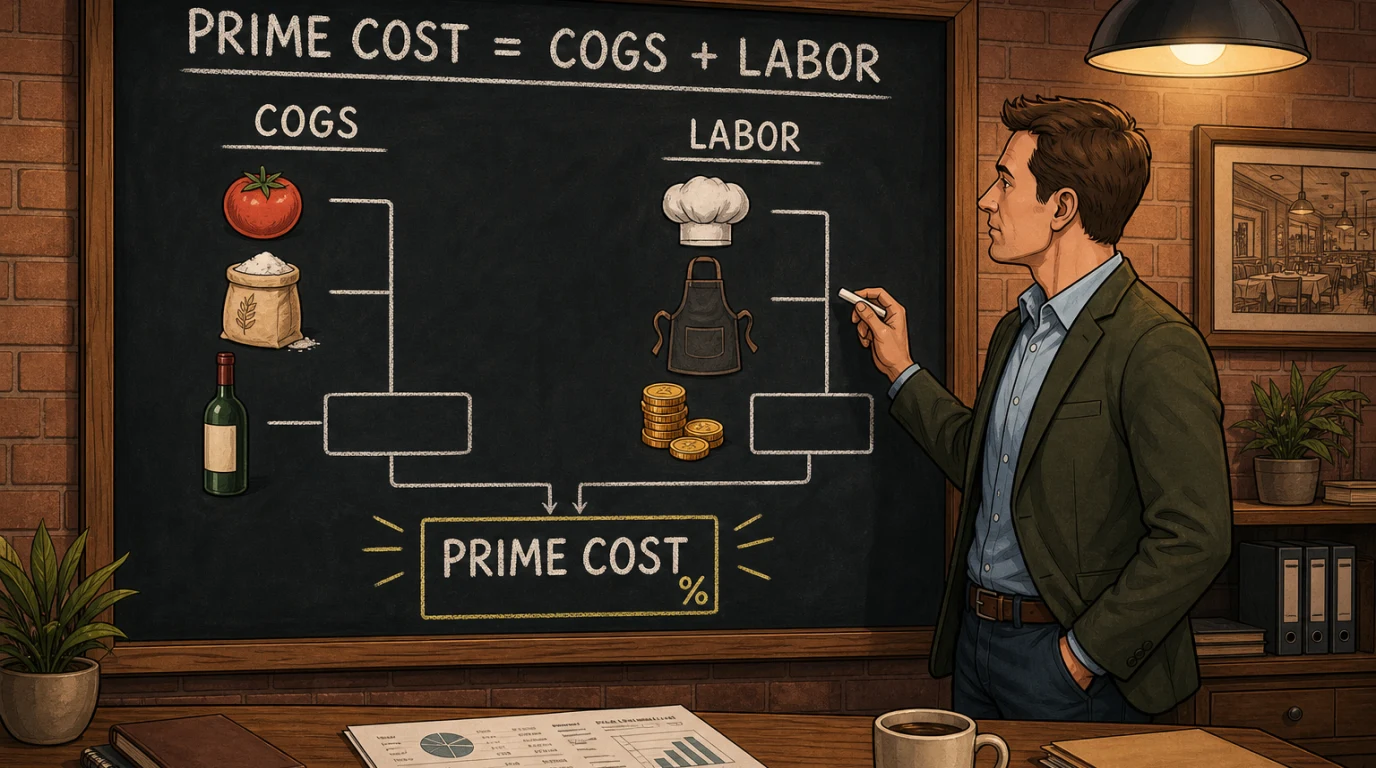
Prime cost is the total of your two largest controllable expenses: cost of goods sold (everything you spend turning raw ingredients into plates and drinks) and total labour cost (every cent paid to anyone who works in the building, from the head chef to the dishwasher to the front-of-house manager). It is expressed both as an absolute dollar figure and as a percentage of total sales.
The reason the industry treats prime cost as the master KPI is simple arithmetic. Rent, utilities, insurance, software, and the rest of the operating expense lines are largely fixed for any given month. They do not go up because you sold more burgers, and they do not go down because you sold fewer. Prime cost, by contrast, moves every shift. Every spoiled fillet, every over-poured glass of wine, every server you scheduled and then sent home after one cover, lands directly on this line. Get prime cost right and the fixed costs take care of themselves. Get it wrong and nothing else you do, not raising prices, not running promotions, not opening a second venue, will rescue the margin.
The prime cost formula
The formula itself is short enough to write on a coaster.
Prime cost = Cost of goods sold + Total labour cost
Prime cost % = Prime cost / Total sales × 100
Cost of goods sold (COGS) is calculated from inventory, not from invoices. Take the value of your starting inventory at the beginning of the period, add every purchase that came in during the period, then subtract the value of inventory still on the shelves at the end. The difference is what you actually used to generate sales. Following FIFO discipline in storage is what makes that closing count trustworthy.
Total labour cost is broader than most operators expect. It is not just gross wages on the payslip. It includes employer payroll taxes, mandatory benefits and contributions, paid holiday accruals, workers compensation, tips processed through the POS and paid out as wages, and any shift incentives or bonuses. Anything that costs you money to have a person in the building belongs in this bucket.
Why prime cost matters more than any other KPI
Operators love dashboards. Food cost percentage, average check, covers per hour, labour percentage, sales mix, void rate. Every modern POS will happily show you all of them at once. The danger of looking at each of those metrics in isolation is that you can win on every single one and still go bankrupt.
An obvious example: a kitchen can drive food cost down to a beautiful 26 percent by switching to slower, more labour-intensive prep techniques. The chef looks like a hero on the food cost line. Six weeks later, labour cost has crept up by four points to cover the extra prep hours, and the restaurant is two points worse off overall. Prime cost is the only number that catches that trade-off in real time, because the two halves move against each other constantly. Cheaper labour usually means more food waste, and cheaper food usually means more labour to handle, portion, and fix it.
The other reason prime cost is decisive is that it is the only ratio your bank manager, your investor, and your accountant will all agree on. Food cost benchmarks vary wildly by cuisine. Labour benchmarks vary by service style and minimum wage law. Prime cost is comparable across formats because it bakes both halves of the equation into one number. When an investor asks how the business is doing, they are really asking about prime cost.
What is a healthy prime cost percentage?
There is no single correct answer, but there are well-understood ranges by format. The rule of thumb most operators inherit, and the one that has held up through three decades of changing menu trends, is that prime cost should land at or below 60 percent of sales for a full-service restaurant and at or below 55 percent for a quick-service or takeaway concept. The lower the number, the more room you have for rent, marketing, debt service, and profit.
Here is how the bands typically break down for the most common formats operating in 2026. Treat these as gravity, not gospel: a particular neighbourhood, lease, or menu can shift any of them by a few points.
- Quick service and fast casual: healthy at 55 percent or below, with the strongest operators sitting closer to 50. Lower labour intensity is supposed to offset the relatively low average check.
- Casual dining and family restaurants: healthy at 58 to 62 percent. Slightly higher than quick service because table service inflates the labour line.
- Full-service casual: healthy at 60 to 63 percent. Beverage mix matters here. Strong wine and cocktail sales pull the number down because beverage margins are higher than food.
- Fine dining: healthy at 65 percent or below. Margins on premium ingredients are tighter and labour ratios are higher because of the service standard.
- Bars and pubs: healthy at 55 percent or below when beverage drives the revenue mix. The combination of high beverage margin and lower kitchen labour gives bars a structural advantage that operators routinely waste through poor pour control.
- Coffee shops and bakeries: healthy at 50 to 55 percent. The combination of low food cost on coffee and limited labour during quiet hours makes this format unusually forgiving, but only if daypart staffing is managed tightly.
If your venue is more than five percentage points above the band for your format, the issue is structural and no amount of supplier re-negotiation will fix it on its own. If you are within a couple of points, the gains are usually inside the building.
A worked example you can copy
Let us calculate prime cost for a mid-size casual restaurant for a single trading week. Use round numbers so the arithmetic is easy to follow, then plug your own figures in tonight.
For the week, total food and beverage sales (net of tax) come in at $48,000. Starting inventory on Monday morning was valued at $12,400. Through the week, the restaurant received deliveries from food, beverage, and dry goods suppliers worth $11,200 in total. The Sunday-night stock count comes in at $11,000.
Cost of goods sold = 12,400 + 11,200 - 11,000 = $12,600.
Now labour. The payroll run for the week came in at $14,400 in gross wages across the full team. Payroll taxes and mandatory contributions add another $2,100. Server tips processed through the card terminals and paid out through payroll were $1,800. Workers comp and benefits add a further $450 for the week.
Total labour = 14,400 + 2,100 + 1,800 + 450 = $18,750.
Prime cost = 12,600 + 18,750 = $31,350.
Prime cost percentage = 31,350 / 48,000 = 65.3 percent.
For a casual restaurant, 65.3 percent is two to three points above the healthy band. Translated into the P&L, that is roughly $1,200 of profit leaking out of the business every single week, or just over $60,000 a year that should be in the owner's pocket and is instead funding inefficiency. The rest of this guide is about closing that gap.
How to reduce the food cost half
Food cost moves on two timescales. The supplier side moves slowly: you re-negotiate contracts a few times a year, you switch a supplier when quality slips, you change a recipe when a price spikes. The kitchen side moves daily: every portion served, every plate sent back, every trim thrown in the bin, and every line check missed shows up in next week's COGS.
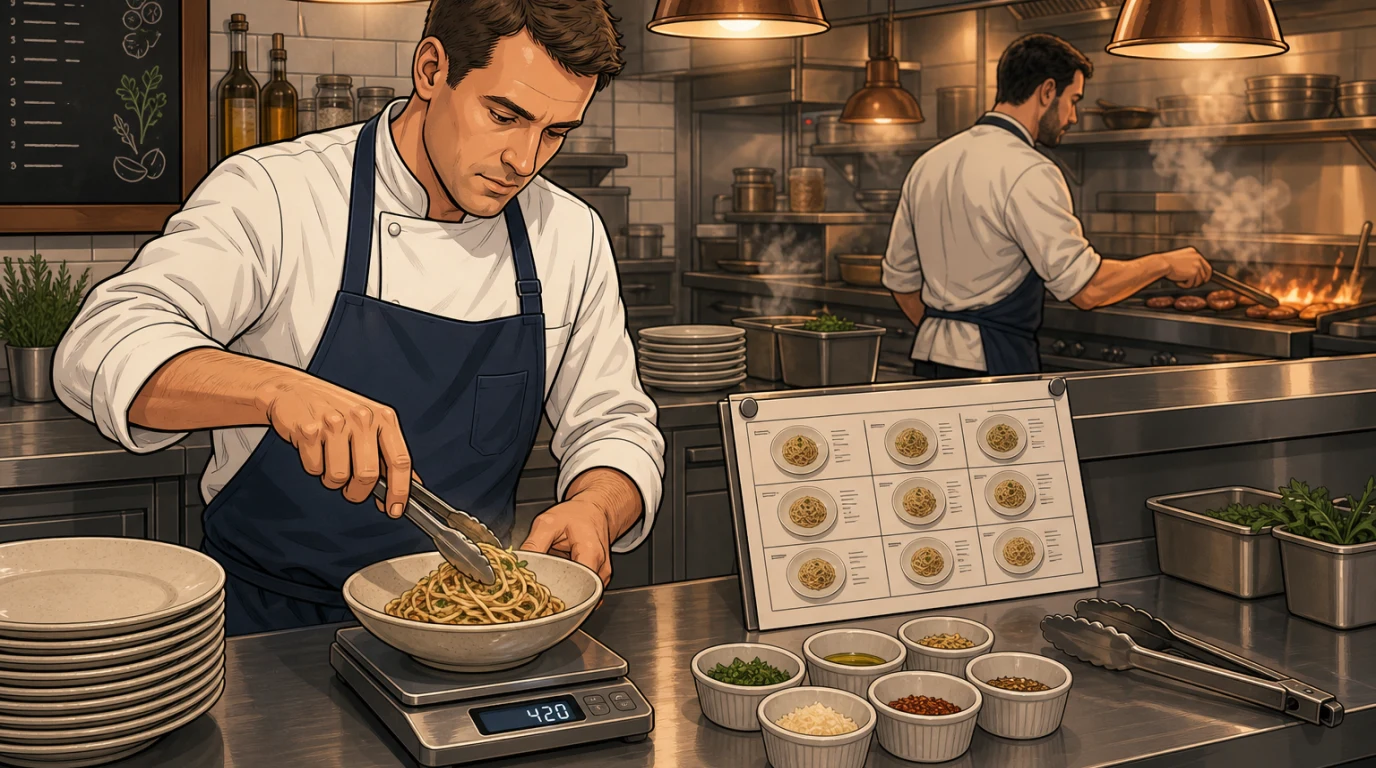
The single most reliable lever for food cost is portion discipline. Most kitchens are giving away two to four percent of their food cost in generous pours, oversized scoops, and "rounded up" garnishes that nobody ever calibrated. A digital scale on the line, a printed portion chart at each station, and a manager who actually walks the line during service will recover that two to four percent inside a month, with no menu changes and no awkward conversations with suppliers.
The second lever is menu mix. Not every item on a menu earns its place. Some items contribute great margin but barely sell. Others sell constantly but have crept into low-margin territory because the supplier cost moved and the price did not. A proper menu engineering pass sorts every dish into one of four buckets (stars, plowhorses, puzzles, and dogs) and tells you which to promote, which to re-price, which to redesign, and which to remove. Done quarterly, it is the highest-return hour any operator can spend.
The third lever is waste. Reducing food waste in a restaurant is partly about back-of-house process (rotation, par levels, prep batching) and partly about front-of-house discipline (correct upselling, allergen handling, return-rate tracking). A waste log kept honestly for two weeks usually reveals one or two patterns that are responsible for half the loss, and they are almost always fixable inside a single team meeting.
How to reduce the labour cost half
Labour is the harder half because it involves people and rosters rather than ingredients and scales. The mistake most operators make is to treat labour cost as a function of hourly rates. It is not. It is a function of productivity, which is sales per labour hour, and schedule fit, which is how closely the roster matches actual demand. You can pay every person well and still have a healthy labour percentage if both of those numbers are right.
Productivity starts with the kitchen. A modern kitchen display system sequences tickets, throws warnings on long tickets, and gives the chef a shift-end report on average prep time per station. The same dishwasher in a kitchen with a well-tuned KDS does measurably more covers per hour than in a kitchen running paper tickets, not because they are working harder but because they are wasting less time on rework. The savings typically pay for the system inside the first quarter.
The same logic applies in the dining room. Restaurant table turnover is just labour productivity expressed in covers. Faster turn times at the same service quality mean more revenue per server hour, which mechanically reduces labour as a percentage of sales. Reservations management, sensible section sizing, and a manager who runs the floor instead of disappearing into the office for paperwork are the levers here.
Schedule fit is the second part. Most restaurants over-staff their slow hours and under-staff their peak ten minutes. The difference between a great operator and an average one is rarely the headcount on Saturday night. It is the headcount at 2:30 on Wednesday afternoon. Use your POS sales history to forecast covers per half-hour, then build the schedule backwards from forecast covers per server. The first time you do this seriously, expect to find an hour or two of overstaffing every weekday. Over a year, that is a full position.
The third lever is cross-training. A line cook who can also run the pass, a barback who can also serve food, a host who can also expedite takeaway, gives you flexibility that turns a six-person shift into the output of a seven-person one. Cross-training is unglamorous and slow, but the labour-cost dividend it pays is the single highest-leverage HR investment most operators ever make.
How POS and accounting systems automate the maths
Calculating prime cost by hand once a month is fine for a single owner who is in the building seven days a week. It is not fine for anyone trying to grow, hand off, or run more than one venue. Modern POS reporting combined with restaurant accounting software does the heavy lifting on both sides of the formula, and turns the monthly arithmetic exercise into a weekly habit.
On the food cost side, an integrated stock management module pulls real-time ingredient usage from sales, posts purchases against the right cost centre, and produces a theoretical food cost that you compare to the actual physical count at the end of the week. Any gap between theoretical and actual is, by definition, waste, theft, or measurement error. Seeing that gap weekly instead of monthly is the difference between catching a problem in week one and discovering it in week four.
On the labour side, the POS already knows your sales by half-hour. If the same system also schedules shifts, or feeds clean payroll data into your accounting platform, you can read sales-per-labour-hour and labour-as-percentage-of-sales for every daypart of every day. Pair that with a modern restaurant POS and the data is already there. All that is left is the discipline to look at it.
Tying both halves together is the job of restaurant accounting software. Daily sales, COGS adjustments, payroll runs, and supplier invoices all flow into the same chart of accounts, so prime cost becomes a single number you read in the morning rather than a project you wait for the bookkeeper to deliver at month end. For multi-venue operators that visibility is non-negotiable; for single-site operators it is the difference between running the restaurant and being run by it.

Common mistakes operators make
Even experienced owners get prime cost wrong in surprisingly consistent ways. Watching for these five patterns will catch most of the noise in your numbers.
The first mistake is using invoices for COGS instead of inventory. Invoices tell you what arrived. Only inventory tells you what was actually used. If you book the full delivery as COGS in the week it arrived, you will show a wildly volatile food cost that has nothing to do with what you actually sold.
The second mistake is leaving tips out of labour. If tips are processed through your POS and paid out through payroll, they are part of labour cost. Excluding them flatters the labour percentage and gives you a prime cost that looks healthier than it really is.
The third mistake is calculating prime cost monthly instead of weekly. A month is too long. By the time you see the number, four trading weeks have happened and you have lost the chance to course-correct. Weekly is the right cadence for an operating restaurant. Monthly is for tax returns.
The fourth mistake is benchmarking against the wrong format. Comparing a wine-led bistro to a quick-service taqueria tells you nothing useful. Find two or three operators in your own format whose numbers you trust and compare against them.
The fifth mistake is treating the food cost half and the labour cost half as separate projects with separate owners. They are not. They are linked by every menu decision, every prep choice, and every roster. If the head chef and the GM are not in the same prime cost meeting, you are going to keep making the trade-offs in the dark.
A weekly prime cost rhythm that actually works
Reading about prime cost is one thing. Building a weekly rhythm that puts the number in front of the right people at the right time is what moves the needle. A version of this rhythm runs in every well-managed restaurant we work with, and it takes the management team about ninety minutes a week to execute.
Sunday evening: close the trading week. Pull the POS sales report, run a physical stock count, post any outstanding supplier invoices, and confirm the payroll figures for the week. The shift manager or assistant manager owns this step. Total time, sixty minutes.
Monday morning: a fifteen-minute prime cost stand-up with the head chef and the GM. Three numbers on a whiteboard: food cost percentage, labour percentage, prime cost percentage. Two questions: what moved compared to last week, and what is the one change we will make in the coming week to push the number in the right direction. Nothing else.
Wednesday afternoon: a mid-week check on labour forecast versus actual. If the week is tracking high on labour, adjust the back end of the schedule before the weekend. If it is tracking low, make sure the weekend is staffed for the forecast and not the average.
Friday morning: a final menu-mix snapshot. If a particular item has slipped sharply on margin or popularity through the week, decide whether to feature it in the weekend specials or pull it quietly until the next menu refresh.
That is the entire process. Ninety minutes of management time a week, spread across three short conversations, against a six-figure annual profit swing for any restaurant doing more than a million in revenue. The reason the rhythm works is not the genius of the meeting agenda; it is that the conversation happens every single week. Prime cost is a habit metric, not a project metric.
Bringing it together
Prime cost is the cleanest single number in the restaurant P&L. It captures both of the costs you actually control, it is comparable across formats, and it responds quickly to the kind of small, daily decisions that make up real restaurant operations. Get the formula right, calculate it weekly, benchmark it against the right format, and put it in front of the chef and the GM on the same Monday morning every week.
Drive it down by combining the food cost levers (portion discipline, a disciplined menu engineering pass, an honest waste log) with the labour cost levers (productive kitchen display, fast table turnover, schedule fit, cross-training). Use a modern POS system and integrated accounting software to make the maths automatic so the time you save can go back into running the restaurant. Audit suppliers and unit economics with help from a proper procurement management workflow.
None of these moves is glamorous, and none of them require a new concept or a refit. They require a routine. The restaurants that survive the next decade will not be the ones with the best chef or the best location. They will be the ones whose owners can tell you their prime cost percentage on any given Tuesday, and what they did about it last week.
Read next: Restaurant Procurement and Vendor Management: The 2026 Operator's Playbook for Lower Food Cost (with Free Vendor Cost Comparison Calculator) and Food Cost Percentage: The 2026 Restaurant Operator's Guide and Restaurant P&L Statement: The 2026 Guide (with Free Calculator).