
A Z report is the end-of-day close from your till. It totals everything sold since the last close, splits it by tax rate and payment method, then zeroes the daily counters so tomorrow starts from nothing. That is where the name comes from: Z for zero, the last letter, the end of the day. Run one twice by accident and you have a real problem, because on most systems the detail behind it is already gone. It is also the single document your bookkeeper, your bank reconciliation and, in four of the five markets this site is published in, a tax inspector will all work from, which is why a restaurant POS that produces a numbered, unalterable close matters more than any other report it prints.
What follows is the protocol, not the theory. What belongs on the report, the four numbers that have to agree before anybody goes home, how to count a drawer without quietly fooling yourself, what variance is normal versus what is a pattern, and what German, Italian, Spanish and French rules now want from the same ten minutes of work. If your close currently ends with a paper slip shoved in a drawer and a figure typed into a spreadsheet on Monday, the distance between that and restaurant accounting you can actually trust is about eleven minutes a night.
What the Z report is doing under the hood
Through service, your till is incrementing counters. Gross sales, sales by category, tax owed at each rate, payments by method, refunds, voids, discounts, receipt count. None of that is a report yet. It is a running tally sitting in the system.
Closing the day tells the system to stop, total those counters, archive them under a sequence number, and reset them to zero. The next sale starts a fresh day. That reset is the whole point, and it is also why a Z is a one-shot document. You cannot re-run yesterday, because as far as the till is concerned yesterday no longer exists as a live figure.
On cloud systems the vocabulary has drifted. You may never press a key labelled Z, and the underlying data is not really deleted, so you can go back and re-report a date range weeks later. What has not changed is the operational need for a hard line between one trading day and the next. Without one, you have no moment where cash on hand is supposed to equal a specific number, and if there is no such moment then nobody is accountable for the difference. The habit matters more than the letter.
One number on the report deserves attention because it is the only one that cannot be edited: the grand total since the system was first activated. It never resets. If your sequence of daily figures has a gap or a rewrite in it, that running total is what exposes it. Auditors know this. Most operators have never looked at it.
X report versus Z report
An X report answers the same question at a different moment. It shows you where the day stands right now and changes nothing: no reset, no sequence number, no accounting weight. Run it as often as you like. A Z ends the day and locks the totals.
Put them side by side at 10pm and the numbers can be identical. The difference is what happens afterwards. X is a look, Z is a lock.
Practically, the X is the more useful report during service and almost nobody uses it. A duty manager who pulls an X at 9pm can see that wet sales are eighty dollars behind a normal Friday while food is ahead, and go find out whether the new bartender is under-ringing rounds or the terrace is simply cold. Waiting for the Z means finding out at midnight, when everyone who could explain it has gone home.
Two rules that save a lot of grief. Never let a Z run while orders are still open, because those tickets either fall outside the close or get dragged into it, and both outcomes make the report a work of fiction. And print or save the Z before anything else happens, because on a traditional register the transaction detail behind it is genuinely unrecoverable.
What belongs on the report
A close that only shows a sales total is not a close. If you cannot answer what was sold, how it was paid for, what was taken off, and what the drawer should hold, you are not reconciling anything.
The lines worth insisting on: gross and net sales; tax broken out per rate, not rolled into one figure, because a venue selling food at one rate and alcohol at another needs the split to file at all; sales by category, at minimum food against drink; a tender breakdown covering cash, each card type, vouchers, gift cards, room charges and anything on account; service charge; the count and value of voids, discounts, comps and refunds, kept as separate lines rather than lumped together; covers and average spend; the first and last receipt numbers of the day; expected cash against counted cash; and the sequence number of the report itself.
That receipt-number range is the quietest useful item on the list. Sequential numbering with no gaps is what makes the day auditable. A gap means either a technical failure worth investigating or a receipt somebody made disappear, and the only way you will ever notice is if the range is printed where you look at it every night.
The four numbers that have to agree
Most venues reconcile two numbers: what the till expected and what was in the drawer. That catches cashier error and nothing else. Cash leaves a restaurant through four hands, and each handover is a place it can stop.
Number one is the cash component of the Z: gross sales minus everything settled by card, voucher, account or app. Number two is the physical count at the drawer. Number three is what was handed to the safe, the manager or the collection agent, recorded on a slip with a name on it. Number four is the amount the bank actually credited, matched back to a deposit reference.
All four should tie. Where they stop tying tells you what kind of problem you have, which is the part that makes this worth doing. A break between one and two is a till problem: miskeyed tenders, a payment rung as cash and taken as card, or theft at the drawer. A break between two and three happened after the count, which narrows the list of people considerably. A break between three and four is either the bank, a bag that never made the trip, or a deposit posted to the wrong account.
The lag between three and four is worth naming in your own procedure. Cash deposited after the bank closes on a Saturday may not be credited until Monday or Tuesday, and that window is where a variance can hide for days looking like a timing difference. Write down the expected lag for your bank, then treat anything older as an exception rather than a maybe.
Counting the drawer without fooling yourself
A blind count means the person counting does not know the target. They count what is there, enter it, and only then does the system reveal what it expected. It sounds like a small distinction. It is the entire difference between a control and a formality.
Show someone the expected figure first and the count becomes a search for that number. Not usually from dishonesty. Somebody who is forty dollars short and can see it will recount the same stack four times until it agrees, or decide the twenty in their apron must belong to the till. The variance vanishes and so does the information you needed.
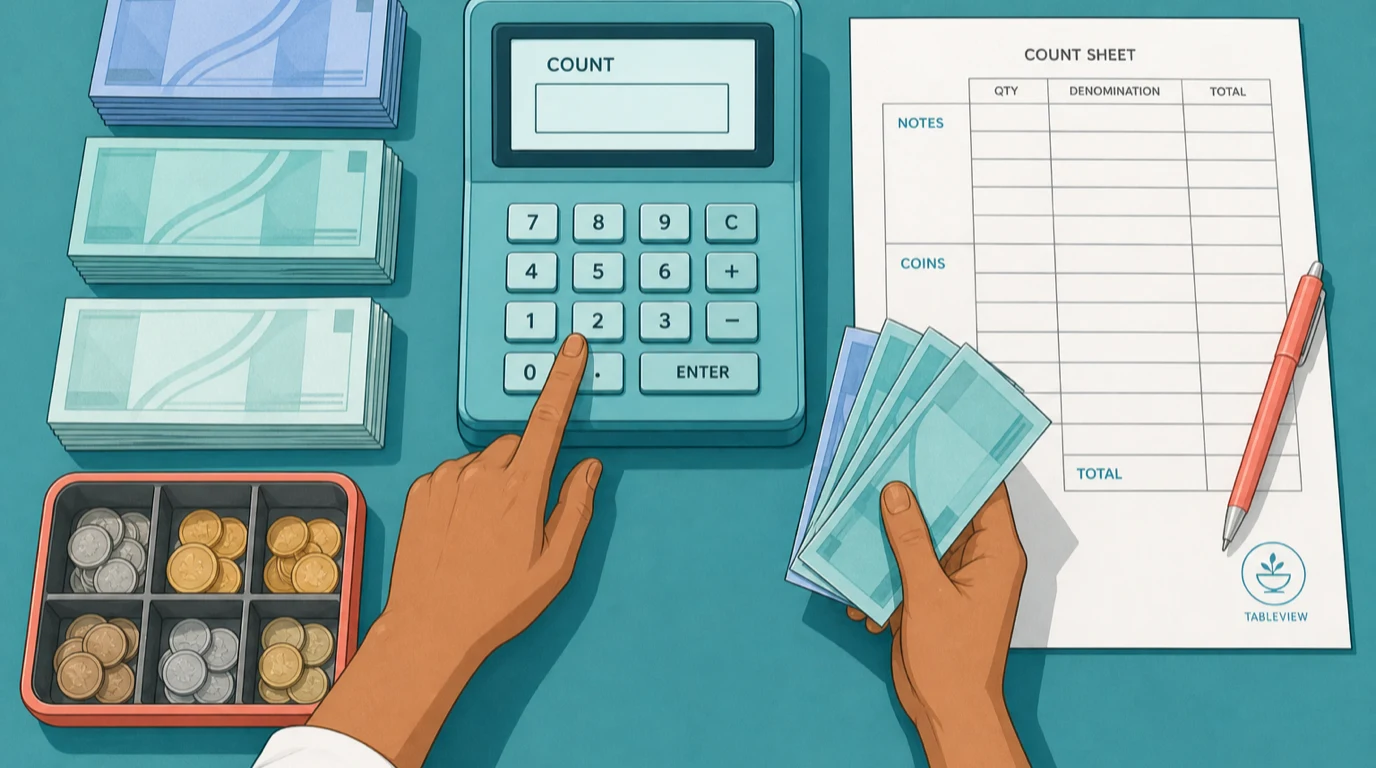
Count by denomination rather than totalling loose. It takes the same time, it makes recount fast when the number is off, and it produces a record you can compare when two counts disagree. Any decent POS gives you a calculator that takes note and coin quantities and does the arithmetic, which removes the other common failure: an accurate count and a wrong sum.
Then the awkward part, which is who counts. If the person who rang the sales is the only person who counts the drawer and the only person who takes the bag to the safe, you do not have a control at all, you have a diary entry. In a small venue where one manager genuinely does all three, the compensating control is that the count is entered into the system before the cash moves, and that a second person verifies the deposit against the Z the next morning. Not perfect. Considerably better than nothing.
Float is the last piece of hygiene. Set the starting float as a policy, count it in at open, and leave the same amount behind at close, recorded. Restaurants that treat the float as whatever happens to be left have removed their own baseline, and every variance from then on is unprovable.
What an acceptable variance looks like
Zero is the wrong target. Insist on it and your team will manufacture it, either by rounding out of tips or by treating the count as paperwork. Cash handled by humans at speed produces small differences, and a policy that pretends otherwise trains people to hide them.
A workable tolerance for a single till on a single shift is a few dollars either way, with five dollars a common line. Over the month, an aggregate of about a tenth of a percent of cash sales is a reasonable ceiling. Pick your own numbers, write them down, and apply them the same way to everyone.
What matters more than any single night is direction. A till that is three dollars over on Monday, four short on Tuesday and two over on Thursday is a human being making change quickly. A till that is short a little almost every shift, or a till that is dead-on exact every single shift, both deserve a second look, the second one more than the first. Consistent perfection in cash handling usually means somebody is balancing the drawer to the expected figure rather than counting it.
Three things should attach to every variance beyond tolerance: a stated reason, a named approver who is not the person who counted, and a record you can pull up in a month. If your system captures a manager approval against the variance with a PIN, that is the audit trail doing its job. If the reason field says "short" you have captured nothing.
And keep this proportionate. A five dollar variance is a coaching conversation at most. Cash discipline is worth doing well because it is the cheapest place to find out whether your controls work anywhere, not because five dollars matters to your P&L.
Where the money actually goes missing
Not usually at the count. By the time the drawer is counted, most of the ways money leaves a restaurant have already happened, and the Z is where the fingerprints show up if you know which lines to read.
Voids after payment are the classic. Ring the sale, take the guest's cash, void the transaction afterwards, keep the difference: the drawer balances against a total that no longer includes the item. Drinks are the favoured vehicle because they never go near the kitchen, so nothing physical contradicts the paperwork. This is the whole reason void count belongs on the Z rather than buried in a menu somewhere, and it is covered properly in our piece on restaurant voids and comps.
Then the unglamorous leaks. Tabs left open at close, which either vanish from the day or land in tomorrow's numbers. Tips paid out of the drawer without a slip. Cash paid to a supplier at the back door against no document at all, which is both a variance and a bookkeeping hole. No-sale drawer pops, worth watching as a count rather than individually, since a legitimate reason exists and forty of them in a shift is not it. Card tips misposted as cash. And refunds processed to a different card from the one that paid, which is a fraud pattern rather than a mistake.
None of this needs a forensic accountant. It needs the same four lines read every day, by name, with the question asked out loud when a number moves. Advisory firms working on restaurant loss put the typical leakage for independent venues with weak controls at somewhere between three and six percent of revenue, against well under two percent for chains that run tight procedures. Whatever the true figure in your building, the gap between those two states is procedural rather than technological.
When end of day is not midnight
A bar that stops serving at 2am does not have a trading day that ends at midnight. If your system rolls the business date at midnight while service is still running, one night's takings land in two reports, and every subsequent comparison is broken. Set the business day boundary after your latest close, then leave it alone.
Multiple tills raise a related question, and there is no universal answer. Per-terminal closes give you accountability by drawer and by person, which is what you want in a bar with three stations and three bartenders. A single venue-level close is simpler and fine for one till. What you cannot do is mix them: three drawers counted into one figure means a variance you can see and cannot place.
Shift-level closes deserve a mention too. A venue running a lunch team and a dinner team with the same drawer and one close at midnight has made every variance a joint mystery. Close per shift, hand over a counted float, and the difference belongs to someone.
Where multiple sites are involved, the daily close is also the thing that makes the group reportable at all. If one venue closes at 11pm, another at 2am and a third whenever the manager remembers, your like-for-like comparison is measuring closing habits as much as trade. Standardising the close across sites is a prerequisite for the reporting in multi-location management, not a refinement of it.

What European rules want from your daily close
In the United States the daily close is good practice. Across much of Europe it is a legal act with a format, a retention period and a penalty attached. This is the part that US-published guides on the subject skip entirely, and it changes what you should be asking a POS vendor. What follows is an operator's summary rather than legal advice, and the detail moves: confirm your own position with a local tax adviser before you rely on any of it.
Germany is the strictest of the four. Under the KassenSichV, which implements section 146a of the fiscal code, every electronic till must use a certified technical security device, the TSE, which cryptographically signs each transaction and stores it tamper-proof. It has been mandatory since 1 January 2020, with no small-business exemption and no transition period left. Systems must be registered with the tax office electronically, records must be exportable in the standard DSFinV-K format, data has to be retained unaltered for ten years, and fines reach twenty five thousand euros per case. Tax officers can also arrive unannounced for a Kassennachschau, and the specific things they expect you to produce on the spot are daily closing reports, transaction history, voids and Z reports. A shoebox of thermal paper does not meet that standard.
Italy added a requirement that landed on 1 January 2026: telematic tills, the registratore telematico, must be digitally connected to the card terminals used in the venue, with payment data transmitted daily in aggregated form to the Agenzia delle Entrate. The connection is made through the tax authority's online portal rather than by cabling anything together, and the deadlines run from when that service became available rather than from the calendar date, so check where your own venue sits. The practical effect is that the card side of your daily close is now visible to the tax authority independently of what you report.
Spain is the one most likely to be quoted at you incorrectly. The Verifactu regime under Royal Decree 1007/2023 requires billing software to produce unalterable, hash-chained records with QR codes and timestamps. Its original deadlines of January and July 2026 were pushed back a full year by Royal Decree-Law 15/2025, so the dates that now apply are 1 January 2027 for corporate income taxpayers and 1 July 2027 for the self-employed and everyone else in scope. Businesses already filing through the SII are exempt. Plenty of vendor pages still quote the 2026 dates, which is worth knowing before you pay for an urgent upgrade.
France works through certification rather than a hardware module. Till software has to satisfy the inalterability, security, conservation and archiving requirements, evidenced through NF525 or LNE certification, with the 2026 finance law restoring the option for vendors to issue their own attestation of compliance alongside third-party certification. Ask which route your vendor is on and get the attestation in writing.
The common thread across all four is worth extracting, because it survives whatever the rules do next. The daily close has to be sequential, unalterable once made, exportable in a defined format, and retained for years. If your current answer to any of those is a printout, you have a compliance problem waiting for a visit rather than a reporting preference.
What your POS should be doing here
Most of this protocol should be enforced by software rather than remembered by a tired duty manager at 1am. A close worth the name does several specific things.
It refuses to run while orders are open, and shows you which tables they are on so somebody can go and settle them. It hides the expected cash figure until the count is entered, so a blind count is actually blind. It takes the count by denomination. It calculates the variance itself, and when the variance breaks tolerance it requires a manager to approve it with a PIN and records whose PIN it was. It captures the float left in the drawer and the amount bagged for the bank, with the bag reference, so numbers three and four in the earlier list have somewhere to live. It gives you an X at any point without touching the counters, clearly labelled as informational. It produces a per-user close as well as a venue close, so a bartender's drawer is that bartender's number. And it keeps the document as a sequenced, exportable record rather than a receipt.
Two more that matter for the money rather than the paperwork. Card settlement should reconcile against the processor rather than only against the till, since a total that matches your own system tells you nothing about whether the money arrived: our guide to restaurant payments covers the settlement side. And the close should hand its figures to your books without anybody retyping them, because a manual step here is where the day's careful reconciliation quietly becomes a rounding error on a spreadsheet.
The uncomfortable test for any vendor demo: ask them to show you a close where the drawer is short, and watch what the system makes the manager do about it. Plenty of systems produce a beautiful report when everything agrees. The interesting behaviour is the other one.
A close that takes eleven minutes
Print the X and stop taking orders. Settle every open tab, and if the system will not let you close because a table is still live, go and look at that table rather than working around the block. Two minutes.
Count the drawer by denomination, blind, and enter it. Three minutes if the float discipline is good, longer if the drawer is full of change nobody banked. Enter the count before you look at anything else.
Read the variance. Inside tolerance, note it and move on. Outside, recount once, then record the reason and get the approval rather than hunting for a comfortable explanation. Two minutes.
Set the next float aside, bag the rest, write the bag number on the deposit record. Then run the Z, save it where your bookkeeper can reach it, and file the paper copy if your jurisdiction wants one. Three minutes.
Last, the thirty seconds most closes skip: glance at four lines. Void count, discount total, no-sale count, and the receipt number range. You are not investigating anything, you are noticing. Anomalies are obvious when you see the same four numbers six nights a week, and invisible when you look at them monthly.
Tomorrow morning, somebody who did not count the drawer checks the deposit against the Z. That one habit is what turns a nightly ritual into a control, and it costs a minute.
Start here this week: pull last night's close and see whether it shows tax by rate, void count and a receipt range. If any of the three is missing, that is your first conversation, and it is with your POS vendor rather than your team.
Read next: voids, comps and discounts, employee theft in restaurants, opening and closing checklists, and the restaurant KPIs worth tracking.