Walk into a busy taqueria at noon and you will spot the same faces you saw last Tuesday. The regulars are the business. They are not some channel you switch on for a weekend promo; they are the quiet slice of your guests, often around a third of them, who cover the rent, the lights, and most of what actually lands at the bottom of the P&L. A restaurant loyalty program is just the system that takes that informal regularity, the nods and the usual orders, and turns it into something you can see and grow on purpose. Done well, it sits inside your restaurant POS and runs itself. Done badly, it is a drawer full of half-punched paper cards and a discount you forgot you were giving.
Here is the part most owners underrate. A loyalty program is not really a marketing gimmick; it is a data and margin decision wearing a marketing costume. Every time a guest is recognized at checkout, you learn who they are, how often they come, and what they buy, and you decide exactly how much margin to hand back to keep them coming. That is why it belongs next to your payments setup rather than off in some separate app nobody opens. Get the plumbing right and loyalty becomes the cheapest growth lever you own. Get it wrong and you are paying your best customers to do what they were going to do anyway.
This guide is the operator version. No fluff about emotional connection. Just what the four program types actually are, how the math works, the one problem that kills most programs (enrollment), how to design rewards that do not bleed your margin, and a rollout you can run in 60 days without melting down the line on a Friday night.
Why loyalty math beats acquisition math
Start with the number that should keep you up at night: it costs far more to win a new guest than to bring back one you already have. Depending on whose study you trust, somewhere between five and twenty-five times more. The exact multiple does not matter. What matters is the direction, and the direction never reverses. You are paying for ads, for the third-party delivery commission, for the discount that got someone through the door the first time. A returning guest costs you a text message and a coffee.
Now layer on a second fact. Repeat guests do not just cost less to reach; they spend more once they trust you. They try the specials. They bring a friend. They order the second drink because they already know the room and they are not in a hurry to leave. A modest lift in repeat rate moves the top line more than almost anything you can do to a menu. This is the boring, durable math that a loyalty program is built to capture, and it is why the smartest operators treat loyalty as a retention engine, not a coupon book.
One caution, because it is the trap everyone falls into. Loyalty only beats acquisition if you are rewarding behavior you want more of, not behavior you would have gotten for free. If your regulars were coming three times a week already and you start handing them a free entree every tenth visit, you just gave away margin and changed nothing. The skill is in finding the guest who comes twice a month and nudging them to three times, or the lunch-only guest who never realized you do dinner. More on that below.
The four types of restaurant loyalty program
Strip away the branding and almost every program is one of four shapes. Pick the shape that matches how often your guests come and how much they spend, not the one with the prettiest app.
1. Visit-based (the modern punch card)
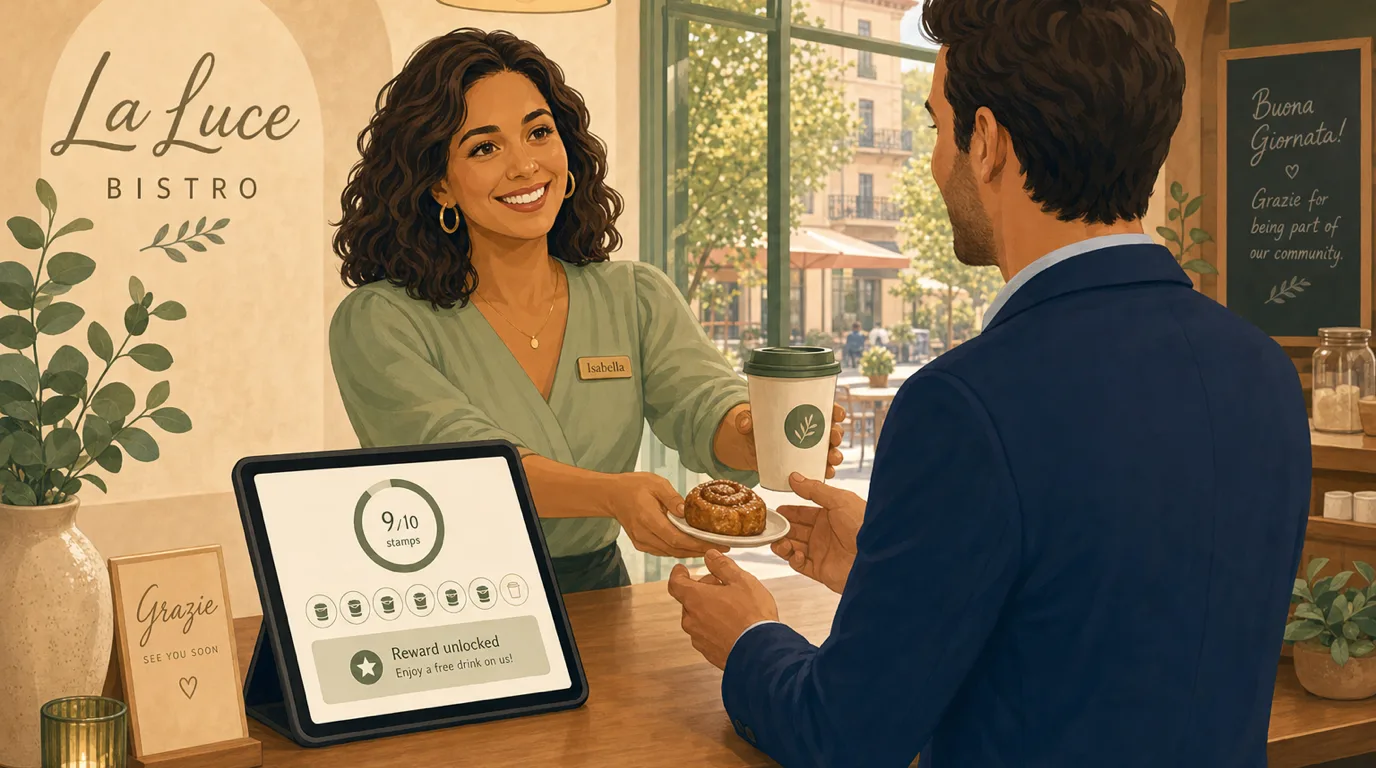
Buy nine, get the tenth. The oldest idea in the business, and for high-frequency spots it is still the best, because the loop is short and the guest can feel progress. A coffee shop, a salad place, a juice bar, a quick lunch counter: these live and die on frequency, and a visit-based reward speaks the language of frequency. The win over the paper version is that a digital one cannot be lost, cannot be forged with a borrowed stamp, and tells you who is on visit two and who is on visit eight. That last bit is gold, because the guest stuck on visit two is the one to nudge.
2. Points-based (rewards tied to spend)
Earn a point per dollar, cash points for rewards. This fits venues where the check size varies and frequency is lower, because the reward scales with what the guest actually spends rather than treating a 12 dollar lunch the same as an 80 dollar dinner. Points programs give you more dials to turn: bonus-point happy hours to fill a dead Tuesday, double points on a slow-moving high-margin category, a points multiplier for the first visit back after a long gap. The risk is complexity. The second a guest cannot tell you roughly how close they are to a reward, the motivation evaporates. Keep the conversion simple enough to say in one breath.
3. Tiered (status that people climb)
Bronze, silver, gold, or whatever you call it. Guests unlock better perks as they spend or visit more, and the climb itself becomes the motivation. Tiers work for venues with a real range of guests, from the occasional drop-in to the twice-a-week loyalist, because they let you reward the heavy user without overpaying the casual one. They also create a status game that some guests genuinely enjoy. The downside is that tiers are the most complex shape to run and explain, so do not reach for them until you have a base program working and enough volume to make the top tier feel exclusive rather than empty.
4. Paid membership (subscription loyalty)
The guest pays you, monthly or yearly, for a perk worth more than the fee. A daily coffee for a flat rate, a standing discount, members-only allocations at a wine bar, early access to a chef's table. This is the newest shape and the most demanding, because the perk has to be genuinely good and the brand has to be genuinely liked. When it works it is extraordinary: you get cash up front, a guaranteed-frequency guest, and a fan who feels like an insider. When it does not, you have sold a discount you now owe forever. Only attempt this if you already have a base of guests who would describe themselves as fans, not just customers.
Card-linked loyalty and the slow death of the punch card
The biggest shift of the last few years is not a new program shape. It is how the guest gets recognized. The old way put the work on the guest: download the app, make an account, remember to open it, let the cashier scan a code while a line builds behind them. Every one of those steps is a place where enrollment leaks and usage drops.
Card-linked loyalty removes the steps. The program attaches to the guest's payment card. They pay the way they always do, the system recognizes the card, and the visit credits automatically. Nothing to download, nothing to scan, nothing for the cashier to fumble during a rush. For the guest the whole thing is invisible, and invisible is exactly why it gets used. You are not asking anyone to change their behavior; you are rewarding the behavior they already have.
The honest tradeoff is permission. When a guest signs up through an app, they hand you an email and a marketing opt-in. Card recognition alone does not. So the practical pattern most operators land on is to recognize the card automatically for earning and redemption, then offer an optional email or phone opt-in for the marketing layer, framed as a benefit ("want your receipt texted, and the occasional heads-up on members nights?"). You get the frictionless enrollment and a path to a real marketing channel, without forcing the guest through a signup wall before they have tasted anything.
The enrollment problem, which is where most programs quietly die
Here is the uncomfortable truth nobody puts in the sales deck. The software is almost never the reason a loyalty program fails. Enrollment is. A program with brilliant rewards and three percent of guests enrolled is worse than a plain one that half the room is signed up for, because loyalty is a numbers game and you cannot grow a list of nobody.
Most programs leak at the same spot: the ask. Either the team forgets to make it, or the signup takes too long, or both. A guest who is asked to scan a QR code, install an app, set a password, and verify an email before they get a single point will, reasonably, decline. So will the next forty guests. The line behind them will not wait for that ceremony either.
The fix is not technology, it is choreography. Make the ask take five seconds and put it in the natural pause while the card processes. "Want me to add that to rewards? You are already halfway to a free one" works better than any poster, because it is specific, it implies progress, and it comes from a human at the exact moment of payment. Train it like you train upselling a side. Track it like you track covers. Some operators put enrollment on a small whiteboard in the back and the number climbs because the team can see it. The feature in your POS is the easy part. The staff habit around it is the whole game.
One more enrollment lever that costs nothing: a reason to join before they have spent enough to care. A small instant perk for signing up (a free drip coffee, ten percent off today, a free side) converts far better than "start earning toward a reward you will see in two months." People discount the future heavily. Give them a little now.
Designing rewards that do not quietly bleed your margin
This is the section most articles skip, and it is the one that decides whether your program makes money or loses it. A loyalty reward is a discount with a delay. The delay buys you visits; the discount costs you margin. Your job is to make sure the visits are worth more than the margin, and to make sure you are not stacking giveaways without noticing.
Start by sizing the reward against lifetime spend, not against the single visit it lands on. A free 12 dollar entree feels expensive in the moment. But if the guest had to spend 250 dollars across nine visits to earn it, that reward is under five percent of what they gave you, and those nine visits would not all have happened without the pull of the tenth. Sized that way, loyalty is one of the cheapest discounts in the building. Sized carelessly, where a guest can earn a big reward fast and then leave, it is a leak.
Reward high-margin items, not your loss leaders. A free coffee costs you cents. A free bottle of wine costs you real money and trains the guest to wait for it. Steer the reward toward things with fat margins (drinks, sides, desserts, that high-markup specialty item) so the perceived value to the guest is high and the actual cost to you is low. The gap between perceived and real value is where a good program lives.
Then watch the stack. This is the silent killer. A guest can walk in with a loyalty reward, hit happy hour pricing, flash a birthday freebie, and have arrived via a third-party promo, and suddenly you are handing them an 18 percent discount nobody decided to give. Set rules in the system about what can combine with what. Cap the total. Your POS should enforce this so a well-meaning server cannot accidentally give the farm away on a Friday. If you take one thing from this section: budget the reward as a line item, and audit the stack monthly the way you audit comps.
The data you finally get (and what to do with it)
Even if a loyalty program never moved a single extra visit, it would still earn its keep for the data alone. The moment guests are recognized at checkout, your sales stop being anonymous. You go from "we did 312 covers" to "we did 312 covers, 41 percent of them were known guests, and here is how often each of them comes and what they order." That is a different business.
With that data you can finally answer questions that used to be guesswork. Who is slipping away? A guest who came weekly for a year and has not been in for three weeks is a churn signal you can act on with a single text before they become a former regular. Who is your most valuable guest, really? Not the big one-time spender, but the steady twice-a-weeker whose annual value dwarfs them. What does a lunch guest never realize you do? Maybe they have never seen the dinner menu, and one targeted message fixes that.
This is also where loyalty stops being a standalone gadget and becomes part of a guest marketing system. The richest version connects loyalty to your wider guest data and CRM so that recognition, spend history, and messaging all read from one place. A guest who orders through your online ordering and e-menu is the same guest who sits at table nine on Saturdays, and the program should know that. Split that identity across systems and you are back to guessing.
Common mistakes that turn loyalty into a liability
The fastest way to learn what works is to look at how programs fail, because they fail in the same handful of ways.
Rewarding loyalty you already had. Giving your three-times-a-week regular a freebie for behavior they were doing anyway. You spent margin and changed nothing. Aim the program at the guest who could come more, not the one who already maxed out.
A reward so distant nobody chases it. If the payoff is forty visits away, the guest forgets the program exists by visit three. Keep the first meaningful reward close enough to feel reachable, then add longer-horizon perks on top.
Making signup a project. Covered above, but it bears repeating because it is the number one killer. Every extra step in enrollment cuts your list roughly in half. Five seconds or you have lost them.
Launching and walking away. A loyalty program is not a slow cooker. The programs that grow have someone watching enrollment weekly, refreshing the rewards quarterly, and pruning the giveaways that are not pulling their weight. Set it and forget it becomes set it and bleed it.
Discount theater. If members only spend more because you bribed them, and they vanish the second the reward is claimed, you did not build loyalty. You trained people to wait for a sale. Real loyalty shows up as repeat visits after the reward, not a spike around it.
A 60-day rollout that survives a Friday rush
You do not need a six-month project. You need a tight plan and the discipline to not over-build. Here is a version that has worked across small groups and single venues alike.
Days 1 to 10: decide the shape and the math. Pick one of the four program types based on your real frequency and check size, not aspiration. Set the earn rate and the first reward, and size that reward against lifetime spend so you know exactly what margin you are committing. Write down the stacking rules: what can combine, what cannot, the cap. Boring, but this is the document that keeps you out of trouble in month six.
Days 11 to 25: build it into the POS, not beside it. Configure earning, redemption, and the enrollment flow inside the point of sale so it runs at the till with no extra hardware and no separate login. Set the stacking rules in the system so they are enforced automatically. Test it the way a real shift works, mid-rush, with a new server, not in a quiet back office where everything looks easy.
Days 26 to 40: train the ask and launch soft. The reward design is done; now drill the five-second enrollment line until the whole team can say it without thinking. Launch quietly to existing regulars first, the people who already love you, so your earliest members are your best guests and your earliest data is clean. Give a small instant perk for joining so the list grows from day one.
Days 41 to 60: measure, then tune. Now you have real numbers. Compare members to non-members on frequency, check size, and retention. Look at enrollment rate by server and by daypart and coach the gaps. Kill any reward that is being claimed but not driving return visits. Only once the base is humming should you consider adding tiers or a paid layer on top.
How to know it is actually working
Member count is a vanity number. A list of ten thousand people who signed up once and never returned looks great on a slide and means nothing. The numbers that matter compare your enrolled guests to everyone else, tracked over time.
Watch three. Frequency: do members visit more often than non-members, and is that gap widening? Average check: do members spend the same or a little more per visit, without you having to discount them into it? Retention: are members still showing up 90 days later at a higher rate than non-members? If all three move the right way, the program is doing its job, and the margin you hand back in rewards is buying real, repeat revenue.
If members spend more only inside the discount and disappear after, you have a sale dressed up as loyalty. Fix the reward design before you fix anything else. And if enrollment is stuck, the problem is almost never the software; it is the ask at the counter. Go watch a few shifts. The truth is always at the till.
A restaurant loyalty program is not a magic app you bolt on and forget. It is a deliberate trade: a slice of margin, given on purpose, to the guests who pay your bills, in exchange for them coming back more often and telling you who they are. Build it into the system you already run, keep the ask short, protect the margin, and watch the gap between members and everyone else. That gap is the whole point, and it is the cheapest growth you will find this year.
Read next: Restaurant CRM: The 2026 Guide to Guest Data, Lifetime Value and Marketing Automation (with Free CLV Calculator) and Restaurant Marketing: The 2026 Playbook for Filling Tables and Restaurant Table Turnover: The 2026 Guide to More Covers Without Rushing Guests.