Almost every restaurant owner meets PCI compliance the same way: a line item on the merchant statement labelled non-compliance fee, 30 dollars a month, appearing without explanation. Someone calls the processor, gets told to complete a questionnaire, opens a 300-question PDF written for banks, and closes it again. The fee keeps coming. That is the state of PCI in hospitality, an annual obligation that most operators either ignore or fake, right up until a card breach makes it the only thing anyone wants to talk about. It does not have to be that heavy. For most restaurants the honest answer is a questionnaire with roughly 30 questions, a handful of network settings, and a payments setup that keeps card data out of your building in the first place. If your restaurant payment processing encrypts inside the terminal, you have already done the hardest part without knowing it.
This guide explains what the standard actually requires, which questionnaire applies to your setup, how to shrink what you are responsible for, what to ask your vendors, and what non-compliance really costs when something goes wrong. The single largest factor is architectural rather than procedural: how your restaurant POS system and terminals handle card data determines whether compliance is a short annual form or a genuine project.
What PCI DSS is, and who is actually enforcing it
PCI DSS stands for Payment Card Industry Data Security Standard. It is a set of technical and operational requirements for anyone who accepts, processes, stores, or transmits payment card data. The current version is 4.0.1, and the requirements that were phased in under version 4 became mandatory on 31 March 2025, so there is no longer a grace period to point at.
Here is the part that confuses people: PCI is not a law and no government agency enforces it. It is a contractual standard created by the card brands, Visa, Mastercard, American Express, Discover, and JCB, and it reaches you through the merchant agreement you signed with your acquiring bank or payment processor. That contract is why compliance is not optional even though no inspector will ever knock. Your acquirer can fine you, raise your rates, or terminate your ability to take cards.
Several countries have layered real law on top. In the EU and UK, a card breach is also a personal data breach under GDPR, with a 72 hour notification duty and penalties in an entirely different weight class. In the US, most states have breach notification statutes, and a few write PCI directly into law. So the practical position is that PCI is contractual, but its consequences are frequently legal.
Your merchant level determines how you prove compliance. Level 4, under roughly 20,000 e-commerce transactions or under 1 million total card transactions per year, covers the overwhelming majority of independent restaurants and small groups, and it means an annual self-assessment questionnaire signed by you. Level 1, above 6 million transactions annually, means an on-site audit by a Qualified Security Assessor. If you run under a dozen locations, you are almost certainly Level 4, and this is a paperwork and configuration exercise rather than an audit.
Why restaurants get hit more than most
Hospitality has been near the top of the card fraud statistics for two decades, and the reasons are structural rather than careless.
You take a very high volume of card-present transactions at small ticket values, which makes you attractive to criminals harvesting card numbers in bulk. You run a network that has to serve several different jobs at once: tills, kitchen displays, back office, reservations, music, cameras, and guest wi-fi, frequently through one router that was configured by whoever installed the internet. Staff turnover is high, so the number of people who have had physical access to your terminals in five years is large. Your equipment sits in a public room, unattended for parts of the day. And most restaurants have no IT function at all, which means nobody owns the router firmware, the till operating system, or the question of who still has a password.
The breaches that make the news are usually one of three things. Malware on the point of sale that scrapes card data from memory before it is encrypted, which is what happened to a long list of chains. Physical skimmers or swapped terminals installed in seconds by someone posing as a technician. Or an unpatched remote access tool, often the one your POS vendor uses for support, left with a default or shared password.
Notice that all three attack the same thing: the moment when readable card data exists somewhere you control. That observation is the key to making PCI manageable.
The twelve requirements, in restaurant English
PCI DSS has twelve top-level requirements grouped into six goals. Translated out of audit language, they say the following.
1. Install and maintain network security controls. Have a firewall between the internet and the devices that touch card data. Guest wi-fi must not be on the same network as your tills.
2. Apply secure configurations. Change every default password and setting on routers, terminals, and the POS itself. Default credentials remain one of the most common causes of a breach.
3. Protect stored account data. Do not store card numbers. If you genuinely must, they have to be encrypted, and the security code on the back can never be stored after authorisation, not even for a minute, not even in a note.
4. Encrypt data in transit. Card data crossing any open network must be encrypted with current protocols.
5. Protect against malicious software. Anti-malware on any general purpose computer in the payment environment, kept updated.
6. Develop and maintain secure systems. Install security patches. If you run an online ordering page, version 4 added specific duties around managing and monitoring the scripts running on your payment pages.
7. Restrict access by business need to know. The dishwasher does not need the till's manager menu.
8. Identify users and authenticate access. Individual logins, no shared accounts, and multi-factor authentication for any remote or administrative access. The single manager password taped inside the drawer fails this outright.
9. Restrict physical access. Control who can touch terminals, and inspect them for tampering.
10. Log and monitor access. Keep records of who did what on systems handling card data.
11. Test security regularly. Quarterly external vulnerability scans if you have internet-facing systems in scope.
12. Maintain an information security policy. Write it down, train staff annually, and have an incident response plan.
Read as a list it looks like a corporate IT programme. In a restaurant that has kept card data out of its own systems, most of these requirements are satisfied by the equipment you already bought, and your job is to confirm and document that rather than to build anything.
Which questionnaire applies to you
The self-assessment questionnaire, or SAQ, comes in several versions, and choosing the right one is the most valuable ten minutes in this entire process. The difference between the shortest and the longest is roughly 30 questions versus more than 300.
SAQ P2PE is the prize. It applies if you take payments only through hardware terminals that are part of a validated point-to-point encryption solution listed by the PCI Council. About 33 questions. Card data is encrypted inside the reader before your systems ever see it, so almost nothing in your restaurant is in scope.
SAQ B-IP applies to standalone, PTS-approved terminals connected over IP, with no card data stored electronically. Around 80 questions and very common for small independents.
SAQ C applies where a payment application on a connected system handles card data, the terminal talks through your POS, and nothing is stored. Around 160 questions. This is where a lot of restaurants land by default.
SAQ A applies to card-not-present business only, with all payment functions fully outsourced to a compliant third party. If your online ordering redirects to a hosted checkout, this covers that piece.
SAQ A-EP applies to e-commerce where your own site does not receive card data but does influence the payment page, for example an embedded iframe under your control.
SAQ D is everything else, and it is long. If you are told you need SAQ D, treat it as a signal to change your setup rather than to start filling in forms.
Most restaurants take payments in more than one channel: in-person terminals, online ordering, and phone reservations that take a card to hold a booking. Each channel gets assessed, so you may complete more than one questionnaire. The phone channel is the one operators forget, and it is often the worst offender.
Shrink the scope before you fill in anything
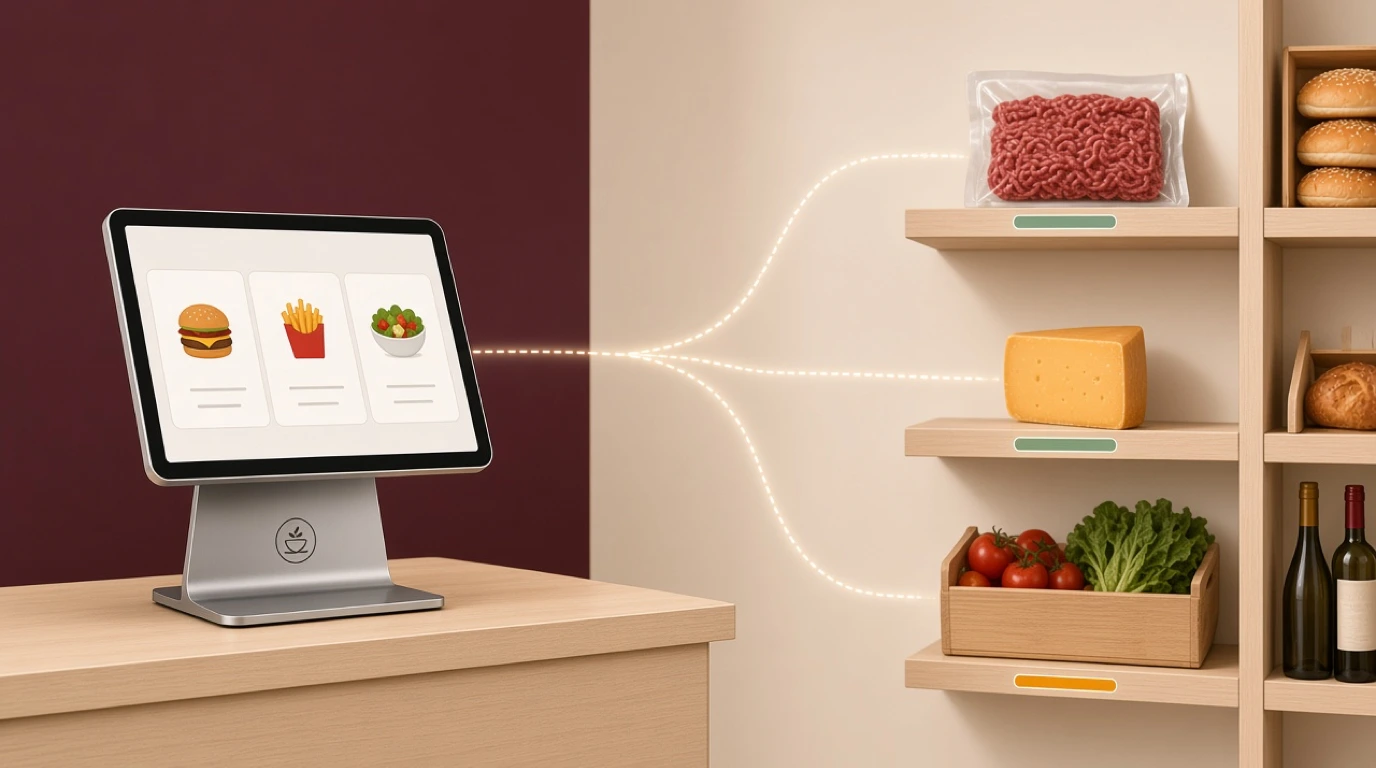
The central insight of modern PCI is that the standard applies to systems that store, process, or transmit card data. Remove card data from a system and that system leaves scope. Do that thoroughly and the annual exercise shrinks from a project to a form.
Point-to-point encryption. With a validated P2PE solution, the card reader encrypts the data at the moment of the tap or dip, using keys your systems do not hold. What travels through your network and your POS is unreadable ciphertext. Your till, your router, and your back office all fall out of scope for the data itself. Ask specifically for a solution listed as validated by the PCI Council, because plenty of vendors describe their encryption as end to end without holding that listing.
Tokenization. Instead of a card number, your system stores a meaningless token that only your processor can map back. This is what makes saved cards for regulars, bar tabs, no-show protection, and subscription memberships safe to operate. The card number never lives in your database.
EMV and contactless. Chip and contactless transactions cannot be cloned the way magnetic stripe data can. Beyond security, EMV matters commercially because of the liability shift: for card-present fraud, whichever party has the less secure technology absorbs the loss, so a restaurant still swiping stripes is choosing to own chargebacks it could have pushed back.
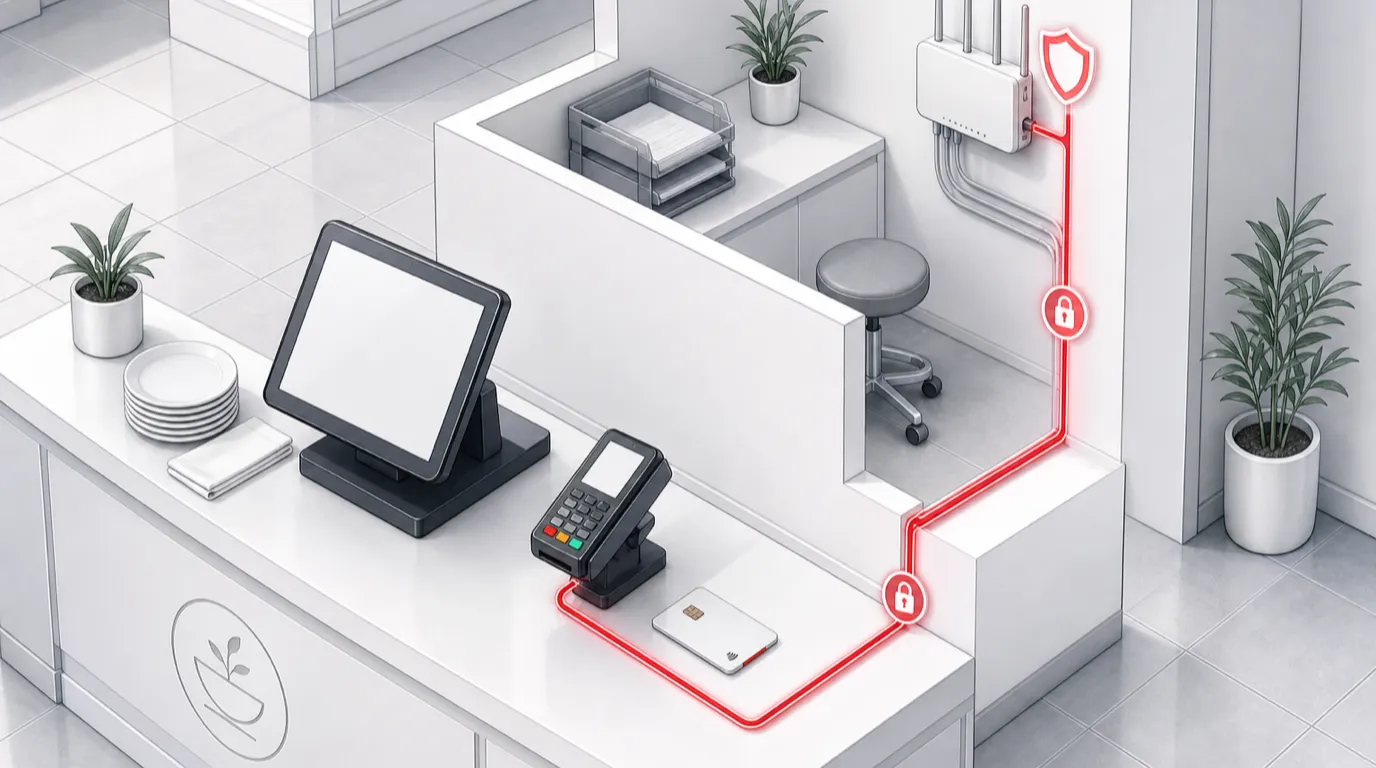
Network segmentation. Put payment devices on their own network segment, separated from guest wi-fi, cameras, music, and the office computer. This one change limits both your scope and the blast radius of anything that goes wrong elsewhere.
Get those four right and a restaurant that was staring at SAQ C or D can often complete SAQ P2PE or B-IP instead. That is the difference between an afternoon and a consultant's invoice.

What to ask your POS vendor and your processor
Vendors will tell you their product is PCI compliant. That phrase does not mean much on its own, because compliance is a property of your whole environment, not of a box. Ask harder questions and get the answers in writing.
Is your payment solution listed as a validated P2PE solution by the PCI Council, and can you send the listing reference? Which SAQ type does your recommended setup allow me to complete? Are card numbers tokenized, and where does the token vault live? Does any card data pass through or rest on hardware inside my restaurant? How do you handle remote support access, and is it multi-factor with individual accounts rather than a shared password? How are software and operating system patches delivered, and what is the schedule? Will you provide an Attestation of Compliance for your service provider role? What happens to stored payment data if I leave you?
Two answers should worry you. A vendor that cannot say which SAQ their setup supports has not thought about your obligations. And a vendor that maintains a permanent remote access tunnel with a shared credential is describing the most common breach vector in the industry.
Ask your processor separately what they charge for non-compliance, whether they include a compliance portal and quarterly scanning, and whether they offer breach cost coverage. Many bundle a scanning vendor at no extra charge, and operators pay for it twice simply because nobody asked. It is also worth reading how the provider handles data security and hosting more broadly, since the same practices that protect card data protect your guest and sales data.
The network nobody looks at
In most restaurants the weakest link is a router in a cupboard behind boxes of napkins, installed years ago, running whatever firmware shipped on it, with a password on a sticker.
Fix the obvious things. Change default administrator credentials on the router, the access points, and every terminal. Update firmware, then diarise it quarterly. Put guest wi-fi on a genuinely separate network rather than a differently named password on the same one, and never let a payment device sit on the guest network. Turn off remote administration from the internet unless you have a reason for it. Keep a written inventory of every device that touches payments, including tablets and handhelds, because you cannot secure what nobody has listed.
Pay attention to the back office computer. It is usually the oldest machine in the building, it is used for scheduling, invoices, email, and personal browsing, and it frequently sits on the same flat network as the tills. If a member of staff opens an infected attachment on that machine and your tills are one hop away, the network has done nothing to help you. Segment it or replace it.
Old operating systems deserve their own mention. Point of sale terminals running Windows versions that stopped receiving security updates years ago are still remarkably common in hospitality, and no amount of paperwork makes them compliant. If your POS vendor still ships on an unsupported operating system, that is a reason to change vendor, not a reason to write a compensating control.
Staff, skimmers, and the phone order problem
Requirement 9 covers physical security, and in a restaurant it translates into a short routine that actually works.
Keep a device inventory with make, model, and serial number, and inspect terminals against it. A weekly look for mismatched serials, unfamiliar attachments, loose casings, or new cables takes two minutes and catches the overwhelming majority of skimming attempts. Train staff that nobody touches, swaps, or services a terminal without a scheduled appointment that a manager has verified by calling the vendor on a known number. Attackers dressed as technicians are a documented and effective method precisely because hospitality staff are trained to be helpful.
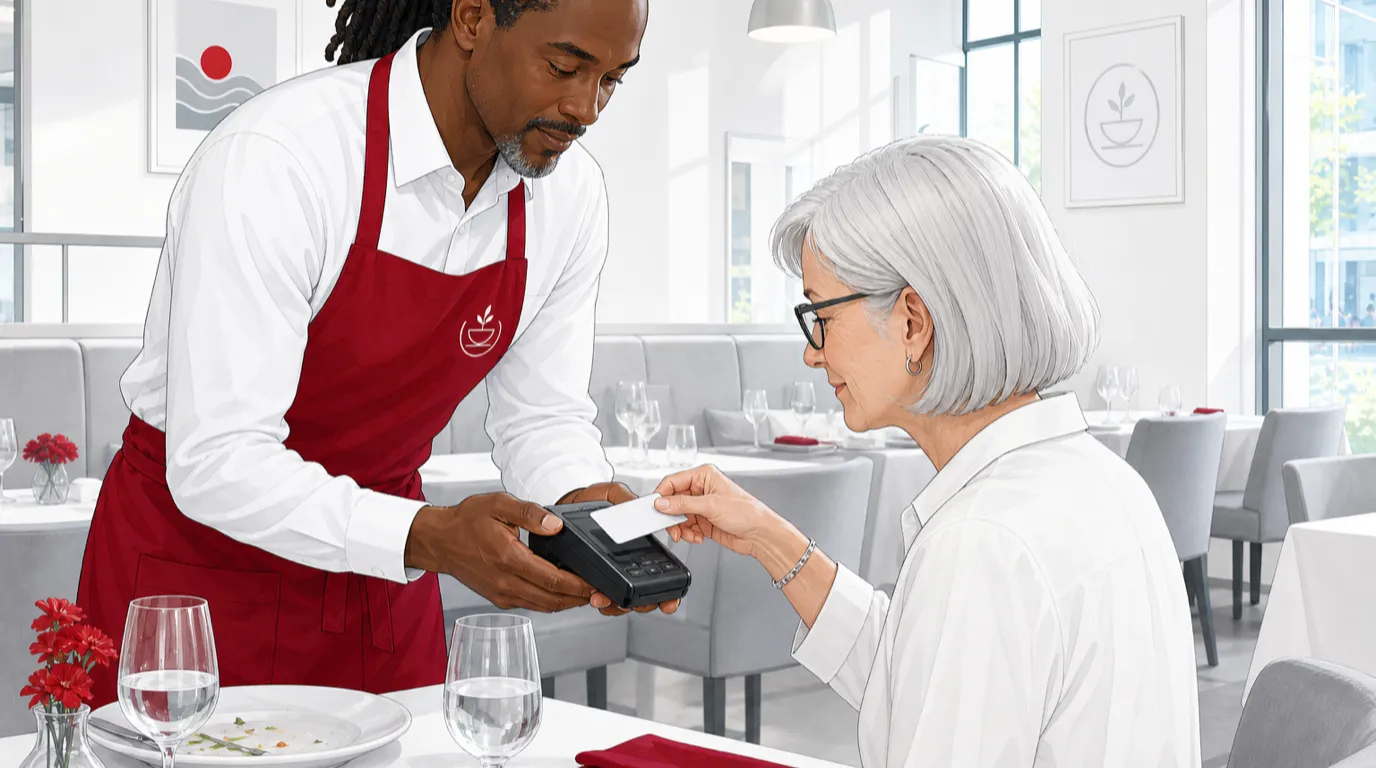
Pay at table matters here too. Handing a customer a wireless terminal instead of walking their card away removes an entire category of risk, including staff-side skimming, and guests read it as professionalism rather than suspicion.
Then the phone problem. Restaurants take card numbers over the phone constantly, for large bookings, deposits, catering, and no-show protection, and the number gets written on a reservation sheet, typed into a booking note, or repeated aloud across a room with a camera in it. Written card numbers in a diary are a PCI violation and a genuine liability. Storing the three digit security code after authorisation is prohibited outright, with no exception. Replace the practice: send a secure payment link, use a hosted pre-authorisation from your booking system, or tokenize the card at the moment it is taken. This single change removes more real risk in most restaurants than everything else on the list.
Annual security awareness training is also a requirement, and it need not be elaborate. Fifteen minutes at a staff meeting covering skimmers, never sharing logins, never writing card numbers down, and who to tell immediately if something looks wrong, then a signed attendance sheet, satisfies both the standard and common sense.
What non-compliance actually costs
The visible cost is small, which is exactly why it gets ignored. Processors charge a non-compliance fee of roughly 20 to 50 dollars a month, so an operator who never completes the questionnaire pays maybe 400 dollars a year and treats it as a nuisance line item.
The cost after a breach is a different category entirely. Card brand assessments passed through your acquirer commonly run from 5,000 to 100,000 dollars, scaled by volume and by how long the exposure lasted. A forensic investigation by an approved investigator is mandatory above certain thresholds and typically costs 10,000 to 50,000, payable by you. Then come card reissuance costs billed back per card, fraud losses, and the operational cost of your terminals being restricted while it is sorted out. In the EU and UK, add a GDPR notification obligation within 72 hours and the regulatory exposure that follows.
Cyber liability insurance is worth having, and it is worth reading. Many policies contain a condition requiring PCI compliance, which means an insurer can decline a claim from a merchant who signed an attestation that was not accurate. An untrue self-assessment is worse than no self-assessment, because it converts a technical failure into a documented misrepresentation.
There is a quieter cost as well. A breach at a neighbourhood restaurant is local news, and the trust that took years to build with regulars does not survive a letter from their bank explaining where their card was compromised.
The annual routine, and what to do this week
Once your setup is right, staying compliant is a short recurring cycle. Annually: complete the correct SAQ, sign the Attestation of Compliance, upload it to your processor's portal, review and update your security policy, and run staff training. Quarterly: run external vulnerability scans through an Approved Scanning Vendor if you have internet-facing systems in scope, check firmware and patches, and review who has access to what. Weekly: inspect terminals against your device inventory. Whenever staff leave: remove their accounts the same day, which is the control most restaurants fail on and the easiest one to fix.
If you are starting from nothing, work in this order. Call your processor and ask which SAQ they have you down for and whether your terminals are part of a validated P2PE listing, since that one call may collapse the whole exercise. Write the device inventory. Separate guest wi-fi from payment devices. Change default passwords everywhere and give every person their own login. Stop writing card numbers on paper and set up payment links or tokenized holds instead. Then complete the questionnaire honestly, and treat any question you cannot answer truthfully as a task rather than a box to tick.
Done in that order it is an afternoon of work and a genuinely lower risk profile, rather than a filing exercise that protects nobody. The restaurants that get hurt are rarely the ones that read the standard and found it difficult. They are the ones that signed the form without reading either.
Read next: handling restaurant chargebacks, payment processing fees, and going cashless.