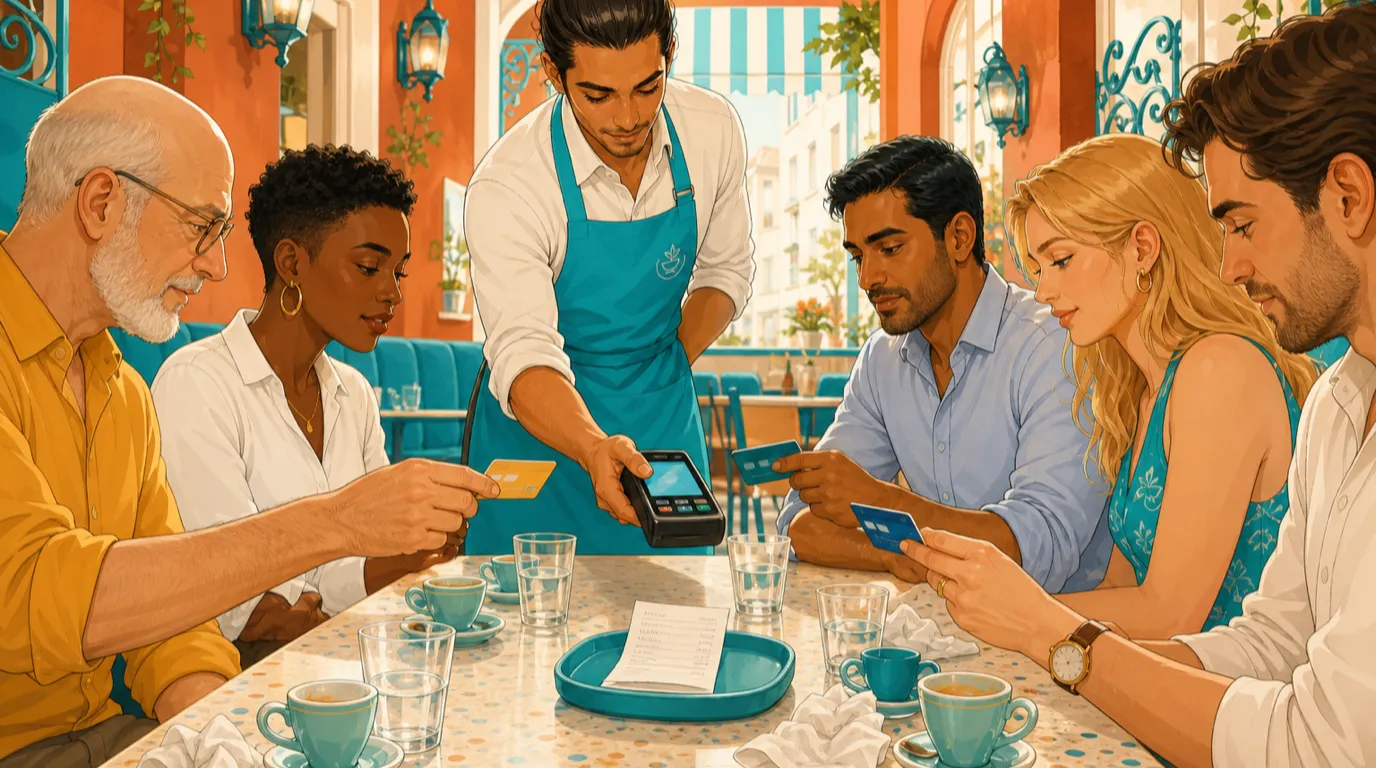
Ask an operator what splitting the bill costs them and you will get a confident answer about card fees. It is usually wrong. The arithmetic is simple enough to settle in one line, and for most independent venues in Europe the answer is that splitting a bill across eight cards costs exactly the same as taking one payment, to the cent. Whether that is true for you depends on a single detail of your restaurant payments contract, and you can check it in about ninety seconds. The real cost of splitting sits somewhere else entirely, and it is bigger than the fees.
What splitting actually costs you is time at the worst possible moment, and the integrity of your own numbers. A four-way split at 9:40pm on a Saturday occupies a terminal and a member of staff while three other tables want to leave. Done carelessly, it also quietly corrupts your average check and your covers count, which then misleads every labour decision you make from those figures. That part is a restaurant POS configuration question rather than a payments question, and almost nobody frames it that way.
Four ways to split, and they are not equivalent
Staff use one word for four different operations, which is where most of the mess starts.
Split by amount. One check, several payments. "Put 40 on this card and the rest on that one." Nothing changes about the order, the items or the reporting. This is the cheap one, and it is what most guests actually want.
Split evenly by cover. One check divided by the number of people. Still one check, still one set of items, just several payments of equal size. Also cheap.
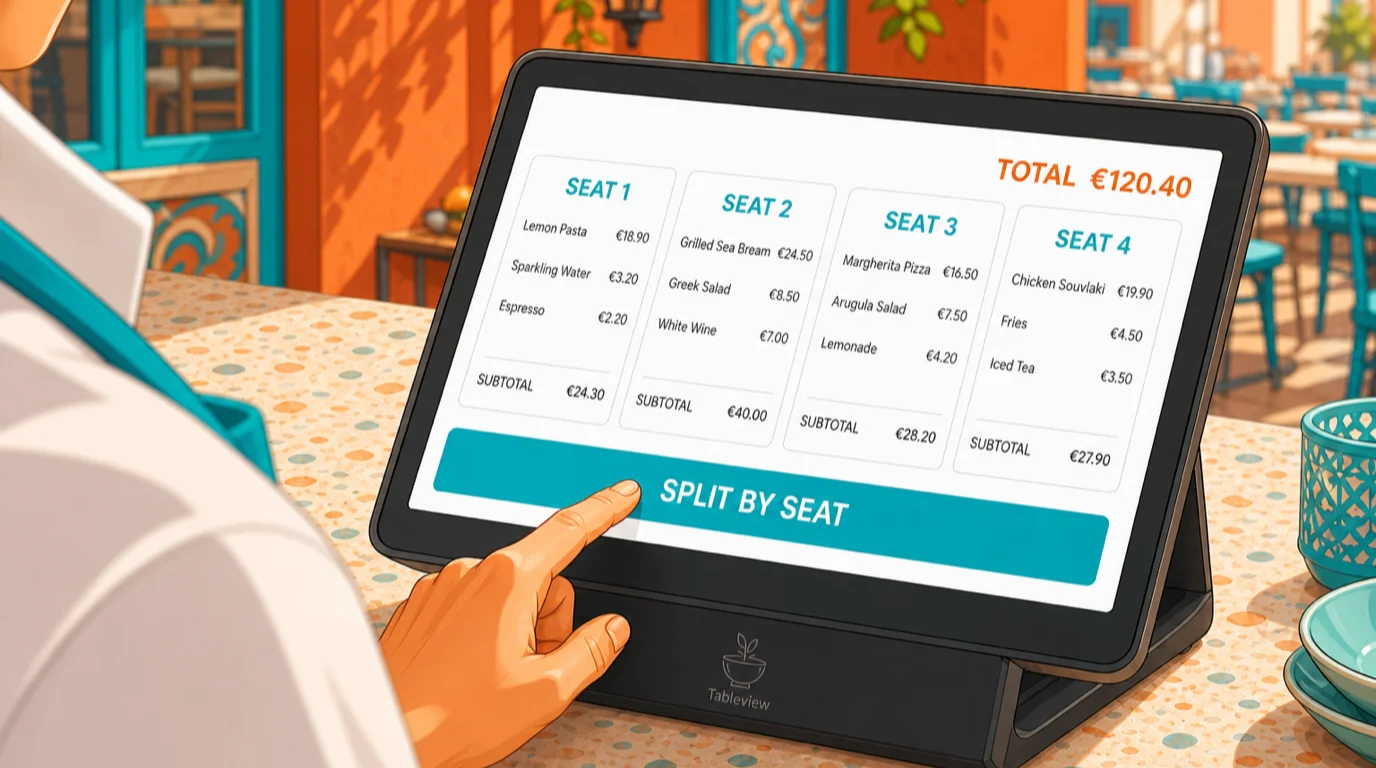
Split by item, or by seat. The check itself is broken into several checks, each carrying the items that person ordered. This is the expensive one, and not because of fees. It changes your data, it takes real time at the till unless the items were already assigned to seats when they were ordered, and it is where service charges and discounts get orphaned on the original check.
Moving items between checks. The manual repair job when somebody says "actually the wine was ours". Fiddly, error prone, and worth watching, because it is the same permission that lets somebody move an item off a check entirely.
The useful distinction to teach: are we splitting the payment or splitting the check? Splitting the payment is almost free. Splitting the check has consequences. Staff who understand that will reach for the cheap operation when the cheap operation is what the guest asked for, which is most of the time.
What splitting really costs in card fees
Card pricing takes one of two shapes. Either a straight percentage of the transaction value, or a percentage plus a fixed amount per transaction. Write it as a percentage r plus a fixed fee f, and the maths falls out immediately.
Splitting a bill of any size into n payments leaves the percentage component untouched, because a percentage of the parts equals the percentage of the whole. Only the fixed fee multiplies. So:
The extra cost of splitting is the fixed per transaction fee, multiplied by one less than the number of payments. Nothing else. Not the bill size, not your rate.
Which means the question "what does splitting cost me" has exactly one input: does your acquirer charge a fixed fee per transaction at all?
Plenty do not. SumUp's UK pay as you go pricing, as published in August 2026, is 1.69% with no monthly fee and no per transaction component. Take a 200 pound bill as one payment and you pay 3.38. Take it as eight payments of 25 and you pay eight lots of 42.25 pence, which is 3.38. Identical. Zettle and Square's in person rates are structured the same way. If that is your setup, every argument you have ever had about splitting being expensive was about something that costs zero.
Others do charge a fixed component, and there the effect is real. Stripe's in person rate for cards issued in the EEA is 1.4% plus 10 pence per successful charge. That same 200 pound bill costs 2.90 as one payment: 2.80 plus a single 10 pence. Split eight ways it costs 3.60, because the 10 pence lands eight times. Your effective cost of acceptance on that table rises from 1.45% to 1.80%, which is a 24% increase in what it cost you to get paid. Adyen publishes a fixed processing fee of 11 cents on every transaction, so seven extra payments adds 77 cents.
Rates move, and every one of those pricing pages is undated, so treat the numbers as illustrations and go and read your own statement. What you are looking for is a line that charges you per transaction rather than per pound. If it exists, splitting costs you something and you can now say exactly what. If it does not, the fee argument is over.
One thing that is not part of this: the EU interchange caps. Regulation 2015/751 limits interchange to 0.2% of the transaction for consumer debit and 0.3% for consumer credit. Both are percentages, so both are indifferent to how many payments you take. Worth remembering that interchange is only one of three components of what you pay, alongside the scheme fee and your acquirer's own margin, and that the caps do not cover commercial cards, three party schemes, or transactions where the card was issued outside the EU. The tourist paying with an American corporate card is outside all of it. There is more on how that bill is built in our guide to payment processing fees.
You almost certainly cannot charge for it
The obvious response to a per transaction fee is to pass it on. In Europe you generally cannot.
Article 62(4) of the second Payment Services Directive requires Member States to ensure that a payee "shall not request charges for the use of payment instruments for which interchange fees are regulated" under the interchange regulation. Consumer debit and consumer credit cards are exactly those instruments. Where a charge is permitted at all, Article 62(3) caps it at the direct costs you actually bear.
Germany wrote this into section 270a of the civil code, which makes an agreement obliging the payer to pay a fee for using a card ineffective, limited to consumer transactions within the scope of the interchange rules. The UK went further than the EU floor when it amended the payment surcharge regulations in January 2018: the prohibition there is framed as a payee not charging a payer, rather than a trader not charging a consumer, and it extends past cards to some non card instruments.
Whether a fee described as being for the service of splitting, rather than for the payment method, escapes the prohibition is a genuine legal question and not one to resolve from a blog post. The prohibition bites on charges for the use of a payment instrument, and a fee that appears only when a second card comes out looks a lot like one. If you are seriously considering it, that is a conversation with a lawyer in your own market, not a policy to roll out on a Friday.
And a card minimum is a different mistake
Minimum card spends are not surcharges and are not caught by that prohibition. They are prohibited by something else: the card scheme rules you signed up to.
The Mastercard rules state that a merchant "must not require, or indicate that it requires, a minimum or maximum Transaction amount to accept a valid and properly presented Mastercard or Maestro Card." The Visa rules say a merchant "must not establish a minimum or maximum Transaction amount as a condition for honoring a Card." Both carve out a narrow exception for the United States and neither carves out Europe.
So the sign by your till saying "card payments over 10 euros only" is not illegal in the sense of breaking a law. It breaches your acquiring agreement, and the consequence comes from your acquirer rather than a regulator: fees, or in a bad case a suspended account. Worth knowing, because operators tend to assume the opposite, that a minimum is fine and a surcharge is the risky one. It is the other way round in terms of who comes after you.
There is an unresolved tension here that is fair to acknowledge. The interchange regulation's own recitals list restrictions on refusing cards for low amounts among the things that ought to be abolished, while the scheme rulebooks still prohibit minimums in their current editions. The legislature's stated intent and the live contractual rules point in different directions, and nobody has settled it.
Refusing to split, on the other hand, is your call
I could find no rule in any of the five big European markets that requires a restaurant to accept split payment, and none that forbids a splitting policy. "We can split up to four ways" is a legitimate house rule. So is "one bill for parties over eight, please sort it out between you".
Do not confuse that with itemisation, which is a different duty. In France, an order dating back to 1983 requires a note for any service of 25 euros or more, delivered before payment and carrying an itemised breakdown by quantity and price, and below that threshold it must still be given if the customer asks. That is a right to an itemised bill, not a right to a separate one. The two get conflated constantly.
If you do run a policy, put it where people see it before they order rather than when they ask for the bill. A splitting limit discovered at the end of a birthday dinner is a bad end to an otherwise good evening, and it is the sort of thing that turns into a review.
The damage you do to your own numbers
This is the part that actually costs money, and it is the same mechanism that makes miscoded voids and comps inflate your food cost.
Average check, in standard POS reporting, is net sales divided by the number of checks. Average party size is covers divided by checks. Both denominators are check counts. So if splitting a table of four by seat produces four checks rather than one, your reported average check on that table falls by roughly three quarters and your average party size falls to one, while precisely nothing has changed about what you sold or how many people ate.
Do that across a busy Saturday and the aggregate moves. Your average spend per check drifts down, month on month, for reasons that have nothing to do with pricing or with what guests are ordering. If you are benchmarking average check against last year, or worse, setting targets on it, you are measuring the popularity of splitting. That matters beyond one metric, because average spend feeds most of the restaurant KPIs operators actually steer by.
The covers figure has a second failure mode that is worse because it is silent. Where staff do not enter a guest count, systems commonly fall back to the number of seats at the table. A party of three on a table laid for four gets recorded as four covers. Combine an unentered cover count with checks multiplying through seat splits and your sales per cover, your covers per labour hour and any staffing model reading them are all working from fiction. The kitchen gets prepped for a volume that never existed.
None of this is measured in published research, so take it as a mechanism to go and test rather than a finding. The test is easy: pull last Saturday, compare your check count against your actual number of tables served, and see whether the two agree. If your check count is materially higher, you now know why your average check has been sliding.
The fix is at the point of order, not the point of payment
Splitting is painful at the till because the information needed to split was never captured. Nobody recorded who ordered the sea bass.
Seat or position based ordering is the upstream answer. Items are assigned to a seat number as they are rung in, so a split by seat is a button rather than an archaeology exercise. It costs a little discipline at the point of order and it removes almost all of the cost at the point of payment, which is the trade you want, because the point of order is not the moment when three tables are waiting to leave.
Two details worth demanding of any system. First, whether a seat split creates new checks or merely splits the payment against one check, because as covered above that determines whether your reporting survives. Second, what happens to a service charge or a discount applied at check level when the check is divided, since the common behaviour is that it stays put on the original and has to be moved by hand. That is a reconciliation trap and a small theft opportunity at once.
Receipts, and the paperwork nobody warned you about
In several European markets each recorded transaction carries its own fiscal footprint, so the number of payments is not purely an internal matter.
In Germany, every recordable transaction has to be recorded individually and protected by a certified technical security device, and a receipt must be issued in immediate connection with the transaction. The required receipt content includes a transaction number, the serial numbers of the recording system and the security module, and a signature counter. Eight payments therefore produce eight signed fiscal records rather than one. There is a draft law from June 2026 that would remove the issuance obligation where a receipt total does not exceed 30 euros, which would flip the position entirely and make a split bill generate fewer receipt obligations than a single one. It is a draft and drafts change, so treat it as something to watch rather than plan around.
In Italy, every payment terminal has had to be logically linked to the till since operations from January 2026, with the linking service opening in March 2026, and the till must record the composition of payment methods. Whether several payments against one table should produce one commercial document with several payment lines or several documents is not something I could settle from a primary source, and the penalties for getting the payment method recording wrong are real. Ask your accountant rather than guessing.
In Spain, the invoicing software rules were pushed back again: businesses filing corporate income tax have until 1 January 2027 and everybody else until 1 July 2027, under a decree law of December 2025. Software producers were already bound from July 2025. This matters here mostly as a warning, because a great deal of published material still prints the old 2026 dates.
France makes the same point twice over. Systematic printing of till receipts ended in August 2023, but restaurant bills and services of 25 euros or more were carved out and must still be produced. And the certification regime for till software was abolished in February 2025, then partly restored in February 2026. Anything you read about French till compliance written between those two dates is now wrong. Check the date on the page before you act on it, including this one.
Some markets already moved the split off your books
The most interesting thing about splitting in Europe is how differently it lands market to market, and how completely some countries have solved it without involving the restaurant at all.
The Netherlands is the clearest case. More than 170 million payment requests went through Tikkie in 2025, worth 8.5 billion euros, in a country of about 18 million people, with over 10 million users. The average request was 50.03 euros and the single most common description on them was food, appearing on roughly six million requests. Read that as a nation that settles the restaurant bill among themselves on the pavement outside. Sweden looks similar through Swish, with 1,135 million payments in 2025 and 8.8 million users, of which a bit over 40% remain person to person.
Germany and Austria sit at the other extreme of expectation, where "zusammen oder getrennt" is asked as a matter of course and paying separately is entirely normal rather than a favour. France, Italy and Spain lean the other way, with one bill for the table as the convention. I want to be honest that this last part is described convention rather than measured fact: I could not find survey data of any quality on it, and the one German figure that circulates is a self selecting newspaper web poll that should not be treated as research.
In fact, nobody appears to measure what proportion of restaurant bills get split, in any European market. If a supplier quotes you a number for that, ask where it came from.
Pay at table, and the tipping claim that does not hold up
QR and pay at table tools move the split to the guest's phone, which genuinely does take the operation off your staff. The claims made for them deserve more scepticism than they usually get.
One prominent European provider's marketing states time savings per table of six to ten minutes on one page and twelve minutes on another, and review uplifts of five times on one page and eight to ten times on another. No methodology, no sample, no control period, and the venues named are mostly American. When a vendor's own pages disagree with each other, the number is marketing rather than measurement.
The tipping claim is the one to be most careful with, because the independent research points the other way. A 2024 study in the Journal of Culinary Science and Technology found that consumers' intention to use QR codes was negatively associated with tipping. A separate study on screen based payment found tip prompts produced significantly more negative feeling than a tip jar and did not increase tip size where tips were solicited before service. Survey work in the Nordics found around three quarters of consumers felt digital tipping had a negative effect on their culture, with under 5% positive. Those studies have limits, mostly small samples and self reported intention, but they have methods, which is more than the vendor figures do.
Which does not mean do not use these tools. It means buy them for the labour saving and the table turn, which is a mechanism you can verify yourself in a fortnight, and treat any promised tip uplift as unproven.
What splitting does to tips and service charge
If you operate in the UK, the tipping rules changed on 1 October 2024 and splitting interacts with them in a way that catches people out.
The statutory code is explicit that the method of payment does not determine whether a tip qualifies. But it also says an employer is likely to receive a tip paid by card or through an app or QR code, which makes it an employer received tip that you are then responsible for allocating fairly, with a written policy and three years of records. Cash a worker keeps with no employer involvement is out of scope, and so is app based tipping that bypasses the business entirely.
Put those together. Moving a table from cash to four card payments, or onto a pay your share flow that routes through your business, can pull tips that were previously outside the regime squarely inside it. That is not a reason to avoid card. It is a reason to know which side of the line your setup puts you on before somebody else works it out. Our piece on service charge versus tips goes into the allocation mechanics.
On service charge specifically: how a mandatory large party charge should be apportioned across split payments is not addressed by any source I could find, in any market. What is clear is the practical failure, which is that a check level charge tends to remain on the original check when the check is divided. Decide your own rule, write it down, and make sure the till enforces it rather than relying on whoever is on the pass.
A policy that survives a Saturday
Decide four things and you have covered nearly everything.
How many ways will you split, and does that limit change with party size? Pick a number you will actually honour rather than one that gets abandoned at the first large table.
Will you split checks, or only payments? If your reporting matters to you, default to splitting the payment and reserve check splitting for when a guest genuinely needs a separate itemised bill, which is rarer than the number of times it gets done.
Are seat numbers being used at the point of order on large tables? If not, that is the single change that removes most of the pain, and it is a training change rather than a purchase.
Where does the service charge go when a check divides? Answer it once, in writing.
Then go and check the one fact this whole article turns on. Open your last merchant statement and look for a per transaction charge. If it is there, you now know what splitting costs you and can decide what to do about it. If it is not, you can stop having the argument, and spend the attention on the check count instead, which is where the money actually leaks.
Read next: payment processing fees explained, how to increase average check, service charge versus tips, and improving table turnover.