Most restaurants pour their marketing energy into social media and treat email as an afterthought, which is backwards. Social platforms own your audience and decide how many followers ever see a post, and that share has been falling for years. Email is the one channel where you own the relationship outright: the list is yours, the inbox is direct, and nobody throttles your reach for not paying to boost a message. If you already capture customer details through your online ordering flow, you are sitting on the start of an email list that can quietly become the most profitable marketing you run. The problem is that almost nobody uses it well.
Here is the uncomfortable truth that makes email worth the effort: a repeat customer is far cheaper than a new one, and email is the best tool for turning a first-time guest into a regular. Every reservation, every takeout order, every loyalty signup is a chance to capture a contact and bring that person back on your schedule instead of waiting and hoping. Tie your guest data together through your restaurant POS and a single email can fill a slow Tuesday, move a seasonal menu, or recover a regular who drifted away. None of that depends on an algorithm, a paid boost, or luck.
This guide covers the whole thing from an operator's seat: why email outperforms social for restaurants, how to build a list the honest way, what to actually send and when, the handful of automated emails that do most of the work, how to write something people open, the deliverability and legal basics that keep you out of the spam folder and out of trouble, what to measure now that open rates are unreliable, and a 30-day plan to get started.
Why email still beats social for restaurants
The case for email comes down to one word: ownership. When you post on a social platform, you are renting access to your own followers, and the landlord keeps raising the rent by showing your posts to fewer people unless you pay. Organic reach on the big platforms has collapsed to a small fraction of your audience. Email reach, by contrast, is close to total: if someone is on your list and your deliverability is healthy, your message lands in their inbox. No middleman decides whether your regulars hear about Friday's special.
Then there is intent. A social follower might like your food; an email subscriber actively asked to hear from you and handed over a direct line. That permission is valuable, and it shows up in the returns. Email consistently posts the highest return on investment of any marketing channel, often cited well above every other option, because the cost to send is tiny and the audience is pre-qualified. For a restaurant running on thin margins, a channel that costs almost nothing to operate and reaches people who already want to come back is not a nice extra. It is the core.
This is not an argument to abandon social. Instagram and TikTok are excellent for discovery, for showing personality, for getting found by someone new. But discovery and retention are different jobs. Social finds you customers; email keeps them. The restaurants that grow steadily use social as the top of the funnel and email as the engine that turns attention into repeat visits.
Put a rough number on it. Say a neighborhood bistro builds a list of 2,000 opted-in guests and sends a Tuesday-night offer. If 35 percent open it and 4 percent of the whole list acts, that is 80 covers driven by one email that cost a few dollars to send. Run a comparable promotion to the same 2,000 people through a single social post and, at the organic reach the platforms now allow, maybe 100 to 200 of them ever see it, and far fewer act. Same audience, wildly different outcome, and the email list keeps performing every time you send while each post starts from scratch. That gap is the entire argument.
Building the list the right way
An email program is only as good as the list under it, and this is the step most restaurants skip or rush. The goal is a list of people who genuinely opted in, because a small engaged list beats a big bought one every single time. Buying or scraping addresses is the fastest way to torch your sender reputation and land in spam, and in many places it is illegal. Do not do it.
The good news is that a restaurant generates list-building moments all day. Online ordering and reservations already require an email, so the contact is right there; the only trick is making sure those addresses flow into your marketing list with clear permission rather than dying in an orders database. Loyalty signups are pure gold, since those guests are your most engaged. A QR code on the table, the menu, or the receipt that leads to a one-field signup form captures the people who loved the meal and are still sitting there. Your website should have a visible, simple signup, not buried in a footer nobody scrolls to. And your staff, trained to mention it in one natural line at the right moment, will out-collect any sign.
Give people a reason to join that is honest and immediate. A small welcome perk on the next visit, early access to a new menu, first dibs on event tickets. Avoid vague promises. The clearer and more concrete the reason, the higher your signup rate and, more importantly, the more those subscribers actually want what you send later. Quality of intent at signup predicts everything downstream.
What to actually send
Once you have a list, the question is what lands in those inboxes. The mix that works for restaurants is a blend of a few repeatable types. Not every one needs to go out constantly; think of them as a menu you draw from.
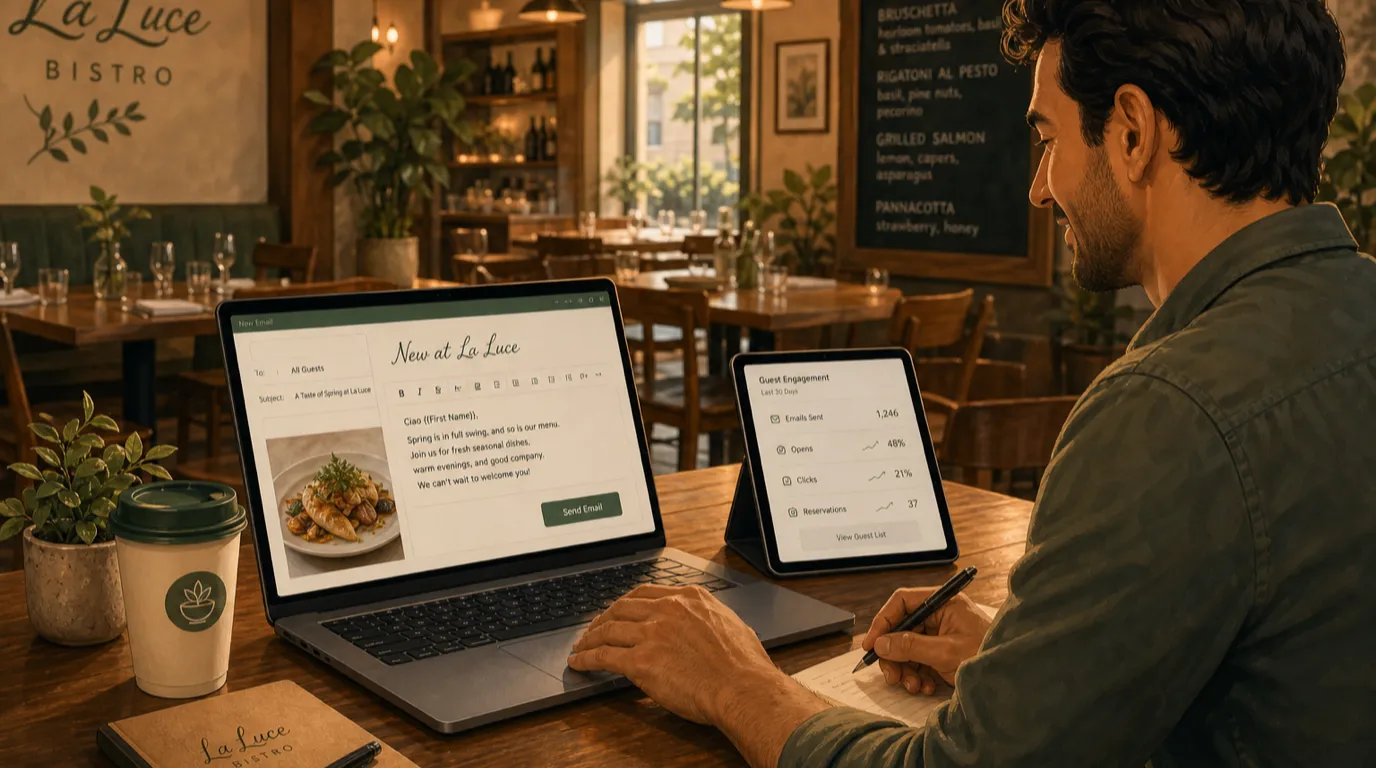
The welcome email is the most important one you will ever send, because it goes to someone at peak interest, the moment they joined. Thank them, set expectations for what they will get, and give them a reason to come in soon. The regular newsletter or update keeps you present: a new dish, a seasonal change, a story from the kitchen, an upcoming event. Keep it genuinely interesting, not a wall of promotions. Promotional sends drive a specific action, a slow-night offer, a holiday menu, a limited special, and they work best when used with restraint so they still feel special. Event invitations for wine dinners, tastings, live music, or holidays tend to get strong engagement because they offer an experience, not a discount. And post-visit or feedback emails can deepen the relationship and surface reviews, as long as they feel personal rather than automated nagging.
The throughline is value. Every email should be worth the half-second it takes someone to decide whether to open it. If your sends are nothing but coupons, people tune out and unsubscribe. Mix the useful and the human in with the promotional, and the promotional lands harder when it does come.
Segment so the right message reaches the right guest
Blasting one identical email to your entire list is leaving money on the table. The same message that excites a weekly regular bores a first-timer and annoys someone who has not visited in six months. Segmentation, splitting your list into groups and sending each what fits, is where email marketing gets genuinely effective.
You do not need anything fancy to start. A few segments cover most of the value: new subscribers who need a welcome and a nudge to return; regulars who deserve recognition and early access rather than discounts they do not need; lapsed guests who have not visited in a while and need a reason to come back; and high spenders or VIPs worth a more personal touch. If your systems track it, you can go further, by visit frequency, by order type, by what someone usually buys, but even four basic buckets will lift your results noticeably. The principle is simple: relevance drives action, and relevance comes from sending less to more specific people.
Let automation do the repetitive work
The highest-return emails in any restaurant program are usually the automated ones, the messages that trigger off a guest's behavior and then run themselves. Set them up once and they keep working while you run the floor.
Three flows earn their keep immediately. The welcome series fires when someone joins, ideally one to three emails over the first week or two that introduce the place and prompt a visit. The birthday or anniversary email sends a small treat timed to the guest's special date, and it converts unusually well because the timing and the gesture both feel personal. The win-back flow watches for regulars who have gone quiet, triggers after a set gap like 60 or 90 days, and gives them a reason to return before they are gone for good. These three alone recover and repeat business you would otherwise never see. You can layer in more over time, a post-order thank-you, a loyalty-milestone note, but start with the three that matter most and resist the urge to automate everything at once.
This is also where connecting your loyalty program to your email pays off. A guest's points, visits, and last-seen date are exactly the triggers good automation runs on, so the more your data lives together, the smarter and more timely your flows can be.
Writing emails people actually open
You can have the perfect list and the right message and still fail at the inbox if nobody opens the thing. A few fundamentals decide that.
The subject line does most of the work. Keep it short, specific, and honest; promise something real and deliver it inside. Curiosity helps, clickbait backfires the moment people feel tricked. The preview text, that snippet next to or under the subject in the inbox, is prime real estate most restaurants waste; write it deliberately to extend the subject, not repeat it. Your from name should be the restaurant, recognizable at a glance, because people open based on who it is from as much as what it says.
Timing and frequency matter too, though less than people obsess over. Send when your guests are likely to be thinking about food or plans, which for many restaurants means late morning or early evening, but test it against your own audience rather than trusting a generic chart. On frequency, land between twice a month and weekly for most independents, and let your engagement and unsubscribe numbers guide adjustments. Consistency beats volume: a reliable, genuinely useful email every other week builds more goodwill than a daily barrage nobody asked for.
Design for the phone, and keep it simple
The large majority of your emails will be opened on a phone, so design for the small screen first. A single clear call to action beats five competing ones; decide the one thing you want the reader to do, book, order, RSVP, and make that button obvious. Use your real photography, because good food images are the most persuasive thing a restaurant has, and a phone screen makes a great shot look great. Keep the text tight. Nobody reads a long essay in a promotional email; they skim, so write for skimming with short blocks and an obvious next step.
Resist the cluttered template. A clean email that loads fast and reads in five seconds will always beat a busy one stuffed with everything you could think to include. White space is not wasted space; it is what makes the one thing you want noticed actually get noticed.
Deliverability and the legal basics
None of this matters if your emails land in spam or get you a fine, so spend a little care here. Deliverability, whether your email reaches the inbox at all, depends mostly on sending wanted email to people who engage with it. Authenticate your domain (the technical setup known as SPF, DKIM, and DMARC) so mailbox providers trust you; a reputable email platform walks you through this. Keep your list clean by removing addresses that never open or that bounce, because a list full of dead contacts drags down your reputation for everyone else. And never send to people who did not opt in, which is the single biggest deliverability killer.
On the legal side, the rules vary by region but the spirit is consistent: permission, transparency, and easy exit. Only email people who agreed to hear from you. Always identify your business clearly and include a real physical mailing address. Make the unsubscribe link obvious and honor opt-outs quickly. In the United States the governing law is CAN-SPAM; in Europe and the UK, GDPR and PECR demand clearer, opt-in consent; Canada's CASL is stricter again. If your guests span regions, hold yourself to the strictest standard, explicit opt-in with records of consent, and you will be covered everywhere. This is not the place to cut corners; the goodwill and the deliverability you protect are worth far more than the shortcut.
What to measure now that open rates lie
Open rate used to be the headline number, but privacy features that auto-load images have inflated it to the point where you cannot fully trust it. Track it for rough trends, but judge success on what happens after the open. Click rate tells you how many people were interested enough to tap through to your menu, booking page, or ordering link. Conversion, the reservations and orders that actually resulted, is the number that pays the bills, so attribute it wherever your tools allow. Revenue per email turns the whole program into a figure you can compare against other marketing. And keep an eye on list growth and unsubscribe rate together; a healthy program adds engaged subscribers faster than it sheds them, and a sudden spike in unsubscribes is a signal to fix relevance or frequency.
Review these monthly, not daily. Email is a compounding channel; the gains come from steady improvement to your list quality, your segments, and your automated flows over months, not from chasing the open rate on any single send.
Test instead of guessing
You will read a lot of confident advice about the perfect subject line length or the one magic send time. Ignore most of it, because the only audience that matters is yours, and the only way to know what your guests respond to is to test it on them. The good news is that testing is built into every decent email platform and costs nothing extra.
Start simple. Try two subject lines on a small slice of your list and send the winner to the rest. Test one variable at a time so you actually learn something: this week the subject, next week the send time, the week after the call-to-action wording or the hero image. Keep a running note of what wins. Over a few months these small, boring experiments compound into a program tuned to your specific guests rather than to some generic benchmark, and that tuning is exactly what your competitors copying a template will never have. Do not over-engineer it; one honest test per send is plenty, and the discipline of testing one thing at a time is what keeps the lessons real.
Common mistakes to avoid
A handful of errors sink most restaurant email programs, and all of them are avoidable. Buying a list instead of building one, which destroys deliverability and breaks the law. Sending only when you want something, so every email is a coupon and people tune out. One blast to everyone, ignoring the difference between a regular and a stranger. Neglecting the welcome email, wasting the moment of peak interest. Ignoring mobile, sending a cluttered template that falls apart on a phone. And going silent for months, then reappearing to a list that has forgotten you and unsubscribes in a wave. Steer around those six and you are ahead of most of your competition already.
A 30-day plan to launch
You can stand up a real program in a month. Here is a sensible order.
Week 1: pick a tool and start collecting. Choose an email platform that fits a restaurant and connects to the systems you already use for ordering, reservations, and loyalty. Turn on email capture at every touchpoint, online ordering, reservations, a website form, a table QR code, and brief your staff on the one-line ask. Make sure existing contacts have proper permission before you import them.
Week 2: set up the foundation. Authenticate your domain, build a simple branded template designed for mobile with one clear call to action, and write your welcome email. Create your first few segments, new, regular, lapsed, even if some are small to start.
Week 3: turn on automation and send your first campaign. Switch on the welcome flow and the birthday email. Send one genuinely useful campaign to your list, a seasonal menu, an event, a real reason to visit, and watch the clicks and conversions, not just the opens.
Week 4: review and build the habit. Look at what the data says, set a realistic sending cadence you can sustain, and add the win-back flow. From here it is repetition and refinement: send consistently, keep the list clean, sharpen your segments, and let the program compound.
Email is the rare restaurant marketing channel you fully own, that costs almost nothing to run, and that reaches people who already want to come back. Build the list honestly, send things worth opening, automate the few emails that matter most, respect the inbox and the law, and measure what actually drives visits. Do that and your list becomes a dependable way to fill seats on your terms, not the platforms'. Start by turning on email capture at your next service.
Read next: Restaurant Loyalty Programs: How to Build One That Pays Off and Restaurant CRM: Turning Guest Data Into Repeat Visits and Restaurant Marketing: A Practical Playbook.