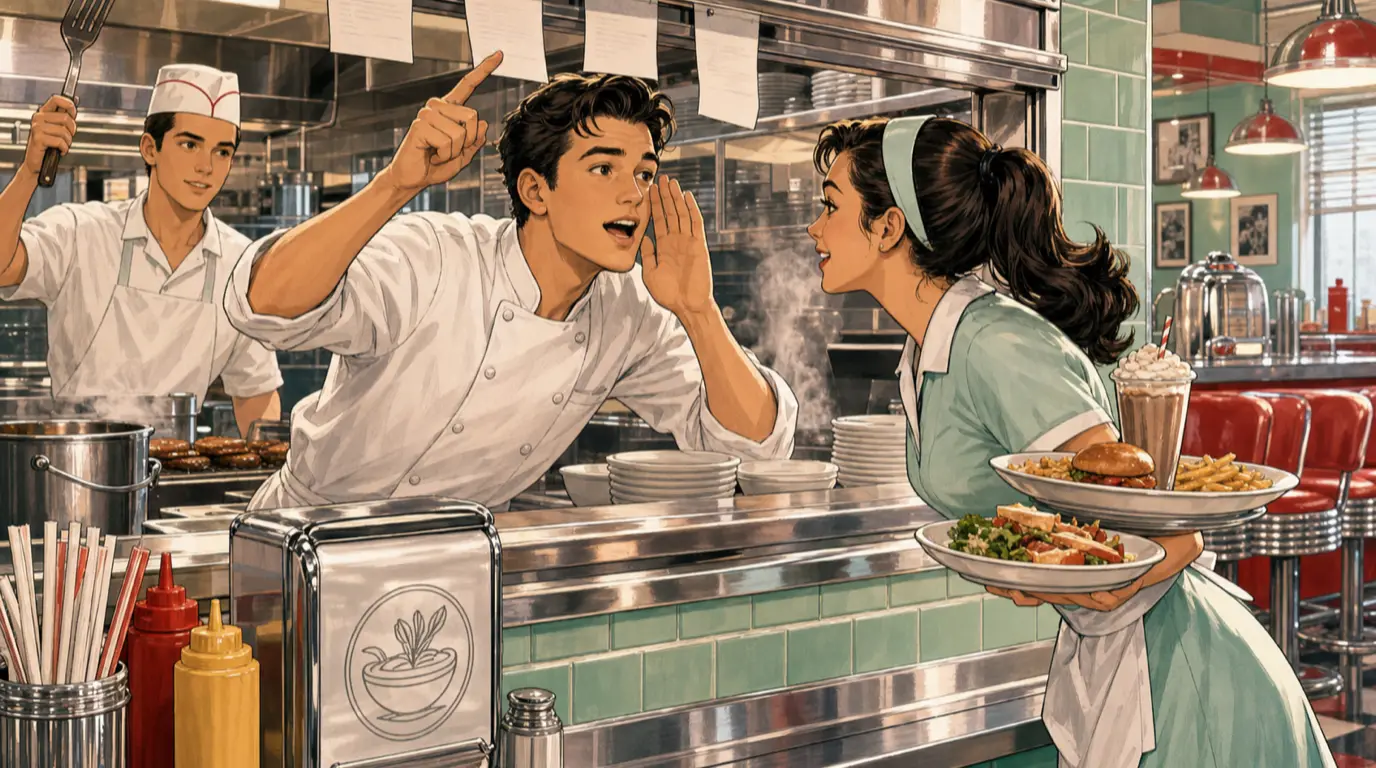
Every trade builds its own language, and restaurants built one of the densest: a mix of French brigade vocabulary, diner-counter code, bar shorthand, and pure survival slang, compressed by decades of shouting over exhaust hoods. To a new hire, the first week sounds like eavesdropping on a foreign country: fire two salmon all day, 86 the special, I am buried on the deuce, corner, hot behind. None of it is decoration. Kitchen and floor language exists because during a rush there is no time for sentences, and because a call like heard confirms in one syllable what a paragraph would confirm slowly. Even the technology absorbed the dialect: tickets fire from the restaurant POS to the kitchen using the same verbs cooks were shouting a century ago.
This glossary collects the hundred-plus terms that working restaurants actually use, organized by where you will hear them: ticket talk on the line, front-of-house floor language, kitchen and brigade vocabulary, menu and bar terms, and the business shorthand managers trade in the office. It leans practical rather than antiquarian, the terms a server, cook, or manager needs in the first month, whether orders arrive on paper dupes or through a kitchen display system. Skim it before a first shift, or use it the way most kitchens do: settle the argument, then get back to work.
Why restaurants talk like this
Three forces shaped restaurant language. The first is speed: service compresses hundreds of decisions into a few hours, and shorthand is measurably faster than description. Fire table twelve beats please begin cooking the main courses for the party seated at table twelve by four seconds, and a busy line fires hundreds of times a night. The second is safety: a kitchen is a small industrial site, and calls like corner, behind, and sharp are its traffic signals. The third is culture: the French brigade system gave professional kitchens their titles and much of their menu vocabulary, American diners and soda counters contributed the number codes, and every generation of workers added slang that stuck because it was useful or funny, usually both.
The result is a working dialect with a stable core and local variation. The core terms below are understood almost everywhere; the exact phrasing, and the house-specific inventions layered on top, differ restaurant to restaurant. When in doubt, use the standard call and ask about the local one.
Ticket talk: the language of the rail
These are the terms that move food. Most fly between the expeditor and the line, but servers need them too, because tickets are conversations.
86. The item is unavailable; stop selling it. Applies to dishes, ingredients, and occasionally guests. The most famous piece of restaurant code in existence.
68. The less-famous reverse: an 86ed item is back on and can be sold again.
All day. The running total of an item across all open tickets. Three salmon on one ticket and two on another makes five salmon all day. The phrase that keeps a busy line from double-cooking.
Fire. Start cooking now. Tickets are often held, then fired course by course: fire apps, then fire mains when the pace is right.
Hold. The opposite: do not start this item or course yet, usually because the table is pacing slowly.
On the fly. Needed immediately, usually because something was dropped, wrong, or forgotten. An on-the-fly order jumps the queue.
Heard. Acknowledged; I have it. The single most important word on a line. A call that gets no heard back must be repeated, because unacknowledged calls are how orders vanish.
Ticket, chit, dupe. The printed or displayed order. Dupe survives from the duplicate carbon copies of paper-pad days.
The rail, the board. Where tickets hang or display, in firing order. Reading the board is the expeditor's core skill.
Expo. The expeditor: the person, often a chef or senior cook, who calls tickets, coordinates timing, checks plates at the pass, and matches food to tables. The air-traffic controller of service.
The pass. The counter where finished plates land, get final checks and garnishes, and cross from kitchen to floor.
Hands. A call for someone to run food: hands at the pass means plates are dying and nobody is free to carry them.
Dying. Food sitting at the pass losing quality while nobody runs it. The saddest word in the kitchen.
Drop. To start cooking something with a fixed time, especially fried items: drop fries. Also used for delivering the check: drop the check.
Re-fire. Cook it again: the plate came back wrong, undercooked, or cold, and the replacement outranks everything but an on-the-fly.
Waiting on. The pass is holding a nearly complete table waiting for one item: waiting on one risotto means the risotto station is now the bottleneck.
On deck. Next in line to fire: the ticket or task queued right behind the current one, so the station can stage it without starting it.
Push. The peak wave of a service: the seven-thirty push. Also a verb from the expo: push table nine means hurry that ticket along.
Run it. The plate is finished and approved, carry it to the table now. The expo's release word at the pass.
Marry. To consolidate part-full containers into full ones at closing: marry the ketchups. A tiny ritual with surprisingly strong opinions attached, since food safety rules limit what may be married.
Side towel. The folded towel a cook uses as a portable pot holder and all-purpose tool. Guarded jealously, borrowed constantly.
Safety calls: the words that prevent injuries
Corner. Called when approaching a blind corner so nobody collides with you. The most reflexive word in a career kitchen.
Behind. Called when passing close behind someone. Variants stack information fast: hot behind for a hot pan, sharp behind for a knife, heavy behind for a loaded tray.
Sharp, knife. A blade is moving through the space, usually being carried to the dish pit.
Hot. A hot pan, tray, or plate is moving. Sometimes stretched into the traditional warning hot stuff coming through.
Open flame, open oven. Position warnings on tight lines, so nobody backs into a burner or a dropped oven door.
In the weeds, buried, slammed. Overwhelmed beyond recovery without help. Calling it early is professional; hiding it is not. Some houses shorten it to weeded.
Front of house: floor language
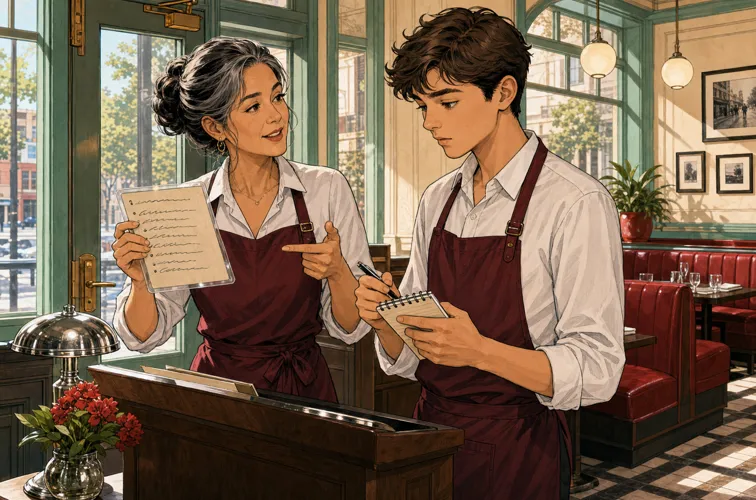
FOH. Front of house: everything guests see, and everyone who works there.
Host, hostess, maitre d'. The door team: greeting, seating, managing the waitlist and the book. The maitre d' title survives mostly in fine dining.
Server, back server, busser, runner. The service chain: the server owns tables, back servers and bussers support water, bread, clearing, and resets, runners carry food from the pass.
Section, station. The block of tables a server owns for the shift. Floor plans divide the room into sections; a strong section is real money.
Cover. One guest. The industry's unit of volume: 180 covers is 180 people fed.
Top, deuce. Table sizes: a 2-top or deuce seats two, a 4-top four, a 6-top six. You will hear I got a deuce and two 4-tops within your first hour on any floor.
Turn. One full use of a table: seat, serve, clear, reset. Turning tables faster, without rushing guests, is the core arithmetic of table turnover and revenue.
Turn and burn. High-speed service on a packed night: seat, serve, reset, repeat, with no lingering.
Camper. A table that finished and paid but will not leave, camping on real estate the waitlist needs. Every server has a camper story.
Walk-in. A guest without a reservation. Also, confusingly, the big cooler in the kitchen; context decides.
No-show. A reservation that never arrived. Tracked, because chronic no-shows shape deposit policies.
Waitlist, quote. The list of waiting parties and the estimated wait each was told: we quoted twenty at the door.
Sidework. The non-table duties servers own before, during, and after service: rolling silverware, stocking stations, wiping menus. The invisible half of the job.
Rollups. Cutlery wrapped in a napkin, produced in bulk during sidework.
Pre-bus. Clearing finished plates and glasses continuously during the meal instead of all at once at the end.
Cut. Released from the floor as business slows: getting cut early on a slow Tuesday. Servers may then finish sidework and cash out.
Cash-out. The end-of-shift reconciliation of a server's checks, payments, and tips.
Upsell. Guiding a guest to a larger or better order: the appetizer, the second round, the dessert. Done well it is hospitality; done badly it is pushiness with a script.
Verbal. An order relayed by voice ahead of the ticket, usually to save minutes on a slow-cooking item.
Comp. A comped item is removed from the check, typically to recover from a mistake or to take care of a guest. Tracked closely, because comps are the manager's currency and the accountant's question.
Void. A canceled ticket line: rung in error, never made, or made wrong. Voids tell the story of training gaps the way comps tell the story of guest recovery.
Split check. Dividing one table's bill among guests, the request every server hears nightly.
Dine and dash, walk-out. Guests leaving without paying. Rare, memorable, and the reason some houses take cards at seating for large parties.
Regular, VIP, soigne. Known and valued guests, and the fine-dining call, from the French for polished, that a plate or table gets extra care.
Pre-shift, lineup. The short meeting before service: specials tasted, 86s announced, VIPs flagged, allergies and large parties reviewed.
Back of house: kitchen and brigade
BOH. Back of house: kitchen, prep, dish, storage, office.
Brigade. The classical French kitchen hierarchy, codified by Escoffier, that still names most kitchen roles.
Executive chef, chef de cuisine. The top of the kitchen: menu, standards, costs, crew. In smaller houses one person carries both titles and the scheduling too.
Sous chef. Second in command, and usually the person actually running the line most nights.
Chef de partie, line cook. The cook who owns a station: saute, grill, fry, garde manger. The infantry of the industry, and its future chefs. A full guide lives in our line cook article.
Garde manger. The cold station: salads, cold apps, some desserts. Pronounced gard mon-ZHAY.
Saucier. The saute and sauce station, traditionally the most senior line position.
Prep cook. The daytime engine: the chopping, portioning, and sauce-making that becomes the line's mise en place.
Mise en place. Everything in its place: the prepared state of a station before service, and the mindset behind it. Big enough to deserve its own guide, which we wrote: mise en place explained. On the line it shortens to meez.
The line. The row of cooking stations where service happens. Working the line is the defining experience of professional cooking.
Station. One cook's territory: equipment, mise, and every ticket item that belongs to it.
Stage, trail. A stage, pronounced stahzh, is an unpaid or trial shift to learn or audition; a trail is the shadowing shift a new hire works before flying solo.
Family meal, staff meal. The crew's meal before service, cooked in-house. Its quality is a surprisingly reliable read on kitchen culture.
Walk-in. The walk-in cooler, the kitchen's refrigerated room. The other walk-in seats itself at table nine.
Low boy, reach-in. Under-counter and upright refrigeration at the stations.
Hotel pan, ninth pan. The standardized steel containers of mise en place: full pans down to ninths, the grammar of every station's setup.
Flat top, salamander, bain-marie. Workhorse equipment: the solid griddle plate, the overhead broiler that finishes and melts, and the hot-water bath that holds sauces at temperature.
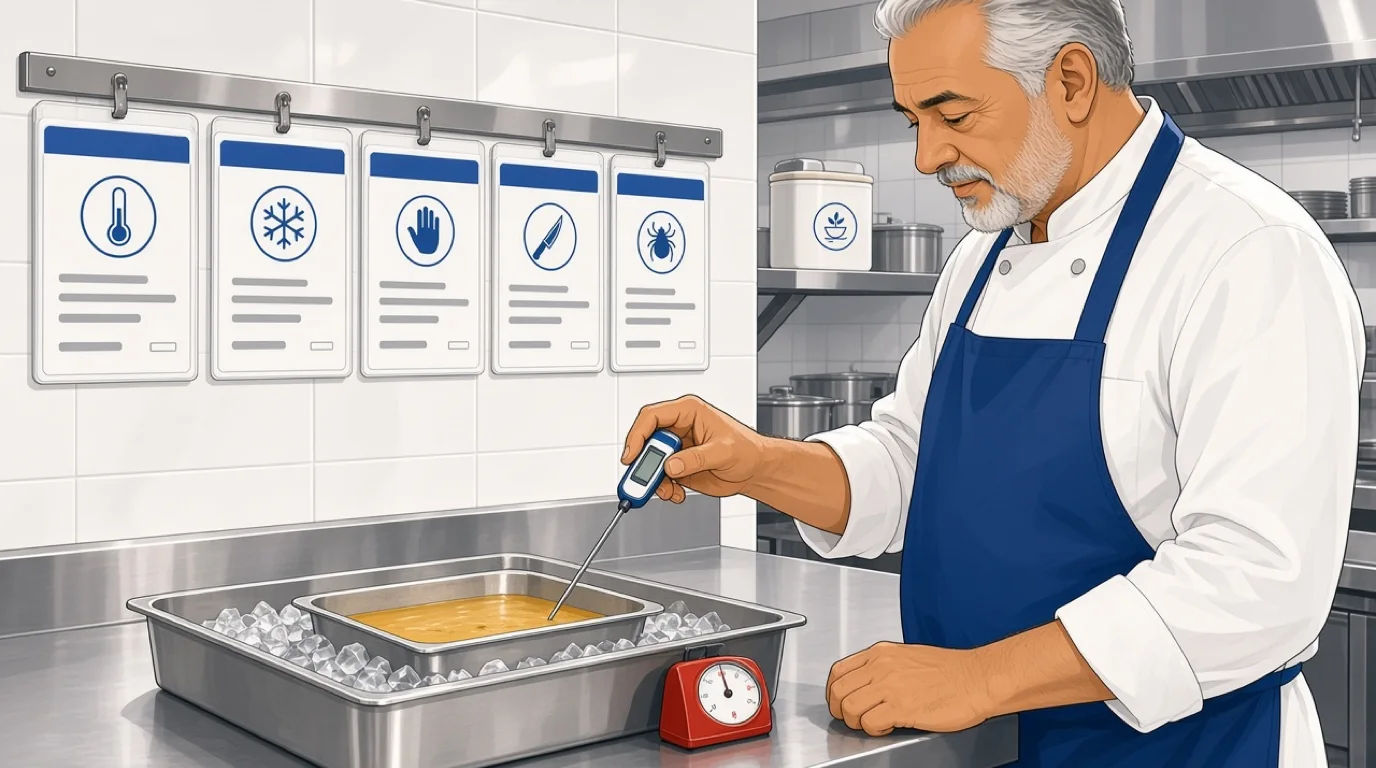
Day dot, date label. The sticker with item and date that belongs on every container, enforcing rotation.
FIFO. First in, first out: the rotation rule that oldest product gets used first. Covered fully in our FIFO guide.
Par. The target quantity of a prepped item a station should hold before service. Pars turn prep from feel into arithmetic.
Prep list. The ranked to-do list of what must be made today, written from pars, sales, and the reservation book.
Working clean. The discipline of an organized station: staged tasks, wiped board, tools returned as used. The highest everyday compliment in a kitchen.
Dish pit. The dishwashing station, and the person running it, the most underrated job in the building: no clean plates, no service.
Waste log, shrinkage. The record of what got thrown away and why, and the inventory that vanished without a sale. Both feed food-cost math.
Menu and food terms
A la carte. Items ordered and priced individually, as opposed to a set menu.
Prix fixe. A multi-course menu at a fixed price. Pronounced pree feeks.
Table d'hote. The older cousin of prix fixe: a set menu with limited choices at a set price.
Tasting menu, degustation. A long sequence of small courses composed by the kitchen, often with wine pairings.
Amuse-bouche. A tiny complimentary bite from the chef before the meal begins, literally mouth-amuser.
Du jour. Of the day: soup du jour changes daily.
App, entree, main. Appetizer and main course. Note the trap: in most of the world entree means the starter; in North America it means the main.
Special, LTO. The off-menu dish of the day, and the chain-world term limited-time offer for a promotional item with an end date.
Mod. A modification to a menu item: no onions, dressing on the side. Mods print on the ticket and multiply during allergy season.
SOS. Sauce on side, the most common mod abbreviation in the POS.
Temp. Meat doneness: rare through well done, with mid-rare the most called. Getting temps right is the grill station's whole reputation.
Sear, deglaze, reduce. The saute station's verbs: brown hard in a hot pan, dissolve the browned bits with liquid, and simmer that liquid down until it thickens into flavor.
Blanch and shock. Boil briefly, then stop the cooking in ice water: the technique behind almost all vegetable prep.
Confit, sous vide. Slow cooking in fat, and precise cooking in a temperature-controlled water bath. Both prep techniques that let the line finish food fast.
Garnish, plating. The finishing elements and the arrangement of food on the plate, the last things checked at the pass.
Behind the bar
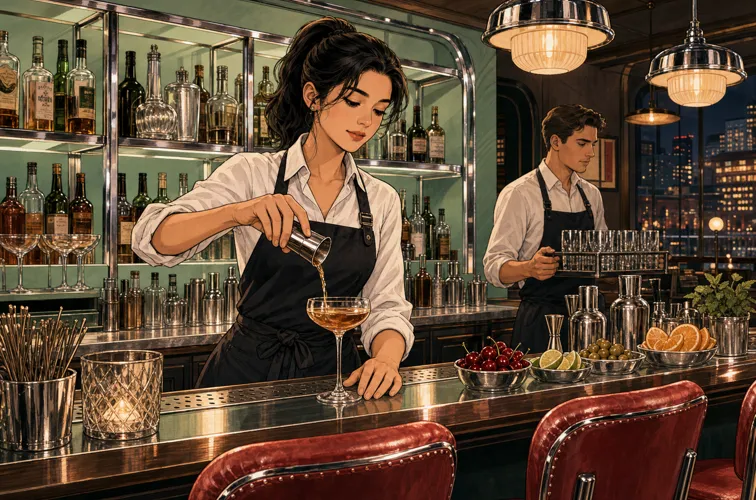
Well. The bartender's workstation, and the house-brand liquors racked in it: a well drink uses the default spirits.
Top shelf, call. Premium spirits, and any drink where the guest names the brand: a call drink like a Tito's soda.
Neat, up, on the rocks. Room temperature with no ice; chilled and strained into a stemmed glass; over ice.
Dry, dirty, with a twist. Martini language: less vermouth, olive brine added, citrus peel garnish.
Jigger, free pour. The measuring tool for accurate pours, and pouring by count without one. The difference between the two shows up directly in pour cost.
Muddle. Crushing herbs or fruit in the glass to release flavor, as in a mojito.
Barback. The bartender's support role: ice, glassware, restocking, prep. The bar's equivalent of a busser and the classic path to the bartender job.
Last call. The final chance to order before the bar closes, announced with ritual seriousness everywhere on earth.
Happy hour. The discounted daypart, usually late afternoon, that fills seats between services. We cover the economics in our happy hour guide.
The office: business and numbers shorthand
Daypart. A slice of the operating day, breakfast, lunch, happy hour, dinner, late night, each with its own economics and staffing.
Check average, PPA. Average spend per check and per person, the two numbers behind every upselling program and menu redesign.
Food cost, pour cost. Ingredient cost as a percentage of an item's price, for the kitchen and the bar respectively. The full math lives in our food cost guide.
Labor cost. Wages and payroll burden as a percentage of sales, the other giant cost block.
Prime cost. Food plus labor: the number that decides whether a restaurant can be profitable at all. See the prime cost guide for benchmarks.
P&L. The profit and loss statement, the monthly scoreboard where all of the above meets rent.
Covers forecast. The predicted guest count that drives prep pars, ordering, and the schedule.
Z-report, end of day. The closing summary the POS produces: sales, payments, voids, comps, tips, the raw material of the nightly close.
Tip pool, tip-out. Structures for sharing gratuities: pooling combines and redistributes tips by formula, tip-outs are the percentages servers pass to support roles like bussers, runners, and the bar.
Service charge, auto-grat. A fixed percentage added to the check, common for large parties, legally distinct from a tip in most jurisdictions; our service charge vs tips guide untangles it.
Clopen. Closing one night and opening the next morning, the schedule pattern every employee dreads and every scheduler tries to avoid.
In the black, in the red. Profitable, and not: the oldest business shorthand there is, and the reason all the other numbers get watched.
House dialects: when lingo varies
Everything above is the shared core, but no two restaurants speak identically. Chains build sanctioned vocabularies into their training manuals; independents accumulate house slang nobody remembers inventing. One kitchen's all day is another's total; some floors call the POS by its brand name, others just say the computer. Fine dining keeps more French alive; diners keep more of the old counter code. Regional differences are real too: the same support role might be a busser, a back waiter, or a commis depending on the city and the segment.
The practical rule for a new hire: learn the standard call, then defer to the house version the moment you hear it. Language in a restaurant is not trivia, it is coordination, and the correct word is whichever one your team reliably understands at volume, at speed, at nine on a Saturday. When you train new people later, hand them a glossary early. Two pages of vocabulary on day one saves a hundred small confusions in week one, and it signals something bigger: this house takes its craft seriously enough to teach the words for it.
Bringing it together
Restaurant lingo looks like slang and functions like infrastructure. The numbers, the calls, the brigade titles, and the office shorthand all exist to move accurate information through a loud, fast, hazardous building with the fewest possible syllables. Learn the safety calls first, the ticket verbs second, and the culture will teach you the rest, one corrected mispronunciation at a time. Keep this glossary in the training packet, add your house's own dialect to it, and retire the terms your team genuinely never uses. The vocabulary, like everything else in a good restaurant, should carry its weight.