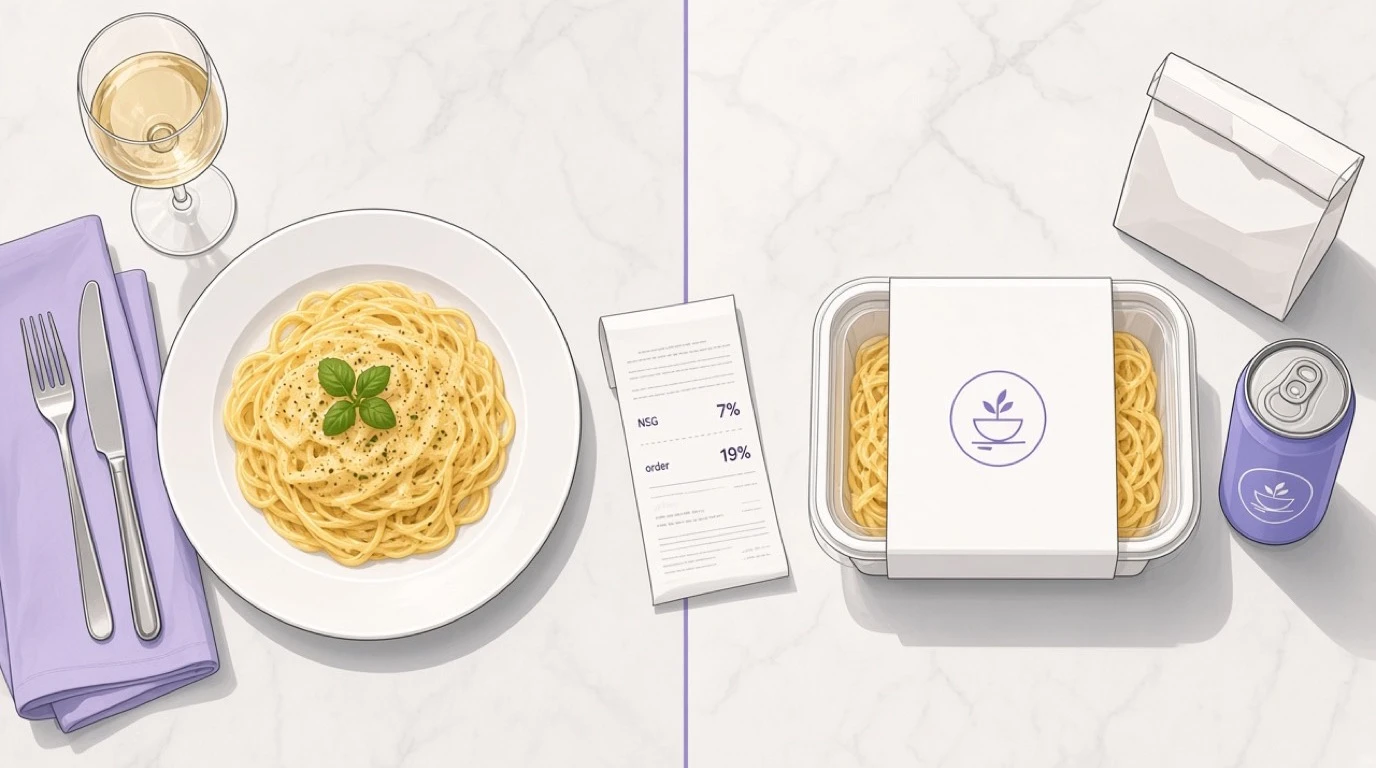
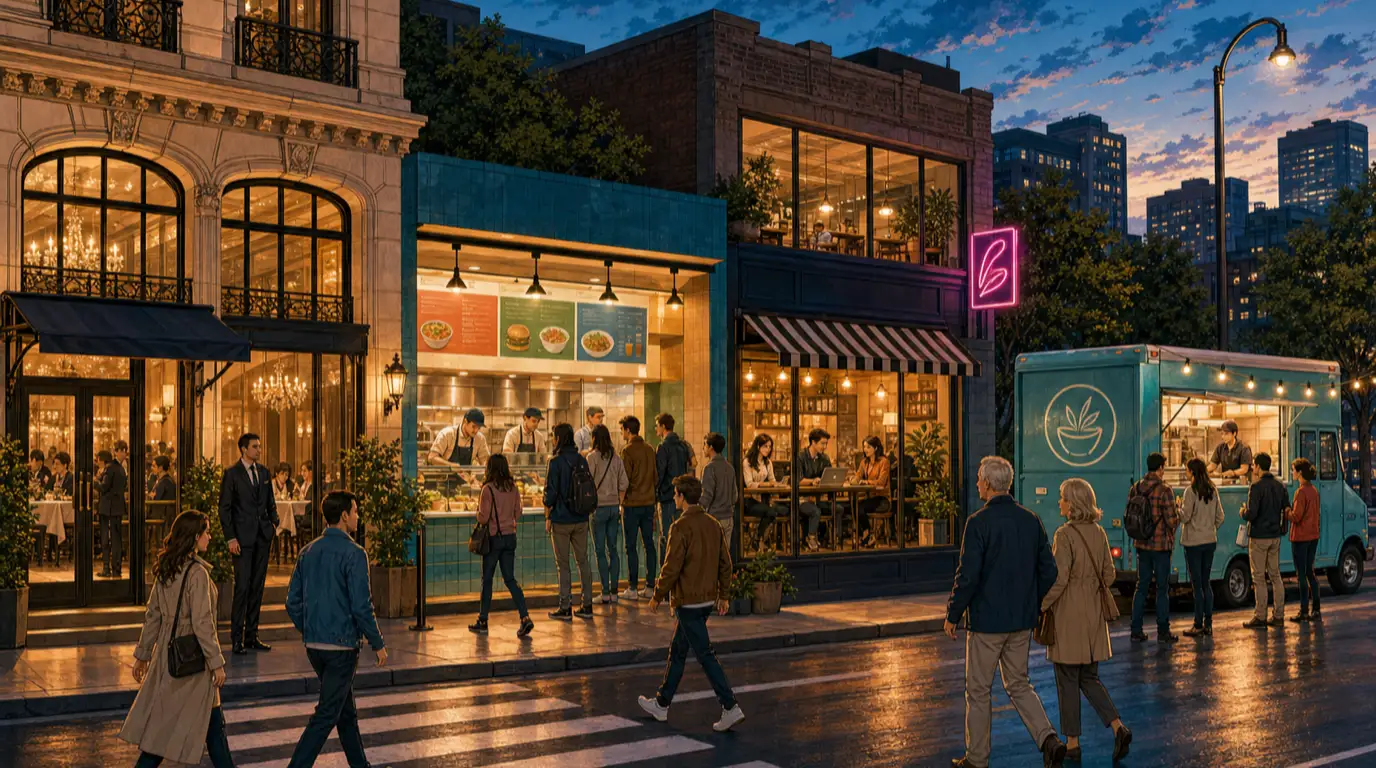
Restaurant is one word doing an enormous amount of work. It covers the tasting room where dinner takes four hours and the drive-through where it takes four minutes, the food truck at the curb and the hotel brasserie, the buffet, the omakase counter, and the kitchen with no dining room at all that exists only inside delivery apps. Each of these is a different machine: different service model, different economics, different staffing, different technology. A full-service restaurant and a takeaway counter may share a cuisine and a neighborhood and still have almost nothing operational in common.
This guide maps the whole landscape: the classic service-model families from fine dining to quick service, the specialist formats like cafes, buffets, and food trucks, the new generation of ghost kitchens and pop-ups, and the ownership structures, independent, chain, and franchise, layered across all of them. For each type we cover how it works, what it costs to run, and the trade-offs that decide whether it thrives, with the real numbers linked out to our guides on margins, startup costs, and turnover. Whether you are choosing a concept to open, studying the competition, or just settling an argument about what fast casual actually means, the taxonomy below is the industry's working map.
How restaurant types are classified
Three axes sort almost every restaurant. The first is the service model: does a server come to the table, or does the guest order at a counter? How much of the experience is delivered by staff versus self-serve? This axis produces the big categories, full service, fast casual, quick service, and drives labor cost, the largest controllable expense in the business.
The second axis is price point and check average, which the industry compresses into dollar signs. Price tracks the service model loosely but not perfectly: a food truck taco can cost more than a diner entree, and a gastropub burger can out-price a casual chain's steak. Where price and service model diverge, the concept is making a deliberate bet, usually on food quality carrying a premium that the service level does not justify alone.
The third axis is ownership: independent, chain, or franchise. It changes nothing about what the guest sees and nearly everything about how the business runs, from purchasing power and marketing budgets to menu flexibility and who keeps the profit. A useful habit when analyzing any restaurant: name all three coordinates. A franchised quick-service burger unit, an independent fine dining room, and a chain fast-casual bowl concept are three different businesses that happen to share an industry.
Notice what is not an axis: cuisine. Italian, Thai, and Mexican are not restaurant types, because each can be executed at any service level and price point, a taco is street food on one corner and a tasting course two blocks away. Cuisine decides what a restaurant cooks; the three axes above decide what kind of business it is, and confusing the two is how first-time operators end up with fine-dining costs attached to fast-casual prices.
Fine dining
Fine dining is the industry's summit and its smallest segment: chef-driven menus, elevated technique, formal or semi-formal service, and the highest check averages in the business, routinely triple digits per guest before wine. Service is choreographed, courses are paced, wine programs run deep, and roles exist here that the rest of the industry has abandoned, sommeliers, captains, maitre d's.
The economics are brutal in a specific way: everything is expensive. Ingredients are luxury-tier, labor is the most skilled and most numerous per guest in the industry, real estate is prestige-priced, and the room seats fewer people and turns them slower than any other format. High checks compensate, but net margins often land no better than a well-run casual place, and the model depends on reputation: reviews, awards, and the long game of prestige, including the star system we covered in our Michelin guide. What fine dining buys the operator is pricing power, brand gravity, and a platform: many chef empires monetize the flagship's reputation through casual spinoffs, cookbooks, and licensing rather than through the flagship itself.
Casual dining and full service
Casual dining is the broad middle of the industry: table service, moderate prices, a bar in most rooms, and a menu wide enough for a family to disagree about. Neighborhood independents, regional groups, and the big national chains all live here, and so do the French-lineage formats we have covered separately, the bistro, the brasserie, and the gastropub, each a distinct flavor of casual full service.
The model's strength is breadth: casual dining serves date nights, family dinners, work lunches, and the Tuesday nobody wants to cook, which makes demand steadier than the occasion-driven segments above it. Its weakness is that it competes on every front at once, against fast casual on convenience and price, against fine dining on occasion, against delivery on the couch. Margins typically run 3 to 6 percent, and the operational fight is fought in table turns, labor scheduling, and menu engineering; the difference between the segment's winners and casualties is usually visible in exactly those numbers, which is why we keep pointing operators to the math in our profit margins guide. For a deeper cut on how this tier differs from the one above it, see fine dining vs casual dining.
Fast casual
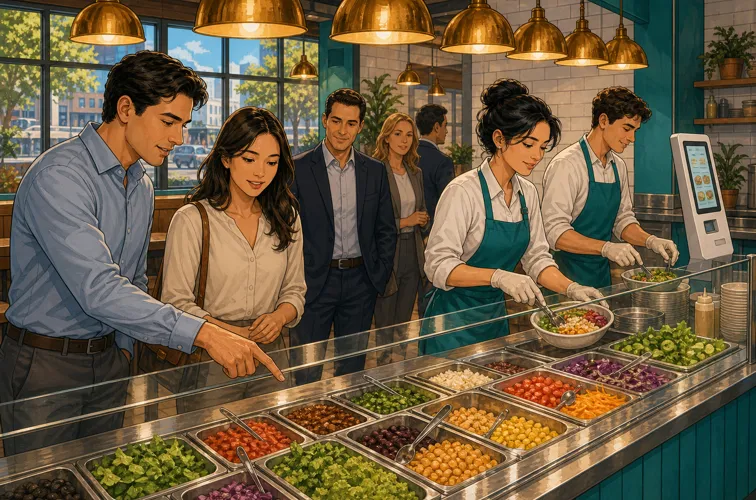
Fast casual is the industry's youngest major category and its fastest-growing for two decades: counter ordering with food positioned well above fast food. The template is the assembly line pioneered by burrito and bowl chains, order at the counter or a kiosk, watch the food built to spec, pay, seat yourself, but the category now spans pizza, salads, burgers, poke, and nearly every cuisine with a build-your-own format.
The pitch to guests is quality without the time and tip of table service; the pitch to operators is casual-dining checks with quick-service labor. Average checks run meaningfully above fast food, labor runs far below full service, and the small kitchens and dining rooms keep build-outs moderate. The model's dependencies: throughput, because the margin math needs volume; consistency, because customization multiplies the ways an order can go wrong; and digital infrastructure, because fast casual leads the industry in app ordering, loyalty programs, and pickup shelves. It is no accident this segment adopted self-ordering kiosks faster than anyone else.
Quick service: fast food and its machinery
Quick service restaurants, QSR in industry shorthand, are the volume end of the business: standardized menus, engineered consistency, drive-through as the profit center, and speed measured in seconds. This is the segment the public calls fast food, and it is the industry's largest by revenue and unit count, dominated by franchise systems whose real product is a replicable operating manual.
Everything in QSR is designed against variance. Menus are short and stable, cooking is deskilled by process and equipment, portioning is automated, and the labor model expects high turnover and trains for it. Checks are the industry's lowest, so the model lives on throughput: drive-through lanes, daypart engineering from breakfast to late night, and increasingly app-driven pickup. Margins at the unit level typically run 6 to 12 percent for well-operated stores, the strongest in the industry, which is precisely why the franchise segment keeps growing. What QSR surrenders is flexibility: the system is the product, and the operator's job is executing it, not reinventing it.
Cafes and coffee shops
Cafes run a different clock than every category above. The product is partly food and coffee, partly time and space: guests come to work, meet, read, and linger, and the best cafes monetize atmosphere as much as espresso. Menus center on drinks, with a food program, pastries, sandwiches, brunch plates, whose ambition varies from display-case-only to full kitchen.
The economics ride on beverages, which carry some of the best margins in food service: coffee's ingredient cost is a small fraction of its price, which subsidizes the slower table turns that lingering guests impose. The operational battlegrounds are morning throughput, the 7 to 10 a.m. window can be half the day's revenue, and the eternal laptop-squatter dilemma, which is really a seating-turnover policy question wearing a cultural costume. Cafes also blur into adjacent formats constantly: add table service and a wine list and it drifts toward bistro; add a full kitchen and it becomes a brunch restaurant; strip seating and it is a takeaway counter with a coffee-shop POS and a line out the door.
Buffets and cafeterias
Buffets and cafeterias flip the service model entirely: the guest does the serving. Buffets sell abundance at a fixed price, all-you-can-eat as both offer and marketing; cafeterias, in their institutional and commercial forms, sell speed and choice, guests sliding trays past stations and paying by item at the end, a model covered in our cafeteria POS guide.
The economics invert full-service logic. Labor shifts from the floor to production, since a small crew can feed enormous volume when guests self-serve. Food cost, everywhere else the controllable variable, becomes the existential one: the fixed price against unlimited consumption means the operator profits on the average appetite, not the biggest one, and the whole model depends on volume forecasting, waste control, and menu design that steers guests toward filling, low-cost items. Buffets were the pandemic's hardest-hit format and have partially reinvented themselves with served stations and higher-end positioning, the Brazilian steakhouse and upscale Asian buffet formats leading the recovery.
Diners, family style, and the specialist formats
A few formats resist the neat service-model ladder. The diner is America's all-daypart institution: table service at counter prices, a menu that spans breakfast to meatloaf at every hour, and economics that depend on volume, speed, and the loyalty of regulars rather than check size. Its cousins worldwide, the British caff, the Japanese shokudo, the German Imbiss with seating, play the same role: full service stripped of ceremony, priced for frequency.
Family-style restaurants serve shared platters to the middle of the table rather than individual plates, a format that dominates in many cuisines, Chinese banquet rooms, Korean barbecue, Italian red-sauce institutions, and quietly changes the operating math: bigger tables, longer visits, higher per-table checks, and kitchens that batch rather than plate. Steakhouses and their single-protein cousins, seafood houses, rotisserie concepts, are menu-narrow but occasion-broad: the focused menu simplifies the kitchen and purchasing while the format's celebration positioning supports checks that rival fine dining with a fraction of the culinary complexity. These specialists prove a rule worth remembering: narrowing the menu is one of the most reliable ways to widen the margin, provided the demand for that narrow thing is real.
Food trucks and street food
The food truck is the lowest-capital entry into the industry and its most constrained format: a full commercial kitchen compressed into a few dozen square feet, a menu that must stay short by physics, and a location strategy that changes daily. Trucks trade the fixed costs of a building for mobility, chasing lunch crowds, breweries, events, and festivals, and often serve as the proving ground for concepts that later open walls-and-roof locations.
The startup math is the draw: a truck typically launches for a tenth of a restaurant's build-out, the full breakdown lives in our food truck guide. The operating constraints are the price: prep usually happens in a rented commissary kitchen, permits and parking rules differ block by block, weather is a revenue line, and the truck itself is a depreciating engine with a fryer attached. The model rewards focused menus, strong branding visible from fifty feet, and social-media fluency, since a mobile kitchen's location strategy is only as good as its ability to tell people where it is.
Ghost kitchens and virtual brands
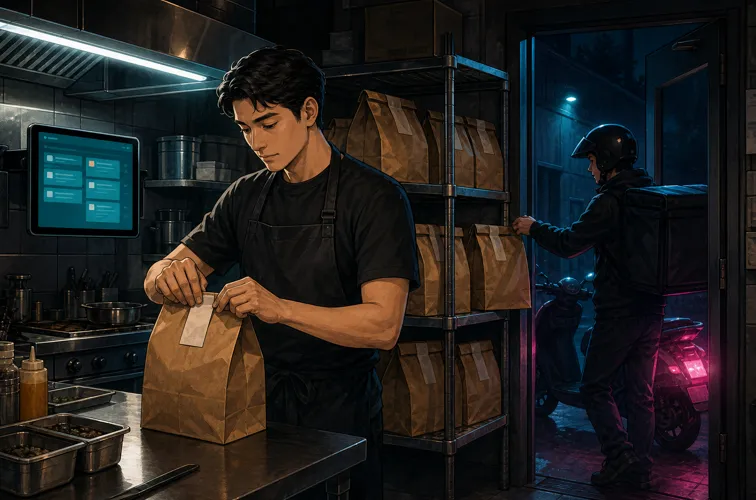
The ghost kitchen is the first genuinely new restaurant type in generations: no dining room, no storefront, often no public address, just a production kitchen cooking for delivery apps and pickup. The format goes by dark kitchen and cloud kitchen too, and it comes in flavors: independent operators in rented kitchen facilities, existing restaurants running delivery-only virtual brands from their own lines, and shared-facility companies renting stations to many brands at once. Our full breakdown is in the ghost kitchen guide.
The appeal is capital efficiency: no prime real estate, no dining room build-out, no front-of-house payroll, and launch timelines measured in weeks. One kitchen can run four virtual brands from overlapping inventory, testing concepts at software speed. The dependencies are equally stark: the delivery platforms own the customer relationship and charge commissions that can consume the margin the format saved, discovery happens entirely inside app rankings, and the brand's whole physical existence is a bag on a doorstep, which makes packaging and accuracy the entire guest experience. The format works best as a portfolio strategy, extra revenue from an existing kitchen, or a low-cost concept test, rather than as a standalone bet on app economics.
Pop-ups, counters, and the occasion formats
A cluster of formats trades permanence for intensity. The pop-up is a restaurant with an expiration date: a chef takes over a bar's kitchen, an empty storefront, or another restaurant's dark night, runs a focused menu for a weekend or a season, and disappears. For chefs it is a low-risk audition for a concept, a following, and investors; for hosts it is revenue from idle space. The chef's counter and tasting-room formats, omakase bars, kitchen counters, ticketed dinners, sell scarcity and access: a dozen seats, one seating time, prepaid reservations, and the chef as the show.
Operationally these formats compress everything: tiny menus, tiny teams, guest counts known in advance, and inventory purchased against exact covers, which makes their food-cost control almost enviable. Their fragility is demand: with no walk-in traffic and no breadth, they live on reservations, press, and social proof, and one slow month tests the model hard. They matter to the broader taxonomy because they are the industry's research lab: formats, dishes, and chefs get proven here before the capital arrives to build something permanent.
Bars, breweries, and drink-led formats
A large slice of food service is drink-led: bars with kitchens, brewpubs and taprooms, wine bars, and the gastropub's more casual cousins. The food menu exists to extend visits and absorb alcohol, and the economics are shaped by the pour: beverage margins tower over food margins, our pour cost guide has the math, so the kitchen can run modestly while the bar carries profitability.
The operating profile differs from food-led restaurants in rhythm and risk: revenue concentrates late and on weekends, staffing peaks accordingly, and compliance, licensing, age verification, over-service liability, is a permanent operational layer that pure restaurants barely think about. Brewpubs add production to the mix, making beer on premises with its own equipment, licensing, and inventory complexity. For operators, the drink-led family is a reminder that within one industry, the profit engine can sit in completely different rooms.
Ownership models: independent, chain, franchise
Cutting across every service model is the question of who owns the operation. Independents, one owner, one or a few locations, are the industry's majority and its creative engine: total menu freedom, local identity, and every decision made in the building. They also carry every risk alone, buy at the worst prices, and market with the smallest budgets.
Chains are multi-location brands under one corporate owner: standardized menus and operations, centralized purchasing and marketing, and the scale to negotiate everything from rent to tomato prices. The trade is uniformity; the chain's promise to guests is that every location is the same, which is exactly what its critics dislike about it. Franchises split the difference structurally: the franchisor owns the brand and the operating system, individual franchisees own the locations, paying an upfront fee and ongoing royalties for the package. Franchising powers most of QSR and much of casual dining because it scales capital and local management simultaneously, though the franchisee's independence is contractual, not creative. Multi-location management has its own playbook regardless of ownership form; we cover it in the multi-location guide.
Choosing a concept: the economics side by side
Set the categories next to each other and the trade-offs get clear. Capital intensity runs from food trucks and ghost kitchens at the low end, through fast casual and cafes in the middle, to full-service build-outs and fine dining at the top; our startup costs guide puts numbers on each tier. Labor cost as a share of sales climbs with service level, from QSR's lean crews to fine dining's brigade-plus-floor payroll. Margins run roughly opposite to prestige: quick service and fast casual post the strongest percentages, casual dining sits mid-single digits, and fine dining survives on checks and reputation rather than margin.
Demand patterns differ as much as costs. QSR and cafes live on weekday routine, casual dining on evenings and weekends, fine dining on occasions, bars on Friday night, trucks on wherever the crowd is. The right question for a would-be operator is rarely which type is best but which type fits this capital, this location, this team, and this appetite for complexity. A concept is a machine for converting a specific kind of demand into margin, and the failures in every category are mostly machines built for demand that was not there.
A quick worked contrast makes it concrete. On the same block, a fast-casual bowl shop might do 400 covers a day at an 18 dollar average with twelve employees, while the full-service bistro next door does 140 covers at 52 dollars with twenty-two. The bistro's revenue per cover is triple; the bowl shop's revenue per labor hour is nearly double. Neither is wrong. They are different machines, and each would go broke running the other's playbook.
Bringing it together
The taxonomy is a map, not a cage. The categories above describe centers of gravity, and the industry's most interesting operators borrow across them: fine dining technique at fast-casual prices, QSR throughput discipline inside a taqueria, a cafe by day that becomes a wine bar by night, a ghost kitchen testing the menu that later anchors a dining room. But the map matters because each model's economics are real: service level sets labor, format sets capital, price point sets the guest, and volume decides everything. Know which machine you are running, run its numbers rather than another model's, and steal from the other categories deliberately instead of drifting between them by accident. The word restaurant contains all of this; the successful ones know exactly which restaurant they are.