Somebody has told you that December is a third of your year. It is the most repeated number in hospitality and it is wrong, and believing it leads to the two classic festive mistakes: overbuying for a month that will not deliver, and pricing a season you have misread. Pull the actual monthly turnover series from the national statistics offices and December lands between 8% and 9.6% of annual food service turnover in every large European market. An even month is 8.33%. What December really is, in most venues, is a month with an unusually violent shape, which is a scheduling and cash problem rather than a windfall, and the reason your restaurant POS reporting matters more in the next eight weeks than in the previous eight months.
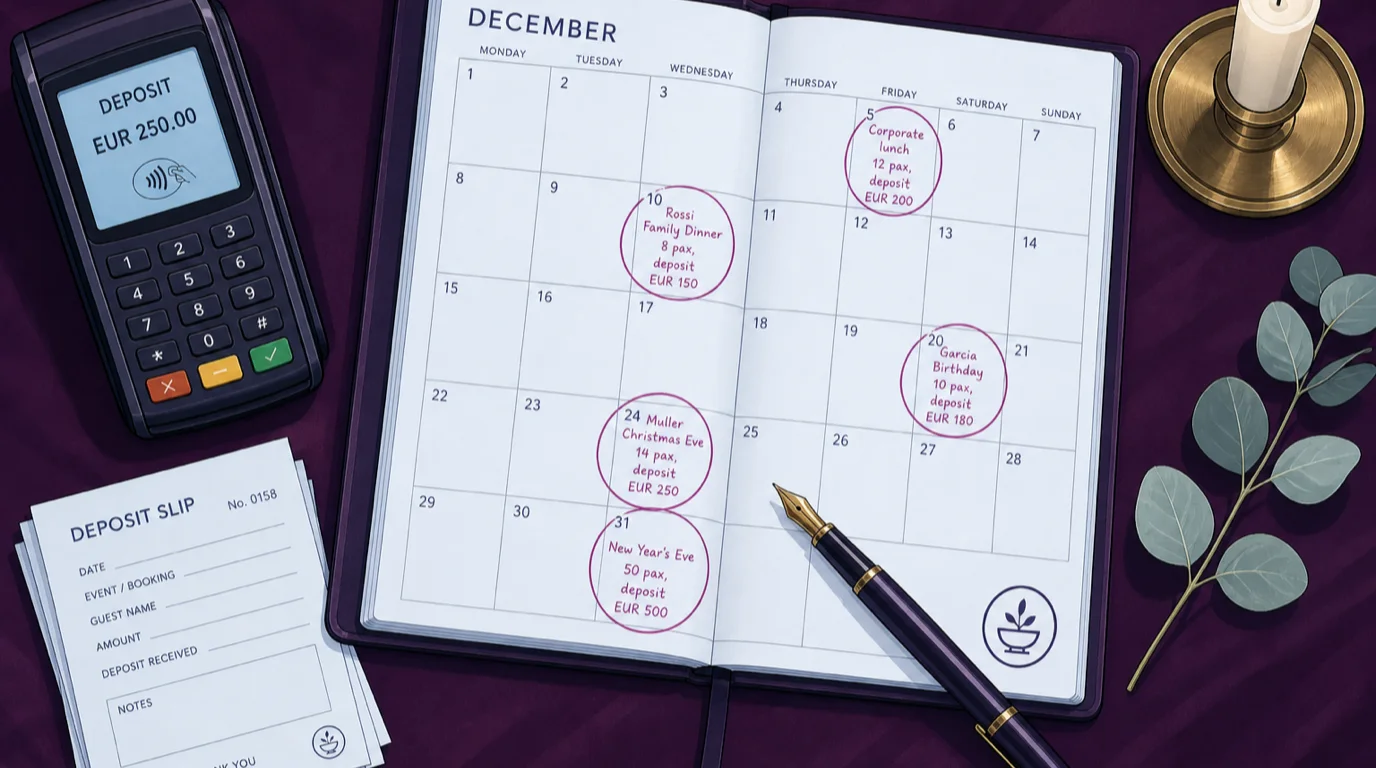
That shape is the thing worth planning for. Trade concentrates into a handful of dates, groups get large, and a table you lose at 8pm on the second Saturday of December is not a table you can win back in January. Most of what follows is about protecting bookings you have already taken, which means deposits, card guarantees and cancellation terms, and that in turn means your restaurant payments setup needs to be able to hold a card and charge it later without breaking either the payment rules or consumer law. That part is more legally interesting than it sounds, and it differs by country in ways that will surprise you.
What December is actually worth
Here are the figures, computed from the monthly turnover series each statistics office publishes rather than from anybody's press release. All are for food and beverage service activities as a whole, which is division 56 in the standard classification.
In the UK, December 2025 took 9.55% of the year's turnover, which made it the biggest month of the year at 1.15 times an average month (ONS series JQ37). In Spain, December 2025 took 8.22%, which made it the eighth largest month of twelve, below average, and well below July (INE table 60288). Germany splits by sub-sector in a way that matters: restaurants and cafés took 8.49% in December, their fifth best month, while bars and pubs took 9.23%, their second best (Destatis). France sat at 8.66%.
Read those two extremes again, because they are the whole argument. December is the single biggest month of the year for a British operator and a quieter than average month for a Spanish one. Spain's December share has fallen three years running, from 8.71% to 8.39% to 8.22%, while the UK's has climbed. Any festive advice written for one of those markets is actively misleading in the other, which is most of what is published on this subject, since most of it is written in North America where the calendar is different again.
Where did the "third of the year" figure come from? As far as I can trace it, from a December 2022 news story about rail strikes, where it appears as unattributed narration. Underneath it sits a genuine January 2022 quote from UKHospitality's then chief executive describing December as "equal to three months' worth of trading for many", which is a careful statement about an unquantified subset of venues during the Omicron winter. Somewhere between the two, "for many" fell off and a quote became a statistic.
None of which means the season does not matter. A month running at 1.15 times average, concentrated into perhaps fifteen trading days, with groups two to four times your normal party size and staff wanting time off, is genuinely the hardest month to operate. It just is not a third of your revenue, and if you have been budgeting as though it is, your January will be worse than it needs to be. Our guide to restaurant cash flow covers the January hangover in more detail, because that is where festive over-optimism actually shows up.
Five markets, five different seasons
The Anglo-American festive template assumes the peak is Christmas Eve and Christmas Day, with a corporate party season in front of it. That template is correct in roughly none of continental Europe.
Germany. Demand rises steadily after Christmas Eve. In a study of 10,185 German restaurants over 24 to 27 December 2024, reservation requests split 18.86% on the 24th, 22.74% on the 25th, 27.48% on the 26th and 30.92% on the 27th. The 26th produced the most revenue. Confirmation rates rose with the date too, from about 71% on Heiligabend to over 80% by the 27th, because 24 December is a short trading day in most venues and often given over to private functions. Two more findings from the same data are operationally useful: 51.7% of confirmed reservations were at lunchtime, and the average lunch party was twelve people. A German festive service is a midday event for a large group, not a candlelit dinner for two.
Spain. The money is in the company lunch and dinner season, which runs from early November to around the 21st of December, and not in Christmas itself. Volume builds from the weekend of 21 November, and trade bodies in Madrid identify the last weekend of November and the second weekend of December as the most in demand, deliberately close to Christmas but avoiding the weekend families reserve for themselves. Parties of six or more make up about 31% of December bookings, roughly half again their share in a normal month, and one weekend in mid December can carry half of the month's group bookings. Spain also has tardebuena, the long afternoon of 24 December before the family dinner, which has become a real trading occasion with no equivalent anywhere else. And then Reyes on 6 January, culturally enormous, commercially dead: it shows the steepest year on year fall in restaurant bookings of any date in the Spanish calendar. It is a day people eat at home.
Italy. Christmas Day is the bigger restaurant occasion and New Year's Eve is the smaller one, which inverts the Anglo assumption completely. FIPE counted more than 93,000 venues open on 25 December 2025, about 69.6% of all active venues, serving 5.5 million diners at an average of €82 a head including drinks. On 31 December, 76,500 venues opened, 57.2%, up from 52.9% the previous year, with the cenone averaging €94 and €120 where it came with a veglione. Notably, FIPE attributed the rise in New Year diners mainly to more venues being open rather than to stronger demand.
France. The occasion is the réveillon on the evening of 24 December, and 25 December is overwhelmingly a day at home when most restaurants close. Where venues do trade the réveillon, average spend has been measured at €68 a head on New Year's Eve, ranging from €79 in Île-de-France down to €48 in Hauts-de-France, from more than 55,000 bills settled through one payment provider's terminals. In smaller French towns the venues open on the evening of the 24th are often the ones outside the French dining tradition altogether.
UK and Ireland. The peak is the Friday before Christmas, the one the trade calls Mad Friday. Drinks sales in managed venues on Friday 22 December 2023 ran 21% up on the year before, against 10% on Christmas Day and 3% on Christmas Eve. And here is the correction most useful to a British operator: Boxing Day was up 0.1%. It has a reputation it does not earn. Concentration is extreme at the top end, with nearly 15% of all British on-trade spirits spend arriving in just twenty trading days.

When the books actually open
Festive booking behaviour is bimodal, and treating it as one curve is how you end up with an empty book in October and a queue you cannot serve in December.
Large groups and marquee dates book months out. UK booking data puts Christmas Day tables at around 59 days ahead on average and groups of thirty to fifty at about 75 days, which means the enquiry you are answering in early October is for a party you will serve just before Christmas. Corporate organisers start looking in late summer, but confirmations bunch into October and November because they are waiting on budget approval, so an early enquiry that goes quiet is usually not a lost booking.
Everything else books late, and later than you think. Median lead time for UK December bookings has been measured at 28.7 hours against 22.4 hours across the rest of the year, with more than a third of December tables booked the same day. Both facts are true at once: your 30 December party of forty was locked in September, and half your covers on a random Tuesday will book that afternoon. In December 2025 the single week beginning 8 December accounted for 34% of all festive bookings taken by one UK payments provider's booking system.
What to do with that: open your festive book and publish your set menus by late September, price the marquee dates first because those are the enquiries already arriving, and hold back a genuine allocation of tables for walk-ins and same-day bookings rather than selling the room out to advance groups. A room that is 100% pre-booked on a mid December Thursday is a room that turned away the late trade at a higher spend.
No-shows: what the data actually supports
You will read that 10% to 20% of restaurant bookings are no-shows. You will also read that the figure is under 3%. Both numbers get quoted confidently and the gap between them is not a rounding error, so it is worth understanding where each comes from before you build a policy on either.
Platform measurements are low. One reservation platform put the average across 50,000 restaurants in fourteen European countries at 2.7% in 2025, and its Spanish figure at 3.3%, down from 3.6%. Those are counted events rather than estimates, which makes them the most reliable numbers available, but they describe bookings made through a system that already sends reminders, offers one-click cancellation, and in some cases holds a card. They also exclude the phone, which in much of continental Europe is still where most bookings happen.
Operator surveys are higher, typically 5% to 8%, because they ask people to estimate across every channel including the telephone. Consumer surveys are higher again, with roughly one in five British adults admitting in one survey to having missed a booking in the previous month, of whom over half said they simply forgot. The double digit figures generally have no traceable method at all, and two of the most linkable "no-show statistics" pages on the subject appear to be generated content with invented benchmark tables. I would not build a deposit policy on either.
The genuinely useful evidence is comparative rather than absolute. Across 9,500 Spanish restaurants on one high demand date, no-shows ran at 1.92% with no protection, 1.52% with an automated confirmation message, and 0.66% where a card was requested or payment taken in advance. That is roughly a fifth off for a reminder and two thirds off for a card. An Italian study covering more than 212,000 bookings found the same direction of travel, from 12.8% down to 5.4% where a deposit or pre-authorisation was required, with an average deposit of €20 a head. The absolute levels differ wildly between those two studies because the populations differ. The relative effect is consistent, and it is the only part you should carry into your own venue.
One caveat worth stating plainly, because it cuts against received wisdom. Everybody asserts that no-shows are worse for large groups and worse at Christmas, and I could not find measured evidence for either. The one trade body that has published a characterisation says the festive increase in multiple bookings and no-shows concentrates in small groups. Treat the large-group risk as commercial rather than statistical: a party of twelve that vanishes costs you more, which is reason enough to protect it.
Deposit terms that would survive a challenge
Charging for a no-show is lawful in every European market I looked at. The risk is not that the practice is banned, it is that your specific clause is unenforceable because of how it was written or presented.
The European floor is the unfair contract terms directive, and two items on its indicative list of potentially unfair terms are directly on point. One catches terms letting the business keep the customer's money when the customer cancels without giving the customer an equivalent remedy when the business cancels. The other catches disproportionately high compensation. So the two features that make a cancellation term vulnerable are asymmetry and size, which are exactly the two features most restaurant terms have.
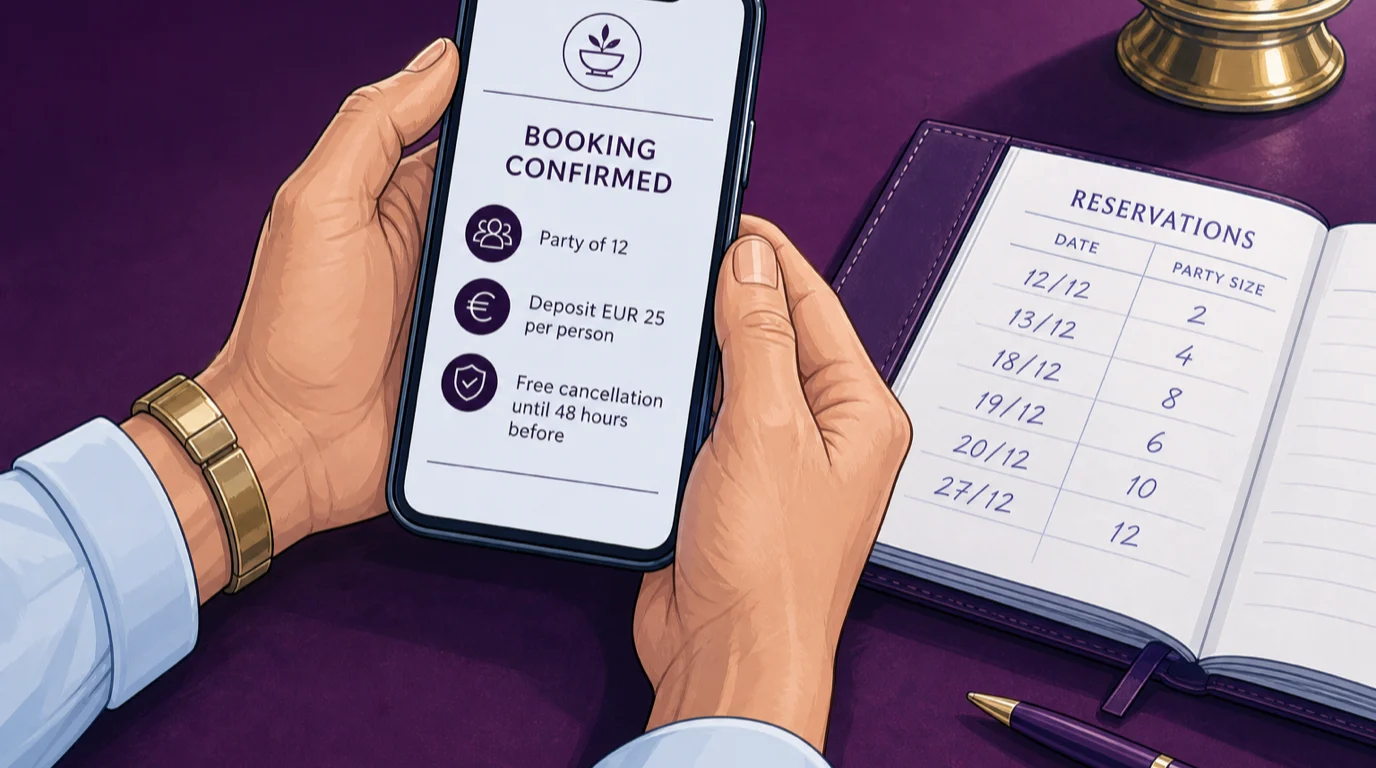
That asymmetry point deserves emphasis because it is the one operators never think about. If your terms say the guest forfeits €25 a head for cancelling inside 48 hours, and say nothing at all about what happens when you cancel their table because you have double booked the private room, you have written a one sided term. Adding a symmetric remedy is cheap, it makes the clause considerably more defensible, and as it happens it also helps you on the tax question in the next section.
Germany has the strictest drafting rules and they are specific enough to check in a minute. A lump sum damages clause is only valid if the amount does not exceed the loss normally expected and the clause expressly allows the customer to prove that the loss was lower or nil. A clause missing that second limb is void. A straightforward contractual penalty for not turning up is void outright. Label the clause as a cancellation fee or damages, never as a penalty. Bavarian trade body guidance suggests €10 to €30 a head for a mid market restaurant and €50 to €150 for fine dining, while stressing that these are not binding benchmarks, and it reminds operators of the duty to mitigate by trying to resell the table.
German courts do enforce this when the drafting holds up. In October 2024 a Munich court awarded a restaurant €2,508.64 net against a company that booked a Christmas party for fifteen people at €125 a head and neither turned up nor cancelled. Two details are instructive: the court treated the booking as a fixed obligation, and it excluded VAT from the award on the basis that VAT would have been paid over to the tax office and so was not the restaurant's loss.
Elsewhere: Spanish trade body model terms suggest an advance charge or card hold of 20% to 50% of average spend per head, with a 30 to 60 minute wait before treating a table as a no-show, and Spanish law treats as abusive any indemnity that does not correspond to actual loss. A consumer group ran a public campaign against restaurant cancellation charges in December 2025, arguing they are disproportionate, so expect Spanish guests to be more likely to push back. In Italy the mechanism to use is the caparra confirmatoria under the civil code, which also carries a double refund obligation the other way if you are the one who defaults. In the UK the test is whether the amount is a genuine pre-estimate of your loss with mitigation taken into account, rather than a profit making charge, and the regulator's guidance says so in plain language.
Wherever you are, three things have to be true. The terms are disclosed before the booking is complete rather than in a confirmation email afterwards, the guest actively agrees to them, and the amount bears a defensible relationship to what you actually lose.
The VAT trap in your deposit
This is the part almost nobody tells operators, and it is the section I would read twice if you take deposits across more than one country.
Start with the easy half. A deposit that gets applied to the final bill is a payment on account, and VAT is due when you receive it. That is not controversial anywhere in the EU. The interesting half is what happens when the guest does not show and you keep the money.
In 2007 the Court of Justice of the EU decided this for a French spa hotel, holding that a deposit retained when the client exercises a cancellation right is fixed compensation for the loss caused by the cancellation, has no direct connection with any supply of a service, and is therefore not subject to VAT. The judgment leaned partly on the fact that under French law a defaulting hotelier had to return double the deposit, which is the symmetry point from the previous section reappearing as a tax argument.
Then the national tax authorities diverged, openly, and the result is that the same deposit gets opposite treatment depending on which side of the Channel you take it. From 1 March 2019, HMRC's position has been that VAT is due on all retained payments for unused services, with no adjustment unless you actually refund the money. HMRC's own manual names the 2007 judgment and explains why it has departed from it, which is an unusually candid thing for a tax authority to publish. Ireland arrived at the same destination by a different route, repealing the relief that allowed suppliers to reclaim VAT on forfeited deposits with effect from 1 January 2022.
Spain, France, Germany and Italy still broadly follow the 2007 line. Spanish tax guidance treats a sum charged on a late cancellation or no-show as compensatory and outside the scope of VAT, and requires you to correct the VAT if you had charged it on a prepayment. French tax doctrine says the same for arrhes, citing the judgment by name, with carve outs where the sum equals the full price. Germany applies a two limb test that turns on whether the guest had a valid right of withdrawal and used it. Italy distinguishes the caparra confirmatoria, outside the scope, from a simple acconto, which is taxable immediately, and where the wording is ambiguous the presumption goes against you.
The practical consequence is worth stating baldly. In Spain, France, Germany and Italy, how you word the clause changes the tax answer. In the UK and Ireland it does not. If you operate in more than one of these countries, your festive terms should not be a single translated template, and if you take a lot of deposits it is worth twenty minutes with your accountant before the season rather than a correction afterwards. Also note the direction of travel: later European judgments on unused services and early termination fees have narrowed the 2007 decision considerably, so treat it as a specific survivor rather than a general principle.
Gift vouchers, and a German trap that costs real money
Festive gift vouchers have their own VAT regime, and one of its consequences is currently catching German operators.
Since 2019, EU rules split vouchers in two. A single purpose voucher is one where the place of supply and the VAT due are both known when it is issued, and it is taxed at the moment of sale, with redemption not treated as a separate transaction. Anything else is a multi purpose voucher, and it is taxed when it is redeemed, on the actual supply.
Now apply that to Germany's rate change. Restaurant food dropped from 19% to 7% on 1 January 2026 while drinks stayed at 19%. A voucher sold during 2024 or 2025, when food and drink were both at 19%, was a single purpose voucher taxed at 19% in the period it was sold. It stays a single purpose voucher taxed at 19% even if the guest redeems it over dinner in 2026, because only the law at the date of issue matters, and there is no retrospective correction available. A voucher sold from 1 January 2026 is a multi purpose voucher, because it can be spent on food at 7% or drinks at 19%, so no VAT is due at sale and the whole amount is taxed on redemption, split between the two rates. Unless you expressly restrict it to food only or drinks only, in which case it is single purpose again.
Worth flagging honestly: the December 2025 finance ministry letter on the rate change does not itself address vouchers, so this analysis rests on guidance issued for the earlier pandemic era rate change applied by analogy, which is how the trade bodies present it too. The professional consensus is unanimous, but it is consensus rather than a fresh ruling. The same letter did confirm something else useful for anybody selling a fixed price festive menu with drinks included: you may attribute a flat 30% of a combined food and drink package price to drinks rather than itemising.
If vouchers are a meaningful part of your December, our guide to restaurant gift cards covers the commercial side, including breakage and expiry.
Holding a card without breaking the payment rules
Taking card details at booking and charging them later for a no-show is a specific kind of payment transaction, and getting the mechanics wrong is how operators end up with a charge that fails or a chargeback they lose.
The European position is settled and slightly counterintuitive. A later charge you initiate for a no-show is a merchant initiated transaction and does not itself require the customer to authenticate, since they are not there. But the regulator has been explicit that setting up that mandate remotely does require strong customer authentication at the time the card is stored. The authentication moment moves to the booking rather than disappearing.
Two practical things follow. Ask your provider about a zero value authorisation, which lets you run authentication at the moment of booking without taking any money. And understand that a pre-authorisation hold is not the same thing as a stored mandate: holds expire within days, which makes them useless for a booking taken six weeks out. If your terms tell guests you are only holding their card while your system actually stores a mandate and charges later, you have a mismatch that will hurt you in both a consumer complaint and a chargeback.
Card schemes recognise a specific no-show transaction type for exactly this case, and misflagging transactions to claim an exemption you are not entitled to is policed. It is worth one conversation with your acquirer in October rather than discovering the problem on 27 December.
Set menus, pre-orders and what is actually known
Fixed festive menus are close to universal in some markets. In Italy, 72.4% of surveyed operators used an all inclusive fixed menu for Christmas lunch, and about a fifth offered a New Year package combining dinner with the party afterwards. Spanish consumer preference clusters at €30 to €45, with a second cluster at €45 to €55, and only around 8% choosing above €75. A UK three course festive menu averaged £36 in December 2025.
What I cannot tell you, because nobody has published it, is that set menus and pre-orders measurably improve throughput or margin. Every source making that claim sells the capability, and none publishes a comparison, a sample or a method. The operational logic is sound and most experienced operators believe it. That is different from evidence, and I would rather say so than dress up a vendor's assertion as a finding.
What the data does support is more specific and more useful. Pre-orders let you buy to a known number, which matters most on the dates where your supply chain is least forgiving. Fixed prices let you publish a package a corporate organiser can get signed off, which is the actual bottleneck in the October and November confirmation window. And they make a deposit easy to justify, because both sides know exactly what has been agreed. Our piece on private events and catering goes further into staged payment structures for larger functions.
One UK detail that shapes every corporate package in the market and that nobody outside Britain would guess: there is a tax exemption for annual staff functions worth £150 a head, and it is an exemption rather than an allowance. At £150.00 a head the taxable benefit for the employees is nothing. At £150.01 the taxable benefit is the full £150.01, not the penny of excess. The figure includes VAT, transport and any overnight accommodation, and it is calculated across everybody who attends including guests. That cliff edge is why British corporate festive packages cluster just under £150, and if you sell to UK companies your pricing should respect it.
Staffing the peak without an argument in January
Holiday pay is where the five markets diverge most sharply, and where assuming your neighbour's rules apply to you gets expensive.
Spain has something close to a statutory premium: where a public holiday or weekly rest day is worked and not compensated with rest, the employer owes the hours worked increased by at least 75%. The trigger is the lost rest rather than the holiday itself, so giving compensatory rest avoids the surcharge. Ireland has no premium at all but a statutory benefit: for each public holiday the employer chooses one of a paid day off, a paid day off within a month, an extra annual leave day, or an extra day's pay. Watch the qualifying rule for festive casuals, who only earn the entitlement if they worked at least 40 hours in the five weeks before the holiday. Italy has no statute but a sector agreement, which adds roughly 20% plus compensatory rest.
Germany has no statutory holiday premium. The law requires a compensatory rest day and that the holiday causes no loss of income, and any premium comes from a collective agreement, which most independent German venues are not bound by at all. The chain and system catering agreement does pay 100%, and it contains a detail worth knowing: staff hired as casuals specifically to cover holiday driven extra work get neither the premium nor the day off. The UK has no statutory premium either and no automatic right to time off on a bank holiday. It is whatever the contract says.
On hiring, the two ends of Europe are moving in opposite directions. Spanish forecasts put hospitality festive contracts at over 174,000 for the 2025 season, up more than 12% and the largest single sector of seasonal hiring. In the UK, hospitality employed nearly 9,000 fewer people in December 2025 than in November, which tells you something about how British operators are now planning for the peak. If you are building a December rota, our guide to staff scheduling covers the mechanics of holding cover for a month where everybody wants the same four days off.
What to do, and roughly when
Now, in late summer. Decide your festive dates and which of them you will price at a premium, using your own last two Decembers rather than a national average. Write your cancellation terms, and check them against the two vulnerabilities: are they symmetric, and is the amount defensible as a real estimate of loss? If you are in Germany, check the clause lets the customer prove a lower loss. Talk to your acquirer about zero value authorisations.
September. Publish set menus and open the book. Marquee date and large group enquiries are already arriving, and corporate organisers are shortlisting before their budgets are approved. Get your allergen and dietary process settled now, because a party of twenty with four requirements is a kitchen problem you want to solve in writing rather than on the night.
October and November. This is the confirmation window, and the thing to manage is your follow up on quiet enquiries rather than new demand. Take deposits as bookings confirm. Hold back an allocation for walk-ins on your busiest days. Check your stock lead times with suppliers for the dates that fall awkwardly, and agree what happens if a delivery lands on a public holiday.
December. Re-confirm every group booking, because an automated message is the cheapest intervention available and the evidence says it removes about a fifth of your no-shows for the cost of nothing. Watch the shape rather than the total: your peak is probably one specific Friday or Saturday, or a lunchtime, or the 27th, depending on which country you are in.
January. Do the one thing almost nobody does. Pull December's numbers by date, not by month, and write down which dates actually paid, which ones you overstaffed, and what your no-show rate was on protected versus unprotected bookings. That single page is worth more next September than anything in this article, because it is about your venue rather than a national average. Our guide to the daily close covers pulling that data reliably.
Start with the cancellation terms. Read your current ones and ask whether they say what happens when you cancel. If they do not, that is fifteen minutes of work that makes every deposit you take this season more defensible, and in four countries it changes your tax position too.
Read next: choosing a reservation system, catering and private events, and restaurant cash flow management.