Gift cards are one of the quietest money-makers a restaurant can run, and most independents either ignore them or treat them as an afterthought stuck in a dusty rack by the host stand. That is a mistake. A gift card is the rare product where the customer pays you today, often does not collect the full value, frequently spends more than the card is worth when they do, and hands your restaurant to someone who has never eaten there. Almost everything about the economics tilts in your favor. The catch is that the program only works if it runs cleanly through your restaurant payments setup, because a gift card that staff cannot issue, check, or redeem in three seconds at a busy counter will quietly die from neglect.
Think about what a gift card actually is from a cash-flow point of view. It is an interest-free loan from your customer, made on the bet that they or their friend will eventually eat at your place. Some of those loans never get called in. The ones that do tend to get spent above face value, and a good chunk of them get spent by brand-new diners. To capture all of that you need the card to behave like real tender at the till, which means it has to live inside your restaurant POS rather than in some disconnected spreadsheet or a separate terminal nobody wants to touch on a Friday night.
This guide is the operator version. We will work through why the economics are so good (breakage, float, and overspend), the difference between physical and digital cards and why you want both, exactly how a card should flow through your point of sale, the legal traps around expiration and unclaimed balances, how to stop the common fraud, how gift cards and loyalty fit together, and a launch plan built to fill your slowest months instead of just your December.
Why the economics quietly favor you
Three forces make gift cards profitable, and they stack. Understand all three and you will treat the program very differently than a rack of plastic by the door.
The first is breakage. Not every card gets fully redeemed; balances get forgotten in drawers, cards get lost, small amounts sit unspent forever. Estimates vary, but a meaningful share of issued value, often cited in the 10 to 15 percent range, never comes back across the counter. Once the legal timeline passes and that balance is recognized as yours, it drops to the bottom line as close to pure profit, because you already have the customer's cash and never had to cook anything for it. Breakage is not something to chase or engineer; treating customers badly to boost it backfires. It is simply a structural tailwind that comes with running the program at all.
The second is float. From the moment someone buys a card to the moment it is redeemed, you are holding their money. For the holiday batch sold in December and spent across the following spring, that can be weeks or months of cash sitting in your account, interest-free, helping you through the lean post-holiday stretch. A restaurant with healthy gift card sales effectively gets a small, recurring, zero-cost line of credit funded by its own customers.
The third, and the one operators most often miss, is overspend. People almost never redeem a card for its exact value. Hand someone a 50 dollar card and they treat it as a starting point, not a ceiling; they add a bottle of wine, an extra course, a tip on the full amount. A 50 dollar card routinely becomes a 75 or 90 dollar check. Layer on the fact that a large share of cards are gifts given to people who have never visited, and the gift card stops being a discount and becomes one of the cheapest customer-acquisition tools in the building. You paid almost nothing to get a new diner through the door with money already in hand and a reason to spend beyond it.
Put rough numbers on it and the picture gets vivid. Say a 60-seat neighborhood spot sells 800 cards over the holidays at an average load of 55 dollars. That is 44,000 dollars of cash in the door in roughly six weeks. If 12 percent of that value is never redeemed, about 5,300 dollars eventually becomes breakage. The redeemed portion, call it 38,700, comes back as checks that average maybe 30 percent above card value once people add a drink or a dessert, so it pulls roughly 50,000 dollars of actual spend across the counter. And a meaningful slice of those redeemers are first-timers handed a card by a regular. One seasonal push, three different wins. The exact figures will differ for your room, but the shape of the math holds almost everywhere.
Physical versus digital, and why you want both
There are two formats, and they capture different buyers. Running only one leaves money on the table.
Physical cards are the plastic or heavy-stock paper cards you sell and display at the counter. They win on impulse and on giftability. A nicely designed card by the register catches the eye of someone paying their check who suddenly remembers a birthday next week. It looks like a real present in a way a forwarded email never quite does. And once it is in a wallet, it works as a tiny, repeated advertisement every time the owner flips past it. The downside is inventory: you have to order, store, and secure the stock, and you can only sell to people physically in front of you.
Digital, or eGift, cards are bought online and delivered by email or text. They own the last-minute market, the 9 pm realization that a present is needed for tomorrow, and they let you sell to anyone, anywhere, including the out-of-town relative who wants to treat a local. There is no inventory and no theft risk on the stock itself. What they lack is the physical, tactile gift quality and the wallet-ad effect. The two formats are not competitors; they are two doors into the same program, and the back-end mechanics, balance tracking, redemption, partial balances, are identical. Sell both.
Card design, denominations, and the small details that sell
The physical card is a tiny piece of marketing, so treat it like one. A flimsy card with a clip-art logo signals a flimsy restaurant; a well-made card with your branding signals a place worth gifting. Spend a little on heavier stock and a clean design that matches your menus and your room. People keep cards they like the look of, and a kept card is a recurring reminder to come back.
Denominations matter more than operators expect. Offer a few preset amounts that map to real visits at your prices, plus a custom field. A fine-dining room might preset 50, 100, and 150; a busy cafe might preset 15, 25, and 40. The presets do quiet work: they anchor the buyer toward a number that covers a genuine meal for two rather than a token amount that barely buys an appetizer. If your presets are too low, you train people to gift a card that does not cover a real experience, which undersells both the gift and your kitchen.
Sweat the practical details too. Print the balance-check method and the basic terms somewhere on the card or its sleeve so guests are not guessing. Keep a presentable sleeve or envelope on hand, because half the appeal of a physical card is that it presents as a proper gift. For digital cards, let the buyer schedule delivery and add a short personal message, since most eGift purchases are gifts with a date attached. These are small touches, and together they are the difference between a card that gets used and a card that gets shoved in a drawer.
How a gift card should move through your POS
This is where good programs separate from abandoned ones. The entire value of gift cards depends on staff being able to handle them instantly under pressure, and that comes down to how the cards live in your point of sale.
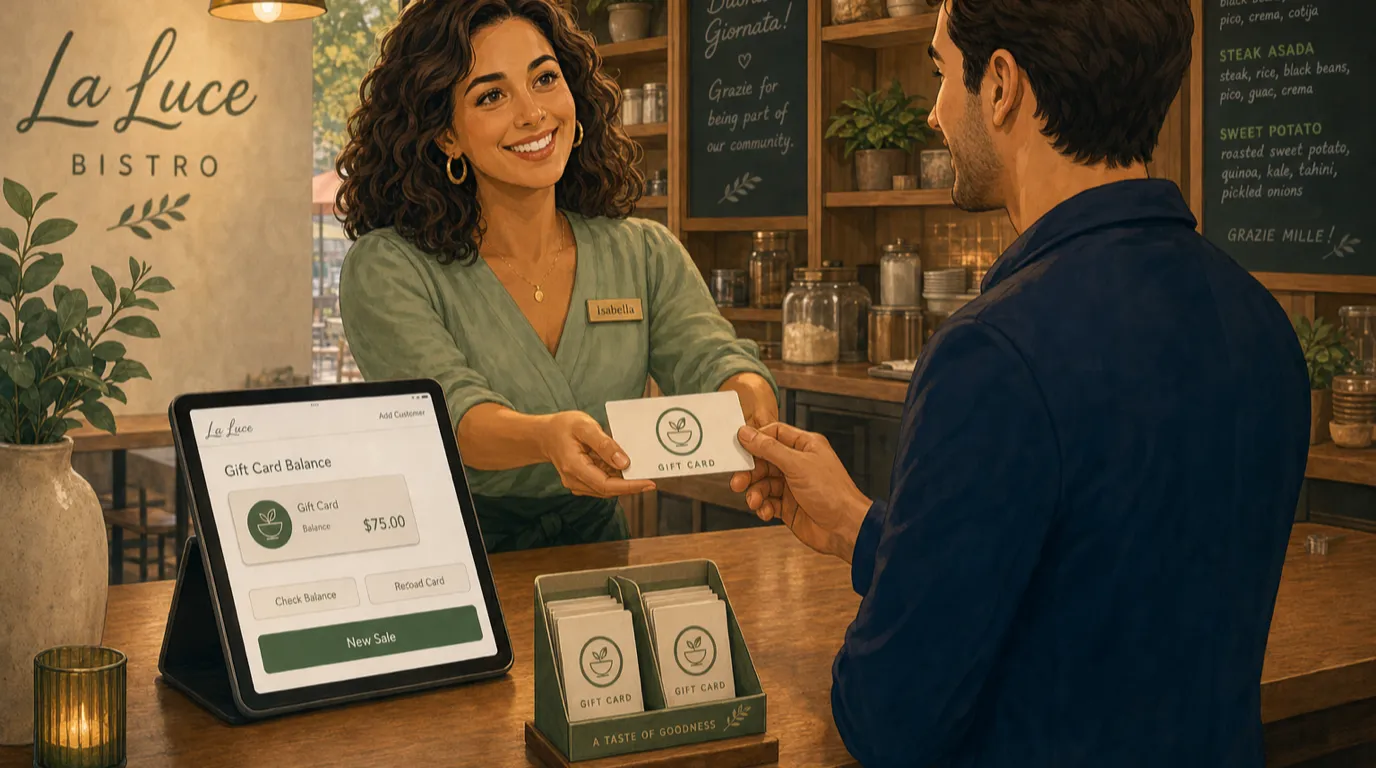
A card has a simple lifecycle, and each step needs to be fast. Issue and activate: a blank card has no value until it is sold and activated at the register, which is also your main fraud defense. Check balance: a guest should be able to ask what is left on a card and get an answer in seconds, without a manager or a phone call. Redeem: the card gets applied to a check like any other tender, full or partial. Partial balance: if the meal costs less than the card, the remainder stays on the card for next time; if it costs more, the guest pays the difference on another method. None of this should require a separate device or a workaround.
The reason this matters so much is friction. If activating a card means logging into a different portal, or checking a balance means calling a vendor, or redemption needs a manager override every time, your staff will stop offering cards and start treating them as a hassle. The programs that generate real revenue are the ones where a card is just another button at checkout, as routine as splitting a check. When the point of sale tracks balances natively and your team can issue, check, and redeem without breaking their rhythm, the program runs itself. When it does not, the cards gather dust.
Selling them: the part most restaurants neglect
Having gift cards available is not the same as selling them. Most restaurants stop at putting a stand on the counter and wonder why volume is flat. Selling takes a little deliberate effort, and the returns are high.
Start with placement and the staff prompt. A card display belongs where people pay and where they wait, by the register, at the host stand, near the door. But the single biggest lever is your team mentioning it. A server who says one line at check drop during the holidays (something as simple as offering a card as an easy gift) converts far better than any sign. Make it a habit during peak gifting windows, and consider a small staff incentive tied to card sales so the prompt actually happens.
Lean into the calendar. The late-November-through-December run is the big one and for many restaurants it is the majority of annual card volume, so stock up and promote hard. Then work the other gifting occasions the rest of the year: Valentine's Day, Mother's Day, Father's Day, graduations, even local events. And do not overlook the corporate and bulk channel. Local businesses buy gift cards in volume for staff rewards, client gifts, and holiday bonuses, and a single B2B sale can dwarf a week of counter sales. A simple note on your site that you sell bulk cards, plus an email to nearby offices in November, can open a channel most independents never touch.
The cleverest tactic is the bonus card. During the holidays, offer a deal like spend 50 dollars and get a 10 dollar bonus card, but structure the bonus to activate only in January or February. You bank the December cash, and you have pre-booked traffic for the slowest weeks of the year, exactly when you need bodies in seats. It is a discount, yes, but a discount that moves business from your busiest month into your deadest one, which is worth far more than its face value.
One more thing most restaurants get wrong: making digital cards hard to find. If a customer has to hunt through your site to buy an eGift, most will give up. Put a clear gift card link in your main navigation, your footer, and your social bios, and mention it in the confirmation emails you already send for reservations or online orders. The buyer is often someone who just had a great meal and wants to share it; catch them in that moment with a link that takes two taps, not a treasure hunt. The easier you make it to hand you money for a future visit, the more often people will.
Gift cards and loyalty are a team, not a choice
Operators sometimes ask whether they should run gift cards or a loyalty program. The answer is both, because they solve opposite problems. A gift card brings in cash now and recruits new diners. A loyalty program deepens the relationship with people who already visit. One is acquisition, the other is retention, and they reinforce each other.
Wire them together and the whole thing compounds. Let customers reload an existing gift card and earn loyalty points on the reload, turning a one-off card into a repeating prepaid habit. Use a holiday bonus card to pull lapsed regulars back, then let your loyalty program keep them once they return. Treat the gift card as the front door and loyalty as the reason to keep walking through it. The restaurants that get the most out of either are usually the ones running both in tandem rather than picking a side.
The legal traps to respect
Gift cards are regulated as stored value, and the rules are stricter than most operators assume. This is not the place to wing it, because the penalties and the goodwill damage both bite.
The big three issues are expiration dates, fees, and unclaimed balances. Many jurisdictions restrict or outright ban expiration dates and dormancy or inactivity fees, or require a long minimum period before any fee or expiry can apply. Separately, unclaimed-property (escheatment) laws in some places require businesses to hand over the value of long-unredeemed cards to the state rather than keeping it, which directly affects how you can count on breakage. The specifics vary by country and often by state or region, and they change, so the only safe move is to check your local consumer-protection and unclaimed-property rules or ask your accountant before you write any policy into your system.
For most independents the practical posture is conservative and customer-friendly: no fees, no aggressive expirations, clear terms printed on the card or receipt, and accurate books that track outstanding gift card liability as what it is, money you owe in food and service. That last point matters for your accounting too: outstanding card balances are a liability on your books until redeemed or recognized as breakage, not revenue you can spend twice. Keep that clean and the program stays an asset instead of a surprise.
Stopping the fraud before it starts
Gift card fraud in restaurants is usually low-tech, and a few habits shut down nearly all of it. The schemes fall into a handful of buckets.
Balance draining happens when someone obtains card numbers, by copying displayed cards or guessing sequential numbers, and spends the balance before the rightful owner does. The fixes: never display live, active card numbers; use cards with a PIN hidden under a scratch-off panel; and activate cards only at the moment of sale, so a copied number from an unsold card is worthless.
Refund fraud is an inside-or-outside scheme where a purchase is refunded onto a gift card and the card is then cashed out or sold. The fix is a firm rule: refunds never go onto gift cards without a manager, and gift card activity gets reviewed like cash. Counterfeit or tampered cards at the counter are caught by treating unactivated stock like cash, locking it up, and training staff to spot scratched or altered PIN panels. The throughline is simple: a gift card is cash once activated, so handle the inventory and the activation step with the same discipline you apply to the drawer.
A launch plan that fills your slow months
You can stand up a real program in a few weeks. Here is a sensible order.
Weeks 1 to 2: set the foundation. Confirm your point of sale handles gift cards natively, issue, balance check, redemption, partial balances, and turn the feature on. Decide your formats (sell both physical and digital), order physical stock with a concealed PIN, and write simple, customer-friendly terms after checking local rules on expiration and fees.
Weeks 3 to 4: merchandise and train. Put an attractive display where people pay and wait, add a gift card page to your website for digital sales and bulk inquiries, and train every staff member on the lifecycle and the fraud rules. Give servers one natural line to offer cards at check, and consider a small sales incentive.
Weeks 5 onward: promote on the calendar. Build your big push around the holiday season, layer in the other gifting occasions through the year, email local businesses about bulk cards before December, and run a bonus-card promotion structured to activate in your slowest weeks. Then watch the numbers and adjust.
What to measure
Track a handful of numbers so the program is managed, not just present. Outstanding liability is the total unredeemed balance you owe; watch it so it never surprises your accounting. Redemption rate tells you how much issued value comes back; the gap is your breakage. Average overspend, the amount of the check above the card value, shows the spending multiplier in action. And new-customer share, how many redemptions come from first-time diners, tells you how well the program is doing its real job of acquisition.
Run those numbers quarterly and the gift card program stops being a dusty rack and becomes what it should be: a low-cost source of upfront cash, free float, above-face spending, and a steady trickle of new diners arriving with money already in hand. Set it up so a card is just another button at the till, sell it like you mean it on the calendar, respect the legal rules, lock down the fraud, and let it quietly pad your slowest months. Then go put a display where your guests actually pay.
Read next: Restaurant Loyalty Programs: How to Build One That Pays Off and Restaurant Payment Processing Fees Explained and Restaurant Marketing: A Practical Playbook.