Restaurants close while showing a profit. It happens constantly, and it confuses everybody involved. The year-end statement says the business made money, the accountant is relaxed, and then a Tuesday in February arrives where payroll runs Thursday, the produce account is 40 days past due, rent cleared this morning, and the operating account holds 3,800 dollars. Nothing in that story requires bad food or empty tables. It only requires money to arrive in a different order than it leaves. Cash flow is that order, and managing it is a separate discipline from the restaurant accounting that tells you whether the month was profitable. Profit tells you the score. Cash tells you whether you get to keep playing.
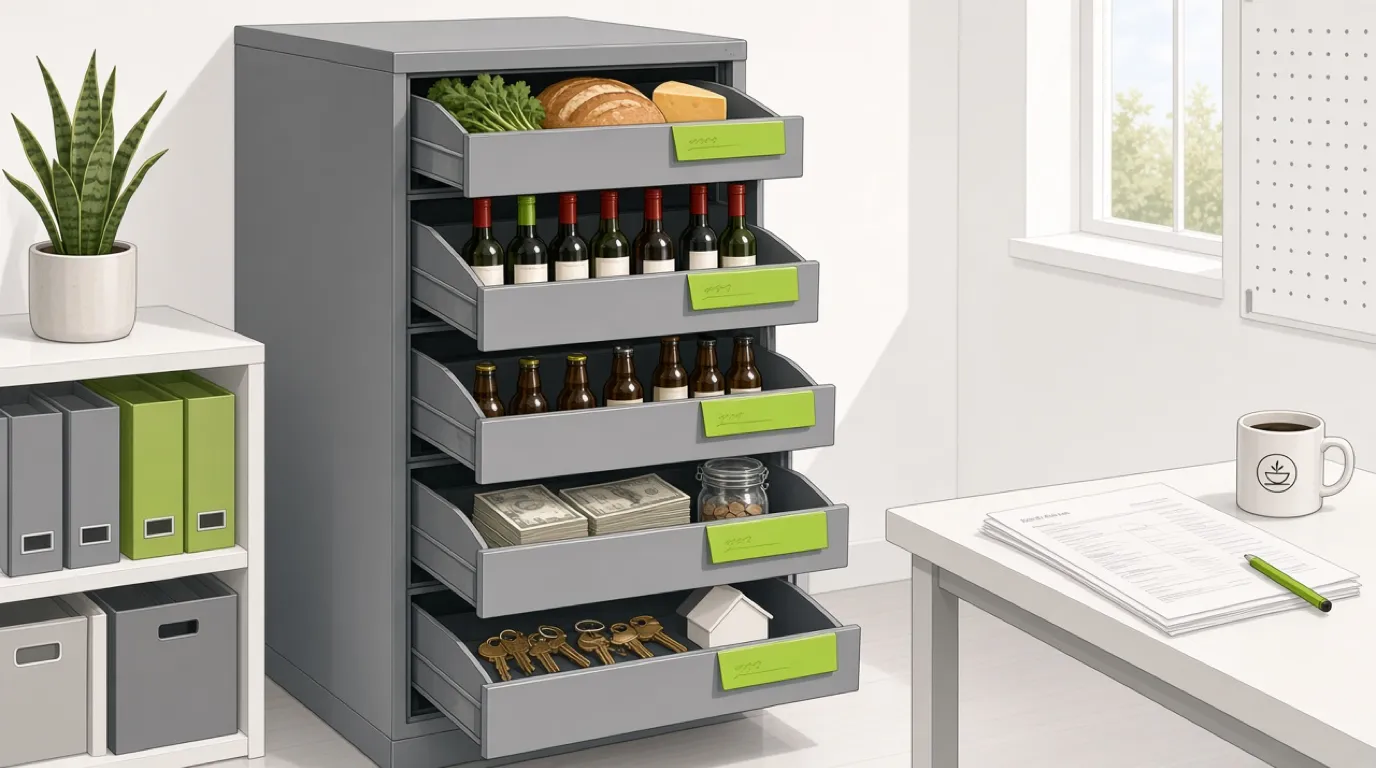
The encouraging part is that restaurants have unusually good cash characteristics when they are run deliberately. Guests pay at the moment of service, so you have almost no receivables, which is a luxury most businesses would trade a lot for. The pressure comes from the other side: food and labor consume cash on a rhythm that has nothing to do with your sales curve. Two levers matter more than everything else combined, and one of them is the walk-in. Money spent on product that has not sold yet is money you cannot use, which is why inventory control is a cash tool before it is a food cost tool. This guide covers the forecast, the levers, the warning signs, and what to do in the week when the numbers stop working.
Profit is an opinion, cash is a fact
Accrual accounting, which is what your profit and loss statement uses, records revenue when it is earned and expenses when they are incurred. That is the right way to understand whether the business model works. It is a terrible way to know whether Thursday's payroll will clear.
Look at what accrual accounting hides. Depreciation on your equipment is a real expense on the statement and moves no money at all this month. The loan payment on that same equipment moves 1,900 dollars out of your account and barely touches the profit line, because only the interest portion is an expense. A 30,000 dollar patio build is an asset on the balance sheet and a crater in your bank balance. Prepaid insurance, deposits, tax payments, owner draws: none of them behave the way the statement suggests.
So you need both. The profit and loss statement answers whether the restaurant is fundamentally viable, whether prime cost is under control, whether the menu prices work. The cash flow view answers a narrower and more urgent question: on any given Friday, is there money in the account to cover what is coming?
The operators who get into trouble are rarely the ones running at a loss and knowing it. They are the ones running a small profit while quietly funding growth, or a slow season, or a bad month, out of working capital, until the working capital runs out. That process is invisible on a monthly statement and obvious on a weekly cash forecast.
Where the money actually goes, and when
Map the calendar before you try to manage it. In a typical independent restaurant, cash moves on four different clocks.
Sales come in almost immediately, but not instantly. Cash and most card payments land within one to three business days. Weekend sales often settle Tuesday. If you run a lot of corporate accounts, catering, or event business with invoiced terms, a slice of your revenue is arriving 30 to 60 days late, and that slice behaves nothing like the rest.
Labor leaves on a fixed cycle you cannot bend much. Weekly or biweekly, plus payroll taxes, and the cycle takes no interest in whether last week was slow. For most full-service operations that is 28 to 36 percent of revenue departing on a schedule set by law and habit.
Food and beverage leave on supplier terms, which vary wildly. The big broadline distributor might give you 14 or 30 days. The farmer at the market wants cash today. The wine rep may offer 30 days and a discount for paying in 10. Each of these is a different cash position, and most operators have never looked at the blended average.
Fixed costs leave in a lump, usually on the first. Rent, insurance, licenses, software, loan payments, often 15,000 to 40,000 dollars hitting within 72 hours of the month turning over, at exactly the point of the month when your account is thinnest if the previous month ended slow.
That last collision is the one that surprises people. The first week of the month is structurally your most dangerous, and January and February are structurally your most dangerous months, and if your lease anniversary or insurance renewal lands there too, you have built a trap without noticing.
Build a 13-week cash flow forecast
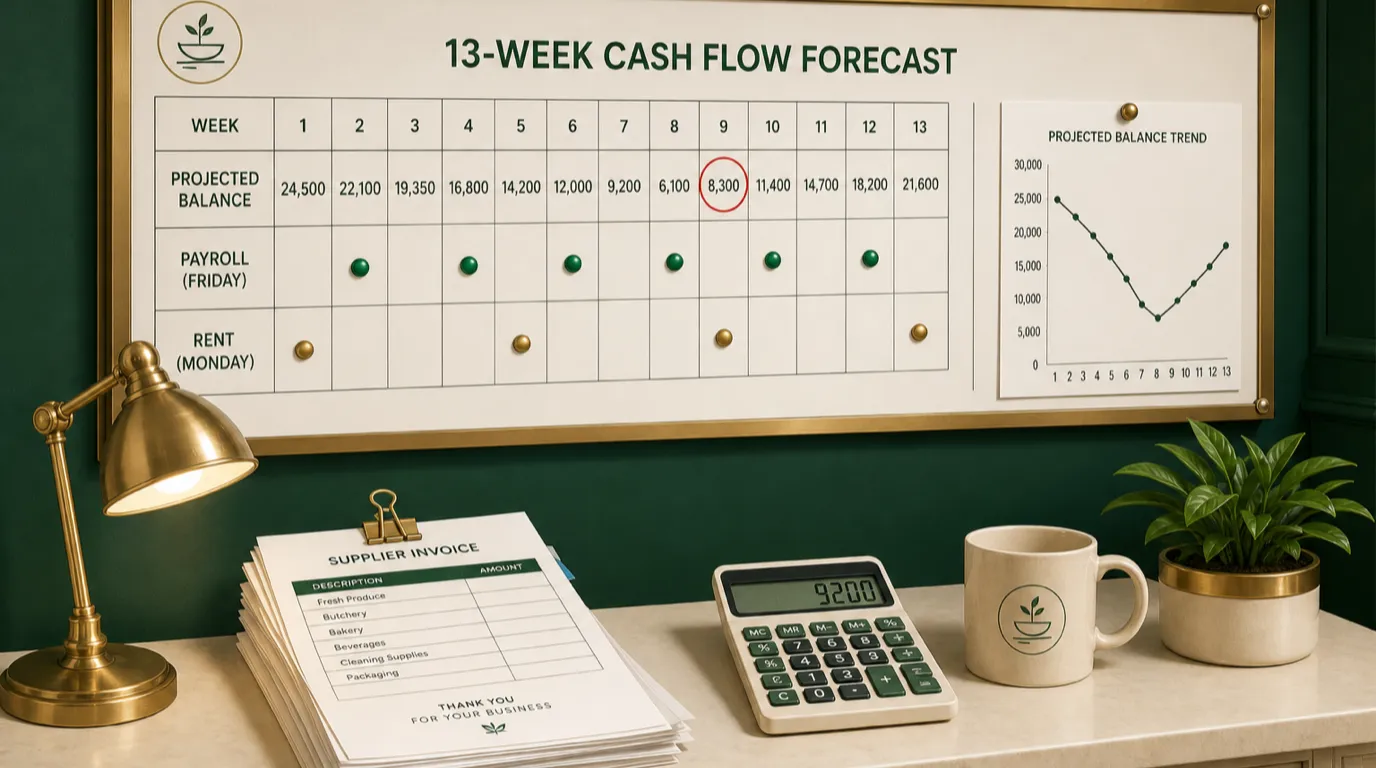
Thirteen weeks is the standard for a reason. It is one quarter, far enough ahead to see a slow season coming and act, short enough that your estimates are not fiction. It fits on one screen. Restructuring specialists use it because it is the tool that tells you the truth fastest.
Set up a spreadsheet with 13 columns, one per week. Rows in three blocks.
Start with the opening bank balance, the real one, from the actual account. Then cash in: card settlements (use last year's same week adjusted for what you know), cash sales, catering deposits, event balances, gift card sales, anything else. Then cash out, listed by when the money leaves rather than when the expense was incurred: payroll and payroll taxes on their real dates, each major supplier on its real terms, rent, utilities, insurance, loan payments, software, marketing spend, sales tax remittance (this one catches people, that money was never yours), and owner draws.
Closing balance equals opening plus in minus out, and it becomes next week's opening. That is the whole model.
The magic is not the arithmetic, it is what shows up. A restaurant doing 90,000 dollars a month, comfortably profitable, will often find week 6 or week 7 dipping to 2,000 dollars because a quarterly insurance payment lands the same week as a slow post-holiday stretch. Seeing that seven weeks early gives you five or six cheap options: move the insurance to monthly billing, delay a small equipment purchase, push a supplier payment three days, run a promotion in week 5. Seeing it on the day it happens gives you one expensive option, and that option usually has a factor rate attached.
Update it every Monday. Fifteen minutes, actuals typed over estimates, the far end extended by one more week. The habit is worth more than the precision. Your first forecasts will be wrong by 15 or 20 percent; by the sixth week you will be uncannily close, because you will have learned what your own business actually does.
Your cash conversion cycle, and why restaurants win it
The cash conversion cycle measures how long your money is trapped between paying for something and collecting on it. Inventory days plus receivable days minus payable days. Most businesses run positive numbers, sometimes 60 or 90 days, which is why they need financing simply to exist.
Restaurants can run it negative. Say you hold seven days of food inventory, collect from guests in two days, and pay suppliers in 30. Seven plus two minus 30 gives you negative 21. You are, in effect, being financed by your suppliers for three weeks. That is a structural gift, and it is why a busy restaurant with terrible margins can feel flush while a profitable one that pays cash on delivery feels broke.
Three things destroy the advantage. Holding too much inventory, because every extra day of stock is a day your cash sits on a shelf getting closer to the bin. Paying suppliers faster than you need to, which happens by accident more than by choice, usually because nobody is tracking terms. And growing quickly, since growth consumes cash before it produces it, which is the specific trap that kills successful second locations.
Calculate yours this quarter. Inventory days is average inventory value divided by daily food cost. If you carry 14,000 dollars of stock and use 2,000 dollars a day, that is seven days. Payable days is what you owe suppliers divided by daily purchases. Then look at the gap and decide whether it is working for you or against you.
Lever one: inventory is cash on a shelf
Walk into your walk-in and look at it as a bank statement. Every case, every bottle, every bag of flour is money you already spent and have not earned back.
Most independent restaurants carry substantially more than they need. Ordering habits calcify, par levels get set during a busy season and never revised, and the reflex to over-order is understandable because running out of the special at 8pm is a visible failure while 4,000 dollars of slow-moving stock is invisible. Cutting inventory from 10 days to 6 in a restaurant using 2,000 dollars of product a day frees 8,000 dollars of cash, permanently, without selling a single extra cover.
Practical moves that work: count weekly rather than monthly, because monthly counts are too slow to change behavior. Set par levels per item from actual usage, not memory. Split orders with your main supplier into two smaller deliveries a week instead of one large one, which cuts average holding and usually reduces spoilage at the same time. Watch the slow movers: the specialty liqueur bought for one cocktail two summers ago is not inventory, it is a decoration.
Beverage deserves separate attention, because wine and spirits are where cash goes to hibernate. A cellar is an asset in the accounting sense and dead money in the cash sense. If a bottle turns twice a year, ask whether it earns its place. The bar program is often the biggest single pool of recoverable cash in a restaurant that feels tight.
Lever two: supplier terms are negotiable, and nobody asks
Terms get set the day you open, usually when you have no leverage and no track record, and then they sit untouched for years while the relationship matures. That is a mistake worth correcting.
After twelve months of paying on time, you have something a supplier values: predictability. Ask. Moving your largest supplier from 14 days to 30 on 25,000 dollars of monthly purchases hands you roughly 13,000 dollars of additional working capital and costs you nothing. Reps have latitude on terms more often than they let on, particularly if you are consolidating spend with them or committing to volume.
Be strategic rather than greedy. Stretch terms with large distributors that are set up for it; pay small local producers promptly, both because they cannot absorb it and because that relationship gets you the first pick of the good stuff. Never take terms silently by simply paying late, which is how you lose credit lines and, in a small market, reputation.
Do the early-payment math before accepting a discount. A two percent discount for paying in 10 days instead of 30 is a 36 percent annualized return on that money, which is excellent if you have surplus cash and terrible if taking it forces you to borrow. That is the whole decision, and it changes month to month.
One structural fix is worth more than any negotiation: stagger your due dates. If four major suppliers all bill on the first, ask two of them to move to the fifteenth. Same money, half the concentration, and the first week of the month stops being a cliff. Our procurement and vendor management guide goes further into structuring these relationships.

Lever three: pull your money in sooner
You cannot make guests pay before they eat, but there is more room here than most operators use.
Check your card settlement speed. Some processors fund in one business day, others take three, and a few hold weekend volume until midweek. On a restaurant doing 8,000 dollars a day, two extra days of float is 16,000 dollars permanently parked at your processor. Ask what your funding timeline is; if it is slow, that alone can justify switching. Modern restaurant payment processing generally funds faster than legacy merchant accounts, and the difference compounds every single day.
Take deposits on anything booked in advance. Private events, large parties, catering: 25 to 50 percent up front is standard, accepted by clients, and it converts a future receivable into cash today. It also cuts no-shows dramatically, which is a second benefit that shows up in the same line.
Invoice corporate accounts the day of the event, not at month end. A five-day delay in sending the invoice is a five-day delay in getting paid, and nobody pays faster than you ask. Put terms in writing, follow up at day 25, and stop extending credit to anyone who has burned you twice.
Gift cards are prepaid revenue, which is the most attractive cash in hospitality: you hold the money now and deliver the food later, and a predictable slice is never redeemed. December gift card sales are the reason many restaurants survive January.
Lever four: match labor to the actual curve
Labor is your largest controllable outflow and the one with the shortest reaction time. You cannot change rent this month. You can change next week's schedule on Thursday.
This is not about cutting people. It is about the gap between the schedule you wrote from habit and the demand your POS data actually shows. Most restaurants are overstaffed for the first 90 minutes of a shift and understaffed for the peak. Pull the sales-per-hour report for the last eight weeks and build the schedule against it. Staggered starts, one prep cook coming in at 10 instead of everybody at 9, tend to recover 3 to 6 percent of labor cost without anyone feeling squeezed.
Watch the payroll calendar for the three-payroll month. If you pay biweekly, twice a year a month contains three payrolls instead of two. Operators discover this the hard way roughly once. Mark those months in the forecast now.
Overtime is a cash leak with a compounding habit attached. It usually signals a scheduling problem or an unfilled position rather than genuine demand, and at time and a half it is the most expensive way to buy labor. Our labor cost guide covers the control side in more depth.
Seasonality and the reserve you keep refusing to build
Every restaurant has a season, and most operators know theirs precisely. A beach town does 60 percent of its year between June and September. A business district dies in August and again between Christmas and mid-January. University neighborhoods empty out on a schedule you can set a watch to.
Knowing it is not the same as funding it. The discipline is to treat the strong season as the source of the weak season's cash, which means transferring a fixed percentage of strong-month revenue into a separate account and refusing to touch it. Two to four percent of revenue during peak months, moved automatically, builds a genuine cushion over one cycle.
How much should sit there? Three months of fixed costs is the textbook answer and is achievable for a mature operation. If your fixed costs run 22,000 dollars a month, that is 66,000 dollars. Most independents hold nothing like this, so treat it as a target to build toward rather than a standard to feel bad about. Even one month of fixed costs converts a crisis into an inconvenience.
Separate account, separate bank if you lack willpower. Money that is visible in the operating balance gets spent on an opportunity that seemed urgent in April.
The weekly dashboard, and the signals that come early
Cash problems announce themselves weeks ahead if you are watching the right things. Five numbers, every Monday, fifteen minutes.
Bank balance, and the direction it has moved over four weeks. Days of cash on hand, which is your balance divided by average daily cash outflow: under 14 days deserves attention, under 7 deserves action this week. Accounts payable aging, specifically what is past 30 days. The 13-week forecast's lowest projected point. And prime cost as a percentage of sales, since a drift there will become a cash problem in about six weeks.
The early warnings are behavioral more than numerical, and operators recognize them instantly: paying suppliers by choosing which ones can wait, using a personal card for a food order, watching for a deposit to clear before releasing payroll, taking a merchant cash advance offer seriously, or stopping yourself from ordering product because of the balance rather than the par level. Any one of those means the forecast should have been built two months ago. Build it now anyway.
Tie these into the broader numbers you already track. Our restaurant KPI guide covers the operational metrics; cash sits alongside them, not underneath them.
When cash gets tight, in order
There is a correct sequence, and following it keeps a squeeze from becoming a spiral.
First, get the exact picture. Bank balance, everything owed and when, everything coming in and when, for the next 30 days. Fear is worse than arithmetic in almost every case, and you cannot triage what you have not written down.
Second, stop discretionary outflow immediately. Marketing that is not producing measurable covers, the equipment purchase that can wait a quarter, the software nobody logs into, owner draws. This is the cheapest money available and it requires nobody's permission.
Third, work the receivable side. Call the corporate account that is 45 days out. Push catering deposits. Sell gift cards with a promotion attached.
Fourth, talk to suppliers before you miss a payment, not after. A call that says "I can pay 60 percent Friday and the rest on the 20th" preserves a relationship. Silence followed by a bounced payment ends one. Suppliers deal with this constantly and would overwhelmingly rather have a plan than a surprise.
Fifth, look at inventory as a source of cash: order minimally for two weeks and eat the walk-in down. This is genuinely uncomfortable and it works, often freeing several thousand dollars inside a fortnight.
Only then consider borrowing, and match the instrument to the gap. A line of credit for short timing gaps is the right tool and should be opened while things are good, since banks lend to businesses that do not appear to need it. Equipment financing for equipment. An SBA loan for structural needs. A merchant cash advance is the last resort and often the beginning of the end, with effective annualized rates between 60 and 100 percent and a repayment mechanism that takes a fixed slice of daily card sales precisely when sales are weakest. Our restaurant financing guide breaks down each option properly.
If you take one thing from all of this, make it the Monday habit. Open the spreadsheet, type in last week's actuals, extend one more week, and look at the lowest number in the next quarter. Most restaurant cash crises are not caused by a bad business; they are caused by a predictable event that nobody looked far enough ahead to see. Thirteen weeks of visibility turns almost all of them into scheduling problems.
Read next: Restaurant profit and loss statements, restaurant financing, and restaurant prime cost.