Almost every list of ways to increase restaurant sales has the same problem: it hands you thirty tactics in no particular order and leaves you to guess which one is worth doing on a Tuesday in your dining room. Some of those tactics cost nothing and pay back this week. Others need a marketing budget, three months, and a bit of luck. Telling them apart is the actual skill, and it starts with knowing which number in your business has the most slack in it, which is a question your restaurant POS system can already answer if you go looking.
So this is not a listicle. It walks the three levers that produce every dollar a restaurant takes, shows you how to work out which one is cheapest for you specifically, and then goes through the moves under each. Some of it is service and menu work you can start on tomorrow. Some of it involves shifting orders onto channels you actually own, like your own mobile ordering and e-menu instead of somebody else's app. All of it comes back to arithmetic in the end.
Start with the arithmetic, not the tactics
Restaurant revenue is three numbers multiplied together. How many people you serve, how much each one spends, and how often they come back. That is it. Every tactic you have ever read about is really an attempt to move one of those three, and most of them move it by a percent or two.
Put real figures on it, because the scale surprises people. Take a 60-seat bistro serving 900 covers a week at an average check of $28. That is $25,200 a week, call it $1.3 million a year. Now suppose you do nothing about guest counts at all and simply lift the average check by $2, from $28 to $30. Same guests, same seats, same rent. That is $1,800 more a week and roughly $93,600 a year.
To earn that same $93,600 from guest numbers instead, you would need to find 64 extra covers every single week, which is about 7 percent more people through the door, week in and week out, forever. One of those two projects is a menu and service exercise you can run in a month. The other is a sustained marketing campaign. They are worth the same money. That asymmetry is the single most useful thing to understand about growing sales, and it is why I would always start at the check before starting at the door. Our piece on average check goes deeper into measuring it properly.
Work out which lever is cheapest for you
The three levers are not equally slack in every restaurant, and the whole point is to find yours before spending anything. Three quick diagnostics will tell you.
First, look at occupancy by day and by service, not as a weekly average. A weekly average of 70 percent hides the truth that Saturday runs at 95 and Tuesday runs at 40. If that is your shape, your growth is not in a busier Saturday, because Saturday is nearly full and the only thing left there is faster turns. Your growth is in the forty empty seats on Tuesday. Second, look at the spread of check sizes rather than the mean. If a third of your tables never order a drink or a dessert, that is a service and menu problem sitting in plain sight. Third, look at how many of last month's guests you have any way of contacting again. If the answer is none, frequency is a lever you do not currently own at all.
Run those three and one of them will be obviously worse than the others. That is where to start. It also tells you what not to do: there is no sense running a discount campaign to fill a Saturday that is already full, which is a mistake I have watched restaurants make more than once. If you want a structured way to keep score on all of this afterward, our guide to restaurant KPIs sets out the numbers worth tracking, and reading your P and L statement shows where they land.
Sell more to the guests already sitting down
The cheapest sales in any restaurant belong to people who are already at a table with a menu in their hands. They have decided to spend money. They have chosen you. Nobody has to be persuaded of anything. And yet this is where most restaurants leak the most.
The reason is usually that upselling has been taught as a question, and questions invite no. "Would you like anything to drink?" gets a shrug and tap water. "Still or sparkling?" gets one of two answers, both of which are a sale. "Any dessert for anyone?" at a table of four people staring at cleared plates gets a collective no, because nobody wants to be the only one. Bringing the dessert menu before you clear, and mentioning the one thing the kitchen is proud of tonight, gets two orders. None of this is pressure. It is just the difference between offering a choice and asking permission.
The other half is timing, which servers can only get right if the room lets them. A drinks order taken at minute two sells one round; taken again as the first round runs low it sells two. If your servers are running so hard they only reach a table twice, that is a staffing and rotation problem dressed up as a sales problem. Getting this consistent is training work rather than inspiration, and our staff training plan covers how to drill it, while restaurant customer service covers the tone that keeps it from feeling like a sales pitch. Handhelds help too, because a server who can send an order from the table without walking to a terminal gets more passes through the section, which is much of the argument for tableside ordering.
Make the menu do the selling
Your menu is the only salesperson that talks to every guest, never has a bad night, and costs nothing per shift. Most menus are still laid out the way the printer suggested.
Two jobs here, and they are different. The first is knowing which dishes actually make you money, which means putting every item into a grid of popularity against contribution margin and then acting on the four corners: promote the popular and profitable, reprice or reposition the profitable but ignored, rework the popular but thin, and cut the rest. That last one is the hardest and the most valuable, because a menu with 46 items has a slower kitchen, more waste, and more guests defaulting to the safest choice. The full method is in menu engineering, and food cost percentage gives you the input it needs.
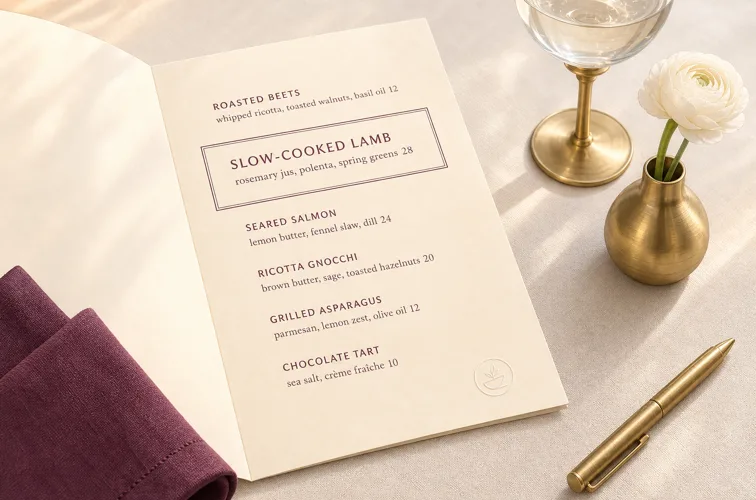
The second job is physical placement, which is where the easy money hides. Guests do not read a menu top to bottom; their eye lands in a predictable place and moves in a predictable pattern, so what sits in that spot matters more than what is written anywhere else. Boxing an item, giving it space, and describing it in a sentence that mentions how it is made will move it noticeably. Listing prices in a tidy right-hand column invites guests to scan the column and pick the cheapest, so run prices into the description instead. Our pieces on restaurant menu design and menu pricing strategy cover both halves properly.
Find turns without rushing anybody
If your busy services are genuinely full, more sales at those times can only come from serving more people in the same hours. The instinct is to hurry guests, which is exactly wrong, because a rushed table spends less and does not come back. The time to attack is the dead time nobody is enjoying.
Look at where the minutes actually go. There is the gap between a party leaving and the table being cleared and reset. There is the gap between the table being ready and the next party being sat, which is a host problem. There is the wait for a check after guests have signaled they are finished, which on a busy night can run ten minutes and is pure loss for everyone. And there is the wait to pay once the check arrives. Each of those is invisible to guests as service quality but adds up to a whole seating across twenty tables on a Saturday. How the room is laid out sets the ceiling on how much of it you can recover, which is why floor plan layouts are worth revisiting before anything else.
Fixing the gaps themselves is mundane and effective: pre-bus through the meal so a table needs thirty seconds rather than four minutes to reset, put the check-and-pay step at the table so it takes one visit instead of three, and give whoever runs the door a live view of which tables are nearly done. The mechanics are in table turnover rate, the tooling is in table management systems, and the door skill itself is in restaurant host responsibilities.
Payment deserves singling out, because it is the one gap guests feel as well. A table that waits ten minutes for a check and another five to pay has had its last impression of you shaped by admin, and you have lost a quarter of an hour of the seat. Taking payment where the guest is sitting fixes both at once, which is the practical reason to care about how restaurant payments are taken.
Fill the seats you are already paying for
Here is the least glamorous and most reliable growth in the business. You pay rent on every seat for every hour you are open, whether somebody is in it or not. A restaurant at 45 percent occupancy on a Tuesday has already paid for the empty half.
Off-peak demand responds to a reason, not a discount. "Twenty percent off Tuesdays" trains your regulars to stop coming on Friday and pay you less on Tuesday, which is worse than doing nothing. A reason to come on a Tuesday specifically is different: a set menu at a fixed price that only runs then, a supplier evening, a single course from a guest kitchen, a wine flight, a quiz. The guest gets something they cannot get on Saturday and you have not touched your Saturday prices. Our piece on happy hour covers the version of this that works and the version that just gives margin away. The longer version, including how to tell whether you filled a Tuesday or simply emptied a Friday, is in how to fill empty tables on slow nights.
The other kind of empty seat is the one created by your own booking process. Walk-ins turned away while three tables sit held for a no-show, parties who leave because nobody told them the wait was twenty minutes, tables held past a grace period nobody agreed on. That is demand you already had and lost at the door. Tightening it up is covered in waitlist management and in choosing a restaurant reservation system that actually releases tables.
Make your regulars come back more often
Frequency is the lever most independents never touch, and it compounds in a way the others do not. A guest who visits monthly at a $28 check is worth $336 a year. Get them to come twice a month and they are worth $672. You did not acquire a single new customer, and you spent nothing on reach.
The precondition is being able to contact them, and this is where most restaurants discover they have served forty thousand people and can reach none of them. Every channel worth having starts with a list: emails captured at booking, at online ordering, at checkout, through a loyalty sign-up. Then the point is to use it sparingly and specifically. A monthly note about what changed on the menu is welcome. A weekly discount blast trains people to wait for the discount and to ignore you in between. The mechanics are in restaurant email marketing, the plumbing that holds the guest record is in restaurant CRM, and the structure that gives people a reason to identify themselves is in loyalty programs.
Two adjacent things belong here. Gift cards are frequency bought by somebody else: the buyer pays now, a new guest arrives later, and they typically spend past the card's value. And reviews are frequency's public face, because the way you answer a bad one is read by hundreds of people deciding whether to book, which is the argument in review and reputation management.
Stop renting your online orders
Third-party delivery is genuinely useful for reach and genuinely brutal on margin, and the mistake is treating it as one decision rather than two. Being on the apps is a reasonable choice. Letting them own the guests who found you there is not.
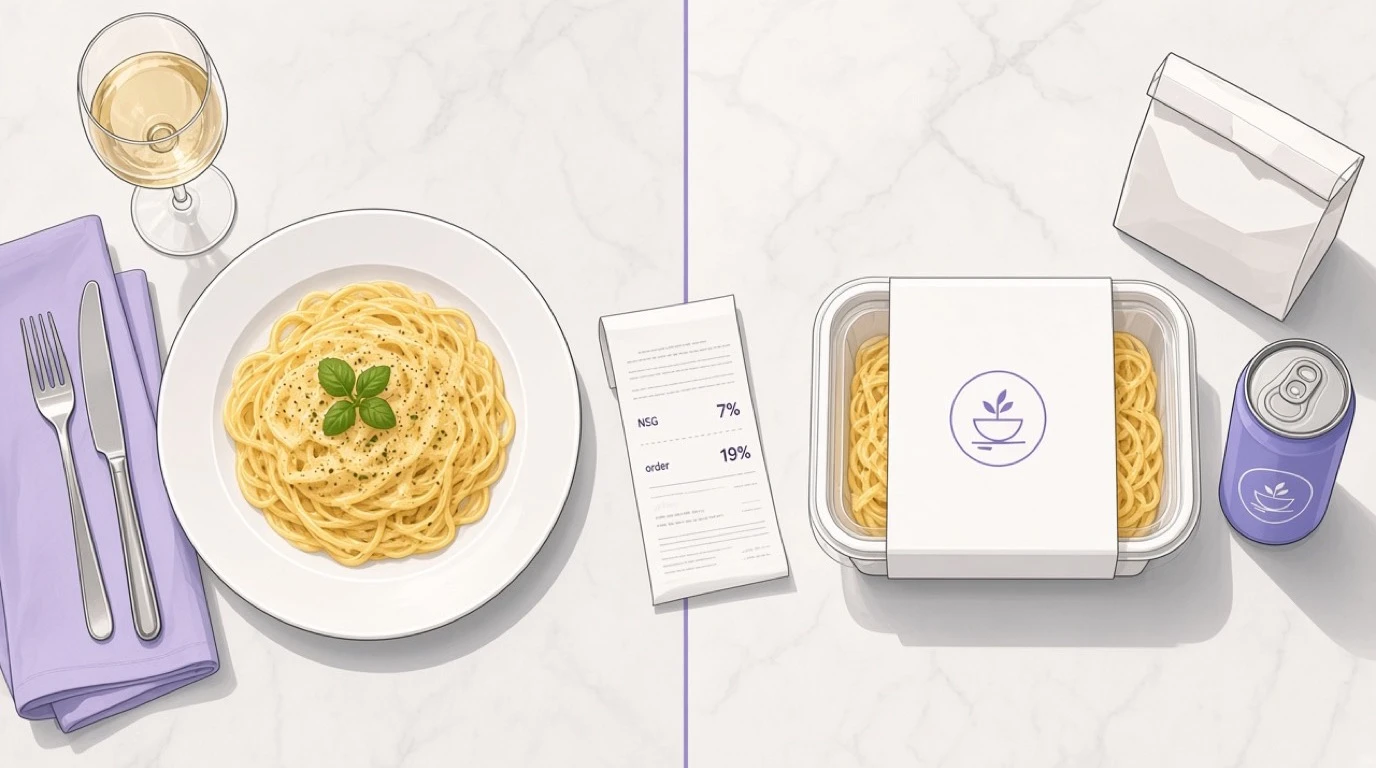
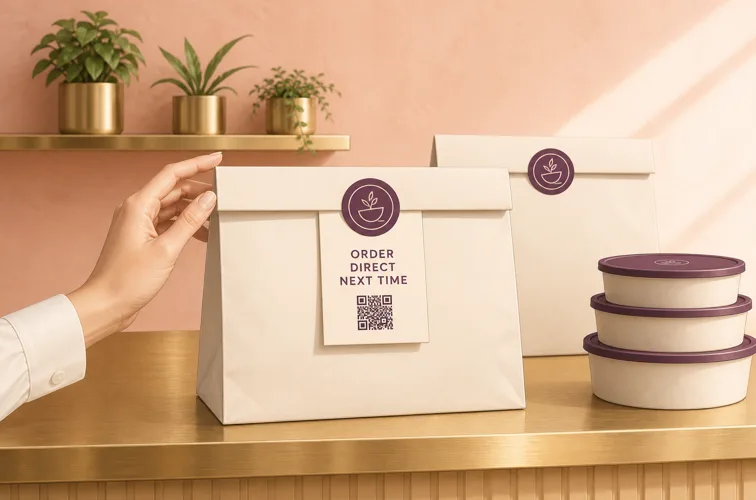
The arithmetic makes the point. A $30 order through a marketplace at 30 percent commission leaves you $21. Take $9 of food cost out and you are holding $12 before anybody has been paid to cook or pack it. The identical order through your own site leaves you $21 after food cost, because there is no commission. Same guest, same food, nearly double the contribution. You do not have to leave the marketplaces to fix this; you have to give people a reason to order direct the second time, which means an insert in the bag, a better price on your own channel, and a site that takes an order in under a minute. That is what POS with online ordering is for, and third-party delivery works through the commission math in full.
If you have no direct channel at all yet, that is the gap to close first, and building a restaurant website walks through it. Our own restaurant website builder exists for exactly that, and for a counter-led operation the same logic runs through a takeaway POS system.
The same instinct applies in the room. QR code menus and self-ordering kiosks both tend to lift average check for an unglamorous reason: a screen offers the side and the extra shot every single time, and it never gets too busy to ask.
Use capacity you have already paid for
You are paying for a kitchen, a room, and a team whether or not they are producing at any given hour. Extra revenue lines that use that idle capacity carry unusually good margins, because the rent is already sunk.
Private events and catering are the clearest example. A dining room closed on Monday, or empty between two and five, can host a party or produce a corporate lunch order using staff you already employ. The margins are strong and the revenue is booked in advance, which is a rare thing in this business. The operational detail matters more than the idea, and that is in catering and private events. Seasonal peaks are the same trick with a calendar attached, and the festive season covers planning for the weeks where demand exceeds your seats.
Beyond that, most kitchens can sell something that outlives the meal: the sauce, the bread, the coffee beans, a meal kit. Small numbers individually, near-zero marginal cost, and it keeps your name in somebody's kitchen. A delivery-only second concept run from the same line is a bigger version of the same argument, with real caveats, and those are in ghost kitchens. On the drinks side, a beverage program built with the pour cost in mind is often the fastest margin available in the building, which is what bar pour cost is about.
Be findable at the moment somebody decides
Most restaurant decisions are made on a phone within an hour of eating, by somebody who has not chosen you yet and is looking at a map. If you are not there, credible, and open, the tactics above never get a chance.
The unglamorous work wins here. Accurate opening hours, including the holiday exceptions. A current menu with current prices. Photographs of the actual food rather than stock images. Enough recent reviews that you look alive, and replies to them that sound like a person. This is not a marketing campaign, it is maintenance, and it is worth more than most paid advertising an independent can afford. Our guide to restaurant local SEO lays out the specifics.
Social media belongs here as a supporting act rather than the main event. It is very good at reminding people who already know you that you exist this week, and much worse at conjuring new demand from nowhere, so budget your effort accordingly. Restaurant social media marketing is honest about which parts pay. And if you want the whole picture in one place rather than channel by channel, restaurant marketing is the overview.
Raise prices properly and stop discounting reflexively
Price is the fastest lever in the building and the one people are most frightened of, largely because they imagine raising prices as a single announcement rather than as ordinary maintenance.
Do the discount arithmetic once and you will never run a blanket promotion casually again. Suppose your gross margin is 70 percent, so a $10 dish costs you $3 to make. Knock 20 percent off the price and you now take $8 with the same $3 cost, so your gross profit per dish drops from $7 to $5. To make the same money you must sell 40 percent more of them. Forty percent. That is what a cheerful "20 percent off everything this month" actually asks of your kitchen, and it almost never delivers it.
Raising prices is better handled as small, frequent, uneven adjustments than as an annual jolt. Move a few items at a time rather than the whole card, protect the two or three dishes guests use to judge whether you are expensive, and use ranges: a small increase on the popular-and-profitable items is invisible, while the same increase on your best-known dish is the thing people mention. And know that price and portion are two dials, not one. Our menu pricing strategy guide covers the method, and prime cost tells you how much room you actually need to find.
Measure what moved, and a 90-day order of operations
The reason most of this fails is not that the ideas are wrong. It is that six things get changed at once, sales move four percent, and nobody can say which change did it, so none of it becomes permanent.
Change one thing at a time and give it two full weeks, because a single weekend tells you nothing. Track a small set of numbers weekly rather than a dashboard of forty: covers by service, average check, gross margin percentage, and the share of orders on channels you own. Your end-of-day totals are the raw material, and the Z report explains what to pull from them. If the numbers are hard to get at all, that is worth solving first, and restaurant management software covers what good reporting looks like. Bookkeeping that keeps up is the other half, which is what our restaurant accounting tools are for.
If you want a running order, this is the one I would use. Weeks one and two: measure, and pick your slack lever using the three diagnostics above. Weeks three to six: the free work, which is service timing, drink and dessert offers, pre-bussing, and the check-and-pay step. Weeks five to eight, overlapping: menu work, meaning the popularity and margin grid, cutting the dead items, and repositioning what is left. Weeks seven to ten: start capturing contact details on every channel and send precisely one useful thing. Weeks nine to twelve: pricing adjustments, now that you know what sells, plus one off-peak reason to visit. Nothing here needs a budget, and by week twelve you will know which of your three levers actually had slack in it. Restaurant improvement ideas has more of the small stuff worth queueing behind it.
Read next: restaurant profit margins, because sales you cannot keep are not much use, and restaurant labor cost, since the fastest way to lose a sales gain is to staff up for it too early.