Most allergen mistakes are not caused by a careless cook. They are caused by information that was correct three weeks ago. A supplier changed the oil in a product, a special went on the board without going through the recipe file, a server asked a chef mid-service and got a shrug, or a guest read a printed menu that had been reprinted twice since the recipe changed. Allergen management is a data problem long before it becomes a kitchen problem, which is why the most useful place to start is wherever your menu information actually lives, whether that is a printed card, a spreadsheet, or a digital menu guests read on their own phones.
What follows is the operational version: how to build the one document everything else depends on, how to keep it true when the menu moves, and how to get an allergen instruction from a table to the pass without it evaporating on the way. It ends with the records that prove you did all of it. The kitchen half of the problem matters too, and flagging an allergen order on the line where cooks actually look, rather than on a paper ticket nobody re-reads, is what a kitchen display system is for.
One caveat before any of it. The rules differ by country and they change, so treat what follows as operational practice rather than legal advice, and confirm the specifics with your local food authority or environmental health officer. Nothing here is a substitute for that conversation.
What the rules generally ask of you
The detail varies by market but the shape is consistent. Regulators define a list of allergens you must be able to declare, they require the information you give to be accurate and current, and they distinguish between food sold loose and food you have packed yourself before selling it.
Across the EU and the UK the list runs to fourteen: cereals containing gluten, crustaceans, eggs, fish, peanuts, soybeans, milk, tree nuts, celery, mustard, sesame, sulphur dioxide and sulphites above ten parts per million, lupin, and molluscs. In the United States the list is nine: milk, eggs, fish, crustacean shellfish, tree nuts, peanuts, wheat, soybeans, and sesame. Same principle, different scope, which matters if you operate in more than one country or if your menu travels.
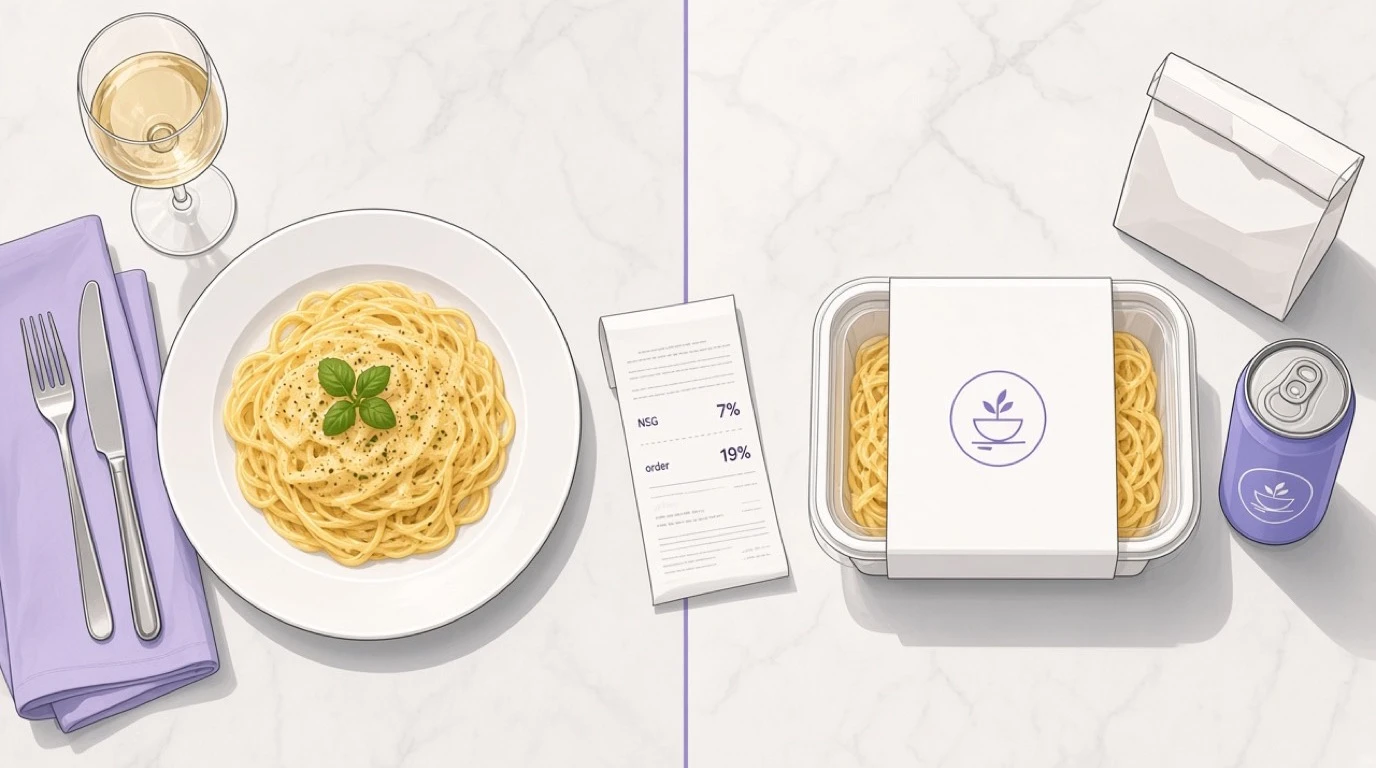
The distinction that trips people up is loose versus pre-packed. A dish plated to order is loose food, and for that you generally need to be able to give accurate allergen information on request, in writing or verbally, with clear signage telling guests to ask. Something you wrap in advance and sell from your own counter, a sandwich or a salad or a tray of pastries, is usually treated as pre-packed for direct sale, and that typically requires a full ingredient list on the label with allergens emphasised. If you run a takeaway counter or a retail fridge alongside your restaurant, you probably have both regimes in the same building, which is worth knowing before an inspector points it out. The wider food safety framework this sits inside is covered in our guide to food safety and HACCP.
The allergen matrix is what everything else hangs on
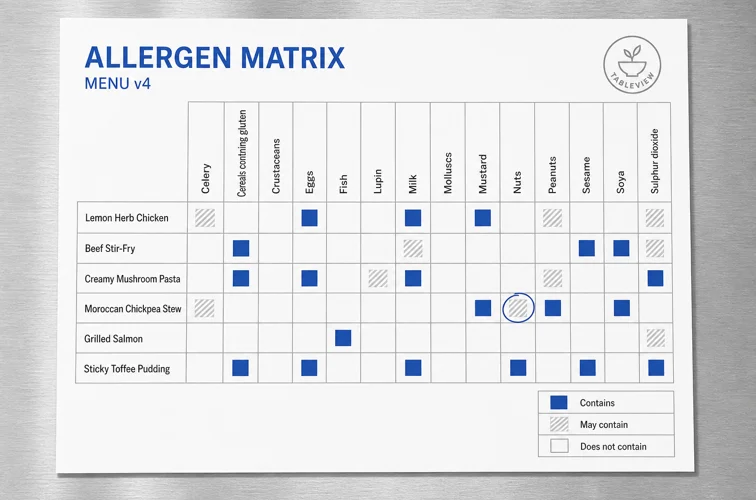
If you take one thing from this, make it the matrix. It is a simple grid: every dish currently on your menu down one side, every regulated allergen across the top, and in each cell one of three answers.
Those three answers matter, and most matrices only have two. "Contains" means the allergen is an intended ingredient. "Does not contain" means it is genuinely absent, including from every sub-recipe. The third, the one people leave out, is "cannot be excluded", meaning the dish has no allergenic ingredient but is produced in conditions where contact is possible: the fryer, the shared grill, the same mandoline. Collapsing that third state into "does not contain" is how guests get hurt, and collapsing it into "contains" makes your matrix so cautious that it stops being useful and staff start ignoring it.
Two disciplines make a matrix trustworthy. Date and version it, so anyone looking at it can tell whether it matches tonight's menu, and keep exactly one authoritative copy rather than a printed version at the pass, a PDF on the shared drive and a laminated card at the host stand that all disagree. Where your recipes and menu structure already live in one place, the matrix should be generated from that rather than maintained beside it, which is one of the quieter arguments for a proper menu management system. Our guide to menu design covers how the information reaches the page once you have it.
Your suppliers own half of your allergen data
Here is the part most operators underestimate. You can only declare what you know, and for anything you did not make from raw ingredients, what you know comes from a supplier.
So collect allergen specifications for every bought-in product that could carry risk, which in practice means most sauces, stocks, breads, marinades, spice blends, dressings, desserts, and anything battered, coated or pre-marinated. Keep those specifications somewhere retrievable rather than in a folder of emails, because the value of a specification is that you can produce it when challenged. This is procurement work as much as kitchen work, and it belongs in the same conversation as the rest of your supplier and vendor management.
The live risk is reformulation. A supplier can change a recipe without telling you in any way you would notice: a different thickener, a switch to a facility that also handles sesame, a new oil. Your matrix does not change, your menu does not change, and yet the truth has. Two habits blunt this. Ask suppliers to notify you of formulation changes as a condition of supply, and re-verify specifications on a schedule rather than only when something goes wrong, treating any substitution your distributor makes on a short order as a new product rather than the same one. Substitutions arriving unnoticed is a stock-control problem as much as a safety one, which is where an honest inventory management process earns its keep, backed by whatever stock control you run.
Keeping the matrix true when the menu moves
A matrix built once is accurate once. Everything that changes your food is a chance for it to drift out of true, and menus change far more often than people admit.
The obvious trigger is a new menu, and that one usually gets handled because it is a project. The dangerous triggers are the small ones: a special written on the board an hour before service, a garnish swapped because a delivery was short, a supplier substitution, a recipe tweak a chef makes and nobody writes down. Each of those changes the truth without going near the document. The fix is procedural rather than technological: nothing reaches a guest until its allergen line exists. That is a genuine constraint on specials, and it is the right one.
Sub-recipes are the other place matrices quietly fail. A dish contains a sauce, the sauce contains a stock, the stock contains a base, and the allergen is two levels down where nobody looks. Anywhere you have a component used across several dishes, work out its allergens once, at the component, and let every dish that uses it inherit them. That is both less work and more reliable than checking dish by dish. It also has a pleasant side effect of forcing the recipe discipline that menu engineering depends on anyway, and it fits naturally into the pre-service routine described in our opening and closing checklists.
Put the information where the guest is already looking
Accurate data nobody can reach is not much use. The practical question is how a guest with an allergy actually finds out what is in your food, and the honest answer in most restaurants is that they have to ask and then trust the answer.
Asking works, and in many places it is a legitimate way to meet your obligation, provided you signpost it clearly and the person answering has something reliable to consult. But it puts the whole system on the shoulders of whoever happens to be on the floor, at the busiest moment, in front of someone who may already feel awkward for asking. Written information reduces that load without removing the conversation. A digital menu earns its place here for a reason that has nothing to do with novelty: it can be corrected once and be right everywhere immediately, whereas a printed card is wrong from the moment a recipe changes until the next print run. Our guide to QR code menus covers the guest-facing side of that.
A few things worth getting right whichever format you use. Do not bury allergen information behind a separate document nobody opens; put it on the dish. Say what you cannot exclude as well as what a dish contains, because that is the information an allergic guest actually needs to make a decision. And keep the wording plain, since "contains dairy" is clearer than a symbol legend, and a guest scanning a menu on a phone is not going to hunt for a key. Delivery adds its own version of this problem, because your allergen information has to survive being copied into someone else's app, which is one more reason to look hard at how you handle third-party delivery.
The conversation at the point of order
However good your written information is, most allergen orders still start with a person saying something to another person. That exchange has a right shape and it is worth teaching explicitly.
Ask rather than wait. A server who asks whether anyone at the table has an allergy or intolerance while presenting menus gets the information early, when the kitchen can still plan, instead of at the pass when a dish is already cooking. It also spares the guest having to raise it, which sounds like a small courtesy and is actually the difference between a guest who tells you and one who takes a chance. This is squarely part of restaurant customer service, and where you have a host greeting and seating, noting it at that first contact is even better, as our piece on host responsibilities sets out.
Then two rules about language. Never guess and never reassure. "It should be fine" and "I think that one's okay" are the two most dangerous sentences in the building, because they sound like answers. The correct behaviour when a server does not know is to say they will check and then actually check, against the matrix rather than against a colleague's memory. And be precise about what you are promising: telling a guest a dish contains no nuts but is fried in oil shared with a nut product is accurate and lets them decide, whereas telling them it is nut-free is a claim you probably cannot support. Scripts for both belong in your staff training, and the standing expectations belong in your employee handbook.
Getting it from the floor to the pass without losing it
An allergen instruction has to travel from a table to whoever is cooking, and every handoff is somewhere it can be dropped. This is the failure mode that produces incidents in kitchens that genuinely know what they are doing.
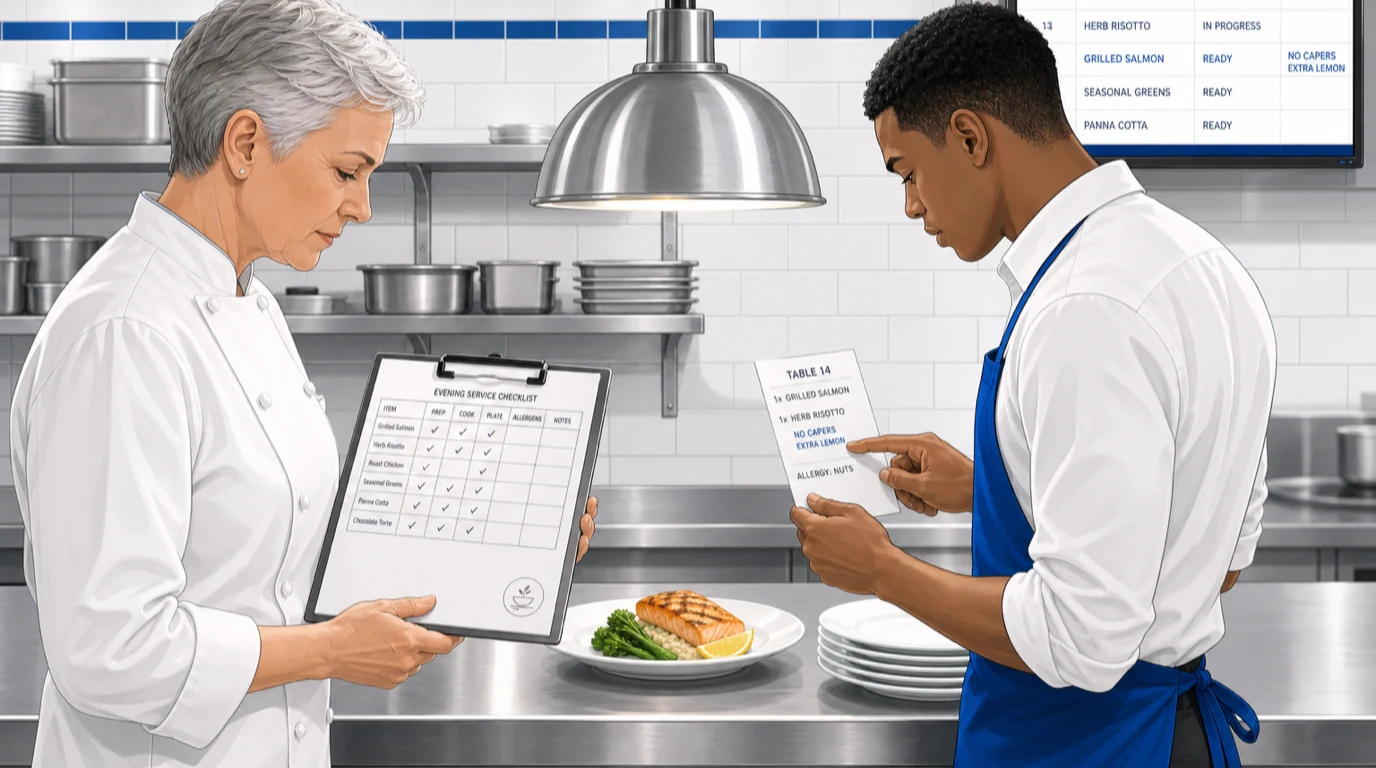
Make it structured rather than conversational. An allergen noted as a typed modifier on the order travels with the item, prints on the ticket, and stays attached if the ticket is reprinted or the item is transferred to another table. An allergen shouted across the pass exists only in the memory of whoever heard it. If the instruction lives in the order itself, it survives a shift change, a server going on break, and the moment when the person who took the order is nowhere to be found. Getting orders into the system accurately in the first place is the argument for taking them at the table on a handheld rather than writing them on a pad, which is part of what a modern restaurant POS is for.
Make it visually unmissable on the line. An allergen flag that looks like every other modifier will be read as a preference, so it needs to be different in kind: a distinct colour, its own alert, something that interrupts. Then close the loop verbally at the pass, because the plate leaving is the last moment anyone can catch a mistake, and a two-second confirmation between the person plating and the person carrying is cheap insurance. The difference between a screen that can highlight this and a printer that cannot is one of the practical points in our comparison of a KDS versus a kitchen printer, and the wider setup is covered in kitchen display systems.
Cross-contact in a kitchen that is actually busy
Everything above concerns information. This part concerns physics, and it is where good intentions meet a service with fourteen tables on at once.
The recurring culprits are dull and predictable. Shared fryer oil, which is why a plain portion of chips is not automatically gluten free. Tongs and spoons moving between products. A mandoline or slicer used for a nut-containing product and wiped rather than washed. Chargrill bars. A single wiping cloth doing several jobs. Flour dust, which travels much further than people expect and settles on everything in a bakery section. None of these are exotic; they are the ordinary rhythm of a kitchen, which is exactly why they need a rule rather than vigilance.
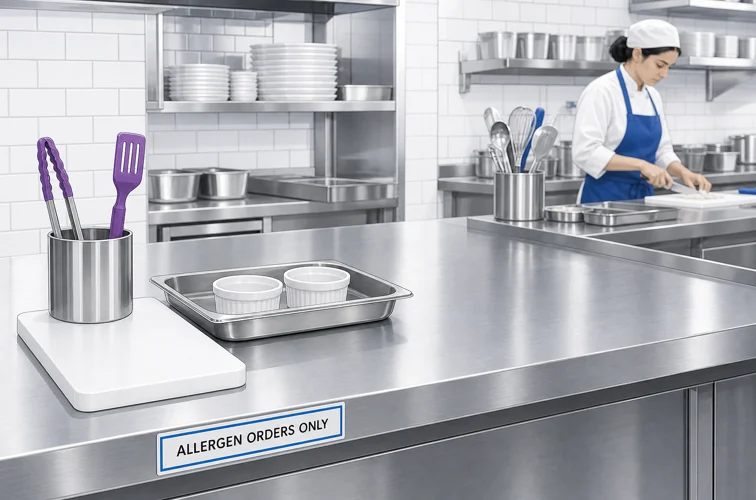
Practical answers are equally dull. Where you can, sequence: prepare the allergen-free version first, before the bench has been used for anything else. Where you cannot sequence, separate: dedicated boards, dedicated utensils, a specific pan that comes out for these orders, stored so grabbing the wrong one takes effort. Wash rather than wipe, because a cloth moves protein around instead of removing it. And prep with the allergen in mind, keeping high-risk products stored below and away from everything else rather than on the shelf above an open container. The colour-coding and hygiene mechanics behind all this are in our food safety guide, and if your kitchen layout makes separation impossible, that is worth knowing when you next look at kitchen equipment.
What to do when the honest answer is no
There is a version of hospitality that treats every request as something to be accommodated, and it is the wrong instinct here. Sometimes the correct answer is that you cannot serve a dish safely, and saying so plainly is better service than an optimistic yes.
A single fryer handling breaded products cannot produce a gluten-free portion of chips, whatever the potato started as. A small kitchen with one prep bench mid-service may not be able to guarantee separation for a severe nut allergy. A dessert section that works with flour all day is a difficult room for a coeliac guest. In each case the guest is far better served by an accurate description of the risk and an alternative you can stand behind than by a dish somebody hoped would be fine.
Train people that declining is allowed, because otherwise the pressure to please quietly produces the guess. The wording that works is specific and non-defensive: naming what you cannot control, saying so directly, and offering something you can control instead. Handled well, this is the kind of interaction guests remember and write about, and it does more for you than a dozen unremarkable meals, as our piece on reviews and reputation covers.
Train it, and keep the records that prove you did
Two separate obligations hide in the word training. One is that people actually know what to do. The other is that you can demonstrate it, and the second is what gets asked for during an inspection or after an incident.
On knowing: everyone who touches food, takes an order or carries a plate needs the basics, which means what the regulated allergens are, where your matrix lives, how to answer a question they do not know the answer to, and what to do if something goes wrong. Kitchen staff need more, covering cross-contact routes, sequencing and the separation rules for their own section. Induction is the moment to do it, and it needs refreshing whenever a recipe, a supplier or a menu changes rather than only on an annual cycle. Short and frequent beats long and rare, and a two-minute allergen item in a pre-shift briefing keeps it present in a way an annual session never will.
On proving: record the person's name, the date, what was covered and who delivered it, and keep it somewhere you could produce it the same day. Keep dated versions of your matrix too, along with supplier specifications and any note of an allergen query that turned into an incident. This is unglamorous filing and it is also the only thing standing between you and having to argue from memory. If your record-keeping is scattered across paper and personal drives, the underlying problem is systems rather than diligence, which is the honest framing in our look at building a restaurant tech stack. Multi-site operations should look at food and beverage management for how this scales across outlets.
When it goes wrong
Assume at some point somebody will be served something they should not have been. What happens in the twenty minutes after that is worth deciding in advance rather than improvising.
The immediate priorities are the guest and then the evidence. Someone senior goes to the table straight away, takes any reaction seriously rather than negotiating about it, and calls emergency services if there is any sign of a serious reaction, since that is not a judgement call for a manager to make on the floor. At the same time, stop the dish going out to anyone else and hold what is left of it and its components rather than clearing them, because that is the only physical evidence of what actually happened.
Then write it down while it is fresh: what was ordered, what was said and by whom, what the guest was told, what was served, who cooked it, and what you found afterwards. Notify the relevant authority if your local rules require it. And treat the follow-up as a process question rather than a search for the guilty person, because in almost every case the cook or server at the end of the chain was working from information that was already wrong. Fixing the information is what stops it happening again, and treating it as a training failure when it was a data failure guarantees a repeat. Our list of restaurant improvement ideas has more in this vein.
Audit yourself before somebody else does
Everything above is easy to agree with and easy to let slide. A short self-audit, run quarterly, is what keeps it real, and it is a much better experience than discovering the gaps during an inspection.
Six questions cover most of it. Does your matrix match the menu you are serving tonight, including specials? Can you produce an allergen specification for every bought-in product on that menu? Pick a server at random: can they find allergen information for a dish inside a minute without asking a chef? Pick a dish with a "cannot be excluded" entry: can the person cooking it tell you why? Can you produce training records with names and dates? And if a guest reacted tonight, does anyone know who to call and what to keep?
If the honest answer to any of those is no, that is your next piece of work, and it is worth doing before the next menu change rather than after. None of this is expensive. It is mostly the discipline of having one true document, generating it from wherever your recipes already live, and refusing to let food reach a guest until its allergen line exists. Where to begin, if you are starting from nothing, is the matrix, because every other control on this list assumes it.
Read next: food safety and HACCP for the framework this sits inside, and restaurant staff training for how to make any of it stick with a team that turns over.