Every restaurant has a night it would rather not talk about. The room is a third full, two servers are folding napkins that are already folded, and the kitchen is doing in four hours what it does in forty minutes on a Saturday. The instinct is to treat this as a marketing problem and put something on offer. That instinct is usually wrong, and acting on it can leave you worse off than doing nothing at all. The first useful step is to look at what your restaurant POS system already knows about which hours are actually quiet, because most operators are wrong about their own trading pattern.
What follows is the unglamorous version: the arithmetic that shows why a quiet Tuesday is the cheapest growth available to you, a test for telling real new demand from demand you simply moved, and how to build something guests plan their week around instead of something they wait for. It applies whether you run a dining room or a bar or late-night venue, though bars feel the swing hardest.
What an empty Tuesday actually costs you
The reason off-peak is the best growth in the building is that you have already paid for it. Rent does not fall on a Tuesday. Neither does insurance, the loan on the espresso machine, the standing charge on the gas, or the salaried half of your team. You bought a 60-seat room for every hour you are open, and on a quiet night you are using a third of what you are paying for.
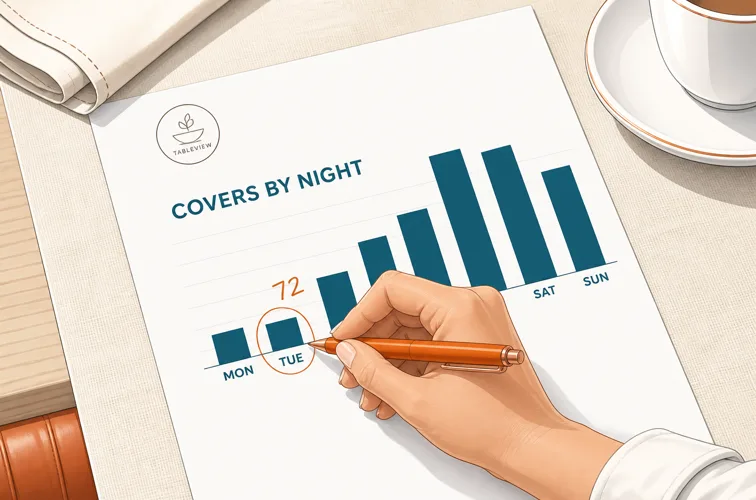
Put numbers on it. Take a 60-seat restaurant serving dinner from five until eleven, so six hours, which is 360 seat-hours available every night. On a Saturday you do 168 covers at a $32 average check, which is $5,376, or just under $15 of revenue per available seat-hour. On a Tuesday you do 72 covers at $28, which is $2,016, or $5.60 per seat-hour. That measure, revenue per available seat-hour, is the one that matters here, because unlike total covers it accounts for the fact that both nights cost you the same 360 seat-hours to open.
Now imagine moving Tuesday from 72 covers to 108. That is not a transformation; it is going from a fifth of the room turning once to a bit over half. It is $1,008 more revenue on that one night, and if you hold it, roughly $52,000 across a year. You added no seats, signed no new lease, and hired nobody. Compare that with trying to squeeze another $52,000 out of a Saturday that is already at 95 percent, where the only lever left is turning tables faster. Our guide to table turnover rate covers that fight, and it is a much harder one. If you want the wider view of where sales growth comes from, how to increase restaurant sales sets out all three levers and this is the cheapest of them.
Find your real off-peak, not the one you assume
Before fixing anything, find out what is actually quiet, because operators are routinely wrong about this. "Tuesdays are dead" is a story people tell about their own restaurant, and the data often says something more specific and more useful.
Pull covers by day and by hour for the last three months, not a weekly average. A weekly average of 70 percent occupancy hides that Saturday runs at 95 and Tuesday at 40. And a daily figure hides more: very often the problem is not the whole night but a window. Plenty of restaurants that describe Tuesday as dead are actually fine from half seven onward and empty between five and half six. That is a completely different problem with a completely different fix, because a two-hour early window suits an after-work crowd, a pre-theatre menu or a bar offer, while a genuinely dead night needs a reason to leave the house at all.
Do the same for lunch, which in a lot of dinner-led restaurants is the real trough and gets ignored because everyone is focused on evenings. Then set a baseline you can measure against later: covers, revenue per available seat-hour, and average check, for each slow slot, averaged over several weeks so one rainy Tuesday does not distort it. Our guide to restaurant KPIs covers which numbers are worth tracking, and the Z report explains how to pull the raw material out of your end-of-day totals.
Why the discount reflex backfires
The default response to a quiet night is to knock money off, and it is worth understanding exactly what that asks of you before you do it.
Suppose your average check is $28 and your food cost is 30 percent, so $8.40 of that is ingredients and $19.60 is gross profit. Take 25 percent off and the guest now pays $21. Your food cost has not moved, so gross profit falls to $12.60. To make the same money on that night you need to serve roughly 56 percent more people. Not 25 percent more, to match the discount. Fifty-six. If a quarter off would genuinely bring in 56 percent more guests on your deadest night, you had a pricing problem rather than a demand problem, and the fix belongs in menu pricing strategy instead.
There is a second cost that shows up later. A standing discount teaches people what your food is worth, and it teaches your regulars to wait. The guest who used to come on Friday at full price and now comes on Tuesday at 25 percent off has not been won; they have been given a discount for behaviour you already had. Worse, discounts create a habit that is theirs rather than yours: when you eventually stop, the night does not return to its old baseline straight away, because the people you trained to come for the deal simply stop coming. That collapse can last weeks.
Tell the difference between new demand and moved demand
This is the test almost nobody runs, and it is the one that decides whether any of this worked. When Tuesday covers go up, there are two possible explanations, and they have opposite implications.
The first is that you created demand: people who would not otherwise have eaten out came in. The second is that you moved demand: people who were going to visit you anyway shifted from another night, and often to a cheaper one. Looked at on its own, the promoted night shows a lovely increase in both cases. So do not look at the promoted night on its own.
Track total weekly covers and total weekly revenue instead, and compare them to your baseline from before. If Tuesday gains 30 covers and the week gains 30 covers, you created demand. If Tuesday gains 30 and the week gains 8, you moved most of it, and if the shifted covers came at a discount you are now serving the same people for less money. Watch average check across the whole week too, not just on the night, because that is where moved demand shows up as margin quietly draining away. If you have guest records, the sharper version of this test is to check whether the Tuesday names are new or are your Friday regulars, which is one of the practical uses of a restaurant CRM. Where it all lands is in restaurant profit margins and eventually your P and L statement.
Design an occasion instead of a promotion
What works on a slow night is not a lower price for the same thing. It is a different thing, available then and not otherwise. The distinction matters because one competes on money and the other competes on interest, and only one of them survives you stopping it.
A promotion says the same dinner costs less tonight. An occasion says tonight there is something here you cannot get on Saturday. That might be a short set menu the kitchen only runs midweek, a supplier evening where the person who grew or made something talks for ten minutes, a single guest dish from a cook you admire, a wine flight built around one region, a quiz, a record night, a chef's counter with twelve seats. None of these touch your prices. Several can carry a higher check than your normal Tuesday, because people who come for something specific tend to order around it.
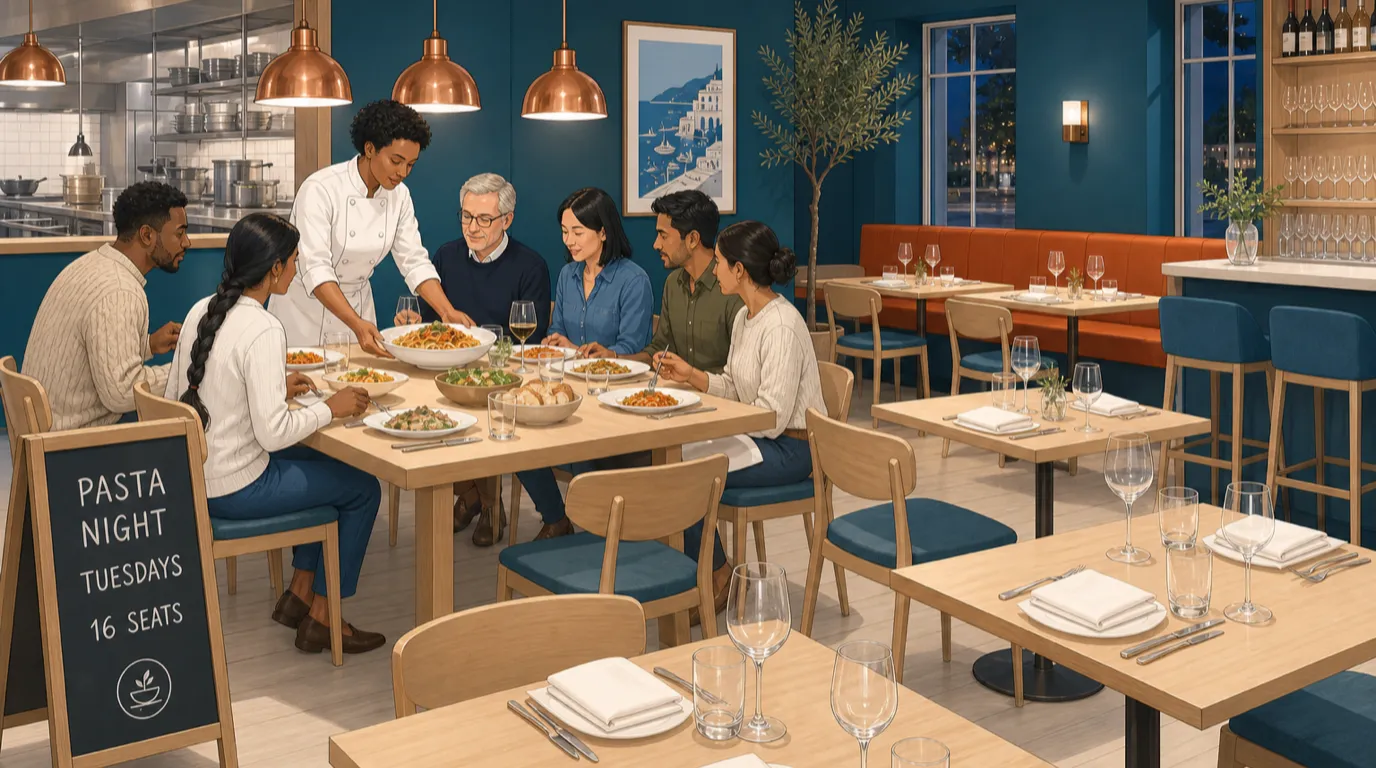
The other advantage is that an occasion gives your team something to talk about and your marketing something to say. "We are open on Tuesday" is not a message. "Six seats left at the counter for Tuesday's pasta night" is. That is also far better material for social media than a discount graphic, and it gives your local search presence something current to show people deciding where to eat. If the occasion leans on drinks, keep an eye on pour cost so the margin story holds up.
Make it recur until it becomes a diary date
A one-off event fills a night once and teaches nobody anything. The value compounds only when the thing repeats on the same night, at the same time, long enough that people stop needing to be told.
The mechanism is habit. A guest cannot plan around something they have to discover each week. When Tuesday is reliably pasta night, it enters people's mental calendar the way a five-a-side game does, and eventually they bring someone. That takes longer than most operators allow: the first two or three weeks are usually flat, week four or five is when regulars start appearing, and the honest evaluation point is somewhere around six to eight weeks. Killing it after a fortnight because it did not work is the most common way this fails.
Two practical notes. Keep the format fixed and the content fresh, so the night, the time and the shape of the thing stay identical while the dish or the region or the guest changes. That gives you habit without boredom. And rotate the content before it goes stale rather than after; roughly every six weeks is a reasonable rhythm. Getting the recurring calendar in front of people is what restaurant email marketing is for, and a booking flow that handles a limited-seat event properly is worth checking in your reservation system.
Use scarcity rather than price
If you want urgency without discounting, limit supply instead of cutting the price. It is the same psychological lever pointed somewhere less expensive.
Sixteen seats. Twelve portions. Tuesdays only. One sitting at seven. These constraints do something a discount cannot: they make the thing feel worth having rather than worth waiting for. They also protect you operationally, because a capped event is something a small midweek brigade can actually execute well, whereas an uncapped offer that suddenly works can produce a bad night for everyone.
Scarcity has a rule attached, which is that it has to be real. If you advertise twelve portions and quietly serve thirty, people notice, and the credibility you spend is worth more than the covers you gain. Genuine constraints are easy to find in any kitchen: a cut that only yields so many portions, a cheese that arrives once a fortnight, a counter with a fixed number of stools. There is a related version of this in happy hour, where the time limit is what makes it work and the open-ended version is what makes it a discount.
Invite the guests you already have
Filling a slow night with strangers is expensive. Filling it with people who already like you is nearly free, and the only reason most restaurants cannot do it is that they have no way to reach anyone.
Start with the list you have, however small: bookings, online orders, loyalty sign-ups, the sheet by the till. The message that works is specific and close to the event. A note a week out that names the thing and the number of seats will outperform a monthly newsletter mentioning it in passing. Timing matters more off-peak than anywhere else, because the decision to go out on a Tuesday is usually made on the Tuesday, often in the afternoon. Something that lands mid-afternoon catches people while the evening is still undecided, which is why text messages tend to outperform email for this particular job even though email is better for everything else.
Segment if you can, even crudely. The single most valuable group is guests who came a few times and have not been back in a couple of months, since they already like you and have simply drifted. A loyalty program earns its keep here by giving people a reason to identify themselves in the first place, and double points on a slow night is one of the few incentives that costs you nothing today. Gift cards work similarly, since they bring a new face in on somebody else's money.
Match your costs to the curve
Filling the night is half the job. The other half is not spending your way through the gain, and this is where a lot of off-peak effort quietly fails.
Most slow nights are overstaffed, because rotas get built from habit rather than from the trading pattern. If Tuesday genuinely does 72 covers spread over six hours, it does not need Saturday's brigade, and it especially does not need everyone starting and finishing at the same time. Staggered starts, a shorter mid-shift, and one person on a split rather than three people standing around will move your labour percentage more than any promotion will move your revenue. The detail is in staff scheduling and restaurant labor cost.
Be careful about the opposite mistake, though. If you build a successful recurring night and keep it staffed like a dead one, you will produce a slow, apologetic service that undoes the work. The point is to match the rota to the curve you actually have, and to update it as the curve changes rather than once a year. The same applies to prep: a midweek occasion built around something you can prep in the same batch as the weekend is far more profitable than one that needs its own separate production run.
Sell the room itself when you cannot sell covers
Some slots will never fill with walk-in dinner trade, and the honest answer for those is to stop trying to sell covers and sell the space instead.
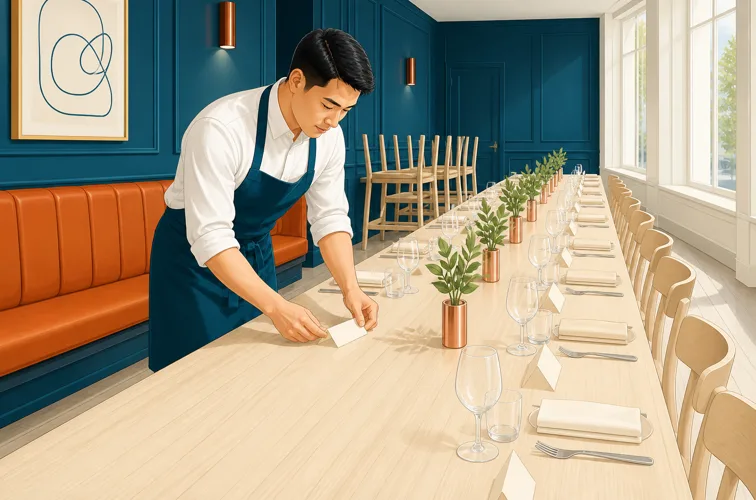
A dining room that is dead on a Monday, or empty between two and five every afternoon, is inventory. It can host a private party, a business lunch, a supper club, a cookery class, a wine tasting, a community meeting, a photo shoot. The revenue is booked in advance, which is rare in this trade, and the margin is strong because the rent is already sunk and you are frequently selling a set menu you can plan around. The operational detail matters more than the idea, and that is in catering and private events.
The same logic runs through the calendar rather than the week. There are stretches of the year that are structurally quiet for almost everyone, and the useful response is to plan for them the way you plan for the busy ones rather than hope. Our piece on the festive season deals with the opposite end of that curve, and the planning discipline is identical. For a neighbourhood dining room the pattern tends to be most pronounced, which is worth bearing in mind if you run a casual dining or bistro operation.
Protect the peak while you fill the trough
Everything above can be undone by letting off-peak thinking leak into the nights that already work. Two things are worth defending.
The first is your prices at peak. If your midweek offer is visible enough, some Saturday guests will find it, and if it is purely a price cut some of them will move. Anchoring the offer to something unavailable at the weekend is what stops this: nobody switches from Saturday dinner to Tuesday pasta night if Tuesday pasta night is a different experience rather than the same dinner for less. Keep the regular menu at the regular price on the regular nights, and make the midweek thing genuinely its own thing. Menu engineering is useful here for working out which dishes can carry an occasion without undercutting your main card.
The second is capacity. A recurring midweek event that outgrows the room is a good problem badly handled if walk-ins get turned away with no record kept. Take the booking, hold a couple of tables back for regulars, and keep a waitlist so the demand is visible next week instead of evaporating at the door. That is what waitlist management and a decent table management system are for, and the same discipline that fills a slow night should not lose you covers on the night it works.
Measure it properly, and a first 90 days
Off-peak work fails more often from bad measurement than from bad ideas, because the promoted night always looks good in isolation and nobody checks the week.
Keep the scorecard small and weekly. Covers in the slow slot. Revenue per available seat-hour in that slot, so you are comparing like with like. Average check in the slot, to catch margin sliding. And total weekly covers and revenue, which is the cannibalisation test. Four numbers, reviewed every week, will tell you more than a dashboard nobody opens. Where the money ends up is in your average check and margins rather than in the covers alone.
If you want a running order, this is the one I would use. Weeks one and two: measure only, and find your true slow slot by hour rather than by day. Weeks three and four: design one occasion for one slot, cap it, and price it at or near your normal check. Weeks three to ten: run it on the same night every week without judging it early, and fix the rota to the pattern you actually have while you do. Week six: rotate the content, keep the format. Weeks ten to twelve: check the cannibalisation numbers honestly, then either commit to it properly or kill it and try a different format on the same night. Do not run three things at once, because you will not know which one worked. Restaurant improvement ideas has more small changes worth queueing behind this one, and taking orders at the table with mobile ordering and an e-menu is one way to keep a busy midweek event moving with a thin team.
Read next: how to increase restaurant sales for where this fits among the other growth levers, and restaurant cash flow management, because a lumpy trading week is a cash problem before it is a revenue one.