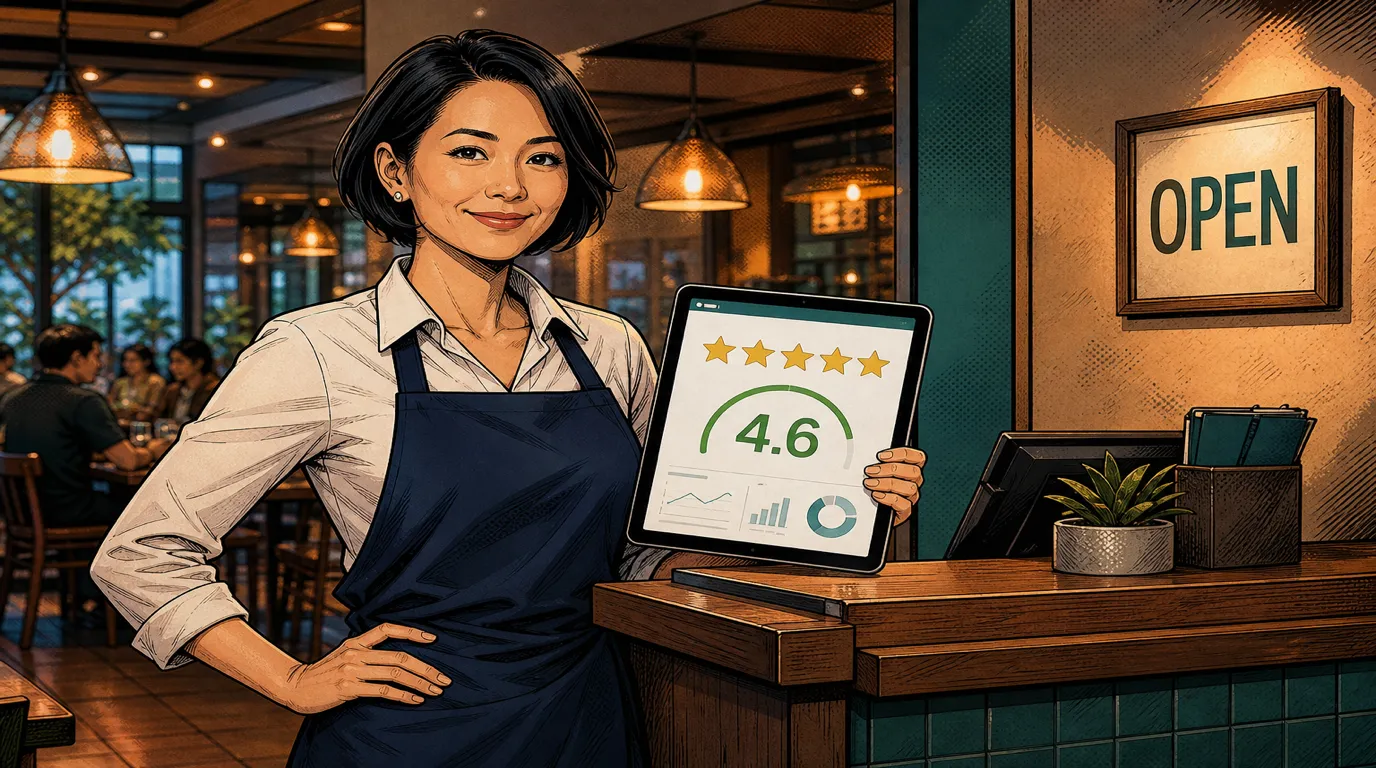
The single most valuable piece of marketing real estate any independent restaurant owns in 2026 is the row of star ratings that appears next to its name on a phone. The cuisine, the price band, the location and the photography all matter, but the rating is the filter that runs before any of them are read. A 4.6 next to your name puts you in the consideration set; a 3.8 quietly removes you from it. The gap is not a hundred SEO tactics. It is one number, visible at a glance, that decides whether the next thousand strangers who search for "restaurants near me" tonight ever click through to your menu.
This guide is the operator's framework for owning that number on purpose rather than by accident. It covers what Google, Yelp and TripAdvisor actually reward in 2026, how to systematically collect fresh reviews without breaking platform rules, how to respond to positive and negative reviews in a way that earns the next click rather than just defending the last one, and how to build the weekly review-handling rhythm that turns reputation from a worry into a predictable input on the P&L. Pair the guide with the embedded Reputation Health Scorecard below to grade your current state across the six dimensions that decide whether reviews compound for you or against you.
Reputation is downstream of operations and upstream of demand. A restaurant that delivers consistently great service and food will, over time, earn a healthy rating. A restaurant that also handles its review surface deliberately will turn that rating into discovery, and turn that discovery into a flywheel. The mechanics are not complicated. They are just rarely owned, and almost never run on a weekly cadence by anyone with the authority to fix the operational issues the reviews surface.
Why restaurant reviews are the highest-leverage marketing channel in 2026
Three structural changes converged in the last five years that made reviews disproportionately powerful. First, Google's local pack ranking algorithm now treats rating and review velocity as primary prominence signals on equal footing with link equity and proximity, which means a restaurant with 600 fresh four-and-a-half-star reviews will out-rank a competitor with a stronger website but 80 reviews from three years ago. Second, the consumer behaviour change finished moving in our direction: the share of restaurant discovery sessions that begin with a phone search and end inside the local pack passed 70% in most western markets in 2024 and is still rising. Third, the half-life of a positive operational change shortened: a kitchen upgrade or a service training intervention used to take six months to register in market perception; now it shows up in the next batch of weekly reviews and starts shifting traffic within four to eight weeks.
The compound effect is significant. A restaurant that moves from 4.0 to 4.5 stars on Google typically sees 15-30% more discovery clicks within 90 days, holding everything else constant. A restaurant that moves from 4.5 to 4.7 with fresh review velocity typically sees another 10-20%. The same uplift applied to a hundred-cover venue at a $45 average check produces $40k-$140k of additional annual revenue from a single dimension of marketing work. We have not seen another channel - paid social, paid search, direct mail, influencer collaborations - return a comparable number for an independent operator without significant ongoing spend. Reviews are essentially free distribution. The trick is that they require discipline rather than budget.
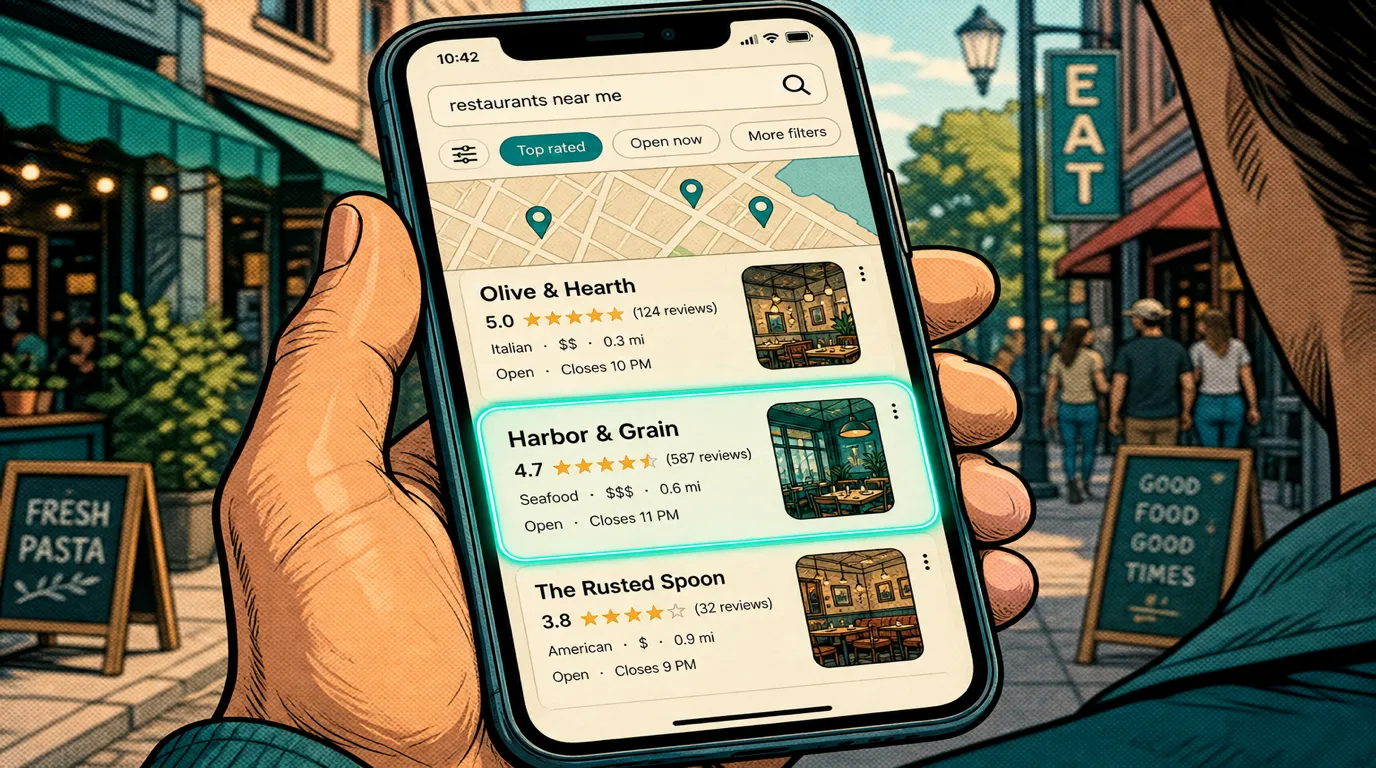
The local pack itself is the surface that converts a search into a click. Three results appear above the fold for almost every "near me" query. The first slot gets roughly 45% of the clicks, the second about 25%, the third about 15%, and the long tail of map results shares the remaining 15%. Where you rank is a function of three inputs the algorithm weights roughly equally: proximity (how close you are to the searcher), relevance (how well your business categorisation, menu and photos match the query), and prominence (rating, review count, review velocity, response rate, photo quantity and freshness, and citation consistency across the web). Proximity you cannot control. Relevance you set up once and refine quarterly. Prominence is where the ongoing work lives, and reviews are the largest single component of prominence.
The same logic applies, with weighting variations, on Yelp and TripAdvisor. Yelp's filter algorithm is famously aggressive about hiding "non-elite" reviews, which means raw count matters less than the count of reviews from established users; the operator move is to get into the rotation of frequent local reviewers (chef events, neighbourhood Yelp meet-ups, claimed business page) rather than to chase blind volume. TripAdvisor's algorithm rewards recency more than count and weighs ratings on a sliding scale that gives recent reviews 3-5x the weight of older ones, which is why a restaurant that stops getting fresh TripAdvisor reviews drops in the rankings within months even if its absolute average is high.
The six dimensions of reputation health
Most operators we work with think of reputation as a single number - the Google star rating - and obsess over the headline figure without changing any of the underlying drivers. The right mental model is to split reputation health into six dimensions, each of which moves on a different operational lever, each of which can be strong or weak independently of the others, and each of which the algorithm reads separately when it decides where to rank you.
1. Volume. Total review count, relative to local competitors in the same category within a 3km radius. The threshold for being a credible result in most cities is 100+ Google reviews; the threshold for out-ranking competitors is being in the top quartile of the local set, which usually means 300+ in dense urban areas. New restaurants have an exemption window of about 12 months where 50+ reviews is acceptable; after that, low volume is read as low prominence regardless of how good the average is.
2. Velocity. How recently the reviews are arriving and how frequently. A restaurant with 600 reviews all from 2022 ranks materially worse than a restaurant with 200 reviews of which 40 are from the last 90 days. The algorithm treats velocity as a freshness signal: if guests are still reviewing you weekly, you are still operating; if the inbound dried up six months ago, the algorithm assumes you have either closed or stopped caring. The actionable target is at least 8 new Google reviews a month for a hundred-cover independent, scaling roughly with capacity.
3. Quality. The weighted star rating. Google weights recent reviews more heavily than older ones, so a restaurant whose last 30 reviews average 3.9 but whose all-time average is 4.5 will see the displayed rating drift down over a quarter or two and the ranking drop accordingly. The actionable target is to maintain a 4.4+ average on the rolling last-30 window; below 4.4 you start losing discovery clicks to higher-rated competitors, and below 4.0 you fall off most "highly rated" filters entirely.
4. Coverage. Presence on the platforms that matter. Google is mandatory, full stop. Yelp matters most in North American markets and varies by city; TripAdvisor matters most in tourist-heavy and destination-dining markets. At least one social platform (Instagram and TikTok for most independents in 2026) is mandatory because they are the inputs the local pack now scrapes for photo freshness. Coverage gaps create a "weakest link" effect: if your Google is at 4.6 but your Yelp is at 3.2 with stale photos, the 3.2 will surface in any cross-platform comparison and the hesitant guest will route around you.
5. Response. What percentage of reviews you reply to and how fast. The operator-side leverage here is bigger than most realise. Operators who respond to 90%+ of reviews within 48 hours see their conversion-from-impression rate improve 10-20% relative to operators who respond sporadically, holding rating and volume constant. Responses are read by the next set of prospects more than by the original reviewer; a thoughtful reply to a negative review reassures a stranger that this is a restaurant that listens, which matters more for the next booking than the original complaint itself.
6. Recovery. The process by which a negative review triggers an operational fix, the fix is verified, and the original guest is invited back with a clear path to revise. Recovery is the only dimension that compounds beyond reputation directly into guest lifetime value. Operators with a documented recovery process salvage roughly 30-50% of complaining guests into repeat visits, and roughly 15-25% of those guests update or remove their negative review of their own accord. Without a recovery process the same guests churn permanently and the review stays up.
The scorecard widget below scores you across all six dimensions with three diagnostic questions per dimension. It takes about five minutes and produces a maturity tier (At-risk, Visible, Trusted, or Authoritative) plus a "fix this next" recommendation pointing to the weakest dimension still below 80%. Use it as a baseline today and re-run it quarterly; the dimensions move in different directions depending on which operational levers you have pulled in the preceding 90 days.
Most operators score in the Visible band first time. The diagnostic almost never flags Quality as the weakest dimension; it almost always flags either Velocity (no systematic ask) or Response (no one owns review replies). Both are fixable inside a quarter without any capital expenditure, which is why working the scorecard backwards from the recommended next dimension is more useful than trying to lift every dimension at once.
How to systematically collect fresh reviews (without breaking platform rules)
The single most common operator mistake in 2026 is treating review collection as an occasional ask rather than a daily operating ritual. The maths is simple: even a venue with a 4.7 average rating and a 1.5% conversion rate from "guests who had a good experience" to "guests who actually leave a review" needs a continuous ask to sustain the velocity the algorithm rewards. A hundred-cover venue doing 600 covers a week needs to surface the ask in front of roughly 500-600 guests to land 8-10 new reviews, every week, indefinitely. Sporadic asks produce sporadic velocity. The fix is a system that runs without any individual remembering to do it.
The system has four touchpoints that work in combination, not in isolation. Each compensates for the failure modes of the others, and none of them is sufficient on its own at the scale most independents need.
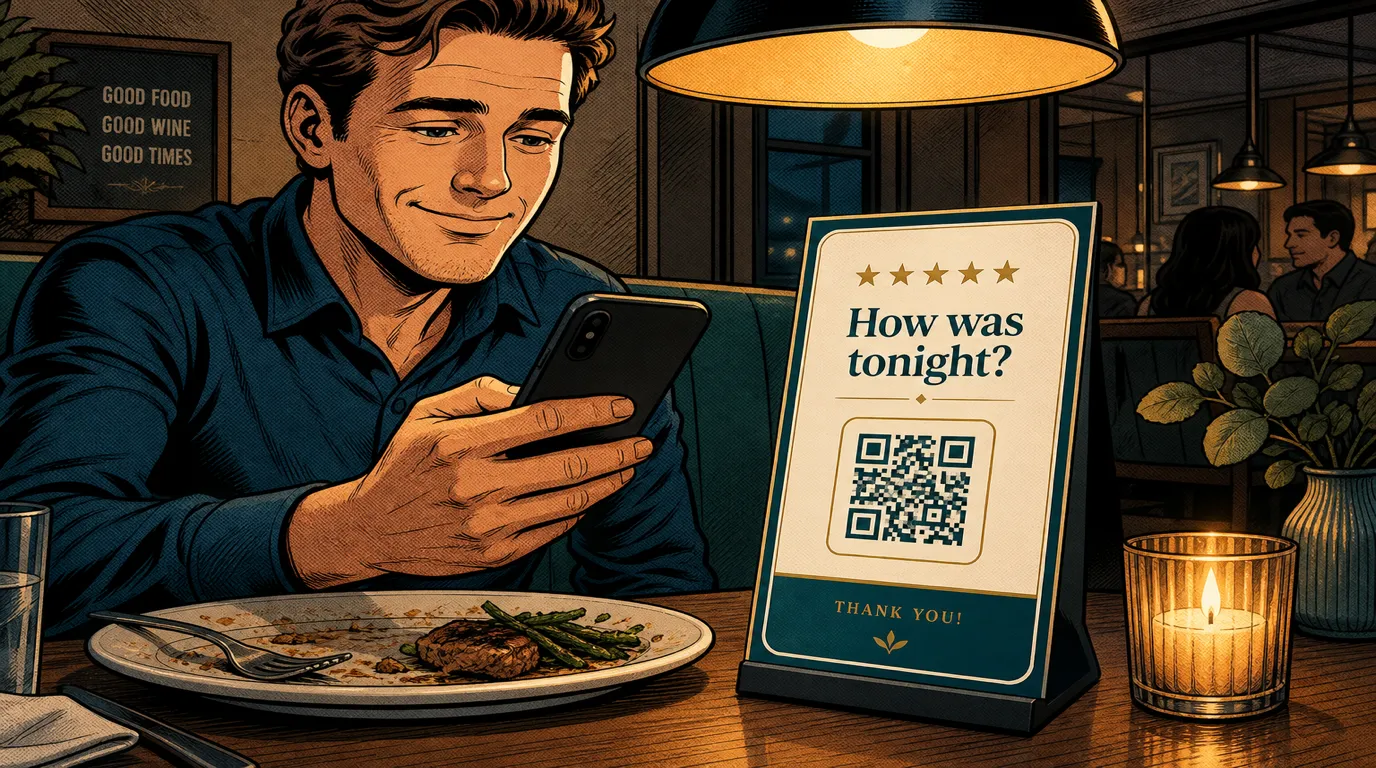
Touchpoint 1: The QR ask at the table. A small branded card or tabletop sign sized roughly 70x130mm, placed on every table or delivered with the cheque, with a QR code that goes directly to your Google review-write surface. The card needs to be visible without being obtrusive (most operators get this wrong by either hiding the card or making it look like a sales pitch). Conversion rate from QR scan to filed review is around 35-50% when the guest had a good experience; the constraint is the scan rate, which sits between 8-15% of guests if the card is well placed and well designed. A neutral question - "How was tonight?" - converts roughly twice as well as a direct ask - "Please leave us a 5-star review" - because the second feels transactional and the first feels human.
Touchpoint 2: The receipt CTA. Every printed and emailed receipt should carry a one-line review prompt with a trackable short link to the Google review URL. The bias here is to do this for every receipt forever rather than for the first week after launch. Email receipts converting to reviews run 1-3% as a single touch, climbing to 4-6% if you also add a small in-message nudge naming the server or chef. POS systems that natively support this configuration (Tableview's restaurant POS platform is one of them) make the ongoing operation zero-effort; PoS systems that do not require an integration with a third party that almost always introduces data hygiene problems within months.
Touchpoint 3: Post-visit SMS or email, 18-30 hours later. The single highest-converting individual touchpoint is a follow-up message sent 18-30 hours after the visit, addressed by name, thanking the guest, and asking for two sentences on how their experience compared to their expectations. The link in the message should go to the Google review surface. Conversion runs 8-15% on first-time guests with a verified phone or email; the operator constraint is having the guest record at all, which is why the touchpoint is downstream of a working CRM. The restaurant CRM playbook covers how to set up the capture flow at the order, reservation or check-out moment.
Touchpoint 4: The targeted ask after a recovery moment. When a guest has had a service issue that the team caught and resolved during the visit (a comped course, a manager visit, a re-fire that landed well), they are 3-5x more likely to leave a positive review if asked explicitly within 48 hours. The operator move is to flag these moments in the POS or shift report and route the post-visit message to a personal text from the manager rather than the generic system message. This is the highest-ROI review touchpoint per touch; the constraint is volume because there are only a handful of recovery moments per shift.
What not to do. Three patterns will get you in trouble with the platforms and should be off the table regardless of how tempting they look in the short term. Do not offer any incentive in exchange for a review (discount, free item, contest entry); both Google and Yelp explicitly prohibit this and Google has gotten visibly better at detecting it in 2024-2025, with review removals and ranking penalties applied within weeks. Do not ask staff to write reviews from personal accounts; the platforms triangulate IPs and device IDs and flag these reliably. Do not buy reviews from third-party services advertising "guaranteed Google reviews"; in 2026 this is the single fastest way to a permanent profile ban, and the residual reputation damage of having reviews wiped from your profile costs more than the reviews ever gave you. Stick to the four legitimate touchpoints above; they produce all the velocity you need.
How to respond to reviews (positive and negative)
Review responses are read by the next set of prospects more than by the original reviewer. Treat them as marketing copy with an audience of one (the original reviewer) plus an audience of hundreds (every future guest who reads the review and your reply when making their booking decision). That second audience is the one the algorithm cares about and the one that drives discovery conversion. A thoughtful, specific reply to a critical review is one of the highest-trust signals a restaurant can produce in 2026.
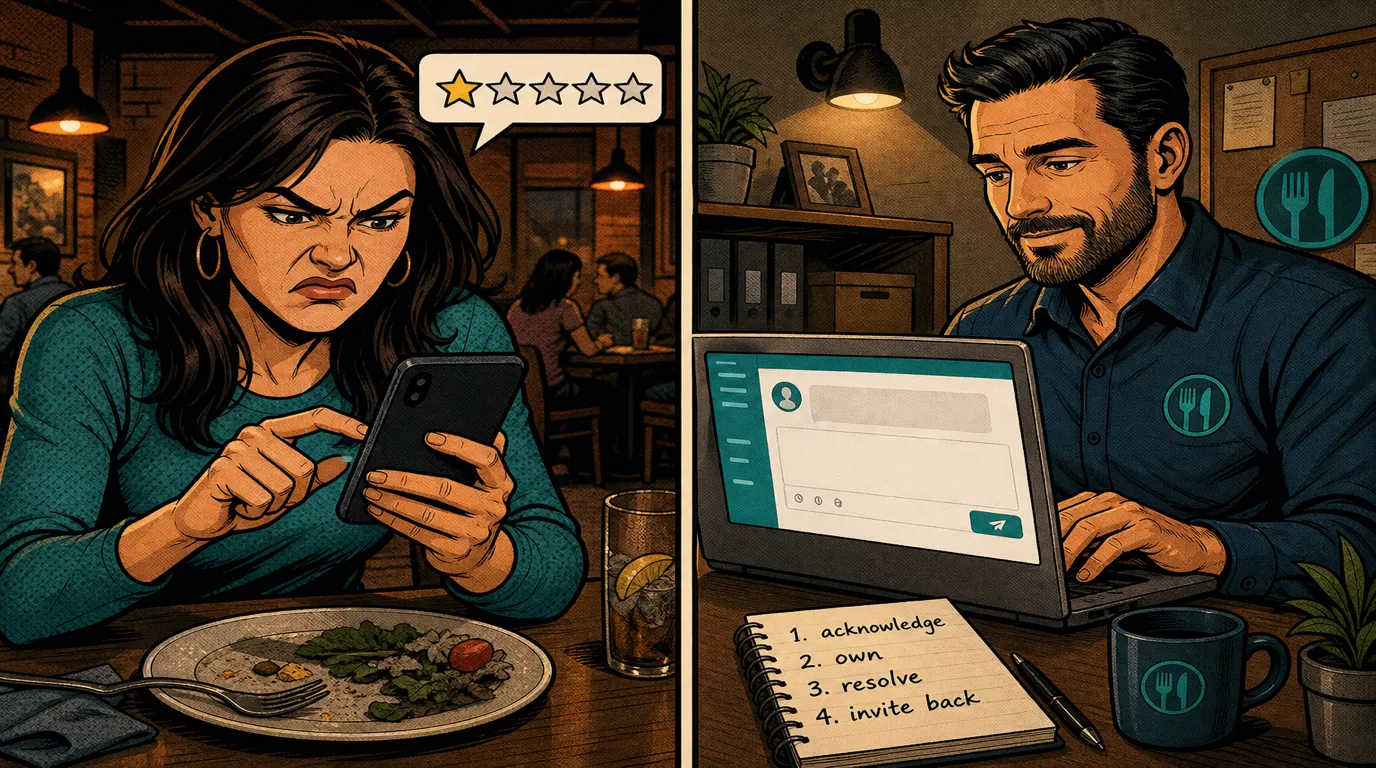
Positive review template. Acknowledge the specific thing the reviewer mentioned (the dish, the server, the occasion), reinforce it with one operator detail that adds colour, and invite them back with a hook that is not generic. The wrong template is "Thank you for the kind words, we hope to see you soon!" because it adds no signal. The right template is closer to: "Maya, I am so glad the duck breast landed - that recipe is a six-month project from our chef Lucia and we are still tuning the sauce weekly. Next time you are in, ask her about the pairing she is working on with the new Catalan rose; I think you will like where it ends up." That reply costs the manager 90 seconds to write, signals to every future reader that there is a real chef and a real manager behind the operation, and gives the original reviewer a reason to return. Replies that include a specific staff name and a specific detail convert 2-3x better than generic replies on the reader-side signal.
Negative review template. Four moves, in order: acknowledge the specific complaint (not a general "sorry you had a bad experience"); own the failure without making excuses or blaming a third party; resolve the underlying issue by naming what changed operationally; invite the guest back with a direct contact path (manager's first name and email, not a generic support address). A worked example: "Daniel, I am sorry the wait for your main was 45 minutes on Saturday night. We had a pass-side equipment failure that backed up the line for forty minutes and we did not handle the communication to the floor well. We have replaced the unit and changed our pre-shift checklist so a backup is available. I would like to make this right; please email me at sara@restaurant.com and I will personally make sure your next visit goes the way it should have on Saturday." Notice what the reply does and does not do. It does not argue with the guest about whether 45 minutes is reasonable. It does not promise a discount in the reply (which other guests would see and read as bribery). It commits to a specific fix and offers a direct path to closure.
The five negative review patterns and the response moves for each. Almost every negative review falls into one of five recurring categories, each of which has a known operator response. Slow service is the most common: respond with the acknowledge / own / resolve / invite template above, and route the underlying operational pattern into the staff scheduling review to check whether the night was understaffed. Food quality issues (cold, overcooked, wrong order) require an acknowledgement that does not blame the kitchen by name and a specific note that the manager will brief the team; if the issue is recurrent, the kitchen display system routing logic usually needs work. Service attitude issues are the highest-stakes category and almost always require a private follow-up call from the GM, not just a public reply; the public reply should commit to the follow-up without throwing the staff member under the bus. Value perception issues ("too expensive for what you get") rarely warrant a price defence; the move is to acknowledge the perception and reinforce the menu's positioning in one sentence. Operational hygiene issues (cleanliness, ambient noise, broken bathroom door) get the operator fix on the next pre-shift and a confirmation in the public reply that the issue has been addressed.
Response time. The platform-level signal that moves the algorithm is "responds to most reviews within 48 hours". The conversion-level signal that moves prospects is "responds fastest to the most recent reviews", because the most recent reviews are the ones a prospect scrolls past first. The combined target is to triage every new review within 24 hours and post a thoughtful reply within 48; for negative reviews specifically, faster is better because a fresh negative review with no reply for a week reads as a restaurant that is asleep at the wheel.
The negative review recovery playbook
The mistake most operators make with negative reviews is treating them as a PR problem to be defended rather than an operational signal to be acted on. The right framing is the opposite: every negative review is a free piece of consumer research that the guest paid you to deliver. The work is in routing the signal into the operational fix, verifying the fix landed, and closing the loop with the original guest.
Step 1: Log the signal weekly. Once a week, ideally on the same Monday morning as the weekly improvement review, pull every new review from the last seven days and code the theme: speed, food, service, value, hygiene, other. Track the themes across a rolling 12-week window. The pattern usually reveals one or two themes that account for 60-70% of the negatives. That is your operational backlog in priority order, sourced directly from guest feedback rather than from manager intuition.
Step 2: Own each theme to a named manager. Each recurring theme gets a named operator owner, a specific fix scope, and a four-week deadline. "Slow service on Friday nights" might be owned by the FOH manager with a brief to revise the pre-shift staffing and trail two new section configurations. "Cold mains in the back corner" might be owned by the head chef with a brief to rework the runner routing through the KDS station map. The single biggest predictor of whether the theme actually resolves is whether the owner is named and the deadline is on the calendar. Unowned themes recur.
Step 3: Verify the fix in the next 4-week review window. Pull the theme counts again at the four-week mark. A fix that worked shows up as a 60-80% reduction in the theme volume; a fix that did not work shows up as theme volume that holds steady or grows. Either result is a useful data point. The default should be that 80% of named fixes resolve their target theme; below that, the diagnosis was wrong and the theme needs re-scoping.
Step 4: Close the loop with the original guest. Once a theme-level fix is in place, send a personal note from the GM to every guest who flagged that theme in the preceding 12 weeks. The message is short: name the issue they flagged, name the operational change, invite them back without an explicit ask to update the review. About 30-50% of the contacted guests will return; 15-25% of returners will update or remove their original review without prompting. The remaining 50-75% appreciate the follow-up regardless and will tell their network about it, which is the long-tail compound effect of doing the work.
The 2026 platform landscape: Google, Yelp, TripAdvisor, social
The four platforms restaurants actually need to manage in 2026 are Google, Yelp, TripAdvisor, and at least one social platform. The relative weight has shifted significantly in the last 24 months and the operator move is to allocate attention by current weight rather than legacy habit.
Google (60-75% of weight). The single most important platform in almost every market in 2026. The Google Business Profile is the surface that powers the local pack, Maps search, and the rating that shows in branded search. The non-negotiables: verified profile, complete category and attribute fill, up-to-date menu (or menu link), opening hours (with holiday overrides actually maintained), at least 30 photos updated quarterly, and the four review collection touchpoints described above running continuously. The restaurant local SEO guide covers the profile-level optimisation work in detail; this article focuses on the review layer that sits on top.
Yelp (10-20% of weight, market-dependent). Material in most North American urban markets, marginal almost everywhere else. The operator pain point is Yelp's filter algorithm, which hides reviews from non-established reviewers and means a lot of legitimately earned reviews never show up. Claim the business page, post photos and updates monthly, respond to every visible review, accept that the filtered ones are not coming back, and avoid paying for Yelp advertising as a route to organic visibility; the budget produces more reliable return on the four touchpoints.
TripAdvisor (5-15% of weight, market-dependent). Material in tourist-heavy destinations and major hotel districts; marginal in pure neighbourhood markets. TripAdvisor's algorithm weights recency aggressively, which makes the platform high-leverage for venues that get sustained tourist traffic. Claim the listing, include a "share on TripAdvisor" option in the post-visit message for out-of-town guests, and respond to every review within 72 hours.
Social platforms (5-15% of weight, growing). Instagram and TikTok increasingly function as discovery surfaces in their own right, and the local pack algorithm pulls Instagram photos into its image carousel - so freshness on the platform feeds back into Google ranking. Non-negotiables: at least one post a week, at least one Story or Reel a week, replies to every comment within 48 hours, and a bio that includes the booking link. Cadence matters more for the algorithm than production quality.
Tools, tech and what to do in-house vs. outsource
The tool market for restaurant reputation management is crowded (Birdeye, Podium, ReviewTrackers, NiceJob and a long tail of mid-market options) and most named players do roughly the same thing: aggregate reviews from multiple platforms into a single inbox, offer template-based replies, run automated review request campaigns, and produce a monthly report. The operator decision is usually less about which tool is best and more about what is already in your tech stack. The configuration that produces the best long-run outcome is to keep the ask flow native to the POS and CRM (so the post-visit message uses the same guest record that drives loyalty and marketing) and to handle the response flow inside whatever inbox the team already lives in. Adding a third-party reputation tool on top of a POS that already has the data is double-billing the same workflow; it produces three months of dashboard enthusiasm followed by quiet abandonment.
Tableview's approach is to bake the four touchpoints directly into the POS and CRM stack: the receipt CTA fires on every printed and emailed receipt, the post-visit SMS routes off the same guest record the POS captured at checkout, the QR cards link to the Google review surface with a UTM tag so the analytics flow back into the same dashboard, and the recovery flag attaches to the guest profile so the personal manager follow-up is one tap rather than a copy-paste exercise. The unified surface means the same data point (this guest had slow service on Friday) feeds the operational review, the personal follow-up, and the lifetime value calculation - which is what the Customer Lifetime Value calculator is built to quantify. If your POS does not support the touchpoints natively, the restaurant tech stack guide and its companion Tech Stack Scorecard cover how to evaluate the upgrade decision rather than layering a third-party tool on top of a stack that cannot share its data cleanly.
The weekly reputation rhythm that runs forever
The single biggest predictor of long-run reputation outcomes is whether the operator has a weekly review rhythm with a named owner and a fixed calendar slot. We have studied dozens of independents that significantly improved their Google rating over a 12-month window, and the one variable they shared was the rhythm. Operators who run the rhythm sustain the improvement; operators who do not slide back to their starting position within 18 months regardless of what marketing investment they make.
The rhythm is two meetings a week, both short, both standing. Monday morning, 30 minutes: pull every new review from the past week, code the themes, brief the team on patterns, and queue replies for any reviews still unanswered. The GM owns the slot and the kitchen manager and FOH manager attend. The output is a themes log (which becomes the operational backlog described above) and a queue of replies that the GM writes by end of day. Friday afternoon, 15 minutes: dashboard check on volume, velocity, quality, and response rate vs. the four-week trend. Anything trending the wrong way gets a named owner for the weekend, and the weekend manager is briefed accordingly.
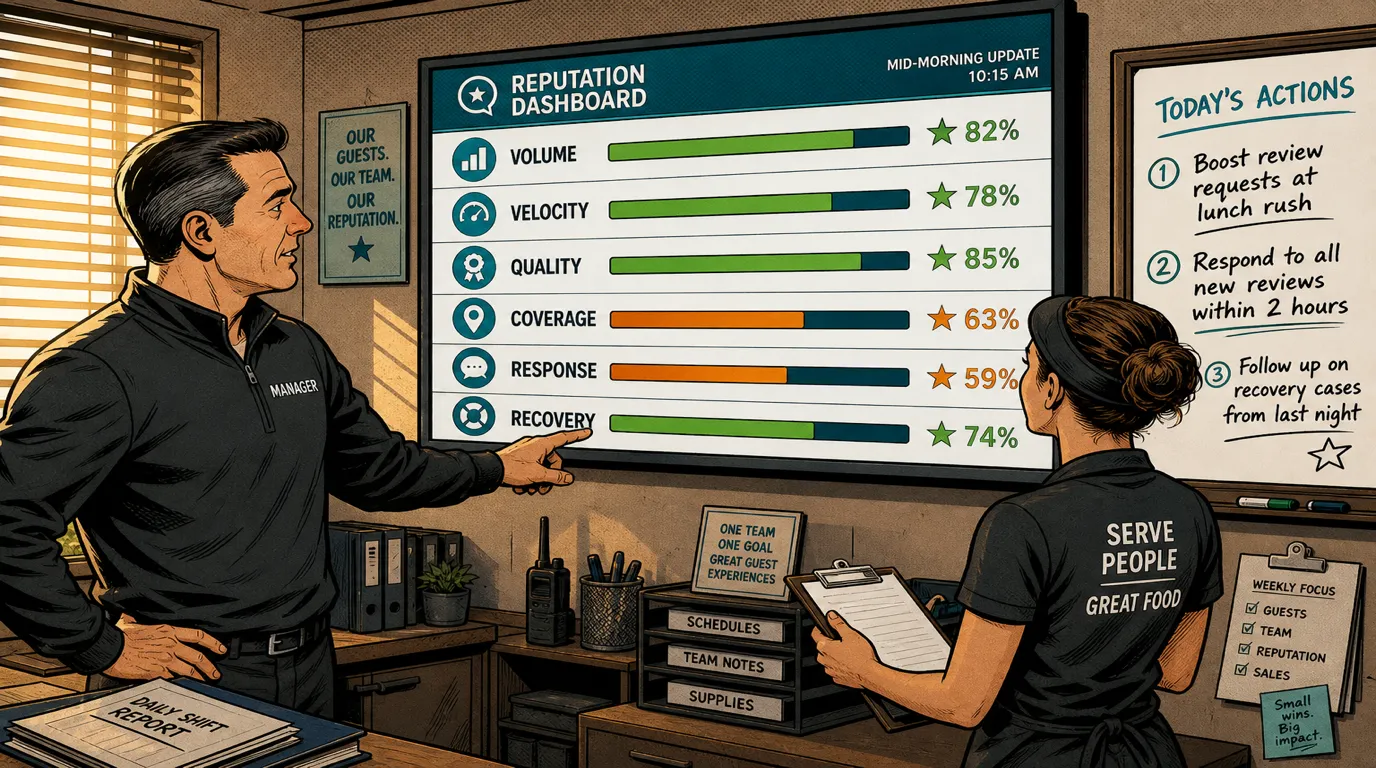
The two meetings combined cost under an hour of management time a week, which is less than most managers spend on a single supplier call. The output is a reputation surface that improves continuously rather than drifts, an operational backlog sourced from real guest feedback rather than manager intuition, and a team that knows the metric matters because they see it every Monday. The compound effect over 12 months is a half-star or full-star improvement on Google, which translates to 15-40% more discovery clicks at no additional marketing spend.
For multi-location operators the rhythm needs an additional layer: a monthly cross-site review where each GM presents their reputation deltas and the regional manager identifies the patterns that are spreading or contained. The cross-site visibility creates the right competitive dynamic between GMs and identifies the high-performing playbooks that should be promoted across the estate. Single-location operators can skip this layer.
Edge cases: fake reviews, defamation, and platform takedowns
A small percentage of negative reviews fall into the "this is clearly not a real guest" or "this is defamation rather than criticism" category, and the playbook for handling them is materially different from the playbook for legitimate negatives. The default operator instinct is to escalate immediately; the right move is usually to wait, gather evidence, and use the platform's takedown process rather than to argue publicly.
Fake reviews from competitors. The tell is usually one or more of: reviewer profile with no other restaurant reviews and a generic name, review posted within 24 hours of another suspiciously similar review on the same business, complaint that references something operationally impossible (a dish you do not serve, a server who does not exist, an event date when you were closed). The Google takedown process accepts evidence in support of this and resolves a meaningful percentage of clearly fake reviews within 5-15 business days. The operator move is to file the takedown, reply publicly with a calm acknowledgement that does not accuse the reviewer of being fake (because if Google rejects the takedown the public accusation becomes a problem), and move on. Do not engage in extended public argument.
Defamatory and off-topic reviews. Reviews with specific factual claims that are demonstrably false (food poisoning with no health department complaint, discrimination with no incident report) cross into defamation in most jurisdictions; file the platform takedown first, document everything, and engage a local hospitality lawyer before responding publicly if the review is gaining traction. Reviews complaining about something outside the restaurant's control (weather, parking, neighbourhood) are eligible for Google takedown under the off-topic policy at a 50-70% resolution rate within a week or two. In all three categories the operator move is the same: file the takedown, reply publicly with a brief calm acknowledgement, and trust the platform process rather than escalating into public argument.
Reputation and the off-premise channels
Reviews on the third-party delivery marketplaces (DoorDash, Uber Eats, Grubhub) operate on different rules from on-premise reviews and have a meaningful effect on your marketplace ranking even though they do not flow into your Google rating. A restaurant with a 4.7 on-premise rating but a 4.1 DoorDash rating will get demoted in DoorDash search and lose 20-40% of marketplace discovery volume. Treat the marketplace channel as a separate reputation surface with its own ask flow, its own response flow, and its own theme review, because marketplace ratings track operational variables that look different on delivery than they do on dine-in (packaging quality, temperature on arrival, order accuracy under volume). The third-party delivery economics guide and the Marketplace Margin calculator together quantify the full economic stack of the channel including the reputation tax of a poor delivery experience. First-party online ordering reviews (left on your own surface or attached to your CRM record) do not surface publicly but are the highest-quality signal you have on the first-party channel; the POS with online ordering guide covers how to capture and route them into the same theme review.
Reputation through openings, renovations and re-launches
Three operational moments distort the normal reputation dynamics and deserve a different playbook. Opening (first 6-12 months): over-invest in the four touchpoints from day one, pre-brief friends, family and industry contacts that the soft-launch is review-eligible, and accept that the first month will read below your steady-state quality because operational issues cluster in the opening period. The restaurant opening guide and the restaurant business plan template both cover the broader launch playbook; reputation is the layer that sits on top. Renovation or concept change: expect a batch of negatives from regulars who liked the old version, do not argue, name what changed, and invite the regulars back personally from the GM; handled with grace the batch resolves within 90 days and damages the long-run rating by less than 0.1 stars. Re-launch after a closure: update the Google profile the day operations restart with new photos and a posted update explaining what changed, brief regulars personally before the public open, and run the four touchpoints aggressively for the first 60 days to flood the recent reviews window with fresh positive signal.
The compound effect: 12 months of reputation discipline
To put numbers on what the discipline returns over a year, take a representative independent: 120-cover venue, $48 average check, 5,000 covers a month, currently sitting at 4.2 stars on Google with 180 reviews and an average of 3 new reviews a month. Pull the Reputation Scorecard on the current state and the diagnostic typically lands in the Visible band with weakness in Velocity and Response. Run the 12-month playbook described above: four touchpoints from day one, weekly Monday rhythm, named owner per theme, recovery loop closed quarterly.
The realistic 12-month delta for that operator: rating moves from 4.2 to 4.5, review count from 180 to 380, monthly inbound from 3 to 12, response rate from 20% to 95%. The local pack position lifts from outside the top three to inside the top three on the highest- volume "near me" queries in the neighbourhood. Discovery clicks lift by 25-40%, which on a 5,000-cover-per-month base translates into 600-1,000 incremental covers per quarter, or $115k-$190k of incremental annual revenue. At typical food-and-labor cost ratios the bottom-line impact is $40k-$85k a year - the same as a $40k-$85k incremental marketing budget, deployed indefinitely, from a discipline that costs roughly one hour of GM time a week.
The compound effect is the real point. Reputation works on a multi-quarter cycle where the rhythm slowly compounds the rating, which compounds the local pack ranking, which compounds the discovery click rate, which compounds the review velocity, which compounds the rating again. Operators who run the rhythm for two or three years end up at a competitive moat that takes the next entrant 18-24 months and a major operational overhaul to close.
The bottom line
Restaurant reputation in 2026 is not a marketing project; it is an operational discipline with a marketing payoff. The six dimensions - volume, velocity, quality, coverage, response and recovery - each move on a different operational lever and each compound differently into the discovery flywheel. Working all six is rarely the right move; identifying the weakest dimension and working that one relentlessly until it crosses the 80% threshold is what produces durable improvement. Run the Reputation Health Scorecard above to find the weakest dimension today, set a 90-day target to lift it across the threshold, and book the Monday morning rhythm into the standing calendar as the forcing function that keeps the discipline going after the initial enthusiasm fades.
The compound math is striking and worth restating: an hour of structured GM time a week, applied to the right discipline, produces the same revenue lift as a $40k-$85k marketing budget for a typical independent. The discipline is unsexy. It is reading reviews on Monday mornings, writing thoughtful replies, naming owners for recurring themes, and closing the loop with disappointed guests ninety days later. None of it requires a new tool, a new vendor, or a new budget line. All of it requires a system that runs after the initial enthusiasm has worn off, which is the only thing that distinguishes operators whose reputation compounds from operators whose reputation drifts.
Pair the Reputation Health Scorecard with the Customer Lifetime Value calculator to see what a sustained reputation lift is actually worth in dollar terms for your specific cover count and average check. Then pair it with the restaurant local SEO playbook and the CRM guide to set up the four touchpoints and the weekly rhythm. Bookmark the calculators hub for the rest of the operator toolkit. Reputation is the discipline that makes every other marketing channel work harder. Start the rhythm this Monday.