Every restaurant operator we talk to in 2026 has the same complaint about third-party delivery: the commissions are too high, the data belongs to the marketplace, and the moment you scale your delivery volume, the bite gets worse rather than better. Every operator also admits, in the same conversation, that they cannot quit the marketplaces, because turning off Uber Eats or DoorDash means losing 30-60% of off-premise revenue overnight and watching the marketplace list a competitor in your old slot the following week. The two positions are both correct, and the tension between them is the most expensive operating question most independent restaurants face right now.
This guide is the operator's framework for resolving that tension. We explain how third-party delivery marketplaces actually work, what the headline commission rate buys you and what it does not, the five hidden costs that never show up on the marketplace invoice, the first-party versus third-party math with real numbers, when each channel wins and when a hybrid is the right answer, the seven operator decisions to make before you sign (or before you renegotiate), format-specific playbooks for pizza, fast-casual, QSR, ghost kitchens, and full-service, and the seven-step hybrid strategy that uses marketplaces for discovery while shifting repeat orders to first-party. An interactive Marketplace Margin Calculator is embedded a few sections down so you can run your own per-order contribution numbers across the channels. The standalone version lives in the calculators hub alongside the rest of the free operator toolkit. Tableview ships a first-party online ordering platform built natively into the same POS, payments, and kitchen flow as the rest of the operation, which is the alternative most of this guide argues for - but the principles below apply whether you run first-party ordering on Tableview or any other platform.
How third-party delivery marketplaces actually work
A third-party delivery marketplace - Uber Eats, DoorDash, Grubhub, Just Eat, Deliveroo, Glovo, and the regional players - is a four-sided market that monetises the gap between guests who want food at home and restaurants that cannot run their own delivery operation profitably. The four sides:
- Guests get a single app with thousands of restaurants, search, ratings, and a single payment method. The marketplace handles refunds, dispute resolution, and the driver logistics.
- Restaurants get inbound order flow, brand discoverability inside the app, and delivery without operating a driver fleet. They pay for it in commissions and reduced data ownership.
- Drivers get gig-economy work with flexible hours. They are paid per delivery plus tip; the marketplace takes its cut from the delivery fee the guest pays on top of the food.
- The marketplace itself takes a percentage on both sides of the transaction (commission from the restaurant, delivery fee plus service fee from the guest) and uses the data it collects to power its own recommendation algorithm, advertising products, and white-label fulfilment business.
The headline commission rate the restaurant sees is typically 15-30% of the food subtotal (not including taxes or guest-paid delivery fees). Inside that range, the marketplace usually offers three tiers: a basic tier at 15-18% with low marketplace visibility, a standard tier at 20-25% with medium visibility, and a "plus" or "premium" tier at 28-32% with priority placement, in-app promotion slots, and (sometimes) a co-funded delivery fee that the guest sees as "free delivery." Each step up the tier ladder buys more discoverability and a faster slide down the contribution margin.
What the commission rate actually buys, and what it does not
The 25% you pay buys five things: app placement, payment processing, marketplace customer service, refund handling, and the driver fulfilment. It does not buy the guest relationship (the marketplace keeps that), the guest's email or phone number (kept), the ability to remarket directly to them outside the app (blocked), the right to set your own promotions inside the app (limited), or any operational data you can use to optimise your own menu and kitchen (restricted to aggregated reports). The asymmetry matters enormously over a 12-month window: the guest who orders six times from your restaurant through Uber Eats is an Uber Eats customer, not a restaurant customer, and the moment that guest opens the app, the algorithm decides which restaurant they see first. Your slot is on loan.
The five hidden costs that never show up on the marketplace invoice
The headline commission is the cost everyone debates. The hidden costs are usually larger in total. The five we see consistently across operator reviews of their own marketplace P&L:
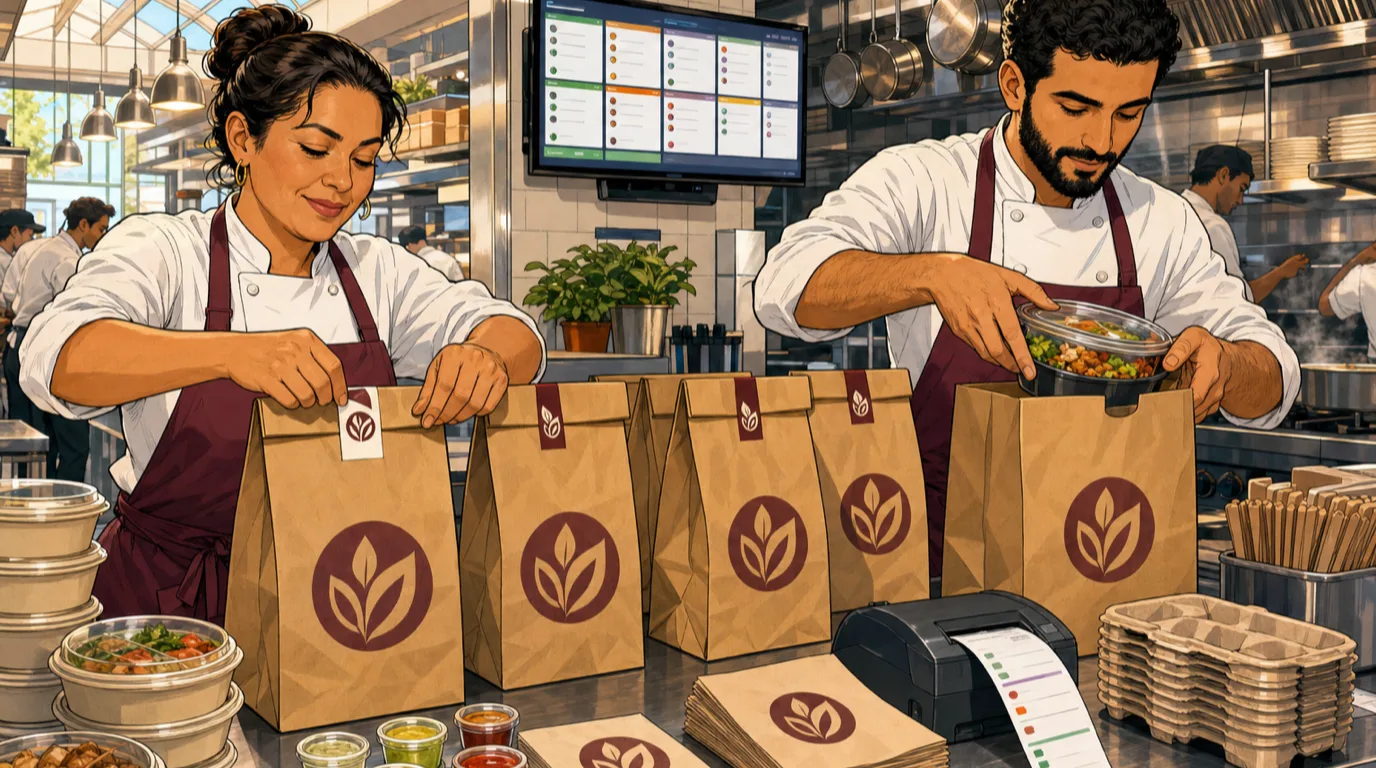
- Packaging inflation. Marketplace orders need sturdier packaging than dine-in plate-ware - sealed containers, vented lids for hot items, separate sauce cups, branded bags, tamper-evident seals. Most operators land at $0.45-$1.20 per order in packaging when they include the bag, the container, the napkin pack, and the seal. On a $32 average order at a 25% commission, the packaging adds 1.4-3.8 percentage points of margin loss on top of the headline. Operators who do not separately track packaging on marketplace orders consistently understate the true commission by 2-4 percentage points.
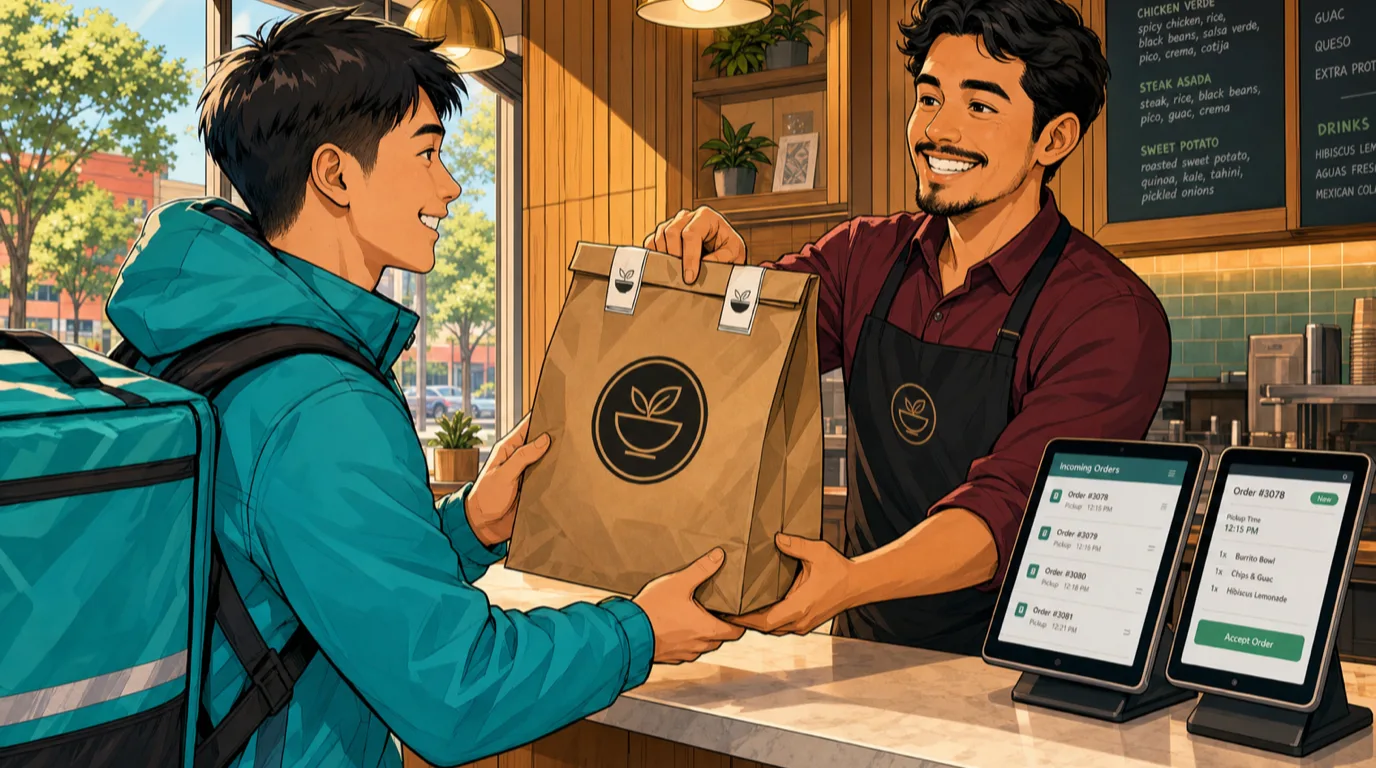
- The tablet attention tax. Most marketplace integrations still arrive on a dedicated tablet at the expo station (one tablet per marketplace), each beeping independently, each with its own UI, each requiring the line to confirm receipt and ETA. The labor cost of monitoring three or four marketplace tablets during a service is real - typically a 15-25 minute per service tax on the expediter, which on a $20/hr loaded wage rate over a 7-day week adds $25-50 per week in unbillable labor. Native POS integrations collapse the tablets into a single KDS queue and eliminate this tax, but most operators still run the legacy tablet stack.
- The promotional spend ladder. Marketplace algorithms reward operators who run in-app promotions (10% off $20+, free item with $25+, free delivery weeks). Most operators discover that promotional spend behaves like an additional commission tier - turn it off and order volume drops 20-35% inside two weeks, leave it on and contribution margin per order drops another 4-8 percentage points. The marketplace funds none of this; it all comes out of restaurant margin. Sophisticated operators budget 3-6% of marketplace gross revenue as ongoing "promotional commission" on top of the headline rate.
- Refunds and adjustments. When the driver spills a milkshake or the order arrives with a missing item, the marketplace typically refunds the guest in full and deducts the amount from the restaurant - even when the issue was a driver problem, a packaging defect from the marketplace's own white-label courier, or a guest who is gaming the refund flow. Refund rates average 1-3% of gross marketplace revenue at most restaurants and spike to 4-7% in markets with aggressive guest refund behaviour. The dispute process is slow, painful, and rarely produces a reversal. Plan for it as a fixed cost rather than a contestable line item.
- Brand fungibility loss. The most insidious cost and the one operators ignore the longest. When your restaurant lives inside an Uber Eats listing alongside fifteen other listings for "healthy bowls", the guest learns to associate the category with the marketplace and to associate your specific brand with the closest substitute that is one slot cheaper. The CRM value of a marketplace guest is roughly 35-55% of the value of an equivalent first-party guest, because the marketplace orientation trains the guest to optimise on category and convenience rather than on restaurant brand. The lost lifetime value compounds quietly across years and shows up in the marketing budget when acquisition spend has to do double duty.
Add the five together and the true blended cost of marketplace orders runs 8-15 percentage points above the headline commission. For most independents that puts the all-in cost in the 35-45% range, which is the level at which the contribution math stops being good.
Run the math on your own channels
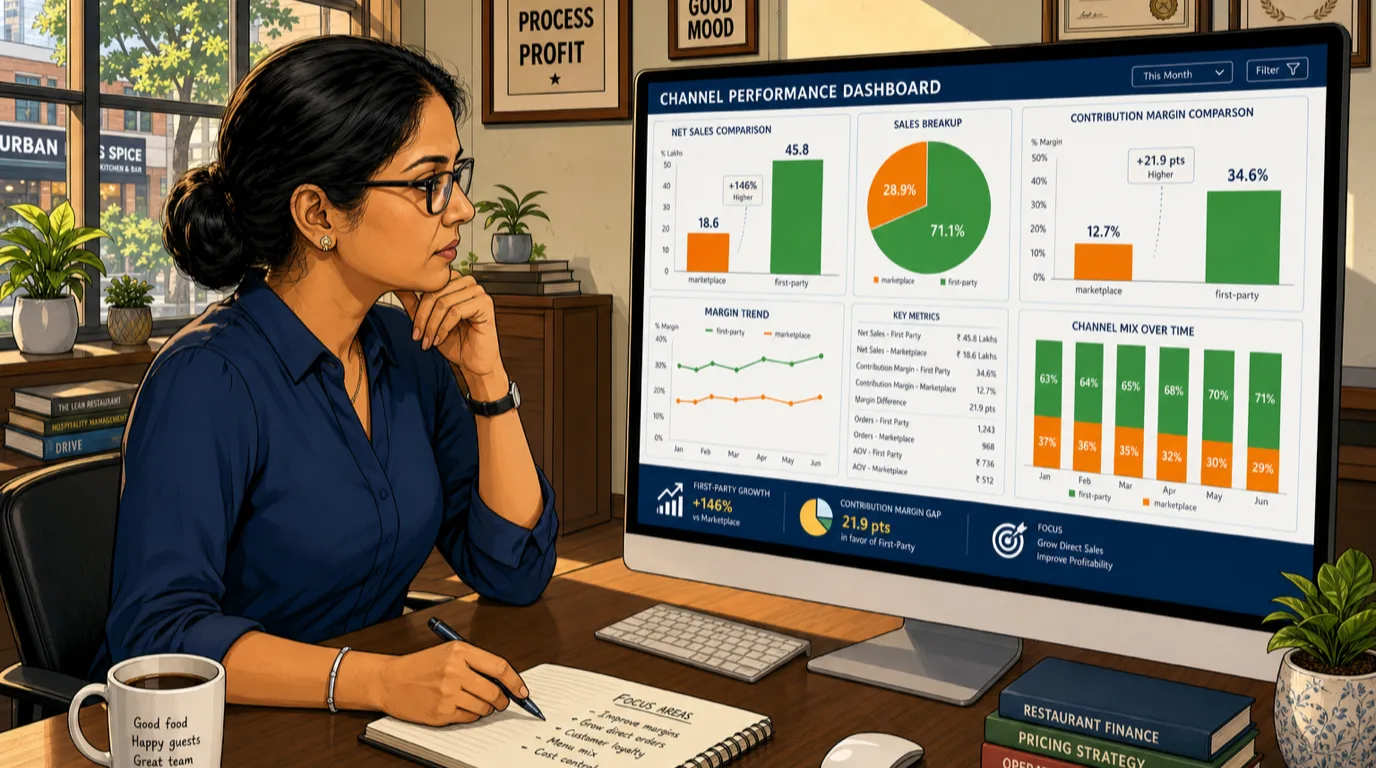
Drop your numbers into the calculator below. It returns per-order contribution for marketplace versus first-party, the weekly and annual contribution split, the contribution gap that would land in your pocket if the same volume shifted to first-party ordering, and a tier badge against the operator-tested healthy band. Nothing leaves your browser.
Run the calculator twice - once at the headline marketplace commission, once with packaging plus promotional spend added on top (the realistic all-in cost). The difference between the two contribution numbers is the hidden margin that most operators do not see on the surface marketplace dashboard. For most restaurants doing $3,000-$8,000 a week through marketplaces, the annual contribution gap to first-party ordering at the same volume lands between $25,000 and $90,000. That gap is the dollar value of the first-party ordering migration program.
The first-party vs third-party math, with real numbers
The clearest way to see the contribution gap is to walk a single order through both channels side by side. Take a $32 order at a neighbourhood bistro with a 30% food cost (i.e., 70% gross margin before packaging, labor, and rent).
Through Uber Eats at the standard 25% commission tier plus a 10% in-app promo:
- Gross order value: $32.00
- Marketplace promo (10%): -$3.20 (the operator pays for this)
- Net food revenue to the operator: $28.80
- Commission at 25% on the net: -$7.20
- Packaging: -$0.80
- Refund reserve at 2%: -$0.58
- Food COGS at 30% of net revenue: -$8.64
- Contribution before labor/rent: $11.58 (40.2% of net)
Through first-party ordering on the same $32 order, with the operator running their own delivery via a marketplace courier (Uber Direct / DoorDash Drive) at $7 per delivery, no promo:
- Gross order value: $32.00
- Payment processing (2.9% + $0.30): -$1.23
- Courier delivery fee (operator pays, recovered partially via guest delivery fee of $4.99): -$2.01 (net courier cost after guest delivery fee)
- Packaging: -$0.80
- Refund reserve at 1% (lower on first-party): -$0.32
- Food COGS at 30%: -$9.60
- Contribution before labor/rent: $18.04 (56.4% of gross)
The first-party order produces $6.46 more contribution than the marketplace order on the same $32 sale. On 200 marketplace orders a week, that gap is $1,292 a week, or roughly $67,000 a year. On a 500-order week, $167,000 a year. The math is unambiguous; the only real question is whether you can build the first-party demand to replace the marketplace order flow.
The five real benefits of third-party (when they are worth the bite)
The marketplaces are not pure margin destroyers. There are five moments where the marketplace bite is the right cost to pay, at least temporarily:
- Discovery for new restaurants. A new restaurant with no organic search presence and no email list lives or dies on local visibility. The marketplaces are the cheapest acquisition channel for the first 90-180 days of trading - cheaper than paid search, cheaper than paid social, cheaper than billboards. Use them explicitly as an acquisition surface during the launch window and plan the migration to first-party for month 6+.
- Trial in new geographies. Opening a second location and want to test demand before signing a longer lease? Marketplaces give you a near-instant read on what dishes sell in the new geography without any local marketing spend. The data is biased toward delivery-friendly menu items, but the directional read is useful.
- Peak-load smoothing. A restaurant with strong dine-in demand and limited off-premise capacity can use the marketplaces as an overflow valve. Turn them on during weak shifts (Tuesday lunch, Sunday night) and off during peak shifts to manage kitchen load without committing to permanent off-premise capacity.
- Ghost kitchen and virtual brand testing. Ghost kitchens and virtual brands that live entirely on the marketplaces have a different math problem - they have no dine-in or first-party demand to fall back on - but for early-stage brand testing the marketplaces are the only viable distribution channel, and the commission is the cost of existing at all.
- Delivery without operational complexity. Operators who genuinely do not want to manage drivers, courier contracts, delivery zones, and refund flows are paying the marketplace commission for outsourced operations. For a single- location independent with no off-premise staff capacity, the operational simplification is worth a meaningful piece of the margin loss. The math just needs to be made explicit so it is a choice, not an accident.
The decision matrix: when each channel wins
The right channel mix depends on five variables: your gross margin, your dine-in demand, your operational capacity for off-premise, your brand strength, and your guest density. The framework that holds up across most independents:
- Marketplace-only wins when the brand is new, the operation is single-location, the dine-in demand is thin, and the operator explicitly wants to outsource off-premise operations. Acceptable for the first 90-180 days of trading and for ghost kitchen / virtual brand formats.
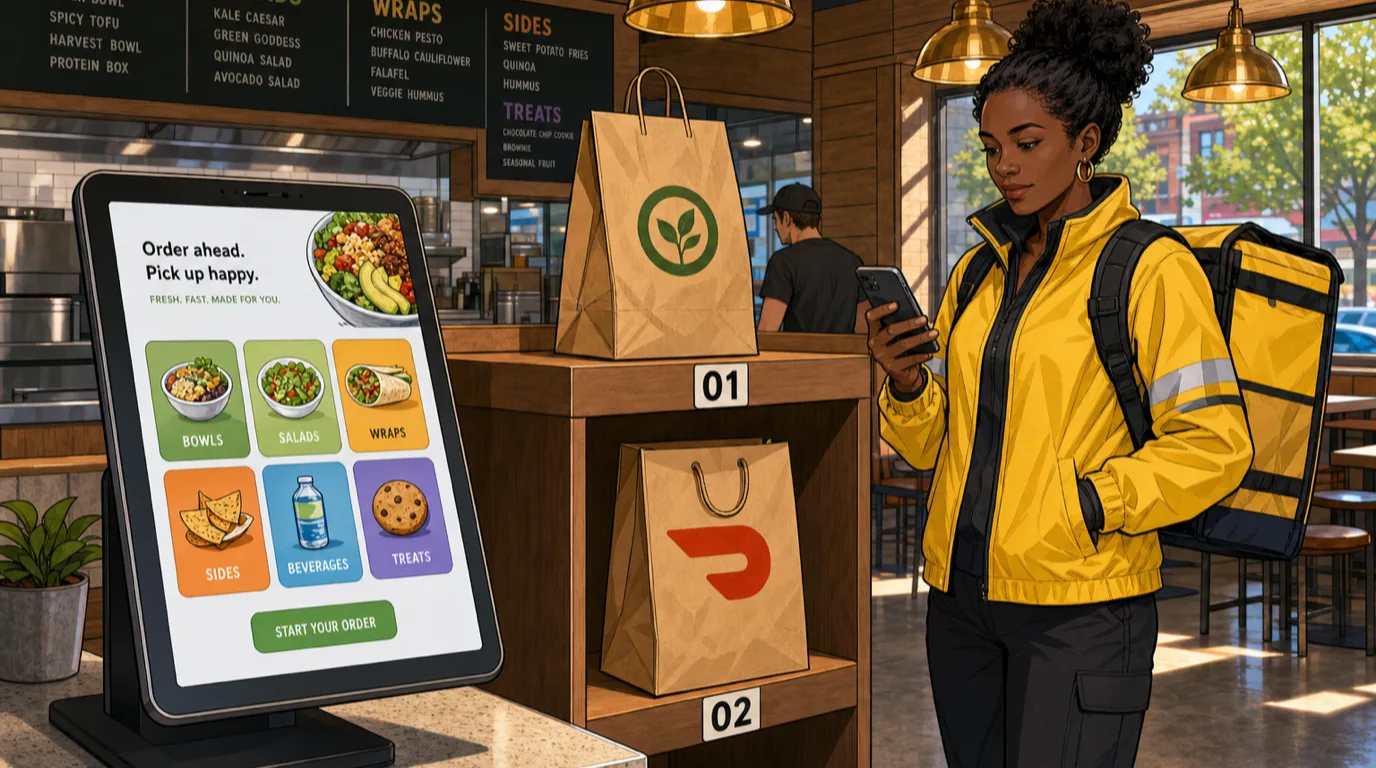
- Hybrid (marketplace as discovery, first-party as conversion) wins for established restaurants with growing guest density, an active CRM, and the operational capacity to fulfil first-party orders. This is the right answer for roughly 80% of independent operators we model. The marketplace acts as the acquisition channel for first-time delivery guests; the first-party ordering surface (with bag inserts, email follow-ups, and loyalty incentives) converts the second and third order.
- First-party only wins for restaurants with strong brand equity, established repeat-guest behaviour, geographic density that makes own-driver economics work, or formats where marketplace economics are particularly punishing (high-margin beverage-heavy bars, fine dining where marketplace packaging degrades the brand, premium restaurants where the marketplace listing context cheapens perception).
The wrong move is letting the channel mix happen by accident. Most independents stumble into a marketplace-heavy mix because turning the marketplaces on is easy and turning them off is hard; they discover three years later that 70% of off-premise revenue runs through a channel that earns half the contribution of the alternative. The deliberate move is to model the channel mix quarterly against the calculator above and adjust the marketing investment to push the mix toward whichever channel is producing the better economics.
The seven operator decisions before you sign (or renegotiate)
The marketplace contracts most independents sign in their first week of trading are usually the worst contracts they will ever operate under. The seven decisions that determine whether the contract is workable or punishing:
- Commission tier choice. The marketplaces will push you toward the highest tier (with the highest commission and the highest in-app visibility). For an established brand with existing demand, the basic tier (15-18%) is almost always the right choice - the discoverability boost from the premium tiers rarely pays back the additional 10+ commission points. For a new brand needing acquisition, the standard tier (20-25%) is usually right; premium is rarely justified outside of major launch windows.
- Integration model: tablet vs native POS. The default integration is the marketplace's own tablet at the expo station. Native integration with your POS - where the marketplace order flows into the same order management system as your dine-in, takeout, and first-party orders, and routes to the same KDS - is the only configuration that does not produce ongoing operational friction. Make native POS integration a hard requirement; if the marketplace cannot offer it, that is a signal to renegotiate or to deprioritise the channel.
- Menu sync model. The marketplace menu has to read from the same source of truth as the POS and the first-party ordering surface. Operators who maintain three separate menus (POS, marketplace, first-party) drift within weeks - prices diverge, modifier inventory diverges, availability rules diverge, and guest complaints multiply. Native menu sync is non-negotiable for the same reason native POS integration is.
- Pricing strategy: parity vs uplift. The marketplaces strongly prefer (and sometimes contractually require) menu price parity with dine-in. Operators who comply lose the opportunity to recover commission costs through pricing; operators who upcharge 10-15% on marketplace prices recover meaningful margin but risk lower guest conversion and (in some contracts) penalty enforcement. Read the contract before deciding; the parity clauses vary by marketplace and by region. Where uplift is allowed, a 12-18% marketplace price uplift typically recovers 60-80% of the commission burden with minimal impact on order volume.
- Image and content rights. The marketplace will take your menu photos, your restaurant name, your tagline, and (in many contracts) the right to use them in any marketing the marketplace runs - including marketing that promotes competing restaurants. Read the IP clauses carefully and provide marketplace- specific photography where the contract allows, so your best restaurant photography is not used to drive traffic to the next listing down.
- Cancellation and pause policy. Marketplaces charge cancellation fees on guest-cancelled orders, restaurant- cancelled orders, and orders that fail to arrive within a specified window. The standard contract puts most of the cancellation cost on the restaurant; better-negotiated contracts shift some of it back to the marketplace when the issue is a driver or platform problem. The pause policy (your ability to temporarily go offline during kitchen overload) is the second most important operational clause; marketplaces with restrictive pause rules will ding your search ranking every time you pause, which compounds the visibility problem.
- Data ownership and portability. The marketplace keeps the guest data by default. Read the data ownership clauses and identify any pathway (the inside-the-app messaging, the bag inserts, the receipt content) that lets you reach the guest after the order. The strongest pathway is usually a paper bag insert with a QR code linking to your first-party ordering surface with a meaningful first-visit incentive (a free dessert, a discount, loyalty signup). The marketplaces tolerate bag inserts in most contracts; some prohibit them. Check before you print.
Format-specific playbooks
The right marketplace strategy looks different by format. The playbook by category:
Pizza and high-frequency casual
The format with the most to lose to marketplaces and the most to gain from first-party. Pizza orders have predictable delivery economics (most are local, most are repeatable, most are family- sized), high gross margin (60-70%), and a guest base with high delivery frequency. The right move is to use marketplaces aggressively for acquisition in the first year and then push the migration to first-party hard with bag-insert promotions, loyalty incentives, and local SEO that ranks the restaurant's own ordering page above the marketplace listings. Most pizza independents can land at 70%+ first-party share within 24 months.
Fast-casual and bowl formats
The hardest category to migrate off the marketplaces because the guest behaviour is genuinely marketplace-orientated - guests search "healthy bowls near me" rather than your specific brand. The marketplaces are deeply embedded in the category. The defensible strategy is hybrid: use the marketplaces for discovery and turn the acquired guests into first-party regulars through the CRM and loyalty channels. Menu engineering matters more in this category because the marketplace listing has to compete on visual appeal of the lead dishes; spend on the photography that the marketplace algorithm rewards.
QSR (quick-service)
Mixed playbook. National QSR chains have the brand strength to push first-party hard; independent QSR usually needs the marketplaces for incremental demand. The right move for most QSR operators is to treat marketplaces as overflow capacity rather than primary demand - turn them on for slow dayparts and off for peak. The takeaway POS system stack should treat marketplace orders as just another channel in the same ticket queue, with the same prep priorities as in-store orders.
Full-service restaurants
The category that loses the most to marketplaces relative to brand strength. Full-service restaurants have meaningful dine-in demand, premium brand positioning, and packaging that often degrades the food quality - a $42 main course delivered in a clamshell at 55 degrees is a worse product than a $24 fast-casual bowl delivered in the same packaging. The right move for most full-service operators is to either skip marketplaces entirely (preserving brand) or to deploy them only for a curated delivery menu of travel-friendly items, with explicit pricing uplift and quality controls. The food cost discipline matters more here because the marketplace bite is harder to recover.
Ghost kitchens and virtual brands
The format that requires the marketplaces. Ghost kitchens with no storefront have no first-party demand to fall back on; the marketplaces are the entire customer acquisition channel. The playbook is to accept the commission as the cost of business and optimise everything else: menu engineering for delivery economics, packaging for travel resilience, brand differentiation against the adjacent listings, and operational efficiency for the cloud kitchen POS stack.
Bars, cocktail venues, and beverage-heavy formats
Skip the marketplaces for most beverage orders - cocktails do not travel well, the regulatory complexity of alcohol delivery is real in most jurisdictions, and the brand cheapening is severe. Use the marketplaces selectively for food menu items only if the bar runs a significant food program, and treat first-party online ordering as the primary off-premise channel.
The seven-step hybrid migration strategy
For most established independents, the strongest move is hybrid - keep the marketplaces for discovery, build first-party for repeat order flow, and migrate the guest base over 12-24 months. The playbook:
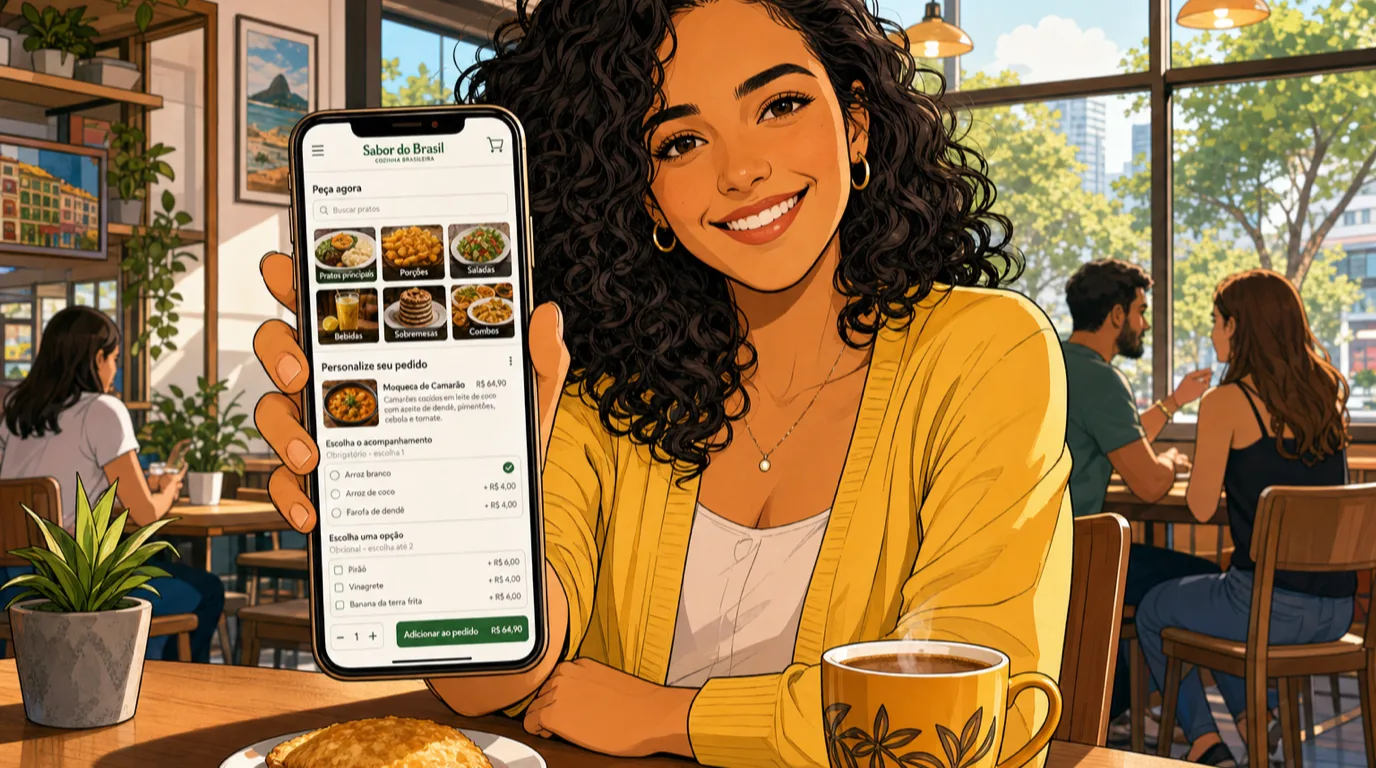
- Stand up first-party ordering on a real platform. The first-party ordering surface has to be native to the POS and payments stack, mobile-first, and integrated with the CRM for identity capture and remarketing. A standalone ordering page on a different vendor that does not write back to the POS is a half-step that produces ongoing reconciliation work and does not solve the data ownership problem. See the POS with online ordering guide for the integration depth that actually matters.
- Make the first-party experience genuinely better. Faster ordering than the marketplace, fewer taps to a complete order, remembered guest preferences from the second visit, exclusive items or pricing the marketplace does not have, faster fulfilment promise. Operators who deploy first-party as a worse copy of the marketplace experience get a worse outcome; operators who deploy it as a better experience pull guests across naturally.
- Bag inserts on every marketplace order. Every marketplace bag should ship with a printed insert (or a sticker on the bag) that offers a meaningful first-visit incentive to order direct - a free side, a discount, loyalty signup. The conversion rate from marketplace guest to first-party guest on a well-designed insert lands at 8-18% within 30 days, which compounds quickly across a quarter.
- Local SEO the first-party ordering page. The first-party ordering URL should rank for branded searches ("[your restaurant] order online") and for the local category searches your guests run. Most independents under-invest here; the marketplace listing typically outranks the restaurant's own site for branded search, which is a freebie the marketplace collects and the restaurant pays for.
- Loyalty incentives that favour first-party. Loyalty rewards are easier to deliver on first-party orders (you control the order surface and the receipt). Build the loyalty program so the rewards are best earned and redeemed on first-party, without overtly violating marketplace contract terms that often require parity on visible promotions. The CRM-led design here matters; the restaurant CRM guide covers the seven moves that move repeat-visit rate.
- Renegotiate the marketplace contract annually. Volume gives leverage. A restaurant doing $100k a year through Uber Eats has more negotiating leverage than a restaurant doing $20k. Use the annual renewal as the moment to push for commission reduction, integration upgrades, image rights, and pause policy improvements. The marketplaces rarely volunteer concessions, but they consistently grant them to operators who threaten to deprioritise the channel.
- Read the channel mix monthly and reallocate. The marketplace versus first-party share should be a board-level metric, reviewed monthly the same way you review prime cost and food cost. Set a 12-month migration target (typically "first-party share rises from 25% to 50% over 12 months"), and adjust the marketing investment - bag inserts, paid local search, CRM cadence - based on whether the migration is on pace.
The common mistakes operators make in the first 12 months
Five patterns that consistently undo a well-engineered marketplace strategy:
- Treating marketplace revenue as equivalent to first- party revenue on the P&L. The same dollar of marketplace revenue produces 40-55% of the contribution of a first-party dollar. Restaurants that aggregate the two on the P&L and read "off-premise revenue" as a single line miss the channel-level economics entirely and over- invest in the lower-contribution channel.
- Letting the highest commission tier creep in. The marketplaces will offer "free 90-day trial of the premium tier" that auto-renews unless cancelled. Most operators forget to cancel. Audit the tier annually; the premium tier is rarely worth the commission bump after the first launch window.
- Running parallel menus that drift. Price the fries at $4.50 on the POS, $5.00 on Uber Eats, $4.75 on DoorDash, and $4.00 on the first-party ordering page. Within six months the guest sees the inconsistency, leaves a one-star review about it, and the marketplace algorithm penalises your ranking. The fix is single source of truth for the menu, propagated to every channel in seconds via native integration.
- Ignoring the refund rate. A 3% refund rate on $200k a year of marketplace revenue is $6,000 a year leaving the operation through one specific line item. Operators who track refund rate weekly and dispute high-rate driver issues consistently recover 30-50% of the cost.
- Never running the hybrid migration. Most operators "intend" to push first-party harder and never set a real target, a real cadence, or a real owner. The migration stays on the wish list while the marketplace share grows. Treat the migration like a product launch with a 12-month plan, a weekly review, and a named owner.
How Tableview's first-party ordering changes the math
This is where the integration depth matters. Tableview ships e-menu and mobile ordering natively inside the same platform that runs your POS, payments, KDS, and CRM. First-party orders flow into the same ticket queue as dine-in, take-out, and (when the marketplace integration is also native) marketplace orders. The menu propagates from a single source of truth across all channels in seconds, the prices stay in sync, the modifier inventory updates everywhere when a stock runs out, and every transaction writes back to the same guest profile in the CRM. Because the first-party ordering surface lives in the same platform as the rest of the operation, the operator dashboard reads contribution by channel in real time - what fraction of off-premise revenue is first-party, what the per-order contribution gap is, and where the marketing investment should shift this month. A bolt-on first-party ordering vendor that lives outside the POS produces a weaker version of every one of these capabilities, which is why the bolt-ons usually fail to make the migration math work in practice.
The integration depth is the entire point. The marketplaces are not going anywhere; they will keep providing discovery, and the operator's job is to migrate the repeat order behaviour to first-party where the contribution is twice as good. The platform that runs the migration cleanly is the platform where first-party ordering, payments, KDS, and CRM are the same system, not four systems that exchange CSVs nightly. See the broader restaurant tech stack guide for where ordering sits inside the seven-layer architecture, and the restaurant industry trends 2026 piece for how the marketplace-versus-first-party tension fits the broader industry direction.
The bottom line
Third-party delivery marketplaces are the most expensive distribution channel most restaurants run, and they are not going to get cheaper. The headline commission of 25-30% understates the true blended cost by 8-15 percentage points once packaging, promotional spend, refunds, the tablet attention tax, and the brand fungibility loss are accounted for. On the same $32 order, a first-party channel typically produces $5-8 more contribution than a marketplace channel, which compounds to $25k-$170k a year in recovered margin at typical independent volumes.
The right operator answer is almost never "marketplace-only" and almost never "first-party-only"; it is a hybrid with a deliberate 12-24 month migration target moving the repeat order flow off the marketplaces. Run the calculator above on your current channel mix, identify the contribution gap, set a 12-month first-party share target, and treat the migration like a product launch with a named owner and a monthly review. The marketplaces stay on the menu as a discovery channel; the first-party ordering surface becomes the home of the relationship.
Run the Marketplace Margin calculator on your channel mix. Pair the modelling with the P&L calculator and the Customer Lifetime Value calculator to see the full picture - the per-order contribution gap, the P&L impact at your current volume, and the lifetime value erosion when guests are trained to think of you as one slot inside a marketplace app. The combined read usually turns a vague intuition about "marketplaces are eating us alive" into a specific dollar number and a specific quarterly target. Bookmark the calculators hub for the rest of the operator toolkit.
Read next: Restaurant Payment Processing Fees: The 2026 Operator's Guide to Lowering Your Effective Rate (with Free Effective Rate Calculator) and Menu Pricing Strategy for Restaurants: The 2026 Operator's Playbook on How to Price Your Menu (with Free Menu Price Recommender) and POS with Online Ordering: Restaurant Online Ordering Systems.