
Every restaurant story begins with the same unglamorous chapter: finding the money. A modest opening runs 200,000 to 500,000 dollars, an ambitious one far more, and almost nobody writes that check from savings alone. Yet financing is the part of the business founders research least, they can describe the menu in loving detail while confusing a term loan with a line of credit, and the gap gets expensive: the wrong capital structure burdens a healthy restaurant with payments it cannot make, while the right one turns the same building, same menu, same team into a business that compounds. This guide maps every real funding source, banks, the SBA, equipment lenders, investors, landlords, and the traps, with the numbers lenders actually use, the same way your accounting stack and payment setup deserve to be chosen: deliberately, on the math.
Before touring the options, anchor on the number they all serve. Your total project cost is build-out plus equipment plus deposits plus licensing plus opening inventory plus, the piece first-timers forget, working capital to survive the ramp: three to six months of payroll, rent, and purchases while sales climb toward plan. Our startup costs guide builds that budget line by line; this one assumes you have it and answers the next question, where the money comes from, and in what mix.
How lenders think, and what they need to see
Every institutional funding source runs some version of the same analysis: can this operator, in this location, with this concept, generate the cash to repay us, and what do we recover if not? That translates into a file you should assemble before approaching anyone: a business plan with three-year projections built from defensible assumptions (covers, average check, margins that match industry reality rather than hope), a break-even analysis that shows you know your fixed-cost line, personal financial statements and two to three years of tax returns, your resume framed around operating experience, the lease or letter of intent, and detailed use-of-funds showing where every borrowed dollar lands. Lenders read hundreds of these; completeness signals competence before a single number is checked.
The five Cs of credit decode the decision. Character: your credit history and industry track record, experience running someone else's restaurant counts heavily. Capacity: projected cash flow against the proposed payment, usually tested at a debt service coverage ratio of 1.25 or better, meaning projected cash flow exceeds payments by 25 percent. Capital: your equity injection, typically 15 to 30 percent of project cost. Collateral: what secures the loan, equipment, personal assets, or the SBA guarantee standing in for what restaurants lack. Conditions: the market, the location, the concept's plausibility. You cannot fix all five overnight, but knowing which one is your weakness tells you which lender to approach and what to strengthen first, and our business plan guide covers the document that carries the argument.
SBA loans: the workhorse of restaurant funding
The Small Business Administration does not lend directly; it guarantees loans made by banks, absorbing enough default risk that lenders will fund deals they would otherwise decline, and restaurants are perennially among the top SBA borrower categories for exactly that reason. The flagship 7(a) program funds up to 5 million dollars for nearly any purpose, build-out, equipment, working capital, buying an existing restaurant, at rates typically pegged to prime plus 2 to 4.75 percent depending on size and term, with terms up to 10 years for non-real-estate uses, and 25 for property. Expect a guarantee fee of 2 to 3.75 percent of the guaranteed portion, personal guarantees from all owners above 20 percent, and a process that runs 30 to 90 days, faster with SBA Preferred lenders who approve in-house.
Inside the SBA family, match the program to the need. SBA Express offers up to 500,000 dollars with a faster, lighter process at slightly higher rates, well suited to working capital lines and smaller projects. Microloans, up to 50,000 through nonprofit intermediaries, fit food trucks, kiosks, and first steps, with coaching attached. The 504 program, paired bank-plus-CDC financing with as little as 10 percent down, exists for buying or building real estate, the day you stop paying rent and start paying your own mortgage. Strategy notes earned from thousands of closed deals: approach two or three SBA-preferred lenders simultaneously (terms vary more than borrowers expect), ask each what bothers them about your file and fix it, and start the process before you sign the lease, a financing contingency in the lease negotiation costs nothing and protects everything.
Banks, credit unions, and term loans without the SBA
Conventional term loans, borrowed principal, fixed schedule, three-to-ten-year terms, price better than SBA deals (no guarantee fee, often lower rates) and close faster, but the underwriting bar is higher: banks writing unguaranteed restaurant loans want experienced operators, existing profitable locations, strong collateral, or all three. For a second location backed by two years of clean financials from the first, a conventional loan is frequently the best paper available, and the relationship compounds: the bank that holds your deposits, processes your payroll, and watches healthy balances flow through your operating account for two years says yes to requests a stranger would decline. This is the practical argument for banking somewhere with a real commercial lending desk, community banks and credit unions in particular, where a human who knows your business reads the application.
First-time openers without collateral should hear the conventional-desk rejection as routing information rather than verdict: it points you back to the SBA programs above or sideways to the capital sources below. What it should never do is route you to the online lenders advertising 24-hour restaurant loans at "factor rates" that obscure APRs north of 40 percent; fast money is available at every stage of desperation, and the discipline of refusing it while you still have options is worth more than any single approval. A useful habit while comparing anything: convert every offer, whatever its vocabulary, into APR and total dollars repaid, the two numbers every honest lender will state and every predatory one will dance around.
Equipment financing: let the asset carry itself
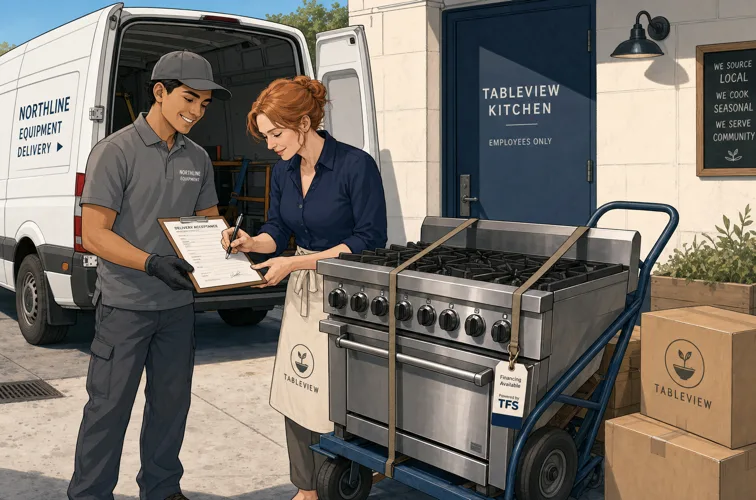
The 80,000 to 150,000 dollars of metal in a commercial kitchen, the ranges, hoods, refrigeration, dish machine, espresso equipment, and POS hardware itemized in our equipment guide, does not need to be bought with precious cash or general loan proceeds, because the equipment itself secures its own financing. Equipment loans fund 80 to 100 percent of purchase price over three-to-seven-year terms at rates commonly between 7 and 15 percent, with approvals measured in days and credit standards more forgiving than banks', since repossessable collateral changes the lender's downside. Equipment leases go further: little or nothing down, payments treated as operating expense, end-of-term options to buy, upgrade, or return, worth pricing for fast-evolving or maintenance-heavy categories, and standard practice for espresso machines and dish machines where service contracts bundle in.
Two disciplines keep equipment financing honest. First, finance assets whose useful life exceeds the term, a range that works fifteen years on a five-year note builds equity, while financing a two-year laptop over five is how businesses drown in payments for things they no longer use. Second, read the lease mathematics: a fair-market-value lease with a large residual can cost dramatically more over its life than the loan alternative, so compute total cost of ownership on both paths before signing whichever document the salesperson slides across. Used equipment, auctions, and restaurant liquidations offer a third path that pairs beautifully with a smaller loan, the sad arithmetic of restaurant turnover means excellent equipment sells constantly at 30 to 50 cents on the dollar.
Lines of credit and the working capital cushion
A business line of credit is the facility you arrange when you do not need it, so it exists when you do: approved capacity, commonly 25,000 to 250,000 dollars, that you draw and repay as needed, paying interest only on the drawn balance. For a business as seasonal and shock-prone as a restaurant, slow Januaries, surprise repairs, a big catering order's up-front costs, the line is the difference between a cash-flow wobble and a crisis, and between planned borrowing at prime-plus and panic borrowing at MCA rates. Banks write lines for operators with track records; new openers can often include a working capital line inside an SBA package, which is the cleanest way to be born with a cushion.
Use the line like an operator: draw for timing gaps and short-lived needs that revenue will cover within weeks or months, never for permanent capital like build-outs (that is term debt's job) or chronic losses (that is a business-model problem no borrowing solves). Keep it mostly undrawn, both because unused capacity is the point and because utilization patterns feed your renewal review. And pair the facility with the reporting rhythm that makes it renewable: clean monthly statements from your accounting flow, an eye on your KPIs, and the six-week cash forecast that spots the gap before it arrives, so the draw is a decision rather than a scramble.
The fast-money trap: merchant cash advances and their cousins
Because restaurants run daily card volume, they are the prime target of the merchant cash advance industry, and every operator will eventually receive the call offering 50,000 dollars by Friday, no collateral, minimal credit check. The product works by purchasing your future card sales: you receive an advance and repay it through a fixed percentage of daily card receipts until you have paid back the advance times a factor rate, typically 1.2 to 1.5. The arithmetic the salesperson will not do for you: a 1.35 factor repaid over eight months annualizes to an APR between 60 and 100-plus percent, and because the repayment rides your daily sales, the drain is heaviest exactly when business is slow. The industry's darkest pattern is stacking, a second advance taken to survive the first, then a third, a spiral that ends operations which were otherwise viable.
The same skepticism applies across the fast-capital shelf: online term loans quoting "simple interest" that doubles when converted to APR, invoice factoring at aggressive discounts, and revenue-based financing with buyback clauses. The rule that sorts all of it: any lender who will not state an APR and a total-dollars-repaid figure is telling you the answer by omission. Fast money has one legitimate niche, the true emergency where the repair cannot wait, the revenue to repay is certain, and every cheaper facility is exhausted, and the way to never occupy that niche is the working capital line arranged in calm times, plus the maintenance schedules and reserves that make catastrophic surprises rare.
Buying an existing restaurant: a different financing problem
Purchasing an operating restaurant changes the underwriting entirely, and usually in your favor: instead of projections, there are actual financials, and lenders fund demonstrated cash flow far more willingly than dreams. The SBA 7(a) is the standard vehicle for acquisitions, funding up to 90 percent of a purchase supported by the target's earnings, with the loan sized against seller's discretionary earnings, the cash flow available to a working owner after adding back the seller's salary and personal expenses. Your diligence list is the lender's: three years of tax returns (not just the P&L the broker hands you), sales data straight from the POS rather than spreadsheets, the lease and its transferability, equipment condition and age, and the licenses, especially the liquor license, whose transfer rules vary wildly by jurisdiction and can gate the entire timeline.
Seller financing deserves a starring role in acquisition structures: a seller carrying 20 to 50 percent of the price at reasonable interest signals confidence in the business, reduces the bank loan you must qualify for, and keeps the seller invested in a clean transition, introductions to regulars, recipes documented, the head chef staying through the handover. Watch the two classic acquisition traps: paying for potential ("imagine the revenue if you added dinner service", if it were easy, the seller would have done it), and inheriting the previous owner's problems, tax liens, supplier debts, wage claims, which is why asset purchases with proper lien searches, rather than entity purchases, are the standard structure for small restaurant deals. Priced correctly against actual cash flow, an acquisition is frequently cheaper and faster than building the same restaurant from a vanilla box.

Investors: selling ownership instead of paying interest
Equity capital fits where debt does not: first-time concepts without collateral, ambitious build-outs, and operators who would rather share upside than carry payments through the fragile first year. The friends-and-family round funds more restaurants than any bank, and destroys more relationships than any other capital source when handled casually, so document it like the securities transaction it legally is: real notes or units, real terms, a lawyer's afternoon of drafting, and the shared understanding that this money can be lost. Angel investors and the classic restaurant limited-partnership structure bring larger checks with formal expectations, commonly 20 to 40 percent equity for funding a first location, or LP structures where investors receive most or all distributions until their capital returns, then step down to a minority share.
Price the trade honestly in both directions. Equity's advantages: no payments during the ramp (the period that kills leveraged restaurants), aligned partners with networks and patience, and expansion capital already at the table if the first location works. Its costs: permanent sharing of profits your labor generates, governance obligations that outlast any loan, and, if you chose partners poorly, conflicts that no refinancing can retire. The mitigations are structural: an operating agreement that separates control from economics (you run the restaurant; investors get reporting and defined consent rights), distribution waterfalls agreed in writing before the first dollar, exit and buyout mechanics drafted while everyone is friends, and monthly financial reporting from day one, the single practice that most separates calm investor relationships from litigious ones.
The landlord, the seller, and the money hiding in the deal
Two capital sources hide inside transactions you are already doing. First, the landlord: tenant improvement (TI) allowances, contributions of 20 to 100-plus dollars per square foot toward your build-out, are standard in commercial leasing and heavily negotiable, especially for spaces that sat vacant or landlords courting food traffic; free-rent periods during construction and percentage-rent structures that flex with sales are the same lever in different clothes. Every TI dollar shrinks the project cost your equity injection and borrowing are calculated against, which makes lease negotiation a financing event, walk in with your business plan and treat the landlord as an investor being pitched, because economically that is what they are.
Second, the seller: if you are buying an existing restaurant rather than building, seller financing, the seller carrying a note for 20 to 50 percent of the price, is common, often cheaper than institutional debt, and doubles as the best due-diligence signal in the deal, a seller confident enough to hold your paper believes the business can repay it. Franchise paths carry their own financing ecosystems, franchisor-arranged lending, equipment programs, and SBA familiarity with established brands, covered alongside the fees in our franchising guide. Round out the picture with the small-but-real sources: local economic development grants and facade programs, crowdfunding (regulation platforms or the pragmatic presell-gift-cards variety), and community development financial institutions (CDFIs) that fund operators and neighborhoods banks overlook, individually modest, collectively often the last 10 percent that closes a budget.
The timeline: from first meeting to money in the account
Financing runs on lead times that must be built into the opening plan, because the money's calendar is less forgiving than the contractor's. A realistic sequence for an SBA-funded opening: month one, assemble the file, plan, projections, personal financials, tax returns, and pre-qualify informally with two or three preferred lenders; month two, formal application with a signed letter of intent on the space (with a financing contingency), followed by underwriting's question cycle, answer within days, not weeks, because stale files sink to the bottom of the pile; months three to four, commitment letter, appraisal and lien work, closing conditions, licenses in process, insurance bound, entity documents clean, then closing and first disbursement. Equipment financing and lines of credit close faster and can trail the main loan; investor rounds run on their own social clock and should start earliest of all.
Draw discipline matters after closing too: construction loans and SBA proceeds disburse against invoices and milestones, so a build-out that runs ahead of its paperwork stalls, and one that runs behind schedule burns interest on drawn funds producing no revenue. Keep a single spreadsheet reconciling budget, drawn, spent, committed, reviewed weekly with your contractor and your banker, boring, and the difference between a build that ends with working capital intact and one that opens broke. The pattern across every stage is the same: money moves at the speed of clean paperwork, and the operators who treat the file as seriously as the food consistently fund faster and cheaper than the ones with a better concept and a shoebox of documents.
Matching the money to the need
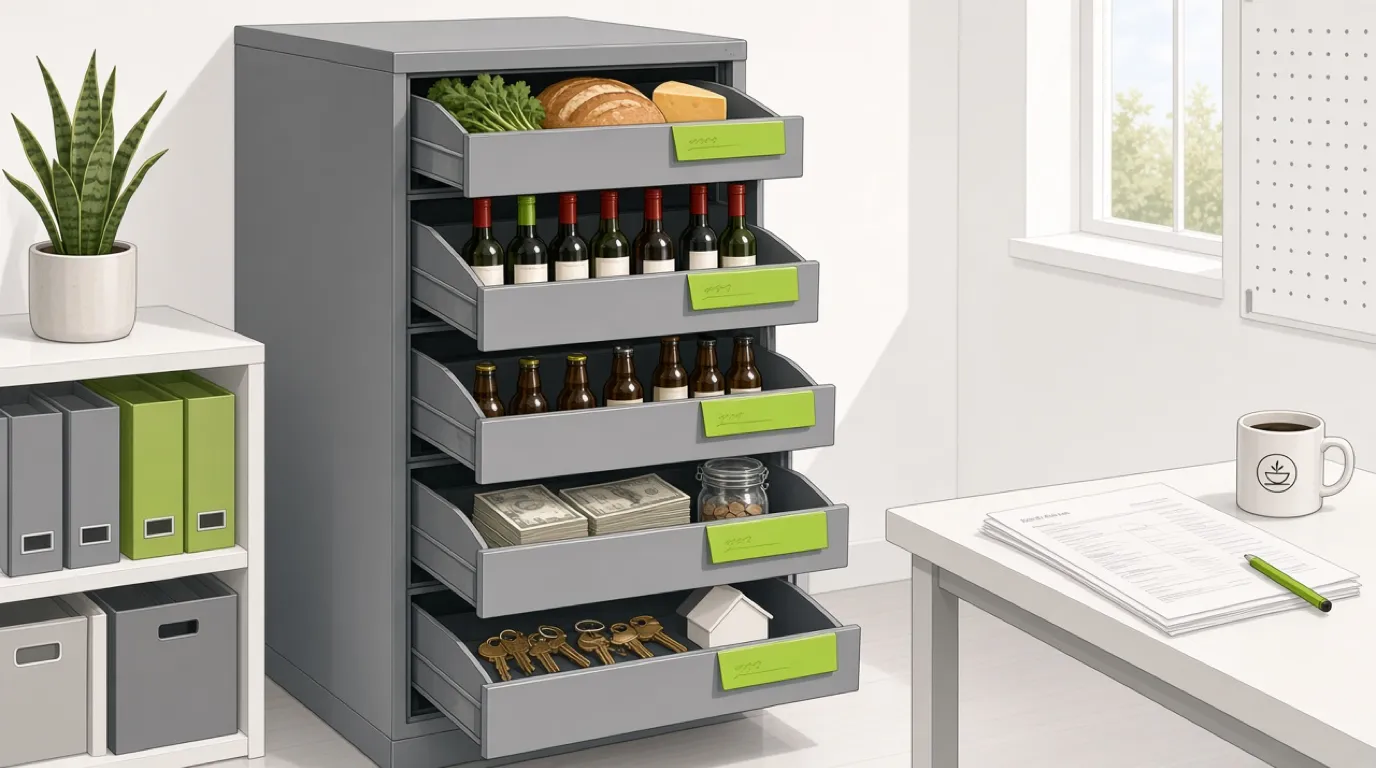
The structure that works is a stack, not a single check, with each capital type doing the job it prices best. A representative 400,000-dollar opening: 90,000 owner equity (the injection that makes everything else possible), 60,000 landlord TI allowance (negotiated, not borrowed), 150,000 SBA 7(a) for build-out and soft costs, 70,000 equipment financing carrying the kitchen, and a 30,000 working capital line, arranged at closing, mostly undrawn, guarding the ramp. Compare that with the same project funded by a single 310,000 loan: higher blended rate, no cushion, and every dollar of equipment paid for with general-purpose debt that stays on the books after the equipment ages out. The stack is more paperwork, and it is worth every form.
Three closing disciplines protect you from the industry's classic financing failures. Borrow for the whole journey, not just the build, undercapitalization at opening, with zero reserve for the slow ramp, kills more restaurants than rent; the working capital is not optional garnish, it is the point. Keep the paperwork investment-grade from day one, licenses and permits current, insurance certificates aligned with lender requirements, monthly statements produced on time, because every future request, the second location, the renovation, the refinance, is priced off the file you build now. And revisit the stack annually: debt paid down, rates moved, track record accrued, all of it repriceable, and the operator who refinances a 12 percent note into an 8 percent one at year three just funded the patio out of the spread. Money is an ingredient like any other; buy it well, and the menu gets easier.