
Ask most restaurants how they train and you get some version of the same answer: the new server shadows whoever is on, reads the handbook at home, and picks the rest up. That is not training, it is hoping. It also explains why the same operator who can tell you the food cost of every dish to the penny cannot tell you how long it takes a new hire to run a section alone, or why three of the last five quit inside a month. A trained team shows up in numbers you already watch: fewer voids and comps, faster tickets, higher average spend. The system that makes it repeatable starts with the till, because a restaurant POS with per-user logins and permissions is what turns "they seem fine" into a record of who is actually ready.
What follows is a 30-day plan for front of house, plus what changes for the kitchen and the bar, the compliance you cannot skip, who should do the training, and how to tell whether any of it worked. The kitchen half deserves its own treatment rather than a copy of the server path, since a cook learns stations and timing rather than tables and tone, and a kitchen display system gives you the ticket data to see where a new cook is actually slowing down.
Why most restaurant training fails
Three failures account for nearly all of it, and none of them are about effort.
The first is treating training as an event rather than a system. A day of orientation, a folder, a handshake, done. Skills that are not practised and checked decay within a fortnight, so the knowledge fades right as the new hire starts working unsupervised.
The second is training by osmosis. Shadowing has its place, but "follow Dave" copies whatever Dave does, including the shortcuts he invented in 2019 and the two steps he skips when the room fills up. Within a year of unmanaged shadowing you have as many service standards as you have long-serving staff, and no way to say which is correct.
The third is never defining the standard in the first place. You cannot train someone to a standard that lives in your head. If nobody has written down how a table is greeted, how long a guest waits before an acknowledgement, what a check-back sounds like, or what happens when a dish is 86'd mid-service, then everyone is guessing and no correction feels fair.
Fixing all three costs a few hours of writing and a change in habit, not a training budget. Money is not usually the missing ingredient.
Write the standards before you write the schedule
Before any plan, you need a short list of what "good" means at your place. Keep it concrete and observable, because anything vague cannot be taught or assessed. "Be friendly" is not trainable. "Greet within thirty seconds, use the guest's name if they gave it at booking, take a drinks order before you explain the specials" is.
Cover the moments that repeat every service: the greeting, the drinks order, menu questions, allergen handling, the check-back, clearing, the dessert offer, the bill, the goodbye. Add the awkward ones, since those are where untrained staff freeze: a complaint, a wrong dish, a card decline, a guest who has had too much, a table that wants to split eleven ways, a walkout.
Write each as a step or two, not a paragraph. Ten sides of prose gets skimmed. Two pages of specifics gets used, and it becomes the checklist you assess against on day 30. Much of this belongs in your employee handbook, but the handbook is the reference and this is the working document.
Before day one
The cheapest improvement available to most restaurants is doing the admin before the new hire arrives instead of during their first shift. It costs twenty minutes and changes the whole first day.
Get the paperwork done in advance: contract, tax forms, right to work, bank details, emergency contact, uniform sizing. Set up their POS login with the permissions their role actually needs, so they are not sharing a code with a supervisor and learning that permissions do not matter. Add them to the rota and the staff chat so the team knows who is arriving and when. Send a short pre-read, no more than a couple of pages, covering the menu, the story of the place, and the parking or bike situation.
Then tell them exactly what the first day is: when to arrive, which door, who to ask for, what to wear, whether they will be paid for it and whether they will eat. New hires who do not know these things arrive anxious, and anxious people learn slowly. A surprising share of first-day no-shows in hospitality are not cold feet, they are people who were never told where to go.
The 30-day plan
Thirty days is the right frame for front of house in a typical full-service restaurant. Faster is possible in quick service, slower is normal in fine dining, where wine and technical service push it toward sixty. The shape stays the same: understand the place, watch it done, do it with a net, do it alone, get signed off.
Day 1: context, not the handbook
Spend the first day on why the restaurant exists and how it physically works, not on policy. Walk the building: sections, station numbers, the pass, walk-ins, chemicals, fire exits, staff room, where the spare cutlery lives. Introduce the kitchen properly, by name, because a server who is comfortable talking to the pass fixes small problems before they become comped dishes.
Then feed them. A tasting of your five best sellers with the chef explaining each one buys more useful menu knowledge than an hour of reading descriptions, and it gives them honest language for recommending. Finish with an hour on the POS in a quiet corner: log in, open a table, fire a course, split a bill, void a line, process a refund with a manager present. Let them make the mistakes on a training till rather than in front of a table of eight.
Do not schedule them on the floor on day one. A first day spent being useful but confused teaches habits you will spend week three correcting.
Days 2 to 5: shadowing with a task list
Shadowing works when the shadow has a job. Give them a written list per shift: today you carry drinks and clear, tomorrow you take drink orders on two tables, the day after you take a full order on one table while your trainer watches. Each shift adds one responsibility and keeps the previous ones.
Pair them with a named trainer, not "whoever is on". Consistency matters more than picking your single best server, and the trainer needs to know they are being judged on the outcome. Brief the trainer on what this shift is meant to teach, otherwise the default is a busy shift where the new person hovers.
Fifteen minutes at the end of each shift is where the learning lands. Three questions: what went well, what confused you, what will you do differently tomorrow. Write the answers down. Recurring confusion across several hires means your standards document is missing a page.
Week 2: their own section with a net
By the start of week two they should have a small section of their own, two or three tables, with their trainer covering the rest and staying close. This is the point where confidence is built or broken, so keep the section small enough that they can be attentive and give them explicit permission to ask for help in front of guests. A new server who fears looking inexperienced will guess at an allergen question, and that is the failure mode that actually matters.
Week two is also when the POS should stop being a hurdle. Watch for the tells: hunting for items instead of knowing where they live, calling a supervisor for every void, taking a payment in three attempts. If those are still happening at the end of the week, the problem is usually a menu layout in the till that follows the kitchen rather than the way orders are spoken, which is a fifteen minute fix in the back office rather than a training problem.
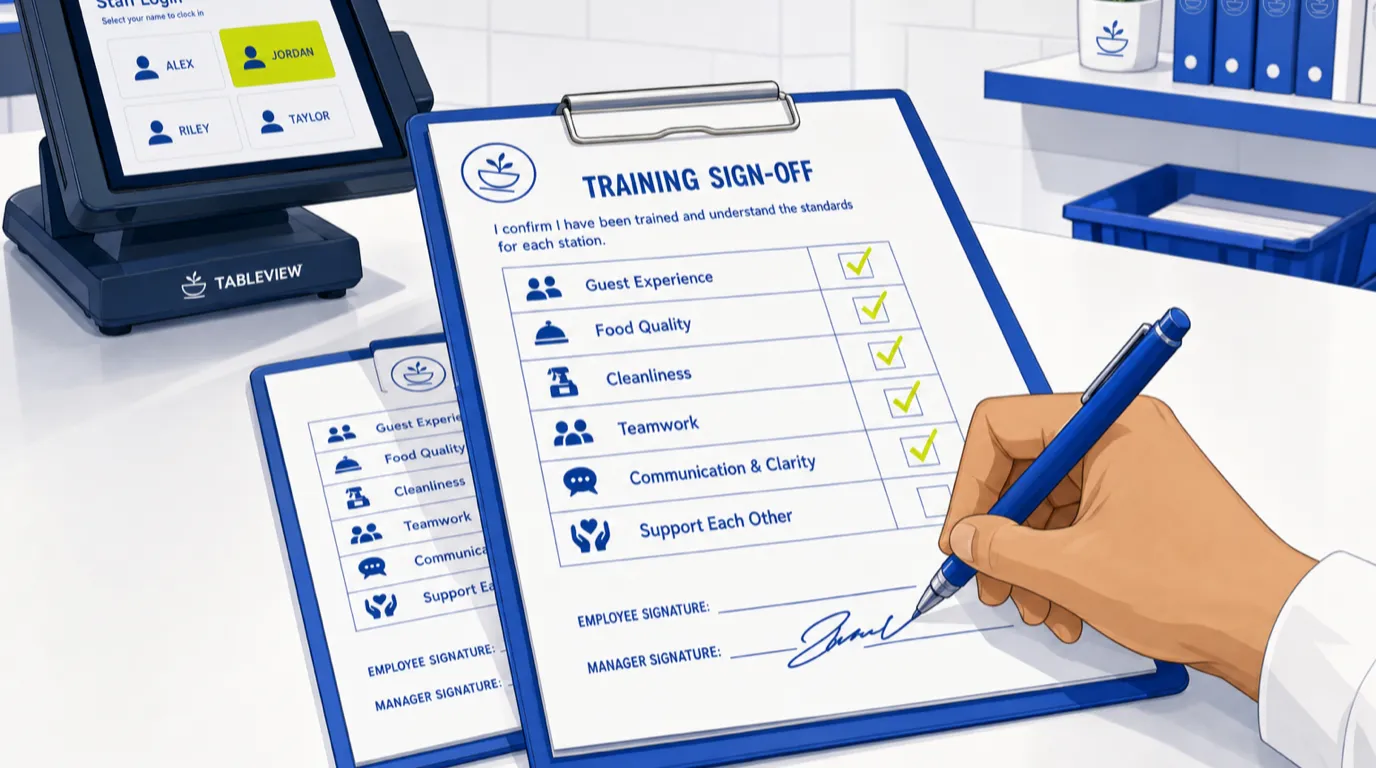
Add station certification here. A short practical check per area: can they open the section correctly, can they run the coffee machine, can they close and cash up. Sign each one off as it passes. This is what makes progress visible to both of you, and it is what lets you put them on a rota with confidence.
Weeks 3 and 4: speed, selling, and the awkward stuff
Competence comes before pace, so weeks three and four are about adding both. Grow the section to full size. Then work on the things that separate a serviceable server from a good one.
Selling first, and honestly. A server who has tasted the food, knows which dishes the kitchen is proudest of, and can answer "what do you recommend" without hesitating will lift average spend by a couple of pounds a head without ever sounding like a script. Teach the specific recommendations you want made: the starter that shares well, the wine that goes with the special, the dessert two people can split.
Then the edge cases, drilled rather than described. Role play them if you can stand it, because they are the situations where instinct is wrong. Walk through the wrong dish arriving, the guest who says the fish is off, the birthday table that arrives an hour late, the card that declines, the allergen question they cannot answer, the moment they need to stop serving alcohol to someone. Tell them exactly what they are allowed to do without asking: whether they can comp a drink, remake a dish, or move a table. Authority limits are what let staff fix problems while the guest is still in the room.
Day 30: the sign-off
End the month with a real review against the standards list and the station certifications, not a chat. Three outcomes: signed off and moving to the standard rate, signed off with two specific things to work on and a date to check them, or not there yet with a clear plan and an honest conversation about whether the role fits.
The sign-off should mean something materially. A pay step, a shift preference, a title, access to the sections that earn better tips. If day 30 passes with nothing but a nod, the message is that the standards were never really the point.
The kitchen trains differently
Copying the server path into the kitchen does not work. A cook learns stations, timing, and consistency, and the assessment is whether the plate matches the spec at the speed service demands.
Train station by station and certify each one. Start with the coldest and least time-critical, usually larder or prep, and move toward the pass. For each station: the recipes, the mise, the par levels, the plate-up spec, and the timing relationships with the other stations. A cook who can execute their station in isolation but cannot read the board is not yet trained.
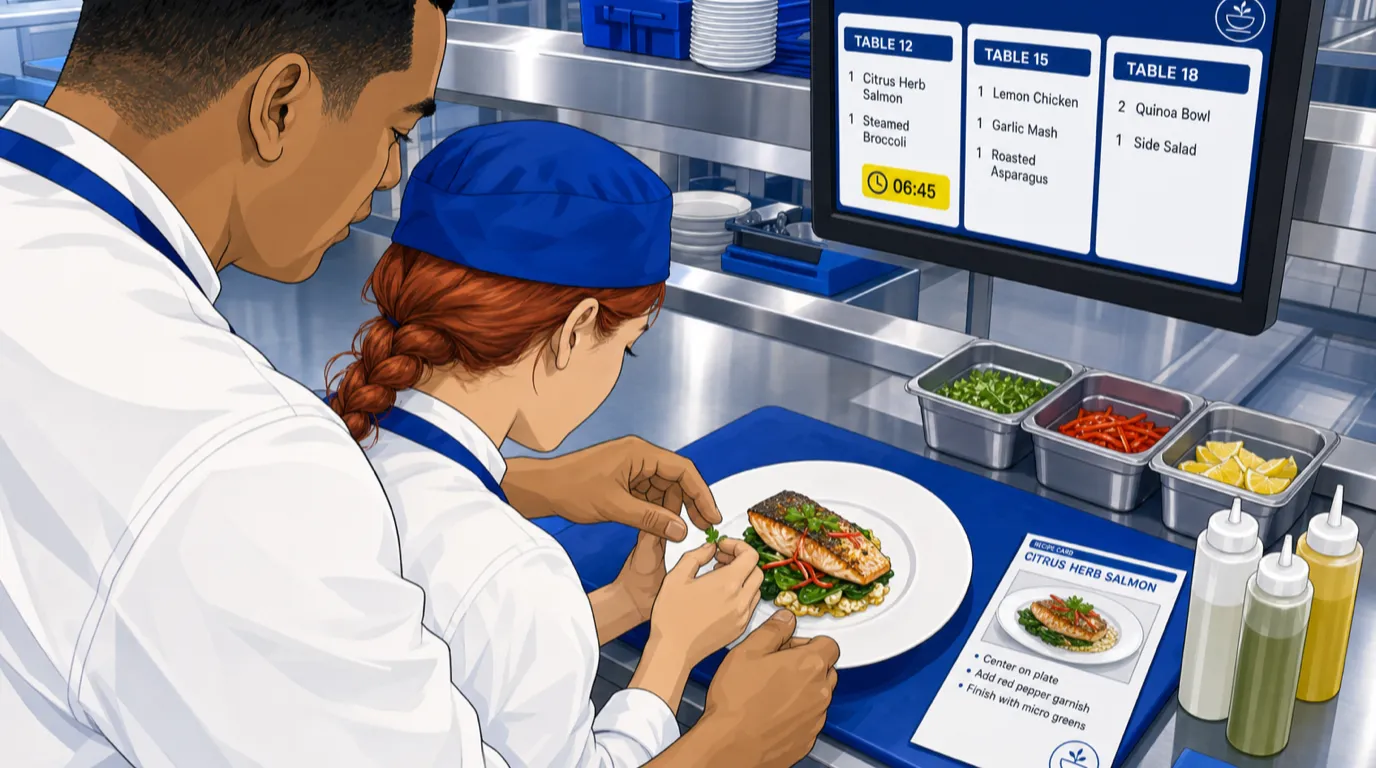
Recipe cards with photographs are the highest-value document in a kitchen and the most commonly missing. Weight, method, plate, garnish, and a picture of the correct plate. Without them consistency depends on memory, and memory drifts by station and by shift.
Use your ticket data honestly. Screens record when a ticket lands, when it is started, and when it goes out, so you can see where a new cook is losing time rather than guess. Expect a new hire on a station to run slower than the section average for a couple of weeks; what you are watching for is the curve flattening at a workable number, not instant parity. The comparison is much easier if you have moved off paper, which is the argument in KDS versus kitchen printer.
Two kitchen-specific habits pay off immediately. Taste as you train, out loud, so the new cook calibrates seasoning against the head chef's palate rather than their own. And teach the 86 process on day one, since an unreported shortage is how a station takes the whole service down with it.
Bar training has its own list
Bar staff carry three loads at once: product knowledge, speed under pressure, and legal responsibility. Train them in that order and check each separately.
Specs before flair. Every drink on your list needs a written build with measures, glass, ice, and garnish, and a new bartender should be making them to spec with a jigger long before anyone talks about free pouring. Pour discipline is where bar margin lives, and a half-ounce of drift per drink across a busy Friday is a number you can see in the stock count. The mechanics are in bar pour cost.
Then speed, built through repetition on the five drinks that make up most of your volume rather than the whole cocktail list. Then the legal side, which is not optional anywhere: checking identification, recognising intoxication, and knowing exactly what to say and who to call when service has to stop. That last conversation needs a script and a manager's backing, because a bartender who is unsure of support will keep serving.
The compliance training you cannot skip
Some of this is legally required, and the requirements vary by country and often by state or city. Check your local rules rather than this list, but the categories are consistent.
Food safety and hygiene certification for anyone handling food, refreshed on whatever cycle your jurisdiction sets. Allergen awareness, which in the UK and EU is a legal obligation and everywhere is the training most likely to prevent a genuine tragedy: what the major allergens are, how cross-contact happens, and the rule that nobody guesses at an allergen answer, ever. Alcohol service certification where it is required. Health and safety basics: chemicals, knives, lifting, slips, burns, and who your first aiders are. Harassment and conduct training, which is now required in a growing number of jurisdictions and is worth doing regardless.
Keep dated records of every certification with expiry dates in one place. When an inspector asks, "we definitely trained everyone" is not an answer, and the records are also how you notice that four people's food safety certificates lapse next month.
Who does the training, and paying them for it
The best trainer is rarely your best server. It is the person who can explain the why, is patient at 8pm on a Saturday, and follows the standard rather than their own refinements. Pick two or three, train them as trainers, and keep the group small so the message stays consistent.
Then pay them for it. A trainer premium of a pound or two an hour on training shifts, or a bonus when a hire passes day 30 and is still there at ninety days, costs very little and changes behaviour immediately. Ask someone to train a new hire on top of a full section for the same money and you get shadowing, because that is all there is time for.
Managers should own the plan and the sign-off, not every hour of delivery. Their job is that day 30 actually happens, that the standards document stays current, and that a trainer who is carrying someone gets a smaller section that shift.
Cross-training, and why it keeps people
Once someone is signed off, the training question changes from competence to development. Cross-training is where the operational and human benefits meet: a server who can make coffee, a bartender who can expedite, a cook who can work two stations gives you a rota that survives a call-out. It also gives people somewhere to go, which matters because most hospitality staff who leave for another restaurant are not chasing fifty pence an hour, they are leaving a job that had stopped teaching them anything.
Make the path explicit. What does a server need to demonstrate to become a section lead, a trainer, a supervisor, an assistant manager. Put the criteria in writing, mention them in the day 30 review, and revisit them quarterly. This is the cheapest retention tool available, and it works because it is honest: promotions stop looking like favouritism when the requirements were published in advance. The wider argument sits in restaurant hiring and retention.
Measuring whether it worked
Training feels unmeasurable, which is why it gets cut first. It is not. Five numbers tell you most of it, and you already collect four.
Time to solo. Days from start to running a full section, or a station, unsupervised. Track it per hire. If it is drifting up, either your plan has gaps or your trainers are stretched.
Voids, comps, and discounts per user. Your POS records these by login. New hires run higher for a few weeks, which is normal. What you are looking for is the individual who stays high after week four, or a whole cohort that does, which points at a process nobody understands rather than a person who is careless.
Ticket times by cook. Same logic on the kitchen side, and the clearest signal that a station certification passed on paper but not in practice.
Average spend per cover. Selling is trainable, so a cohort trained on specific recommendations should show a measurable lift against the ones who were not.
Ninety-day retention. The blunt one, and the most honest. Most hospitality turnover happens in the first three months, and it is usually a training and onboarding failure rather than a hiring mistake. If four in ten of your new hires are gone by day 90, no recruitment spend will fix the hole.
Review these monthly alongside the numbers you already read. Training that is not measured competes with everything else on the rota and loses.
What it costs, and what it saves
Build the cost from the parts. Thirty hours of trainer time at a partial premium, twenty to thirty hours of the new hire's paid time that is not productive, a few hours of manager attention, and whatever your certifications cost. For a typical hourly hire in a full-service restaurant that lands somewhere between eight hundred and two thousand, depending on wages and how long your path runs.
Set it against replacement. Recruiting, interviewing, the paperwork, the training you just paid for again, the overtime that covers the gap, the manager hours pulled off the floor, and the slower, less accurate service the guest experiences while the seat is empty or new. Most operators who add it up land in the same range as the training itself, and often well above it, which means the comparison is not training cost versus nothing. It is training cost versus paying it repeatedly.
Restaurant turnover is commonly reported north of 70 percent annually, and the first ninety days is where most of it happens. That is the window a real onboarding plan is designed to survive.
Start here this week
Write the standards for the ten moments that repeat every service. Two pages, specific enough to assess. That single document is the thing everything else hangs off, and most restaurants do not have it.
Then take your next hire through a named 30-day plan with a named trainer, station sign-offs, and a real day 30 review. One hire is enough to learn where your plan is thin, and you will find out fast: the questions they keep asking are the pages you have not written yet.
Read next: Restaurant employee handbook, restaurant positions and job descriptions, and hiring and retention.