
Every restaurant is an assembly of jobs that fit together like gears: the host who paces the seating, the server who owns the table, the line cook who owns the saute station, the sous chef calling the pass, the manager watching the labor line. When the gears are well-cut, a Saturday night looks effortless; when a role is vague or missing, the whole machine grinds. Understanding what each position actually does is the foundation for hiring, training, scheduling, and the permission structures in your systems, from who can void a check on the POS to which stations the kitchen display routes to during service.
This guide maps the complete roster: the management layer, the front-of-house team, the kitchen brigade, and the bar, what each role does, what it requires, who it reports to, and how the titles collapse or expand with the size and style of the operation. At the end, we cover how to write job descriptions that actually recruit and how staffing patterns differ by concept. Where a role deserves its own deep dive, we link the dedicated guide, and if you are building a team from scratch, this pairs with our hiring and retention guide.
How a restaurant team is organized
Restaurants divide into two worlds joined at the pass: the front of house, everything the guest sees, and the back of house, everything that feeds it. Over both sits the management layer, and alongside them, in bar-led or full-service formats, the bar team operates as its own small kingdom with its own hierarchy. The dividing line is more than geography: the two houses run on different rhythms, different skill sets, and famously different temperaments, and half the craft of running a restaurant is making them move as one, our guide to restaurant lingo decodes the shared language they use to do it.
Two structural truths apply across every concept. First, titles scale with size: a 200-seat hotel dining room staffs every role in this guide separately, while a neighborhood bistro runs on six people wearing fifteen hats, the roles still exist, they are just distributed differently. Second, clarity beats headcount: a small team where everyone knows exactly what they own outperforms a large one with blurred lines. As you read each role, the question is not do I need this person but who owns this work tonight, because in a restaurant, unowned work has a way of surfacing at 8 p.m. on a Saturday. If the French titles are what you are trying to decode, they are set out rank by rank in our guide to the kitchen brigade and every chef rank.
General manager
The general manager owns the restaurant as a business. The GM answers for the P&L: sales targets, labor cost, food and beverage cost, and the controllable expenses in between. They hire and develop the management team, own the vendor and landlord relationships, drive the marketing calendar, ensure licensing and compliance stay current, and set the standards everything else runs on. A good GM spends their time on the numbers, the people, and the guest experience in roughly equal thirds, and their scoreboard is the KPI dashboard: prime cost, covers, average check, reviews, and staff turnover.
What the role requires: several years of management experience, financial literacy deep enough to read a P&L and act on it, and the temperament to lead through service pressure without burning the team. In independent restaurants the GM is often the owner; in groups, the GM answers to an operations director and typically earns a salary plus performance bonus tied to the unit's results. The classic GM failure mode is drowning in shift-running, working in the restaurant instead of on it, which is precisely why the next layer exists.
Restaurant manager, assistant managers, and shift leads
Managers own execution: running shifts from open to close, building the schedule, coaching servers mid-service, resolving guest complaints before they become reviews, counting drawers, and enforcing the standards the GM set. A typical full-service operation runs a manager or shift lead on every service, with an assistant general manager as the GM's second where volume justifies it. The manager is also the person the systems empower: approving voids and comps on the POS, adjusting the floor plan when a section stacks, and closing out the night with the sales and labor report. Our dedicated guide to restaurant manager responsibilities details the full daily cycle.
The role demands calm authority, most manager hours are spent making dozens of small decisions at speed, and the career path usually runs through it: strong servers and bartenders become shift leads, shift leads become assistant managers, assistant managers become GMs. Operations that formalize that ladder, with defined skills per rung and scheduling authority granted progressively, grow their own managers instead of renting strangers, and the difference shows in both retention and standards.
Executive chef and head chef
The executive chef owns everything edible: the menu and its evolution, recipe specifications and portioning, food cost targets, supplier selection and quality, kitchen hiring and training, and food safety compliance. In a single restaurant the title often merges with chef de cuisine or simply head chef, the person who runs this kitchen; in groups, the executive chef sets direction across venues while a chef de cuisine runs each one. The role is as much accounting and leadership as cooking: costing recipes, negotiating with suppliers, engineering the menu, and building a kitchen culture where standards survive their absence.
What it requires: years on the line, command of technique broad enough to train others, and financial discipline, the best menu in town fails if it costs 42 percent to serve. The chef and the GM form the restaurant's central partnership, jointly owning prime cost, and the healthiest operations make that shared number explicit rather than letting kitchen and floor optimize against each other. Career-wise, the title is the summit of the brigade: nearly every executive chef climbed the exact ladder described in the next three roles.
Sous chef
The sous chef is the kitchen's operating officer: where the executive chef owns the menu, the sous chef owns the service. They run the line during the rush, call the pass or hand it to a trusted expo, cover any station that falls behind, manage the prep plan and the ordering, train the cooks, and inherit the kitchen whenever the chef is out, which is often. Larger kitchens run multiple sous chefs by shift or specialty, with a junior sous as the first management rung a line cook reaches.
It is the hardest job in most kitchens: the sous chef needs the technique to cook every station, the organizational discipline to run the prep and inventory cycle, and the leadership to manage cooks who were peers a month ago. When done well, it is nearly invisible, services simply run, and it is the single most important hire for a chef who wants to take a day off. Operations that skip the role, running chef-plus-cooks with no middle layer, discover its value the first week the chef gets sick.
Line cooks and the stations
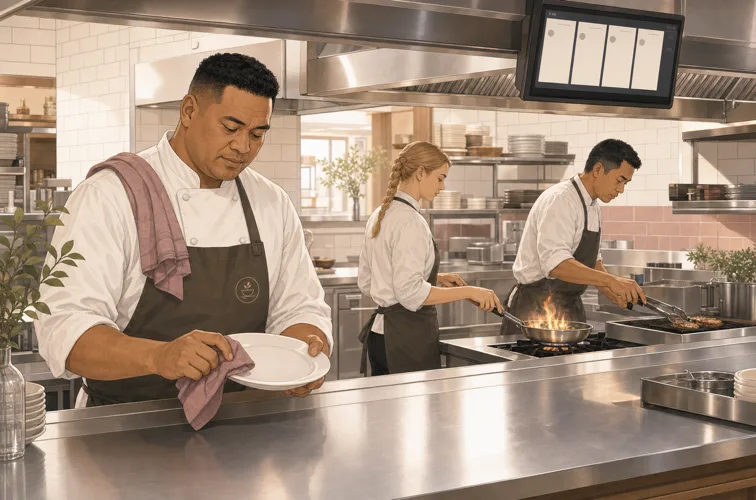
Line cooks are the production core: each owns a station, saute, grill, fry, cold side or garde manger, pizza oven, pastry where the concept has one, and executes every dish that station fires, at speed, to spec, for the length of service. The job runs in two phases: the methodical setup, stocking and prepping the station's mise en place, and the sprint of service, reading tickets, timing multiple dishes to land together, and communicating constantly with the pass. Our deep dive on what a line cook does covers the stations, the skills, and the career path in full.
Below and beside the line sit the roles that make it possible. Prep cooks produce the components, sauces, stocks, proteins portioned, vegetables cut, working mornings against par lists so the line can survive the night. Dishwashers and kitchen porters keep plates, pans, and the kitchen itself turning, the humblest title in the building and historically the industry's front door: an enormous share of chefs started at the sink. Junior cooks and commis learn stations under the line cooks, forming the pipeline that staffing plans should cultivate deliberately: prep to line, line to senior line, senior line to junior sous is the promotion ladder that costs least and retains best.
Expeditor
The expeditor, expo, is the air traffic controller at the pass: they read incoming orders, call the fire times to stations, coordinate multi-station dishes so everything for a table lands together, check every plate against spec before it leaves, and match the flow of food to the rhythm of the room. In many kitchens the sous chef or chef expedites; busy operations staff it as its own position, and it is one of the highest-leverage roles in the building: a good expo adds capacity to every station simultaneously, a bad one creates a traffic jam out of a functioning line. During a full service, the expo touches every plate the kitchen produces, which also makes the role the natural quality gate: garnish, temperature, spec, and presentation get one last professional glance before the dining room renders its verdict.
The role demands total menu knowledge, a sense of timing that borders on musicality, and communication that stays clear at full volume. It is also where technology touches the kitchen most directly: on a kitchen display system, the expo works from a screen that sequences tickets, times every item, and flags what runs long, replacing the memory-and-shouting model with measured flow. Front-of-house-side, a food runner often pairs with the expo, carrying finished plates to tables so servers stay in their sections, with the expo confirming every plate finds its table still hot.
Host and maitre d'
The host owns the door and, less obviously, the restaurant's pacing. Greeting and seating guests is the visible half; the invisible half is managing the reservation book and waitlist, distributing seatings across sections so no server drowns, and pacing the door against the kitchen's actual capacity, seat a rush of six-tops in ten minutes and the kitchen backs up for an hour. The host also delivers the first and last impression of the visit, which makes warmth under pressure the core hiring criterion. In fine dining the role matures into the maitre d': commanding the reservation strategy, recognizing regulars, orchestrating the room, and managing the waitlist as revenue, the craft our table turnover guide quantifies.
Equip the door properly: a reservation and waitlist system tied to the floor plan, so the host stand and the POS agree about table states, quoted waits are honest, and no-shows are managed with confirmations and deposits where the format warrants. The host is frequently the youngest and lowest-paid person on the floor while making decisions that swing thousands in nightly revenue; smart operators train and pay the role accordingly, and the host-to-server path is the floor's natural first promotion.
Servers, food runners, and bussers
Servers own tables end to end: greeting, guiding the order, ringing it accurately, pacing the courses, reading the table's mood, resolving small problems before they grow, and closing the check. The craft is customer service and salesmanship in equal measure, a skilled server lifts the average check with well-judged recommendations while making the table feel cared for rather than sold to, and their compensation usually reflects it through tips or service charges. Requirements: menu knowledge deep enough to answer allergy and preference questions, POS fluency, physical stamina, and legal alcohol-service certification where required. Section sizes run 4 to 6 tables in full service, fewer in fine dining, more in casual formats with runner support.
Around the servers work the roles that multiply their capacity. Food runners carry finished plates from the pass to tables, keeping food hot and servers in their sections. Bussers clear, reset, and turn tables, directly driving seating capacity on busy nights, and typically share in the tip pool for it; on a full Saturday, the difference between a three-minute reset and an eight-minute one, multiplied across every table in the room, is an entire extra seating. Both roles are classic entry points and feed the server ranks; cross-training hosts, runners, and bussers into one flexible pool is the floor's best insurance policy against call-outs and uneven rushes.
Bartender and barback
Bartenders run a production station and a stage at once: building drinks to spec at speed for both the bar guests in front of them and the service well feeding the floor, managing tabs honestly, checking IDs, watching intoxication levels with the license on the line, and delivering the conversation and recognition that turn first-timers into regulars. The craft side demands recipe command and consistent, measured pours, the discipline our pour cost guide turns into arithmetic; the hospitality side makes the bartender many guests' primary relationship with the restaurant. Requirements: alcohol-service certification where mandated, speed under pressure, and the judgment to refuse service gracefully.
The barback is the bar's pit crew: stocking ice, glassware, and bottles ahead of demand, changing kegs, prepping garnishes and juices, and keeping the wells full so the bartenders never leave the rail during a rush, the full rundown lives in our barback guide. It is also the industry's standard apprenticeship for the bar: barbacks who learn the specs and the speed become bartenders, which is both the cheapest hiring pipeline a bar has and a strong reason to hire barbacks with intent rather than as an afterthought. In wine-led rooms, the sommelier completes the beverage team: curating the list, training the floor, and guiding guests to bottles that fit both the meal and the margin.
How the positions are paid
Compensation structure varies more by role than almost any other industry, and misunderstanding it is a common source of both budget surprises and staff friction. Management is salaried, with GM pay typically anchored to a bonus on unit performance. The kitchen is hourly or salaried at the senior levels, and in most markets does not share in tips, the structural gap between tipped floor earnings and untipped kitchen earnings is the industry's oldest compensation tension, and some operators address it with kitchen service-charge shares or higher base rates. The floor and bar are usually hourly plus gratuity: servers and bartenders at the center of the tip economy, with hosts, runners, bussers, and barbacks participating through tip-outs or pools according to house policy and local law.
Three disciplines keep pay from becoming a nightly argument. First, write the tip policy down, who tips out whom, at what percentage, calculated on what base, and apply it identically every night; the mechanics and the legal boundaries are covered in our service charge and tips guide. Second, run it through the system rather than the shoebox: tip declarations, pool calculations, and payout records that live in the payments and payroll flow survive audits and disputes; envelope arithmetic does not. Third, benchmark the whole package, base, gratuity, meals, schedule quality, against the restaurants your staff would otherwise work for, because in this labor market every employee re-prices weekly, and the operators who treat compensation as a designed system rather than an inherited habit keep their teams measurably longer.
Writing job descriptions that actually hire

A job description is marketing to candidates and a contract with the person you hire, and most restaurant listings fail at both by being either vague or fantastical. The formula that works: a searchable title (line cook, not kitchen wizard); a short honest summary of the role in your operation; duties written as observable actions, works the grill station during dinner service, completes the closing checklist per our opening and closing standards, runs weekly bar inventory counts; requirements split into must-have and trainable; the schedule stated honestly, including weekends and holidays; the real pay range and how tips flow, transparent-pay listings convert dramatically better in a labor market where candidates filter by it; and the reporting line, so the hierarchy is clear before day one.
Write the description before you need the hire, one per role in this guide that your operation staffs, and keep them as living documents: they become the syllabus for training, the baseline for performance conversations, and the paper trail that protects you when a role change goes sideways. Pair each with a wage band and a progression note, what this role can become and what it takes to get there, because in an industry where the next job is always available across the street, the visible ladder is a retention tool, as our hiring and retention guide argues with numbers.
Staffing patterns by concept and size
How many of these roles you staff, and how many hats each person wears, is a function of the service model. A quick-service or fast-casual spot collapses the floor into counter staff and cashiers, runs a short line with cross-trained cooks, and puts a shift lead rather than a layered management team on each service, 12 to 20 people total. A 100-seat casual full-service restaurant staffs the classic pattern: GM plus two managers, host, six to eight servers with runners and bussers, a chef, sous chef, five to eight cooks, and dish, 25 to 40 people across the roster. Fine dining adds depth at every layer: maitre d' and sommelier on the floor, captains and back servers in the sections, a full brigade with pastry in the kitchen. Bars invert the weight toward bartenders and barbacks with a minimal kitchen, and cafes run the leanest: an owner-operator, baristas, and a cook or two.
Whatever the pattern, the same closing advice applies across all of them. Define every role in writing, even, especially, when one person covers three of them, because clarity survives turnover and ambiguity does not. Build the promotion ladders deliberately: dish to prep to line, barback to bartender, host to server to shift lead, they are the cheapest recruiting you will ever do. And give the structure a spine in your systems: roles and permissions in the POS that match the org chart, stations on the kitchen display that match the brigade, and schedules built on forecasted demand rather than habit. A restaurant is its people arranged in working order; the arrangement is the part the owner controls.