
Every restaurant already has an employee handbook. In most of them it is unwritten, a floating oral tradition of who covers a dropped shift, what happens to tips on a walkout, and how many no-shows end a job, enforced from memory and renegotiated with every manager change. The written version exists so the rules stop depending on who is asking and who is answering. It is the document a new hire reads before their first shift, the reference a manager reaches for before a hard conversation, and the exhibit a lawyer asks for when a disagreement leaves the building. Alongside the systems staff learn in week one, the POS at front of house and the kitchen display at the pass, the handbook is onboarding infrastructure: it does its job precisely when nobody is around to explain things in person.
This guide walks through the handbook section by section: what belongs in each part, the restaurant-specific policies that generic templates miss, the legal traps hiding in tips and scheduling, and the difference between a handbook that protects you and one that merely exists. It also covers the practical side, writing, legal review, distribution, signatures, and revisions, and how the handbook connects to the hiring and retention system it lives inside. It is written for independents and small groups; if you have an HR department, you have most of this already, and if you do not, this is the roadmap.
What a handbook is, and what it is not
An employee handbook is the written statement of your employment policies: what you promise employees, what you expect from them, and what happens when either side falls short. It is not a training manual, procedures like table numbers, pour specs, and POS steps belong in a separate operational document that changes weekly without lawyers involved. It is not an employment contract, and it should say so explicitly, most handbooks include language preserving at-will employment (where that doctrine applies) and reserving the right to revise policies. And it is not a culture deck: values matter and deserve their page, but a handbook that is thirty pages of inspiration and two pages of policy protects nobody.
The distinction that organizes everything else: the handbook carries the rules that would matter in a dispute, and the training program carries the skills that matter in a shift. Keep the two documents separate, let them reference each other, and give each a different revision rhythm, the handbook changes deliberately with dated versions and fresh signatures, while the training material changes as fast as the menu. Restaurants that merge them end up with a 90-page binder nobody reads and no clean record of which policies an employee actually acknowledged.
Why restaurants need one more than most businesses
Restaurants combine every ingredient that makes written policy valuable: high turnover, meaning constant onboarding and constant policy explanation; wage complexity, tips, tip pools, tip credits, overtime, split shifts, that generates the majority of hospitality employment claims; a young and often first-job workforce that genuinely does not know the norms; alcohol and food safety obligations with legal consequences; and shift-based scheduling where the rules for swaps, call-outs, and no-shows get tested nightly. Our restaurant positions guide catalogs how many distinct roles even a small operation runs, and each role stresses different policies.
The economics are lopsided. Writing a handbook costs a few days of focused work and a modest legal review. Not having one costs nothing until it costs a lot: a wage-and-hour claim where you cannot produce a written tip policy, an unemployment hearing where the termination looks arbitrary because no attendance policy exists on paper, a harassment complaint with no documented reporting channel, each of these is dramatically harder to defend from memory. There is also a quieter daily return: managers stop improvising answers, staff stop testing boundaries that are clearly drawn, and the manager's job shifts from adjudicating disputes to running shifts. Consistency is also a fairness technology, the handbook is what makes discipline defensible because the rule existed before the incident.
The welcome: story, values, and how to read this thing
Open with two or three pages that sound like your restaurant rather than a law firm. A short history and concept statement, why this place exists, what good service means here, gives new hires context that pure policy cannot. State your values concretely enough to act on: hospitality first, honesty about mistakes, respect across every position, whatever is true for you, phrased so a seventeen-year-old busser knows what it means on a Friday night. Then explain the document itself: what the handbook covers, where the training manual lives, who to ask when something is unclear, and the standard legal framing, this is not a contract, policies can change with notice, local law wins wherever the two conflict.
Resist the temptation to inflate this section. Its job is tone-setting and orientation, not persuasion, and every page added here is a page of pay and safety policy the reader is less likely to reach. The strongest welcome sections in restaurant handbooks share three traits: they are short, they are specific to the actual restaurant (a line about the neighborhood, the founding, the food), and they are honest about the work, acknowledging that service jobs are hard and saying plainly what the restaurant offers in return. Staff can smell corporate boilerplate a paragraph away, and the welcome section decides whether they read the rest as their document or as management's.
Employment basics: status, classification, and equal opportunity
This is the legal foundation layer, and most of it is standard but none of it is skippable. Cover employment classifications, full-time versus part-time thresholds and what each status means for benefits and scheduling priority; the at-will statement where applicable, plainly worded; equal opportunity and anti-discrimination policy naming the protected categories under your local law; anti-harassment policy with a real reporting procedure, at least two channels, so nobody must report a problem to the person causing it, and a no-retaliation commitment; and accommodation procedures for disability and religious needs. Several jurisdictions mandate specific harassment-policy language and training hours for hospitality, check yours.
Add the pieces restaurants specifically need: minor labor rules if you hire under-18s (hour caps, prohibited tasks like slicers, alcohol handling limits, all locally defined); work authorization and I-9 or local equivalent; and personnel file access. Write all of it in plain language, the section fails if staff cannot understand it, and translate the handbook if a meaningful share of your team reads another language, a bilingual handbook is standard practice in kitchens across the industry and courts look kindly on policies employees could actually read. Keep legal jargon quarantined to where it is unavoidable, and define terms the first time they appear the way our restaurant lingo guide would.

Pay, tips, and the section that causes the most lawsuits
Compensation is where handbook precision pays its rent, because wage claims dominate hospitality litigation and vague policy loses them. Document pay schedule and method; overtime rules as they apply locally; clock-in expectations and the prohibition on off-the-clock work (including side work, a classic claim); meal and rest breaks per local law; and uniform or tool cost treatment where regulated. Then tips, the highest-stakes paragraphs in the document: who is in the tip pool and who is legally barred from it (managers, almost everywhere), how pools are calculated and distributed and when, how card tips reach paychecks, what happens with tip credits if you use them, and how service charges differ from tips, a distinction with legal weight that our tips and service charges guide unpacks in full.
Two disciplines make this section durable. First, state the mechanics, not just the principles: a policy that says tips are pooled fairly is useless in a dispute, while one that says pooled by points, server 10, busser 5, distributed weekly with the pay stub showing the calculation settles arguments before they start. Second, keep it synchronized with reality: if the handbook says one pool structure and the spreadsheet does another, the gap is evidence against you. Because pay rules are the fastest-moving legal territory, minimum wages and tip rules change yearly in many places, this is the section your annual legal review should read first, and the one that most justifies the lawyer's fee. Connect the policy to systems staff can see: payroll reflected in the accounting flow, tip calculations visible rather than mysterious.
Scheduling, availability, and time off
Scheduling policy is where the handbook earns daily use, because these are the rules staff actually look up. Cover when schedules post and how far ahead, several cities now mandate advance notice under predictive scheduling laws, with penalty pay for late changes; how availability is submitted and changed; the shift swap procedure, who can swap with whom, what approval it needs, and who owns the shift if a swap falls through; call-out procedure with a concrete notice window and a named contact method (a call, not a text to a coworker); and the attendance policy itself, what counts as late, how occurrences accumulate, and what they trigger. Vague attendance policy is unenforceable attendance policy.
Then time off: vacation or PTO accrual and request lead times, sick leave per local mandate (accrual rates and permitted uses are legislated in many jurisdictions and must be stated accurately), holidays and how holiday pay works in an industry that works holidays, and leave categories, parental, bereavement, jury duty, military, at least at the level local law requires. Explain how scheduling actually happens in your operation, including the scheduling system staff use to see shifts, request swaps, and log availability; policy that lives inside the tool staff already open daily gets followed, while policy that lives only in a binder gets forgotten. The goal of the whole section is that no employee ever has to guess whether they are allowed to do the thing they are about to do with their schedule.
Conduct, appearance, and phones
The conduct section works when it is specific and reasoned, not when it is long. Dress code and grooming by position, written with an eye to local laws on hair, religious dress, and gender neutrality; personal phone policy that acknowledges reality, most operations land on stowed during service, usable on breaks, rather than pretending phones do not exist; meal and drink policies, the shift meal, its timing and cost, and the alcohol rule for staff during and after shifts, stated without wiggle room; guest interaction standards at the level of principle (the detail belongs in service training); and social media boundaries, no posting guests without consent, no speaking for the restaurant, disclosure rules if staff promote the venue.
Include the integrity policies that protect both sides: cash handling and register accountability, comp and void authority, what requires a manager, employee discounts and their limits, and anti-theft policy with consequences stated plainly. This is also where a no-tolerance policy for working under the influence belongs, alongside the drug and alcohol testing policy if you have one (locally regulated, check before writing). The tone test for the whole section: every rule should carry its reason in the same sentence where the reason is not obvious. Staff follow rules they understand at roughly twice the rate of rules they merely fear, and a conduct section that reads like it was written by someone who has worked a Friday service earns more compliance than one that reads like a liability checklist.
Safety: food, alcohol, and the workplace
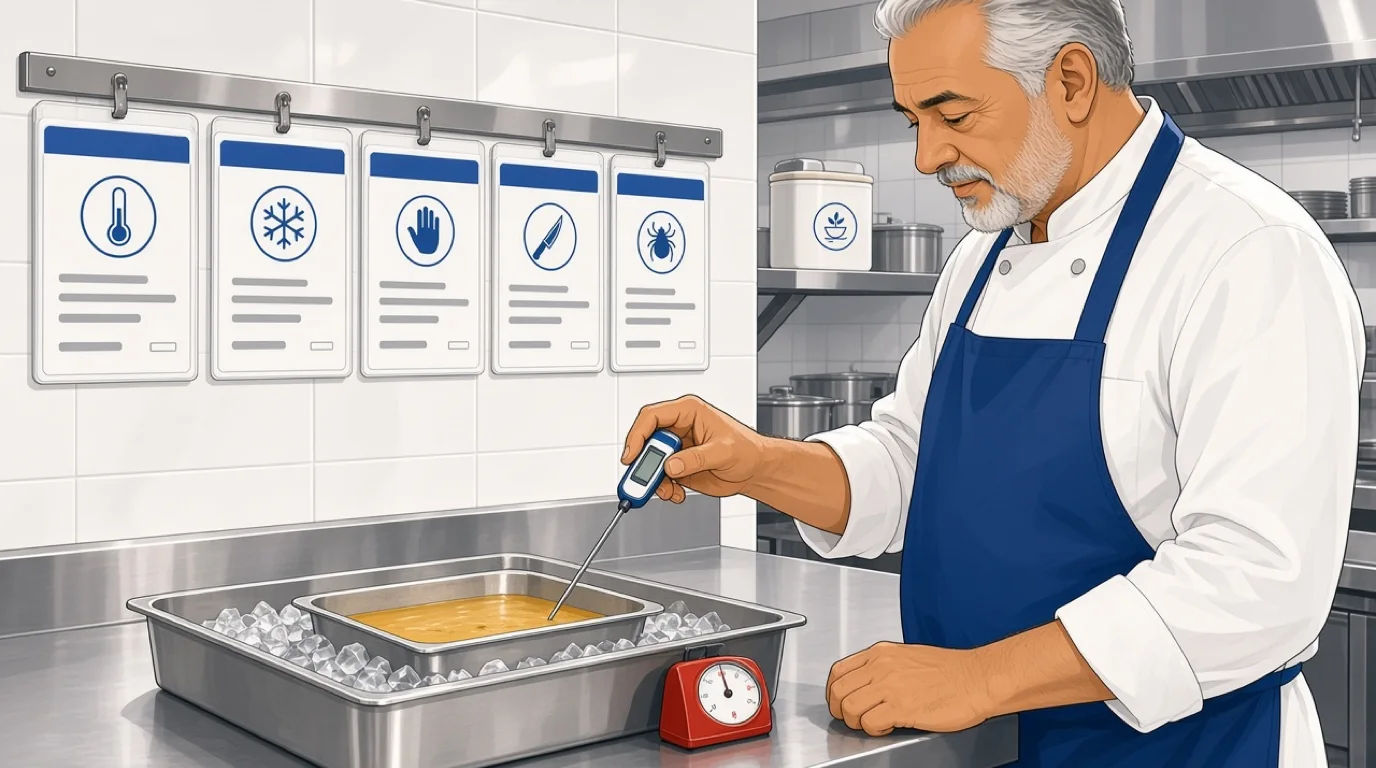
The safety section carries obligations with legal consequences, so it must be accurate and current. Food safety: required certifications by role and who pays for them, core handling rules, temperature logging, and glove and handwash standards, at the policy level, with the operational detail living in your HACCP program; illness reporting rules, the symptom list that requires staying home, stated bluntly because a sick cook is a public health event; and injury procedure, first aid locations, incident reporting, and workers' compensation basics. Alcohol service, if you pour: certification requirements, the absolute rules on checking identification, the refusal procedure for intoxicated guests including who backs the server up, and the reminder that servers carry personal legal exposure in many jurisdictions, which is why the restaurant's policy protects them, not just the license.
Round it out with workplace safety: knife and equipment rules, burn and slip prevention, lifting standards, and what to do when equipment is broken (tag it, report it, never improvise around a safety guard). Add emergency procedures, fire, evacuation, severe weather, robbery, at the level of who decides, where to go, who calls whom. And state the workplace violence and weapons policy explicitly. None of this needs to be long; all of it needs to be findable in seconds, which argues for a one-page emergency summary posted physically in the restaurant and referenced from the handbook. Safety policy is also the section where signatures matter most, since acknowledgment of safety rules is often the first document examined after an incident.
Service standards and the guest chapter
A short chapter on service belongs in the handbook even though the craft of service lives in training, because some guest-facing rules are policy, not technique. Complaint handling authority: what any staff member may do to fix a guest problem without a manager, a defined comp ceiling turns service recovery from an escalation into a reflex, and when a manager must be pulled in. Review and feedback policy: who responds to public reviews (one voice, usually a manager or owner) and the rule that staff never engage reviewers personally, which pairs with the playbook in our reputation management guide. Guest privacy: no photographing guests, no sharing who dined, no discussing regulars by name outside work.
Also codify the hard cases: the refusal-of-service policy and its legal boundaries (you may refuse for behavior, never for protected characteristics), harassment of staff by guests, staff have the right to step away and managers have the duty to intervene, written down so nobody wonders in the moment, and incident documentation, when a guest interaction should generate a written note. This chapter is where the handbook and your customer service philosophy shake hands: the philosophy says the guest experience comes first, and the handbook says exactly how much authority each person has to make that true, and where the line sits when a guest crosses one.

Technology, systems, and data
Modern restaurant work runs through systems, and the handbook should set the rules of the road for them. Account discipline: every employee uses their own POS code and never shares it, because the audit trail on voids, comps, and drawer counts is only meaningful when identity is real, and shared logins are how honest staff end up implicated in someone else's shrinkage. State what is monitored, POS activity, cameras where legal, order timing data, plainly, both because transparency is fair and because several jurisdictions require disclosure of workplace monitoring. Cover acceptable use of restaurant devices and wifi, the rule that guest payment data is never written down or photographed, and the immediate reporting duty when a device is lost or a system behaves strangely.
Then the positive half: list the systems staff are expected to learn and where to learn them, the POS at front of house, the kitchen display at the pass, the scheduling app on their phones, the tableside ordering flow if you run one, with the training manual carrying the how. A sentence committing the restaurant to train every employee on every system their role requires belongs here, both as culture and as fairness, discipline for misusing a system nobody taught you is exactly the kind of dispute handbooks exist to prevent. Finally, social engineering: staff never give out system passwords, guest information, or business data by phone or email, however plausible the caller sounds; the two-minute version of that paragraph has saved restaurants real money.
Discipline, complaints, and how employment ends
The discipline section should read as a fair process, not a threat. Describe the progressive discipline ladder, typically verbal coaching, written warning, final warning, termination, while explicitly reserving the right to skip steps for serious misconduct, and give examples of what serious means: theft, violence, harassment, serving a visibly intoxicated guest after refusal, safety sabotage. Pair it with the complaint procedure pointing the other direction: how an employee raises a concern about a manager, a coworker, pay, or safety, with at least two routes and a written no-retaliation promise. An open-door line is worth including only if it is true; a named external contact (owner's email, an HR service) is worth more.
Then endings, handled with the same clarity: resignation notice expectations and what leaving well earns (rehire eligibility, references); final paycheck timing, legislated to the day in many places, including how outstanding tips are settled; return of property, uniforms, keys, and the deactivation of system access; and continuation-of-benefits notices where applicable. Two practical notes: document every disciplinary step in writing at the time it happens, because a warning that exists only in memory does not exist, and audit the file before any termination, the combination of a clear handbook policy, documented warnings, and consistent enforcement across employees is what makes a termination defensible. Inconsistency is the killer: a rule enforced against one server and waived for another is worse than no rule at all.
Writing it, reviewing it, and keeping it alive
The build sequence that works for independents: draft from a reputable template but rewrite every section in your restaurant's voice; localize the pay, tips, breaks, sick leave, and scheduling sections against current local law, this is where templates silently fail; have a local employment lawyer review the whole document once, a few hundred dollars against wage-claim risk is the best insurance in the building; and translate it if your team reads more than one language. Keep it between 15 and 30 pages by exporting all procedure to the training manual. Then distribute deliberately: walk new hires through the pay, tips, scheduling, and safety sections during structured onboarding rather than handing over a PDF, collect a signed acknowledgment from everyone, digital is fine, and store acknowledgments where you can produce them years later.
Keeping it alive is a calendar problem. Review annually on a fixed date with fresh legal eyes on the compensation section; issue dated versions and archive the old ones, since disputes are judged against the version in force at the time; re-collect acknowledgments when substantive sections change; and treat every real-world dispute as a unit test, if the handbook did not answer the question cleanly, revise the section that failed. Measure the return where it actually shows up: fewer improvised manager decisions, faster onboarding, cleaner unemployment hearings, and a labor cost line that stops leaking through undocumented disputes and churn. A handbook is not paperwork; it is the operating agreement between a restaurant and the people who run it, and like every agreement, it works best written down, read, and kept current.