In 2013 the largest hotel in New York City stopped serving room service. The New York Hilton Midtown, roughly two thousand rooms on Sixth Avenue, closed its in-room dining operation and put a grab-and-go market in the lobby instead. The trade press treated it as the beginning of the end, and for a while it looked like one. Every operator with a calculator had reached the same conclusion independently: a department where one member of staff spends fifteen minutes delivering one club sandwich cannot be made to work. What almost nobody did was check whether the calculation was measuring the right thing, or whether the ordering process, rather than the food, was what made it expensive. A decade later the ones that survived mostly did it by changing how the order arrives, which is a mobile ordering problem rather than a menu problem.
The instinct to kill room service is understandable and usually premature. It is the only outlet in the building with no competition, no walk-in trade to lose, and a guest who has already decided not to leave the room. That is a rare commercial position. It gets squandered by a menu built for a dining room, a fifteen minute phone call to place a nine minute order, and a kitchen where the room service ticket queues behind the restaurant on a kitchen display system that treats both as the same kind of work. Fix those three and the department stops being a subsidy.
The evidence here is thin, and you should know that
There is very little published research on in-room dining economics. What exists is either proprietary benchmarking sold by consultancies, or vendor material with an obvious interest in the conclusion. I could not find a peer reviewed study measuring delivery times, order-to-door variance or contribution per delivery in hotels, and if you are quoted an industry standard figure for any of those, ask where it came from.
So this article does two things instead. It uses arithmetic you can check with your own numbers, and it is explicit about which claims are reasoning rather than measurement. The Hilton closure is documented. The rest is a model, and the point of a model is that you substitute your own inputs.
Margin per dish is the wrong unit
Almost every room service P&L is built the way a restaurant P&L is built: revenue, food cost, labour, and a percentage at the bottom that looks embarrassing. The percentage looks embarrassing because the denominator is wrong. Room service does not sell dishes, it sells deliveries, and the delivery is the thing that costs money.
Work it in those terms and the picture changes. Take a hypothetical property paying a server 18 an hour fully loaded. A delivery that takes twelve minutes of that server's time, door to door including the tray setup and the lift, costs 3.60 in delivery labour. Add kitchen labour and the food cost of what is on the tray, and you have a real cost per delivery rather than a percentage.
Now the part that matters. A single 16 club sandwich against 3.60 of delivery labour is a poor trade. That same twelve minute delivery carrying a 16 sandwich, a 9 glass of wine and a 6 dessert is an excellent one, because the delivery cost did not move. The labour is a fixed cost per journey, not a variable cost per item, and it is the only line in the department that behaves that way.
Everything follows from that. The commercial objective of in-room dining is not to sell more expensive dishes, it is to increase the value of each journey, and every design decision downstream should be judged against whether it puts more on the tray or fewer trays in the corridor. Our guide to average check covers the general mechanics, and this is that idea with a much harder constraint attached.
Which makes the ordering channel a margin decision
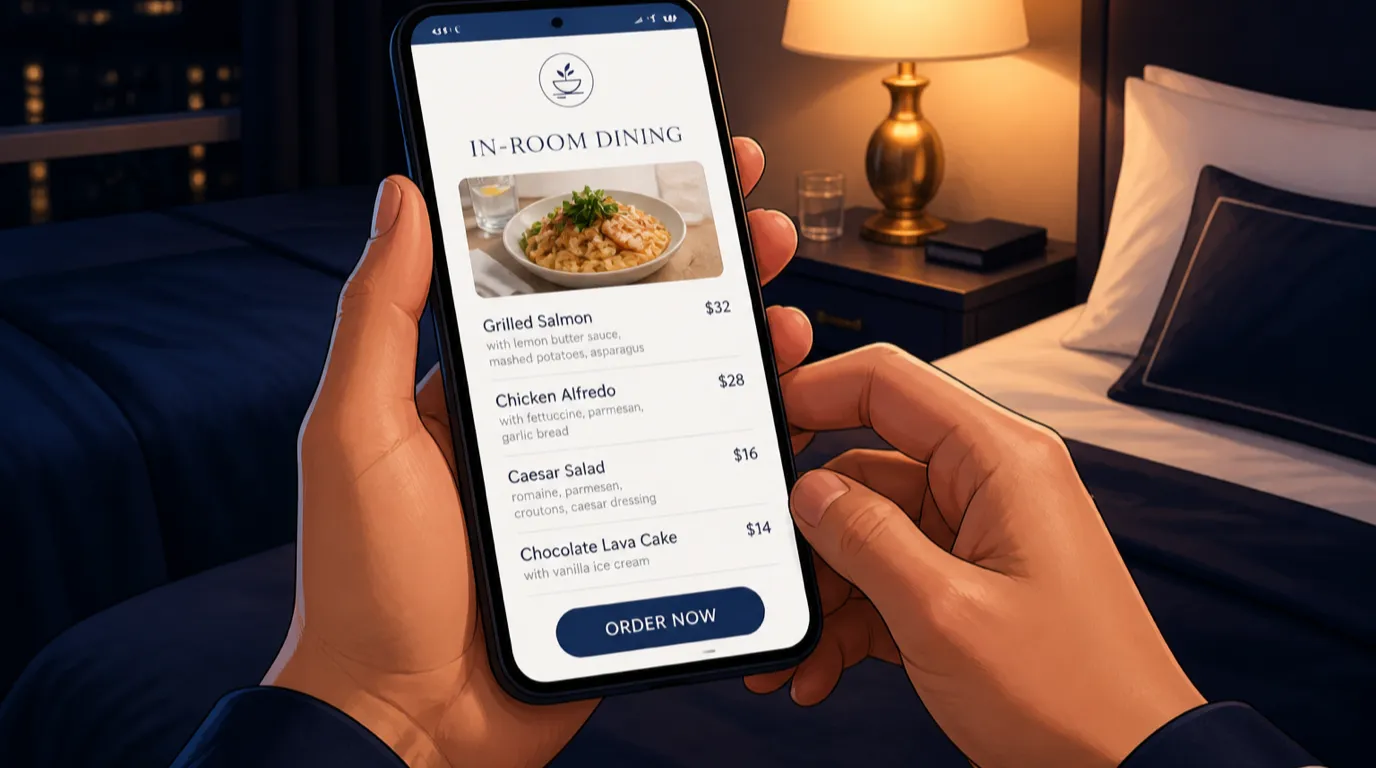
A phone order is one item plus whatever the order taker remembers to suggest, delivered to a guest who is faintly embarrassed to be ordering at all and wants the call over. A digital order is a menu the guest browses, with the wine list visible next to the burger and a dessert prompt at checkout that costs no social energy to accept. The uplift from that difference is the entire argument for in-room digital ordering, and it lands directly on the number that matters, which is value per journey rather than covers.
The other thing digital ordering removes is the transcription error. Somebody writing an order by hand at the desk, then keying it into the system, then a kitchen reading it off a printer, is three chances to lose a modifier. A wrong tray does not just cost the food, it costs a second delivery, so it is charged twice at the only line that matters.
Order to door is the only service metric worth keeping
Most hotels quote a delivery time and measure nothing. If you keep one number in this department, keep order-to-door: the elapsed time from the guest committing the order to the tray being at the door. Not ticket time, which is what the kitchen sees and which flatters everyone, because it excludes both the ordering process at the front and the journey at the back.
Splitting it into three segments tells you where the problem is. Order capture, from the guest deciding to the kitchen seeing the ticket. Production, from ticket to ready. Transit, from ready to door. Operators who measure this for the first time are usually surprised twice: capture is longer than they thought when orders come by phone, and transit is longer than they thought because the lift is not a straight line and the service lift is often busy with housekeeping.
The variance matters more than the average. A department that delivers in twenty five minutes plus or minus five is a good department. One that averages twenty five minutes with a range from twelve to fifty five is a bad one that happens to have a respectable mean, and the guest who waited fifty five minutes is the one writing the review. Quote a time you hit consistently rather than the best time you have ever achieved, then hit it.
Food that survives the journey
Transit is also a product constraint, and it is the one most in-room dining menus ignore because they were copied from the restaurant. Anything crisp arrives soft. Anything that depends on a temperature contrast arrives at one temperature. Sauces skin, herbs wilt, and fries are the single most complained about item in hotel food for a reason that no kitchen can fix from the pass.
The menu that works is built backwards from an eight minute journey under a cloche. Braises, curries, pasta with a sauce that clings, soups, congee, a burger built so the bun is not carrying moisture for ten minutes, a dessert that is meant to be cold. It is a smaller menu than the restaurant's and it should be. A shorter list also cuts production variance, which tightens the number in the previous section, and it lets you hold prepped components for the overnight period when the brigade is one person. Our guide to menu design covers the layout side, but the selection rule here is specific: if it does not survive the lift, it does not go on the card, however well it sells downstairs.
Breakfast is the volume, and it can be sold in advance
In most hotels, breakfast is the majority of in-room dining orders, and it is the only meal period that can be sold before the day it happens. That combination makes it the most fixable part of the department and the part most often left exactly as it was in 1995.
The classic instrument is the door hanger: a card the guest completes and hangs outside before going to sleep, choosing dishes and a delivery window. Its virtue is not nostalgia, it is that it converts an unpredictable morning rush into a known production list at midnight. The kitchen can prep to an actual count. The rota can be built to the actual shape of the morning rather than an average. Nothing else in in-room dining gives you that.
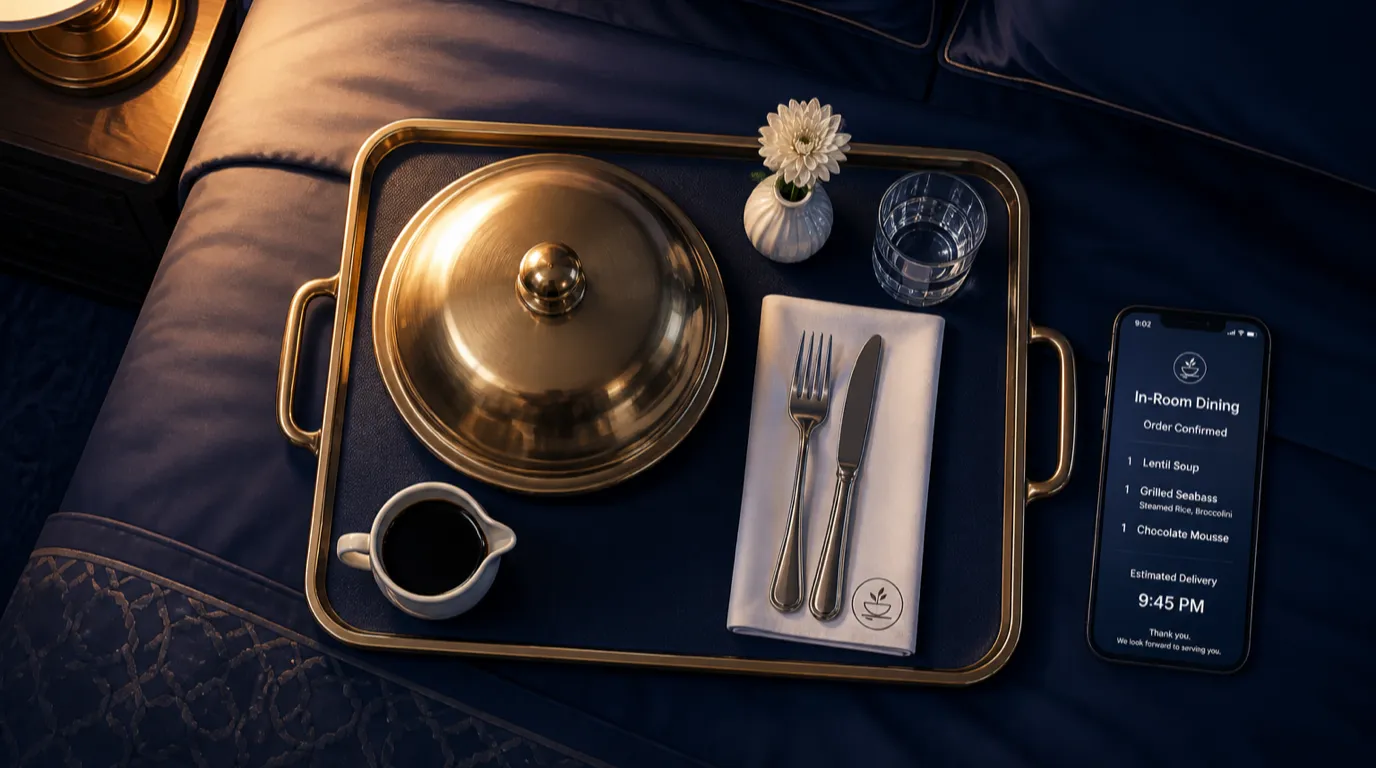
Its weaknesses are equally well known. Cards get lost, handwriting gets misread, guests tick a fifteen minute window and then sleep through it, and the whole thing is invisible to the system until somebody keys it in at 5am. A digital pre-order fixes all four: the order lands in the system as a real ticket with a delivery window attached, the guest gets a confirmation, and nobody transcribes anything. It also lets you cap each window, which is the piece door hangers cannot do. If 07:30 to 07:45 is full, the next guest is offered 07:45, and you have smoothed the peak at the point of sale rather than absorbing it in the kitchen.
Windows are what make the promise keepable. A guest with a 9am flight and a confirmed 07:30 tray is a satisfied guest. The same guest told breakfast takes about thirty minutes, ordering at 07:20, is a complaint waiting to happen. Batching deliveries by window also collapses the labour maths from the earlier section: three trays leaving together for three rooms on the same floor is one journey with three lots of revenue on it.
Price the pre-order like the commitment it is
Since a pre-ordered breakfast is worth considerably more to you than a spontaneous one, it is reasonable to price it that way, and many properties do the opposite by accident. If your in-room breakfast carries the same tray charge as a 1am burger, you are taxing the order you most want. Waiving or reducing the delivery charge on pre-orders placed before midnight costs little and buys forecastability, which is the scarcest thing in the department.
Who actually carries the tray
The staffing model is where in-room dining quietly breaks, because the department rarely has enough volume in any one hour to justify a dedicated person and rarely has so little that nobody is needed.
Three models are common. A dedicated in-room dining team, which gives the best delivery times and the worst utilisation outside the breakfast and dinner peaks. Restaurant servers covering deliveries between tables, which utilises labour well and produces exactly the prioritisation failure described above, since a server with a live section will always choose the section. And a multi skilled overnight person covering in-room dining, the lobby bar and night porter duties together, which is the only model that makes financial sense between midnight and six and which caps what the overnight menu can realistically be.
Most properties end up with a hybrid, and the thing that makes a hybrid work is naming, per shift, the person who owns the delivery queue. Not the department, not the duty manager in general, a person. Queues without an owner get served last.
The other claim on that same labour is the one nobody puts in the P&L: amenity deliveries. Welcome fruit for arriving VIPs, turndown items, a birthday cake for a room the front office promised something to, the champagne that comes with a suite booking. Each is a journey with the same cost structure as a paid delivery and no revenue attached to it at all, and they cluster in the early evening alongside the dinner peak. If your in-room dining team is missing delivery targets between six and eight, count the amenity runs before concluding the department is understaffed. It may simply be doing unbilled work for another department, which is a conversation about a transfer charge rather than a rota.
Trays in corridors are a real cost
The unglamorous half of in-room dining is retrieval. Every delivery creates an object that has to come back, and the failure to collect it is simultaneously a brand standard breach, a pest control risk, and a photograph on a review site. It is also labour nobody budgets, because the delivery is scheduled and the collection is not.
Two design choices reduce it. The first is tray versus trolley: a trolley is a better guest experience for a full dinner and a considerably worse retrieval problem, because it cannot go in a cupboard and it blocks a corridor. Use trolleys where the order justifies it, not by default. The second is asking the guest to call for collection and actually answering when they do, which sounds obvious and fails constantly because nobody owns the collection queue at eleven at night.
The practical fix most properties land on is a scheduled corridor sweep at fixed times, owned by a named person on each shift, rather than a collection triggered by a guest call. It is less elegant and it works, because it does not depend on the guest doing anything.
Three ways to charge, and the one that causes complaints
In-room dining is priced with some combination of three things: a premium on the menu prices relative to the restaurant, a fixed delivery or tray charge, and a service charge. Most properties use at least two, many use all three, and that stacking is where the resentment comes from.
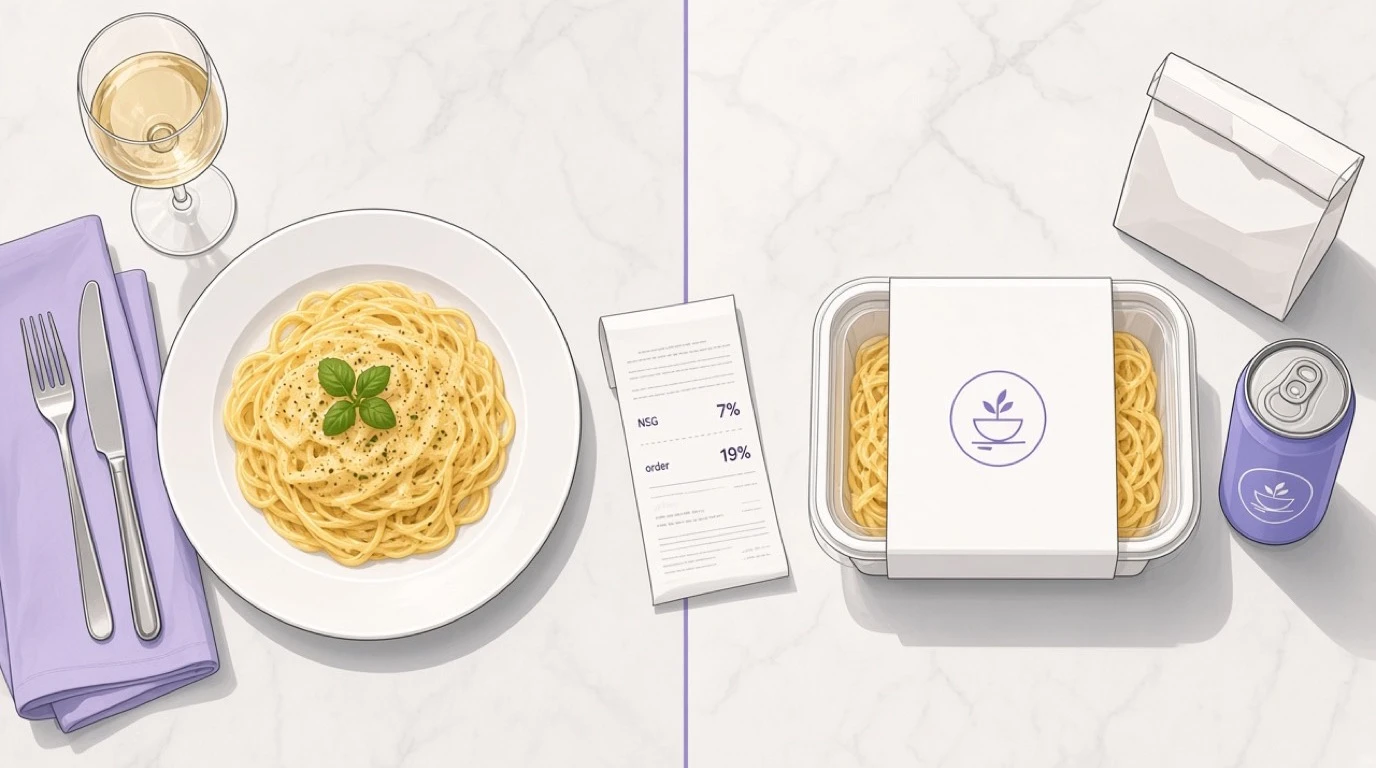
The guest arithmetic is unforgiving. A 16 sandwich that becomes 16 plus a 7 tray charge plus a service charge plus tax is not a 16 sandwich in anybody's memory, it is an expensive sandwich, and the complaint that follows is never about the food. Whether that is the right way to recover the cost of the journey is a commercial judgement, but the visibility of it is not: the total the guest will actually be charged has to be on the screen before they commit, not discovered on the folio at checkout.
This is one of the clearest advantages digital ordering has over a phone call. A menu screen can show the full total including every charge before the guest confirms, which the phone call structurally cannot do without an awkward recital. Complaints about in-room dining pricing drop when the number stops being a surprise, even when the number itself does not change. Our piece on menu pricing strategy deals with the psychology of the underlying prices.
Charging to the room is the easy part, and it has rules
Almost all in-room dining settles to the guest folio, which removes the payment moment and raises spend for the same reason it does everywhere else in a hotel. It also inherits the control problems that come with folio posting: a charge on the wrong room, a charge against a room that has already departed, and a docket that never made it into the system before the night audit closed the business date.
The discipline is the same as for any hotel outlet. Validate the room and the guest name at the point of order rather than at the door, close every check before the audit runs, and reconcile outlet revenue to posted revenue before anybody goes home. In-room dining is the outlet most likely to break this, because it trades overnight, and the overnight shift is the one with the fewest people and the least supervision. Our guide to hotel food and beverage management covers the folio and night audit mechanics in more depth.
Room service always loses the kitchen at peak
Here is the operational truth nobody writes on the org chart: when the restaurant is full, the in-room dining ticket loses. It loses because the guest is not visible, the section is not waiting at the pass, and a chef optimising for the room in front of them is behaving rationally. The result is that order-to-door blows out exactly during the hours when the most orders arrive.
Pretending this away with a policy does not work. What works is making the room service queue visible and separately timed, which means treating it as its own station with its own targets rather than as overflow. A display that shows in-room tickets as a distinct queue with their own timers, rather than mixed into the restaurant fire sequence, changes behaviour because the delay becomes visible to the person causing it. Our comparison of kitchen displays and printers covers why a printed ticket cannot do this: paper has no state, so a ticket that has been sitting for nineteen minutes looks exactly like one that arrived thirty seconds ago.
The other honest option is to narrow the overnight menu to what one person can execute alone and be explicit about it, rather than offering the full card at 2am and delivering it in fifty minutes. Guests forgive a short menu. They do not forgive a long wait.
When the market beats the tray
Sometimes the Hilton was right. A grab-and-go market, an honesty fridge or a pantry with a self checkout genuinely does beat in-room dining in some properties, and it is worth being clear about which.
The case for replacement is strongest where the average delivery value is low and stubbornly refuses to move, where the guest mix is dominated by single business travellers who want something quick rather than an occasion, where the building's layout makes transit long, and where there is enough alternative food within a short walk that the outlet has no captive advantage anyway. In that combination the market wins, and it wins decisively, because it converts a labour cost per journey into a stocking task.
The case against is equally clear. Resorts where guests cannot easily leave, properties with a strong leisure and family mix, anywhere with meaningful suite or club accommodation, and any property where the room rate implies a level of service that a vending pantry contradicts. Removing in-room dining from a resort because the departmental margin is thin is a decision about the rate you can charge for the room, not just a decision about food, and it should be made with the rooms side in the meeting.
A third path exists and is underused: keep in-room dining for the hours when it can be delivered properly, and run a market for the rest. The mistake is treating this as a binary choice made once for the whole day.
What to do first
Measure order-to-door for two weeks, split into capture, production and transit, and look at the spread rather than the average. You will find one of the three segments is carrying most of the variance, and it is usually not the kitchen.
Then calculate value per journey rather than margin per dish, and set the department's target on that number. It reframes every subsequent decision correctly, including the ones about menu length and delivery charges.
Then cut the items that do not survive the lift, whatever their popularity downstairs. A shorter menu tightens production time, reduces overnight complexity and improves the thing guests actually complain about, which is temperature and texture on arrival rather than choice.
Then move ordering off the phone, because it is the single change that raises value per journey and removes transcription errors at the same time. If you only do one thing from this article, do that one, and measure the tray value before and after so you know what it was worth.
Read next: hotel food and beverage management, tableside ordering, and kitchen display systems.