
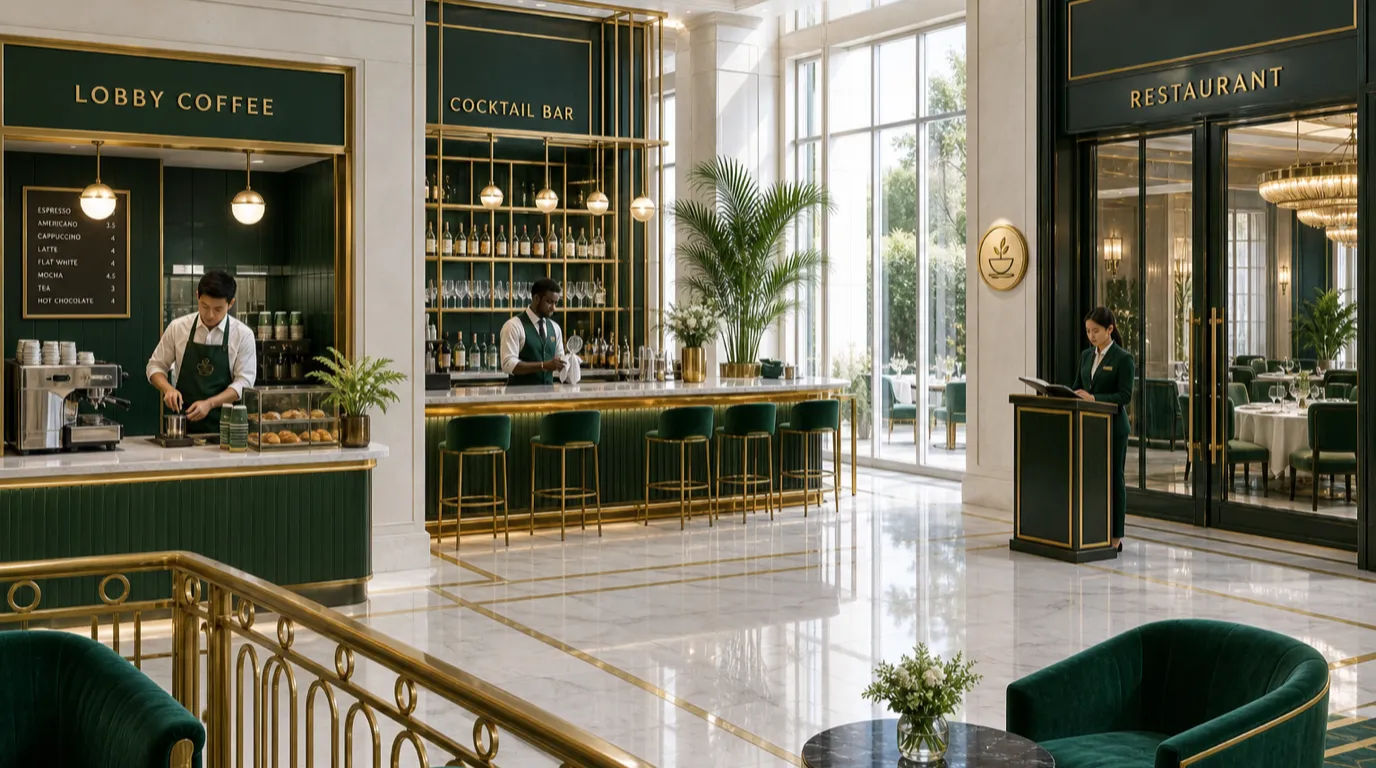
A restaurant knows within a week whether it is working. Covers, average check, food cost, labour percentage, and the four of those together tell you almost everything. Hotel food and beverage does not behave like that, and operators who arrive from the restaurant world spend their first year applying the wrong instruments to the wrong department. The outlets look like restaurants. They are staffed like restaurants, and the restaurant POS in the lobby cafe is the same software you would put in a bistro. But the money moves differently, the guest arrives for a different reason, and half your revenue is generated by a part of the operation that has no covers at all.
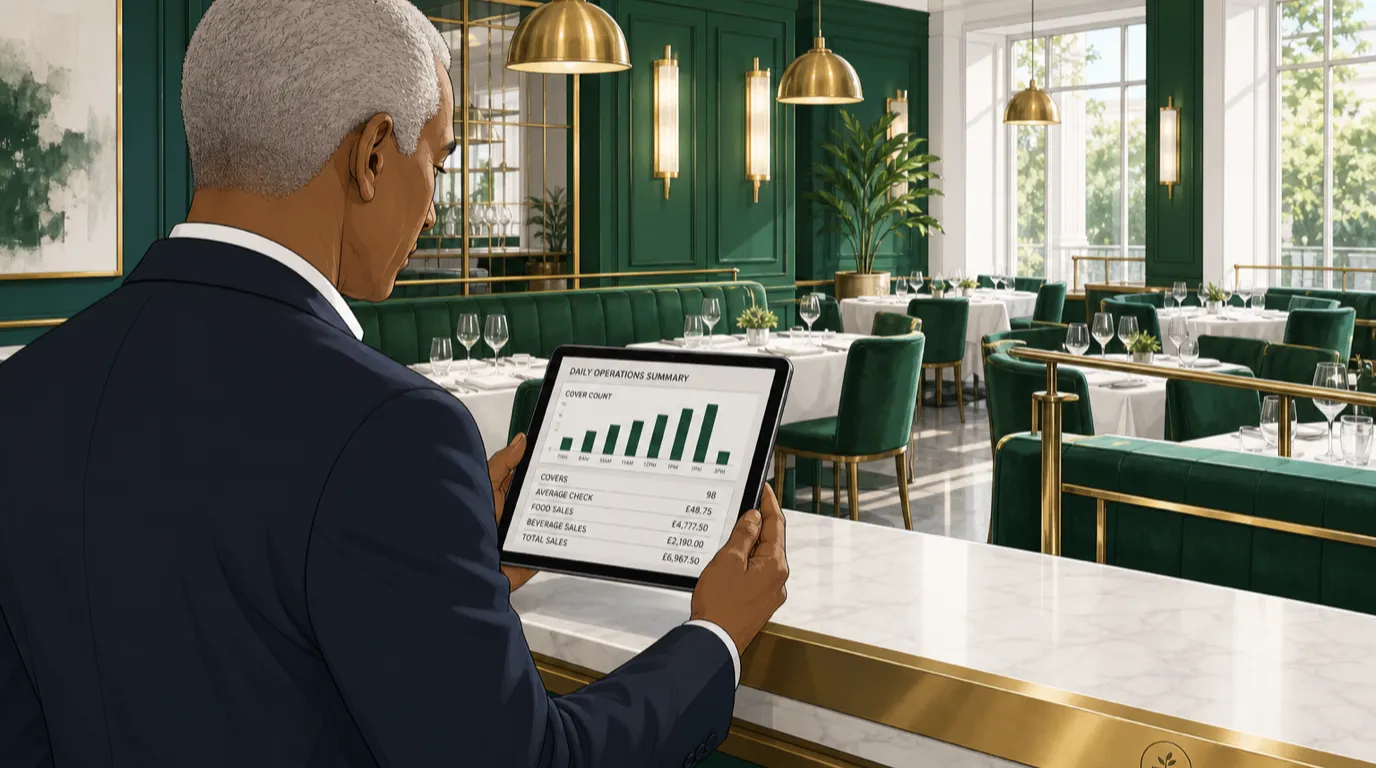
The gap shows up first in reporting. Hotels do not measure a department by prime cost, they measure it by departmental profit, because the hotel industry runs on a shared chart of accounts called the Uniform System of Accounts for the Lodging Industry. F&B is an operated department in that system with its own schedule, its own payroll line and its own bottom line, sitting alongside Rooms rather than underneath it. Get your restaurant accounting mapped to that structure on day one and every conversation with an owner, an asset manager or a brand gets easier. Map it the restaurant way and you will spend every month translating.
Be careful with hotel F&B benchmarks
Before any numbers, a warning that applies to this whole subject. The good hotel F&B benchmarking data is commercial. STR and the big consultancies publish departmental profit ratios by segment and market, and those reports cost money and come with licence terms. What circulates freely is mostly derived from them at second or third hand, stripped of the segment and region that made it meaningful in the first place.
This matters more in hotel F&B than in restaurants, because the spread between segments is enormous. A limited service hotel serving a complimentary breakfast and nothing else, a full service airport hotel doing conference lunches five days a week, and a resort running six outlets and a beach club are three different businesses filed under one department name. A ratio that describes one of them describes none of the others. When somebody quotes you an industry average F&B profit margin without naming the segment, the market and the source, that number is decoration.
So the figures below are either arithmetic you can check or clearly labelled worked examples from a hypothetical property. Where a real benchmark would help, I will say that you need to buy it.
Capture rate is the number restaurants never learn
The first metric that separates hotel F&B from restaurant thinking is capture rate: the proportion of your in-house guests who eat or drink in your outlets. Divide the covers you served that came from the hotel by the number of guests staying, and you have it. Run it separately for breakfast, lunch and dinner, because those three numbers behave nothing alike and averaging them destroys the signal.
Breakfast capture in a property with a rate that includes breakfast approaches total. Dinner capture in a city hotel with fifty restaurants inside a ten minute walk can sit in single digits, and no amount of menu work will move it much, because you are not competing on food, you are competing with the entire neighbourhood plus the guest's own inertia. Dinner capture at a resort on a peninsula where the nearest alternative is a twenty five minute taxi is a different proposition entirely, and the failure mode there is not attracting guests, it is having enough seats and enough kitchen at 7:30pm.
What capture rate does that average check cannot is tell you whether a bad night was a demand problem or a conversion problem. Two hundred covers on a night with four hundred guests in house is a poor result. Two hundred covers on a night with two hundred and twenty guests in house is an extraordinary one. The covers figure is identical. Only one of those nights needs fixing, and without occupancy in the denominator you cannot tell which.
Run it against the arrivals list, not the forecast
Capture rate is most useful segmented by why the guest is in the building. A conference block that arrives with dinner already contracted is not a capture opportunity, it is contracted revenue that will distort your ratio upward while telling you nothing about the outlet. Leisure couples on a third night behave differently from Tuesday business travellers on their first. Pull the segment mix from the arrivals list and you can predict outlet demand a week out with unnerving accuracy, which is the input your rota and your ordering both want.
RevPASH, and why seats are the constrained resource
The other metric worth importing is RevPASH, revenue per available seat hour, developed by Sheryl Kimes and colleagues at Cornell. Take the revenue an outlet earned in a period and divide it by the seats available multiplied by the hours it was open. It is the F&B analogue of RevPAR, and it exists because a seat hour, like a room night, is perishable inventory. An empty two top at 6:15pm is gone forever.
Here is why it changes decisions. Average check rewards you for selling an expensive bottle to a table that occupies a four top for three hours. RevPASH does not, because it charges that table for the seat hours it consumed. A bistro turning eighty covers at $45 through forty seats over four hours produces a RevPASH of $22.50. The same room doing sixty covers at $58 produces $21.75, and the second night has the better average check and the worse economics. Our guide to table turnover covers the mechanics of moving that number.
The correction RevPASH forces in hotels specifically is around opening hours. Every hotel outlet has a stretch of the day it is open for service reasons rather than commercial ones, usually the dead zone between breakfast and lunch, or a bar that opens at four for the two people who want it. Those hours sit in the denominator and drag the number down, and once you can see the cost of them you can make an actual decision: close them, consolidate two outlets into one during the trough, or accept the drag because the brand standard requires it. Any of those is defensible. Not knowing is not.
The folio changes what a sale even is
In a restaurant, service and settlement happen in the same ten minutes at the same table. In a hotel, a guest signs and walks away, and the charge lands on their folio to be settled at checkout, possibly days later, possibly by a company, possibly by a tour operator on thirty day terms. That single difference cascades through everything.
Start with behaviour. Removing the payment moment reliably raises spend, which is exactly why the facility exists and why bars in resorts do the volume they do. It also removes the friction that makes a guest think twice about a second bottle, and the invoice at checkout is where the surprise arrives. Properties that get complaints about F&B pricing very often do not have a pricing problem, they have a visibility problem: nobody saw a total until the folio printed. A dockets copy left with the guest at signature, or a running total available in the app, costs nothing and defuses most of it.
Then the accounting. F&B revenue posted to a folio is not collected by F&B. It leaves your department as a posting and arrives in the rooms ledger, and from there it goes wherever that ledger goes, including into accounts receivable if the booking was on account. Your outlet can have an excellent month and contribute nothing to cash for sixty days. Anyone running cash flow on restaurant instincts will get this wrong, because in a restaurant revenue and cash are close to the same event.
And then the control problem, which is the one auditors care about. A room charge is authorised by a signature against a room number, and the two failure modes are ancient: a charge posted to the wrong room, and a charge posted to a room that has already checked out. Both are recoverable only if you catch them the same day, which is what the night audit is for.
What the night audit actually does to you
The night audit is the process that closes the hotel's business date, posts room and tax charges, reconciles the day, and produces the reports the morning management meeting reads. For F&B the important consequence is a hard cutoff. Once the business date rolls, a docket that was never posted is an adjustment against a closed day, not a sale, and adjustments against closed days are the thing that makes finance stop trusting your department.
So the operational discipline is simple and non negotiable: every check closed before the audit runs, every open table resolved, every signed docket posted. A restaurant can be relaxed about a table left open until the morning. A hotel outlet cannot, and the daily close deserves the same treatment as a Z report in a standalone site, with an added step to prove that outlet revenue and posted revenue match before anybody goes home.
Meal plans turn breakfast into an internal transfer
Nothing confuses imported restaurant managers faster than the rate plan codes. Room only is EP. Bed and breakfast is BB, and CP is the version where breakfast means continental. MAP, the modified American plan, is breakfast plus one other meal, almost always dinner. AP is all three. AI is all inclusive, which is a different animal again.
The trap is that under any plan above EP, the meal was sold by the rooms department at a rate the guest agreed weeks ago, and your outlet is delivering it. If nothing is posted, your F&B department shows the cost of every breakfast and the revenue of none, and your departmental P&L is a work of fiction. Fix that with an allowance: a set value posted from Rooms to F&B for each entitled cover, so both departments carry a number that reflects what they actually did. The precise value is a management decision and every property sets it differently, but the choice must be made deliberately and applied consistently, because it moves profit between two departments that may well be judged separately.
Allowances also make the upsell visible. A guest on half board who orders the lobster supplement, a bottle of wine and a second coffee generates two lines: the allowance, and the overage that is genuinely yours. Without the split, your team cannot tell a good half board night from a bad one, and there is no way to reward the section that sells the difference.
All inclusive is a different business
All inclusive breaks the model entirely, because there is no marginal revenue event at all. Every consumption is a cost against a package sold once. The consequence is that consumption forecasting, portion control and waste discipline stop being back office hygiene and become the entire commercial game, and every incentive that normally motivates a floor team (sell more) inverts (serve well, waste nothing). Run all inclusive with a standard restaurant incentive structure and you will pay bonuses for destroying margin. This is where stock management discipline earns more than any menu change will.
Breakfast is a factory, not a restaurant
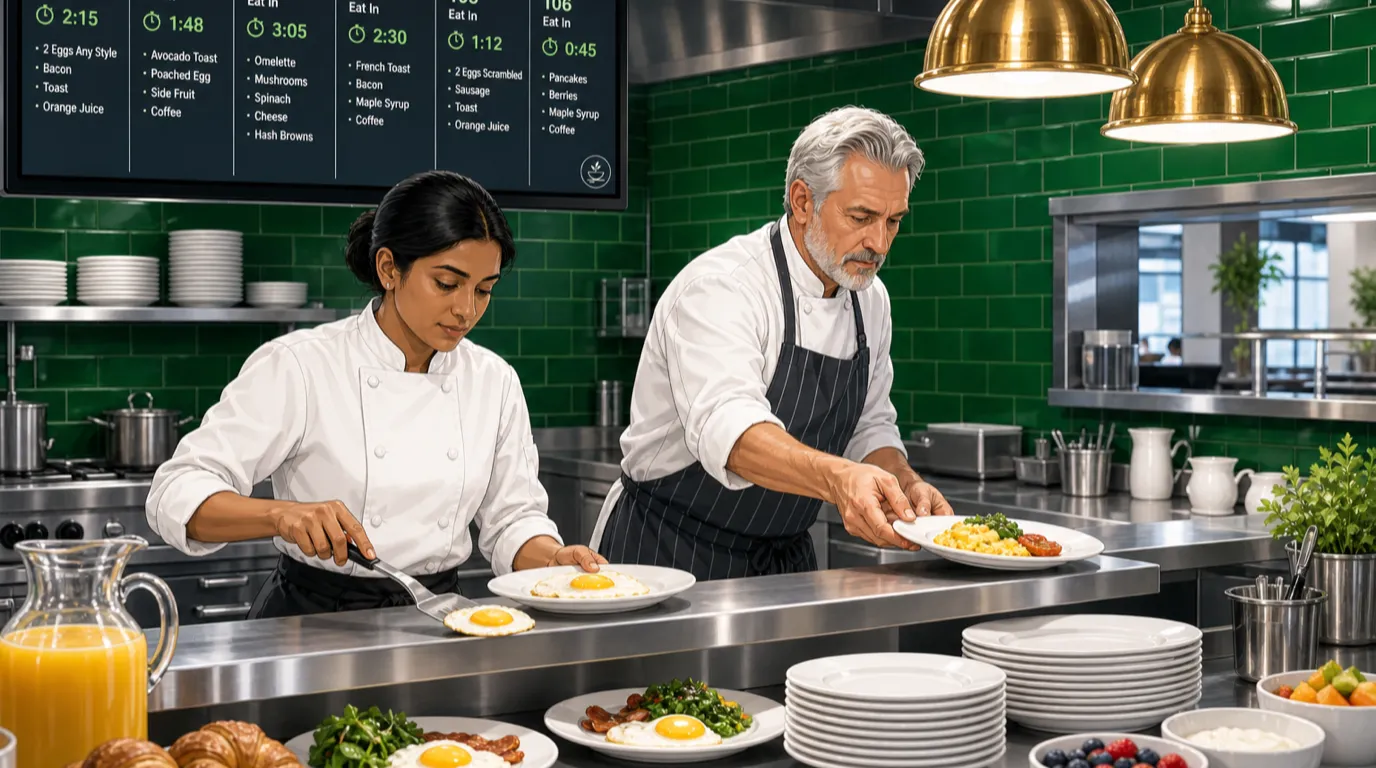
Breakfast is the highest volume service in most hotels, the one with the worst reviews, and the one run with the least design. It has properties no other service has: near total capture, a demand curve with a violent peak, guests who are leaving for something with a fixed start time, and a product that is mostly assembled rather than cooked.
The peak is the whole problem. A hundred and forty room hotel does not serve breakfast evenly across three hours. It serves a trickle from 6:30, a wall between 7:30 and 8:30, and a long tail. Staff it to the average and the wall destroys you, staff it to the peak and you pay four people to watch the tail. What actually works is a shift shape that mirrors the curve, which requires knowing the curve, which requires having measured it rather than assumed it. Most properties have never counted breakfast covers in fifteen minute buckets. It takes a week and it is the highest return week of analysis available in hotel F&B.
Two more things worth knowing. Buffet waste is measurable and almost nobody measures it, so weigh what comes back for a fortnight before redesigning anything. And breakfast is where allergen and dietary handling is most exposed, because a buffet is a self service environment with shared utensils, which is precisely the setting where cross contact happens; our guide to food safety and HACCP covers the controls.
Banquet is usually where the money is
Ask a hotel general manager which part of F&B pays and the answer, in almost any full service property with function space, is events. The reason is structural rather than culinary. A banquet is sold in advance at a contracted price for a known number of covers on a known date with a menu chosen weeks earlier. Every variable that makes restaurant margin unpredictable has been removed before a single item is ordered.
That certainty is worth more than the menu price. You can order to the cover count instead of to a forecast, so waste approaches zero. You can roster to the exact service requirement instead of to a guess. Production can be batched. The kitchen knows the plating at eleven in the morning, not at eight in the evening. A la carte gives you none of this and never will.
The implication for how you spend your attention is uncomfortable for chefs, and correct: an hour spent tightening the event order process is usually worth more than an hour spent on the restaurant menu. Our guide to catering and private events covers the packages, the deposits and the event order workflow in detail, and most of it transfers directly to a hotel banqueting operation.
One kitchen, several P&Ls
The structural fact that makes multi outlet hotel F&B hard is that the outlets are separate businesses on paper and one business in the basement. The same walk-in, often the same brigade, certainly the same delivery, feeding a restaurant, a bar, a pool deck, room service and banqueting, each of which reports separately.
Which makes inter outlet transfers the thing you either handle properly or lie about. A case of wine moved from the bar store to a banquet, a tray of pastries sent from the bakery to the lobby cafe, prepped stock issued from a central kitchen to three outlets: if none of that is recorded, the outlet with the store carries costs it did not consume and the receiving outlet looks better than it is. The bar takes the blame for a pour cost that a banquet actually caused. Nobody is stealing anything and every number is wrong.
Two decisions make this tractable. Decide where stock is owned, ideally in a central store that issues to outlets rather than outlets that borrow from each other. And require a transfer document for every movement, which is far easier when it is a couple of taps in the system that already knows your product list than when it is a notebook by the walk-in. The multi-location playbook deals with the same problem across sites rather than across outlets, and the centralisation logic is identical.
Menus should live in one database
The other multiplication problem is menu maintenance. Five outlets, five menu builds, five sets of modifiers, five places to update a price or an allergen note. The failure is not that it is laborious, it is that the copies drift, and a drifted allergen flag is a safety issue rather than an inconvenience.
Hold one product database for the property and let outlets inherit from it, overriding price and availability where they genuinely differ. Then a supplier substitution updates every menu it touches, once. This is also the only sane way to run consolidated reporting, because a dish sold in three outlets under three slightly different names cannot be analysed at all. Our piece on menu engineering assumes clean product data, and this is where it comes from.
What the systems have to do
Strip out the marketing and a hotel F&B stack has a short list of obligations that a restaurant stack does not.
It has to post to the folio, against a room number, with the guest's name validated at the point of signature rather than at checkout. It has to handle a meal plan allowance as a distinct posting from an overage. It has to route production tickets from several outlets into one kitchen without the pool bar's order arriving in the middle of a fine dining fire sequence, which is a kitchen display system routing question rather than a printer question. It has to let one product database serve many outlets. It has to close cleanly before the night audit and prove that it did. And it has to report by outlet, by meal period and by revenue centre in a shape that maps to the departmental accounts rather than to a restaurant P&L.
Notice what is not on that list: anything about the dining room. The floor plan, the modifiers, the split checks and the course firing are all the same problems a good restaurant system already solves. Hotel F&B does not need different table service software. It needs table service software that speaks to the rest of the hotel and reports in the hotel's language. Our overview of hospitality point of sale systems goes further into how those integrations are put together.
Where to start on Monday
If you inherited a hotel F&B department this month, the sequence that gets you furthest fastest is not the menu.
Count breakfast covers in fifteen minute buckets for one week and reshape the rota around what you find. That is the single highest return week of work available, and it usually pays for itself in labour inside a month.
Then calculate capture rate by meal period for the last ninety days, split by market segment, and find the one period where the number is worse than the building deserves. Fix that period rather than everything at once.
Then establish the meal plan allowance if one does not exist, so your department is being judged on numbers that describe what it actually did. You cannot manage a P&L that is missing the revenue for a third of the covers you serve.
Then, and only then, look at the menu. It is the most enjoyable lever and the smallest one, and in hotel F&B it is almost never the reason the department is underperforming.
Read next: hotel room service and in-room dining, catering and private events, and the KPIs worth tracking.