
A late-night venue is not a restaurant that stays open later. It is a different business wearing similar clothes. The revenue arrives in a burst rather than a steady flow, often the majority of it inside about three hours; the guest count can turn over twice in a night; the risk profile changes as the room gets drunker; and the whole thing has to be counted, reconciled and locked by a time when most people are asleep. Almost none of the habits that make a dinner service run well transfer directly, which is why plenty of good restaurateurs open a bar or club and discover they are learning a new job.
This is the operational version. The door, because that is where capacity and most of your legal exposure live. The bar, because speed per bartender per hour is the ceiling on what the night can earn. And the close, because a night that traded brilliantly and cannot be reconciled at four in the morning has not finished making money yet, it has just stopped counting it. Tabs and pre-authorisation get their own section, since unclosed tabs are the single largest avoidable leak in late-night trade and the mechanics sit squarely with how you take payment. One caveat throughout: licensing, permitted hours, door-staff accreditation and occupancy rules differ in every market and often between cities in the same country. Treat what follows as the operating discipline and confirm the specific rules with your own licensing authority. Opening one from scratch is covered separately in how to open a bar.
Why late night is a different business
Start with the shape of the night, because it drives every other decision. A restaurant's revenue curve has two humps and a long tail. A late-night venue has one steep climb, a plateau, and a cliff. Between the quiet first hour and the peak you may go from a handful of people to a full room in forty minutes, and the staffing, stock and cash positions all have to be right before that happens rather than during it.
The second difference is that your capacity constraint is not seats. A dining room is limited by tables and how fast they turn, the logic behind table turnover. A club is limited by occupancy, by how many drinks a bartender can physically make in an hour, and by the length of the queue people are willing to stand in. Two of those three are yours to improve.
The third is that risk rises through the night while judgement, yours and everyone else's, declines. A mistake at nine in the evening is a mistake. The same mistake at two in the morning, in a full room, is an incident. That asymmetry is the argument for putting the thinking into written procedure beforehand, because the last two hours are not when anyone invents good policy. It is also why your insurance and your licences and permits deserve reading properly rather than filing.
The door is the whole night
Everything downstream is decided at the entrance. Who is inside, how many, how quickly they got there, and what mood they arrived in.
Separate your entry lanes. Guest list, table or VIP bookings, and walk-ins should not be one queue, because merging them means your highest-spending guests wait behind your lowest and some of them leave. Brief the door team before every session on the night's programme, the dress or entry policy, expected arrivals, the capacity target and who to call for what. An unbriefed door improvises, and improvisation at the entrance is where most bad nights begin.
Then measure the queue, because it is a revenue instrument and not just a nuisance. A short queue signals a busy room and helps you. A long one loses people who will not tell you they left, which makes it invisible in your figures unless somebody counts. Track how long the wait actually is at intervals through the night and how many arrivals turn away, and you will learn more about your pricing and programme than any survey will tell you. The pacing logic is the same one behind waitlist management, and the welcome matters just as much here as it does in customer service.
Capacity, and the number below the legal one
Your occupancy limit is set for you, usually by fire safety, and exceeding it is the fastest way to lose a licence. That part is not negotiable and the specific figure and how it is calculated is a question for your local authority.
The operational point is that you should run to a working limit somewhere below the legal maximum. Common practice is a margin of roughly ten to fifteen percent, and the reason is practical rather than cautious: staff need to move through the room, exits and gangways have to stay genuinely clear, and a counter that has drifted by a few people should still leave you legal rather than in breach. Running at the hard cap all night means any counting error is a violation.
Which requires that somebody owns the count, in real time, all night, and that it is a named person rather than an assumption. The usual failure is that the door counts arrivals, nobody counts departures with the same discipline, and by midnight the number is fiction. Set alerts at a proportion of the working limit rather than at the limit itself, so you get to manage entry rather than stop it abruptly, and log the count at intervals so you can show what you were doing rather than assert it.
Security, and the record that protects you
Door and floor security is a licensing matter in most jurisdictions, and the accreditation, the minimum numbers and who is allowed to do what are all local questions you need answered locally. What travels is the shape of the staffing and the discipline of the paperwork.
The commonly cited planning ratios put one person on each entrance, with a second on high-volume doors, roughly one on the floor for every fifty to seventy-five guests, one per bar where there are several, and dedicated cover for closing and dispersal. Treat those as a starting point for a conversation rather than a standard, because a seated late-night bar and a full-capacity club with several rooms are not the same problem. The pattern that matters is that floor cover scales with headcount while door cover scales with entrances, so they grow at different rates.
The part operators under-invest in is the log. Refusals, ejections, incidents, capacity readings, ID checks that failed, anything requiring first aid: time, description, staff name, outcome. It feels like bureaucracy for fifty-one weeks of the year, and in the week a licence is reviewed or a claim is made it is the entire difference between a venue that can demonstrate it runs responsibly and one that can only promise to do better. Operators who can produce records generally fare better than operators who cannot. Keep it in the same place your team already writes things down, which for most venues means alongside the shift handover.
Tabs, pre-authorisation and walk-outs
Here is the leak. In late-night trade the open tab is both the thing that raises spend per head and the thing that quietly loses you money, and most venues never quantify which side they are on.
The mechanism is simple. A card gets left behind the bar or a tab gets opened against a name, the guest keeps ordering, and at some point in the night they leave without closing it, sometimes deliberately and more often because they forgot, lost their friends or were asked to leave. The card is still there and the tab is still open. Pre-authorising the card when the tab opens is what turns that from a write-off into a recoverable amount, and it also caps your exposure per tab, which matters more as the average grows. Run the same discipline on table and bottle service, where individual tabs get large enough that a single unclosed one is a meaningful part of the night.
Then close them systematically rather than hopefully. Someone should be working the list of open tabs before last call rather than after it, because a guest still in the room can settle and a guest in a taxi cannot. Watch the count of tabs opened against tabs closed as a nightly figure; it is one of the few numbers that tells you about a specific failure rather than a general trend. And be strict about the adjacent leaks, because a room this busy is where voids and comps stop being exceptions and start being a habit, and where the patterns in employee theft are easiest to hide. Groups splitting a large tab at speed is its own problem, handled in split bills.
Speed behind the bar
Your ceiling on revenue is drinks per hour, and it is set by the physical layout of the bar far more than by how hard anyone works.
Count the wells. A bartender working a properly stocked station, with spirits, ice, glassware and garnish inside a step, will outproduce a better bartender who has to walk for anything. Every trip away from the station is drinks you did not sell during the ninety minutes when you could have sold them. Then cut the menu for peak: a long cocktail list is a liability after midnight, and the venues that trade fastest either shorten the offer late or pre-batch the drinks that would otherwise take three minutes each. Nobody at one in the morning is choosing you for a stirred cocktail built to order.
Barbacks are the cheapest capacity you can buy, and the first thing most operators cut. A bartender who never runs out of ice or clean glassware is worth substantially more than the barback costs, which is the whole argument in barback responsibilities. Beyond that, know your pour discipline, because the margin you lose to heavy hands compounds across thousands of drinks and it is invisible without measurement, which is what pour cost is for. Where the offer allows it, letting people order from their phone takes pressure off the service well entirely, which is one of the more useful applications of mobile ordering.

Cash and card at peak
Payment is where speed and control pull against each other, and late night is the hardest place to hold both.
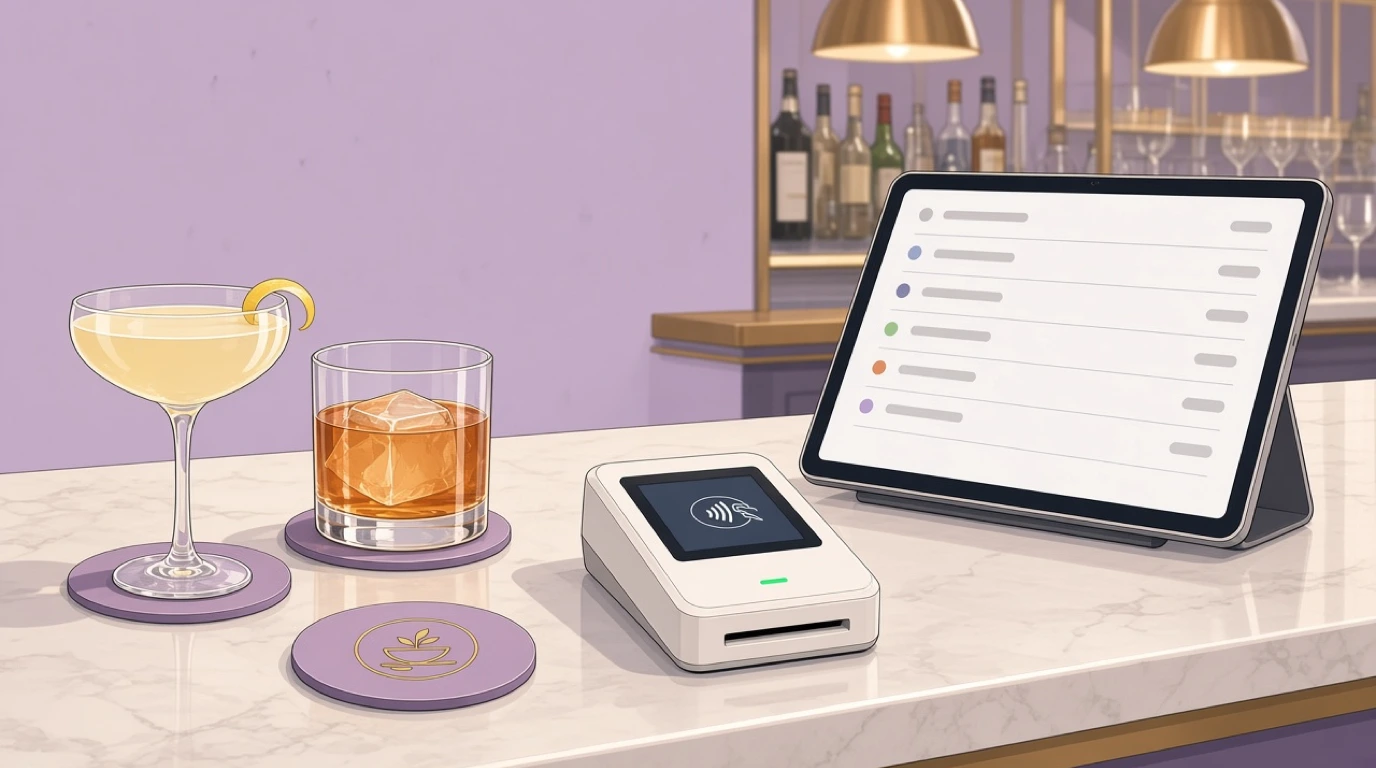
The faster you can take money, the more you can sell in the window that matters, which is the practical case for tap-to-pay everywhere, a terminal per bartender rather than a shared one, and as little cash as your market will tolerate. A queue at the till is a queue that is not ordering. Where cash remains a real share of trade, the discipline is boring and non-negotiable: one person per drawer, counted in and counted out, drops to the safe at intervals through the night rather than one terrifying pile at the end, and no shared floats. Most cash losses are not dramatic thefts; they are the accumulated ambiguity of several people using one drawer.
Going fully cardless removes a whole category of risk and cost, and it excludes some customers, which is a decision about your market rather than a best practice; the trade-offs are set out in going cashless. Whatever you choose, know your processing costs, because at late-night volumes a small difference per transaction is a real annual number, as covered in payment processing fees.
Tables, bottles and minimum spends
Table service is where a late-night venue makes disproportionate money, and where the operational detail is most often improvised.
What you are actually selling is space and status rather than the bottle, which is why minimum spends work and why discounting them undermines the product. Decide the minimum by table and by night, write it down, and hold it, because a minimum negotiated at the door on a Saturday is a minimum you no longer have. Take a deposit on bookings, since a reserved table that does not arrive is worse than an empty one; it occupied your best real estate and then earned nothing.
Then treat those tables as inventory with a plan, not as a favour granted by whoever answers the phone. Who booked, what they committed to, which host owns them, what has been served against the minimum so far. Losing track of that mid-night is how a group leaves under their commitment without anyone noticing until the morning. The mechanics are close enough to a dining room that table management applies, and the commercial thinking overlaps with private events. Watch the spend per table as a distinct figure from the room's average check, because they move for different reasons.
Last call and dispersal
The last hour is the highest-risk hour of the night, and it is the one most venues plan least.
The room is at its most intoxicated and about to be moved outdoors in a group, into a street that has neighbours and possibly other venues emptying at the same time. Do it abruptly and you get a crowd on the pavement, which is where fights, noise complaints and the sort of attention that shortens licences all happen. The approach that works is graduated: lights and music shift before the hard stop rather than at it, the bar closes in stages, staff move through the room rather than announcing from behind it, and security repositions outward to the exits and whatever car park or street you are responsible for.
Get the tab list closed during this window, not after. And think about how people physically leave, since transport is part of your dispersal plan whether you treat it as your problem or not; a venue with no way for people to get home has a crowd standing outside it. Note also what your neighbours experience, because noise and dispersal complaints are among the most common triggers for a licence review, and they accumulate quietly until they do not.
The close
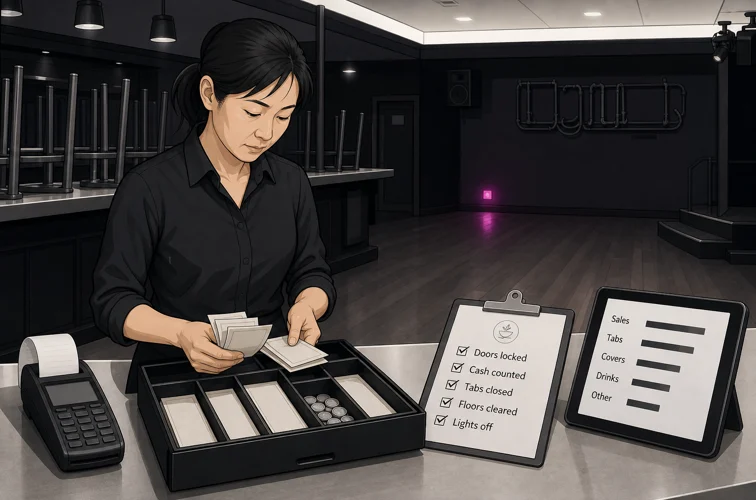
The night is not over when the room is empty. It is over when the money is counted, the stock is known and the building is secure, and that sequence is where tired people make expensive mistakes.
So make it a written checklist rather than a memory, in the same spirit as opening and closing checklists. Close every remaining tab and account for the ones you could not. Reconcile each drawer separately against its own terminal, so a discrepancy points at a person and a session rather than at the night in general, and run the end-of-day report properly, which is what the Z report exists for. Count the fast-moving spirits nightly even if the full stocktake is weekly, because the gap between what you sold and what left the shelf is the most informative number the night produces and it is useless a week later.
Then the physical close: doors, tills, safe, cellar, lights, gas where you have a kitchen, cameras still recording. And write the handover while it is fresh, because whoever opens tomorrow needs to know what broke, what ran out and what happened, and none of that survives until the afternoon in anybody's head. The stock side of this connects to inventory management, and the cash side to cash flow.
Staffing a night that ends after dawn
The rota is harder than a restaurant's for reasons that have nothing to do with the number of hours.
Your peak is short and intense, which means the shape of the shift matters more than its length. Overstaff the quiet first hour and you burn labour cost on an empty room; understaff the peak and you lose sales you cannot recover, because the queue at the bar does not wait for you to catch up. Staggered starts fix most of this, with the core team arriving before the climb and the tail of the shift covering the close. The general labour arithmetic is in labour cost and the mechanics in staff scheduling.
The part that is genuinely different is the human cost of the hours. Late-night work runs against the body clock, and the industry's turnover in these roles is worse than in daytime hospitality for that reason more than any other. What helps is unglamorous: predictable rotas published far enough ahead that people can have a life, a real plan for getting staff home safely at four in the morning, food on shift, and not rostering the same people onto every closing shift because they never complain. Retention in late-night venues is mostly a scheduling problem wearing a culture costume, which is the argument running through hiring and retention. Who does what on a busy night is worth writing down too, as in restaurant positions.
The numbers that tell you whether it worked
Late-night venues are often run on the till total and a feeling, which is a shame, because a handful of figures explain almost everything.
Spend per head, split by entry channel, tells you whether guest list, walk-ins or tables are actually carrying the night, and it frequently contradicts the assumption. Drinks per bartender per hour at peak tells you whether your ceiling is demand or your own bar layout, and it is the number that justifies a build change. Door count against your working limit, by hour, tells you when you were genuinely full rather than when it felt busy. Tabs opened against tabs closed tells you what walked out. And pour cost by category tells you whether the margin you think you have is the margin you took.
Compare like nights to like nights, since a Saturday tells you nothing about a Thursday, and expect the programme rather than the operation to explain most of the variance between them. The wider set of figures worth watching sits in restaurant KPIs, and everything here ultimately lands in prime cost. Keeping it in one system rather than three spreadsheets is the practical case for a single POS across bar, door and tables.
Programming the week
The last thing that separates venues that last from venues that do not is that they treat the week as a portfolio rather than hoping every night works.
Most late-night venues make their money on one or two nights and spend the rest of the week deciding whether the other nights are worth opening at all. That is a real question and the answer is arithmetic: a night that covers its own labour and contributes something to fixed costs is worth running, and a night that does not is a hobby. Once you have decided which nights are which, the quiet ones need a different product rather than the same one with fewer people in the room, which is the argument in filling empty tables on slow nights. An early-evening offer before the late crowd arrives is one of the few genuinely free levers available, and the mechanics of pricing it are in happy hour.
Then plan the year, not just the week, because late-night trade is more seasonal than restaurant trade and the difference between a good December and an average one is decided in October, as set out in the festive season. Promotion is its own discipline and mostly happens where your audience already is, which for this trade means social media more than anything else, inside the wider frame of restaurant marketing.
Read next: how to open a bar if you are still at the planning stage, and bar pour cost, since speed at the bar is worth very little if the margin leaks a measure at a time.