A waitlist is the only part of your operation where you make a promise before you have any idea whether you can keep it. Someone walks in at 7:40 on a Saturday, you glance at the floor, and you say "about twenty minutes." That number is now a contract. If they sit at 7:58 you are a hero. If they sit at 8:25 you have a table of four who spent forty-five minutes deciding they do not like you, and they had not even seen a menu yet. Most of the tools for getting this right are already sitting in your restaurant POS system, unused, because the quote gets treated as a guess rather than a calculation.
Which is odd, because the math is not hard. Waits are queue theory with tablecloths, and queue theory has been solved for about a century. What makes waitlist management genuinely difficult is everything wrapped around the number: the party of six that refuses to split across two tables, the couple who wander off to a bar and come back at minute thirty-one, the regular who expects to skip, and the host who is nineteen years old and has been told to keep everyone happy without being given a single rule for how. This is mostly a guide for full-service rooms, where the problem bites hardest, and if you run one you will find the operational side covered from the other direction on our full-service restaurant POS pages.
A waitlist is a revenue tool, not a holding pen
Start here, because it changes every decision that follows. A waitlist exists to make sure that the moment a table is bussed and reset, there is a party ready to sit at it. That is all. Every minute a four-top sits empty on a Saturday at eight o'clock is revenue that does not come back, and on a busy night the difference between a well-run list and a badly run one is measured in whole extra turns.
Run the arithmetic on your own room and it becomes uncomfortable. A 60-seat bistro doing an average check of 38 dollars, losing an average of six minutes of idle time per table across twenty tables on a Friday and Saturday, is leaking roughly two hours of table time a night. At a 55 minute turn that is two turns you did not sell. Two turns is four covers. Call it 150 dollars a night, 15,000 dollars a year, from nothing more than dead air between one party leaving and the next sitting down.
The flip side is that a waitlist is also the single most dangerous place in the building for your reputation, because it is where you set expectations. A guest who waits thirty minutes after being told thirty minutes is content. A guest who waits twenty-two minutes after being told fifteen is annoyed. The absolute wait matters far less than the gap between the wait and the promise, which is why the quote deserves more thought than it usually gets.
How to calculate a quote you can actually keep
The formula is simple enough to do in your head at the door. Count the parties ahead of the new arrival that need the same size table. Divide by the number of tables in the room that seat that size. Multiply by your average turn time for that table size. That is the wait.
Concretely: a guest wants a table for two, there are four other pairs ahead of them, you have ten two-tops, and your average two-top turn is 52 minutes. Ten tables turning every 52 minutes means one frees up roughly every five minutes. Four parties ahead means about twenty-one minutes. You say twenty-five.
You say twenty-five because the second rule of quoting is that you pad, always, in the guest's favor. Quote five to ten minutes longer than your calculation. Seating a party early is a small gift that costs you nothing; seating them late is a complaint that costs you a review. Any host who has been given a formula and permission to round up will outperform one who has been told to use their judgement, every single service.
What makes this work or fail is the average turn time, and most operators are using a number they made up in 2019. It needs to be measured, per table size, per daypart, because a two-top at lunch and a two-top at nine on a Saturday behave nothing alike. If you have never pulled those numbers, the method is in our guide to table turnover rate, and the timers that produce them live in a table management system.
Three things that quietly break your quote
The first is the party that will not fit. Your ten two-tops are irrelevant to a party of seven, and a room that can seat seven in exactly one configuration has a queue of one. Large parties need their own quote logic and, frankly, their own honesty: "we have one table that fits you and it sat down twenty minutes ago, so realistically an hour" is a better sentence than a cheerful guess that falls apart.
The second is the lingering table. Turn times are averages and averages have tails. The two-top on their third coffee is not a rounding error, they are the reason your twenty-five minute quote became forty. You cannot rush them, and you should not try, but you can stop treating them as unforeseeable. If you know that roughly one table in eight runs twenty minutes long, that risk belongs in the pad.
The third is your own kitchen. When tickets back up, turns stretch, and the waitlist inherits the delay with no warning at all. The host is quoting from a floor plan while the actual constraint has moved to the pass. This is the argument for the host being able to see kitchen state, not just table state, and it is one of the quieter benefits of running a kitchen display system that the front of house can actually read.
Walk-ins against reservations: how much to hold back
Every full-service restaurant is running two businesses at once and pretending it is one. Reservations give you predictability. Walk-ins give you yield, because a walk-in never no-shows. Hold too much back for walk-ins and you turn away bookings you could have banked; take too many bookings and your door becomes a place where people are told no.
There is no universal split, but there is a way to find yours. Look at your last eight weeks by daypart and count how many walk-in parties you actually seated, not how many arrived. If Friday between seven and nine reliably absorbs fourteen walk-in parties, that is your answer, and you should be protecting roughly that much capacity rather than guessing. Most rooms I have looked at land somewhere between 20 and 40 percent of covers held for walk-ins, skewing higher in casual neighborhood places and lower in destination restaurants where nobody turns up on spec.
The awkward part is that these two streams compete for the same tables in real time, and a host cannot arbitrate that from memory at half past seven. It needs to be visible in one place, which is the whole argument for running the door and the book on the same screen rather than two, something we get into in the piece on choosing a restaurant reservation system.
Seating out of order without starting a riot
Here is the thing nobody tells a new host: a waitlist is not a queue, and treating it like one costs you money. If a two-top frees up and the next party on the list is a group of five, seating strictly in order means either leaving the two-top empty or putting five people somewhere that does not fit them. The correct move is to seat the next party of two, which means passing over the party of five, which means they watch it happen.
So say it out loud, early, at the moment they join the list. "You are next for a table that seats five, but you will see smaller parties go ahead of you, because they fit different tables." One sentence at minute zero prevents the entire confrontation at minute twenty-five. Guests are remarkably reasonable about fairness when the rule is explained and consistently applied. They are not remotely reasonable about what looks like favoritism.
Which brings up the regular. Every restaurant has someone who expects to skip, and every restaurant should decide deliberately whether that is a thing it does, then apply the decision the same way every night. The version that damages you is the ad hoc one, where whether a regular jumps depends on which manager is standing there. If you do want to recognize loyalty at the door, do it with something that does not visibly cost another guest their turn: a drink at the bar, a table held at a specific time next week, something recorded against their profile in your restaurant CRM rather than improvised.
Buzzer, clipboard, or text message
The clipboard still works and there is no shame in it. It fails in exactly one way, which is that it chains a member of staff to a piece of paper and produces no data whatsoever. You will never know your quote accuracy from a clipboard.
Coaster pagers had their moment. They cost real money for a set, they have a range of a few hundred feet at best, guests walk out of coverage and then out of the building, and roughly one in twenty ends up in a handbag on the way home. If you already own them, keep using them. I would not buy them now.
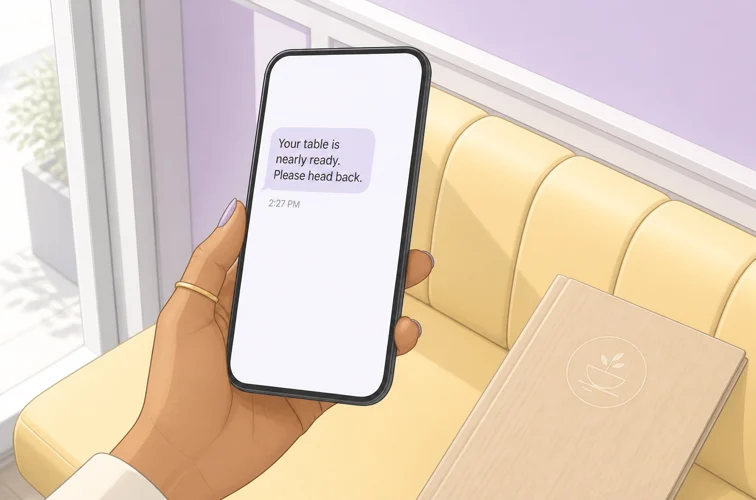
Text messaging is the default for good reason: the guest's own phone has unlimited range, they can walk to a shop, and you get a timestamped record of when you told them and when they replied. Two details make the difference between a system guests like and one they resent. Send a "you are next, please head back" message before the table is ready rather than when it is ready, because the walk back takes four minutes and you have just added four minutes of idle table. And give them something to do while they wait: a link to the menu on their phone turns fifteen dead minutes into a table that orders in ninety seconds, which is most of the case for QR code menus and for letting people browse before they sit through mobile ordering.
The guests who leave before you seat them
Waitlist abandonment is the number almost nobody tracks and it is the one that should worry you, because every abandoned party is a table you had demand for and did not sell. Somebody joined your list, waited, and left. That is not a lost guest, it is a lost cover with a grudge attached.
You reduce it in three unglamorous ways. Quote honestly, because the parties who leave are disproportionately the ones who were told fifteen and are standing there at thirty. Make waiting tolerable, which usually means somewhere to stand that is not the doorway and a drink they can buy, and a bar wait that sells two glasses of wine is not really a cost at all. And close the loop: if you have said twenty minutes and you are at eighteen with nothing free, go and tell them before they work it out themselves. A host who volunteers bad news keeps most of those parties. A host who hides behind a screen loses them.
One more thing worth doing. When somebody does walk out, note why, in one word, and look at it monthly. "Quote too long" and "nowhere to stand" are entirely different problems with entirely different fixes, and you cannot tell them apart from the abandonment rate alone. This kind of small deliberate logging is the same habit that makes a shift handover useful rather than ceremonial.
Staffing the door properly
On a genuinely busy Friday the host stand is doing four jobs at once: greeting arrivals, quoting waits, tracking which tables are close to finishing, and managing the people already waiting. That is not one job. Rooms that struggle at the door are usually rooms that put one person on it and hoped.
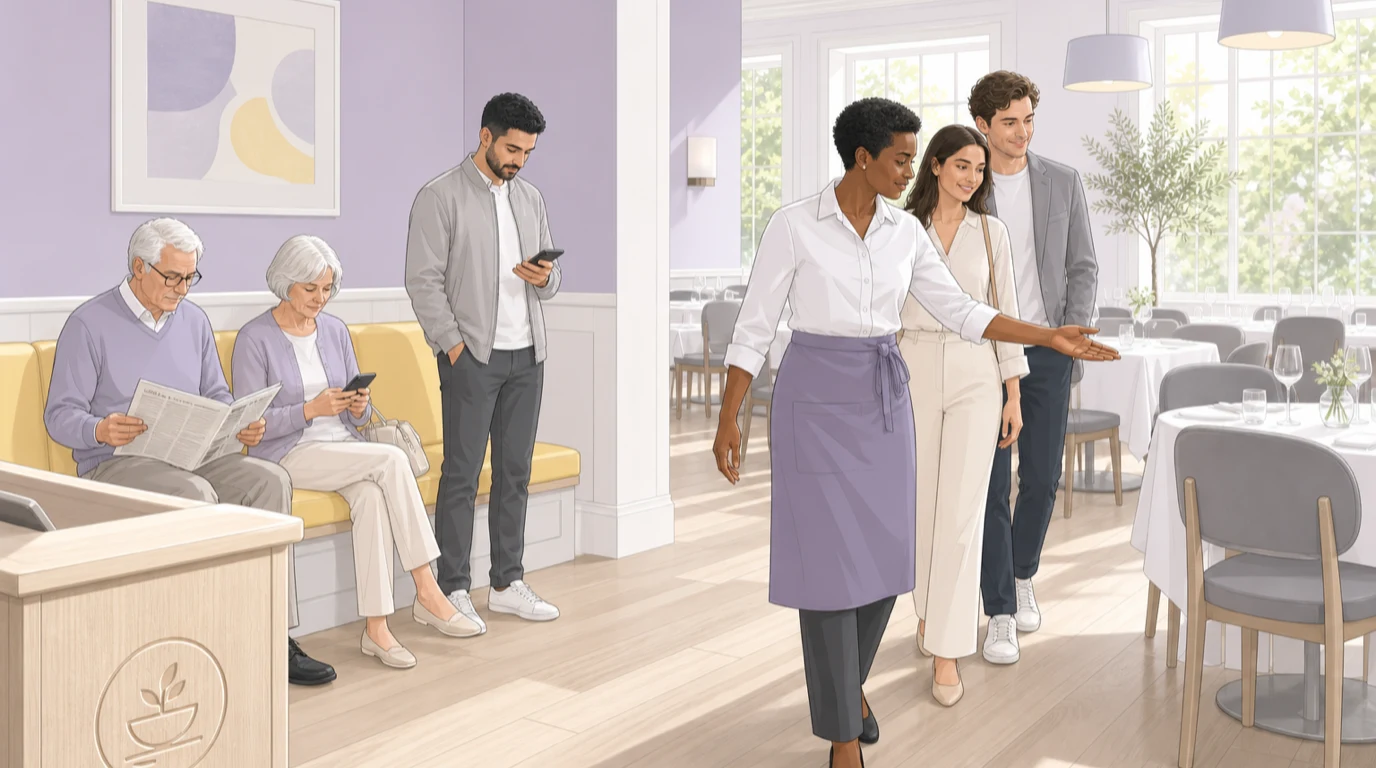
Above about eighty covers in a peak two-hour window, split the role. One person owns the list and the quote and does not leave the stand. A second walks parties to tables and reads the floor. The second job is the one that finds you turns, because a host who is actually looking at the room spots the table paying its bill and gets the next party moving before the plates are cleared. The full set of who does what at the front of house is laid out in our overview of restaurant positions.
Whoever is on the door needs authority as well as a script. A host who has to find a manager before offering a party of five a drink at the bar is a host who will not offer it. Decide in advance what they can give away, write it down, and let them use it. Where this consistently goes wrong is training: the door is treated as the entry-level job while being the single highest-leverage position in the building on your busiest night, a mismatch we come back to in the guide to restaurant staff training.
What the host should actually say
Scripts get a bad reputation because bad ones sound like a call centre. Good ones just remove the twelve decisions a nineteen year old should not be making at 7:40 on a Saturday.
The join is four pieces of information and nothing else: the wait, the reason if it is unusual, the warning about seating order if the party is large, and how you will reach them. "About twenty-five minutes for two. I will text you when you are next. There is space at the bar if you would like a drink while you wait." Then the number goes into the system, not onto a napkin.
The update matters more than the join. At roughly two thirds of the quoted time, tell them where they stand, whether the news is good or not. "You are next, ten more minutes" is worth a great deal, and "the table ahead of you is taking longer than expected, we are looking at another fifteen" is worth even more, because it is the sentence that proves you were not lying the first time. Guests forgive a wait that was communicated. They do not forgive being managed. That distinction is most of what separates good and bad restaurant customer service, and it shows up in reviews with striking reliability, which is worth bearing in mind when you read your next month of restaurant reviews.
The two numbers worth measuring
Most waitlist reporting is noise. Two figures tell you almost everything.
Quote accuracy is the first: the difference between the wait you promised and the wait you delivered, per party. Do not average it, because a quote fifteen minutes short and one fifteen minutes long average to perfect while producing one furious guest. Measure the share of parties seated within five minutes of the quote, and aim for eighty percent. Under sixty percent means your turn times are stale or your padding is guesswork.
Abandonment rate is the second: parties who joined and left, as a share of parties who joined. Anything over about one in ten on a normal service says either the quote or the waiting experience is broken, and quote accuracy will usually tell you which. Both of these belong on the same weekly page as the rest of your restaurant KPIs, not in a separate report nobody opens.
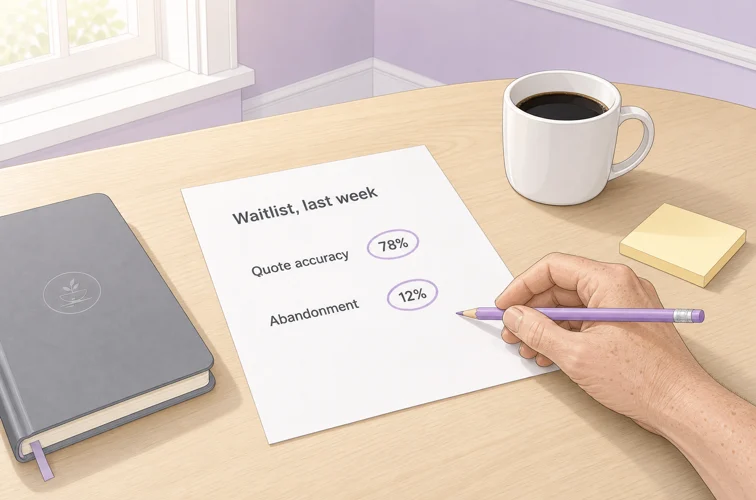
One number worth watching that is not a waitlist metric at all: average check for parties who waited versus parties who walked straight in. If waiting guests spend meaningfully less, your wait is not a neutral queue, it is dampening appetite and mood, and that shows up in average check long before it shows up in a complaint.
The same problem in different rooms
A bistro with twenty tables and a bar runs the version described above and the bar is the pressure valve. Sell the wait rather than apologizing for it, and a thirty minute queue becomes the most profitable half hour in the building. That is the model most casual dining rooms should aim for.
A bar or a late-night venue barely has a waitlist in the same sense; it has a door count and a capacity limit, and the constraint is legal occupancy rather than tables. Different discipline, different tools, covered on the bars and clubs side.
A hotel restaurant has a problem nobody else has: a meaningful share of the queue is already staying in the building, which changes the stakes completely. Telling a resident there is a fifty minute wait for breakfast is not turning away a walk-in, it is degrading a stay somebody has already paid for, and the complaint lands with the front desk rather than with you. Room service and outlet capacity have to be considered together, which is why the waitlist question looks different across hotel and resort F&B and why in-room ordering is part of the same conversation, as we covered in the piece on hotel room service.
Thirty days to tighten it up
Week one, measure only. Do not change anything. Record the quote given, the time actually seated, and the party size for every walk-in, and log abandonments with a one-word reason. It is tedious and it is the only way to know which of your assumptions is wrong.
Week two, fix the turn times. Pull real averages per table size per daypart and replace whatever number your hosts have been carrying around. This one change usually improves quote accuracy more than everything else combined, because most quotes are wrong at the input rather than the arithmetic.
Week three, introduce the script and the pad. Formula plus five to ten minutes, the four-part join, the update at two thirds. Have a manager stand at the door for one full service and listen, without stepping in, then coach afterwards.
Week four, compare against week one. If quote accuracy has not moved, the problem is not the door, it is the floor: tables are not being bussed fast enough or the kitchen is the real constraint, and no amount of host discipline will fix either. That is a different project, and a useful one, and there are plenty of places to start in our list of restaurant improvement ideas.
Read next: Restaurant floor plan layouts, since how many parties of five you can seat is decided long before anyone joins a list. Tableside ordering, which shortens turns at the other end of the meal. And Getting through the festive season, when every problem in this article arrives at once.