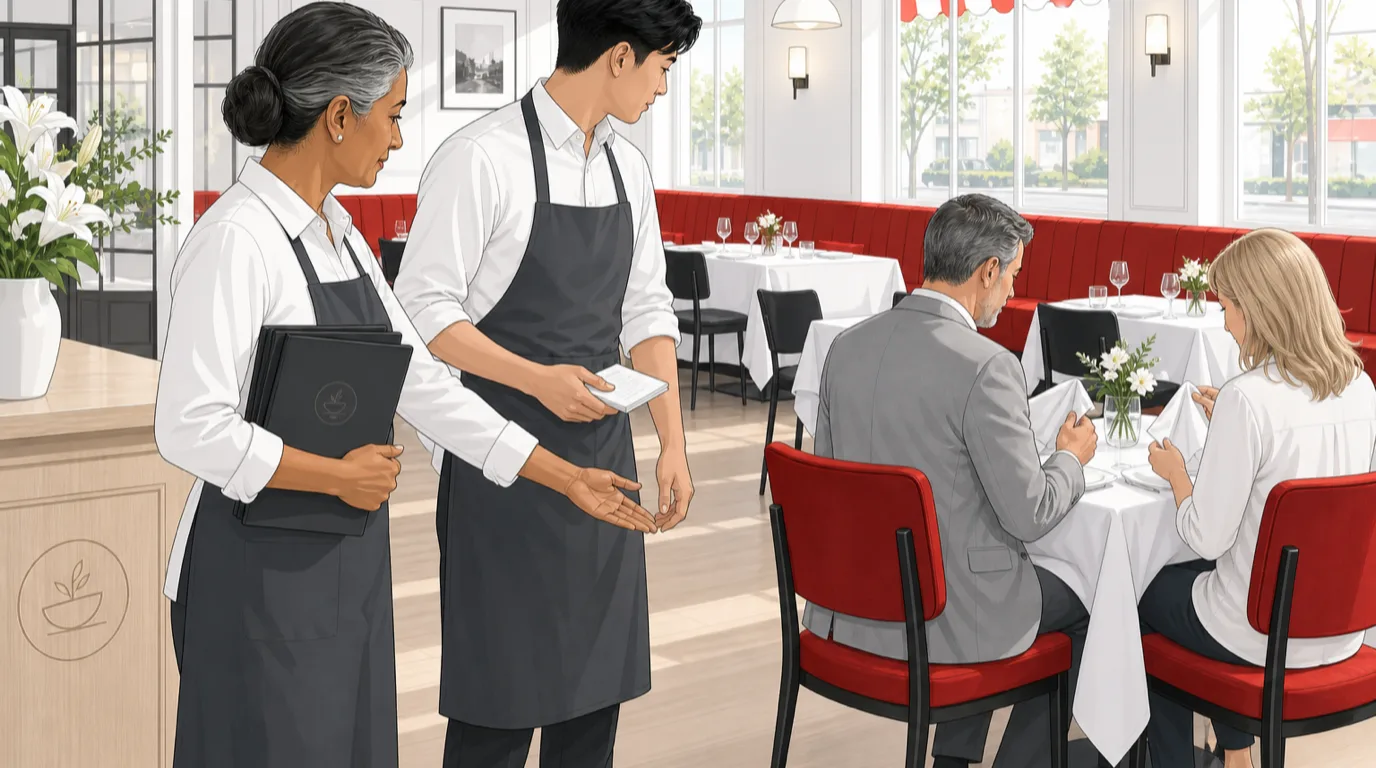
The host is the only person in a restaurant who touches every single guest. The chef never meets them, most servers meet a third of them, and the manager meets the ones who complain. The host meets all of them, twice, once on the way in and once on the way out. And in a startling number of restaurants this job is handed to the youngest, newest, cheapest member of staff, with a floor plan, a phone, and roughly ninety seconds of instruction. Then everyone acts surprised when Saturday goes badly. If you run a room where the door matters, the tooling side of this is covered across our full-service restaurant POS pages.
What follows is not a job description you can paste into a hiring ad. It is what the role actually consists of, hour by hour, and where it tends to break. Most of the work is decision-making under time pressure with incomplete information, which is why good hosts are unreasonably valuable and why the ones who are merely pleasant do not cut it. Nearly all of those decisions get faster when the floor plan and the book live on one screen instead of in someone's head, which is the argument for running the door from your restaurant POS system rather than a clipboard.
The only role that touches every guest
Start with the stakes, because they are routinely underestimated. The first thirty seconds of a meal and the last thirty seconds both belong to the host, and those are the two moments a guest is most likely to remember. Psychologists have a name for this, but you do not need the theory: think about the last restaurant that annoyed you and there is a decent chance the annoyance happened within three feet of the door.
The host is also the only person with a live view of the whole room. A server knows their four tables intimately and the other sixteen not at all. The kitchen knows tickets, not people. The host knows which tables are close to leaving, which party has been waiting nineteen minutes, which server is drowning, and that the two-top by the window has been nursing coffee for half an hour. Nobody else holds that picture, which means nobody else can make the decisions that depend on it.
And it is a revenue job, not a hospitality job with a revenue side effect. The host decides how quickly a bussed table gets filled, how evenly the covers land across sections, and whether a party of five waits twenty minutes or walks out. On a busy Saturday the gap between a good host and an adequate one is worth more than the position costs for a month. The broader map of who does what and how the roles fit together is in our overview of restaurant positions.
What a host actually controls: the seating rotation
Here is the core of the job, and it is the part that never appears in the job ad. The host controls the rotation, meaning the order in which sections receive new tables. Get it right and four servers each end the night with a similar number of covers and a similar quality of service. Get it wrong and one server has eleven tables while another has four, and both of them do a bad job, one from overload and one from boredom.
The mechanics are simple. Divide the floor into sections, assign a server to each, and seat new parties in strict rotation: section A, then B, then C, then D, then back to A. What makes it hard is that reality keeps interrupting. Section C's tables are all full. Section A just got a party of eight. Section D has two tables that sat down within four minutes of each other and the server has not caught up. So the host is constantly holding a rotation in their head and deciding when to deviate from it and by how much.
The single most common mistake is double-seating, putting two parties into one section within a couple of minutes. Both tables get greeted late, both order late, both wait longer for food, and one server spends the next forty minutes apologizing. A host who understands that the rotation exists to protect service quality, and not merely to be fair to servers, will space seatings deliberately and the whole room runs smoother. How sections are drawn in the first place decides how much room the host has to maneuver, which is the practical reason to care about restaurant floor plan layouts.
Pre-shift: the fifteen minutes that decide the night
Almost everything that goes wrong at the door on a Friday was decided, or could have been prevented, before service started. The pre-shift routine is short and it is not optional.
Read the book properly. Not a glance at the cover count, an actual read: how many parties, at what times, how large, and where the pinch points are. If you have fourteen covers booked at 7:30 and nine at 7:45, you have a problem at 7:30 that you can only solve by deciding now which of those tables you will set up early and which you will stagger. Note the parties with a birthday, an allergy, a wheelchair, a stroller, a regular who always sits at 14. Those details are the difference between a guest feeling recognized and a guest feeling processed, and they should be sitting in the guest's record in your restaurant CRM rather than in the memory of whoever worked last Tuesday.
Then walk the floor. Physically. Confirm every table is set, know which ones are wobbly or too close to the kitchen door or under the cold vent, and confirm which sections are actually open tonight, because a host seating a section that has no server is a special kind of disaster. Find out what is off the menu before service rather than during it, since a guest who is told at the door that there is no fish is mildly disappointed and a guest who is told at minute twenty is annoyed. Most of this belongs on a written routine, the same way the rest of the building runs on opening and closing checklists.
The first thirty seconds at the door
There is a version of greeting that is warm and useless, and a version that is warm and gets four pieces of information in under half a minute. Aim for the second one.
Acknowledge the guest within about five seconds of them entering, even if you cannot deal with them yet. Eye contact and "I will be right with you" buys a remarkable amount of patience; being ignored while someone stares at a screen burns it immediately. Then: how many in the party, do they have a reservation, any preference on where they sit, and if there is a wait, how long and how you will contact them. Get the name. Use it when you seat them.
The part people get wrong is walking guests to the table. Do not stride ahead and leave a family of four trailing behind you. Set the pace to the slowest person in the party, which on a Sunday might be a grandmother with a stick, and glance back once. When you arrive, say what happens next: "Danny will be right over to look after you." That single sentence prevents the most common complaint in casual dining rooms, which is a table that does not know whether they have been forgotten. The wider habit that sits behind all of this is covered in the piece on restaurant customer service.
Why servers argue about seating, and how to settle it
Every restaurant has a version of this fight. A server says the host is skipping them, or loading them, or giving the good tables to somebody else. Sometimes they are wrong. Often they are right, and the host has no idea, because they have been deviating from the rotation twenty times a night for perfectly sensible reasons and never tracking the cumulative effect.
The fix is to make the rotation visible instead of mental. If the seating order and the cover count per section are on a screen both the host and the servers can see, the argument evaporates, because it becomes a fact rather than an accusation. When the numbers are genuinely lopsided, the host can say so and correct it over the next four seatings. This is one of the underrated benefits of running the floor in a table management system: the record of who got what exists, so nobody has to rely on their own sense of grievance.
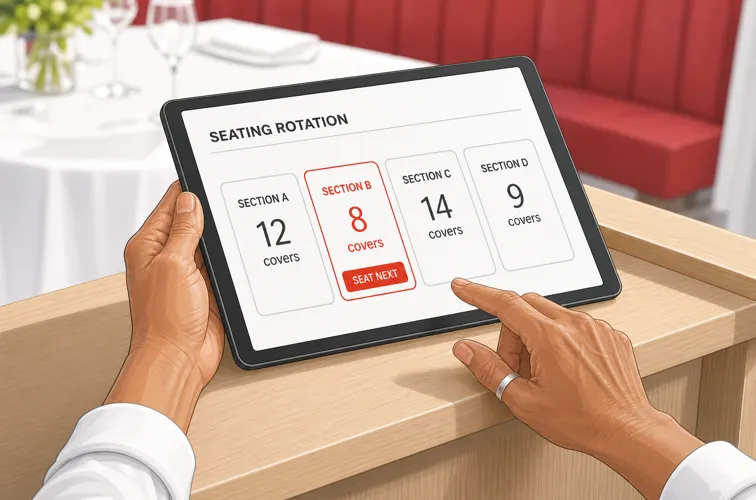
The other half of the fix is authority. A host who can be argued out of a seating decision by a forceful server has effectively lost control of the room, and the rotation will bend toward whoever complains loudest. Managers need to back the host's call in the moment and review it afterward if it was wrong, which is a management responsibility rather than a host one, and part of the job described in restaurant manager responsibilities.
Quoting a wait the room can keep
When the room is full, the host's most consequential act is telling somebody how long they will wait. That number is a promise, and the gap between the promise and reality matters far more than the length of the wait itself. A guest told thirty minutes who sits at thirty is content; a guest told fifteen who sits at twenty-two is irritated.
Quote from arithmetic, not instinct. Count the parties ahead who need the same size table, divide by the number of tables that fit them, multiply by the average turn time for that size, then add five to ten minutes in the guest's favor. Seating a party early is a free gift; seating them late is a review. The full method, including how to measure the turn times the formula depends on, is in our guide to restaurant waitlist management.
The discipline that separates a good host here is the update. At roughly two thirds of the quoted time, go and tell the waiting party where they stand, whether or not the news is good. "You are next, about ten minutes" is worth a lot. "The table ahead is running long, realistically another fifteen" is worth more, because it proves the first number was honest. Hosts who hide from waiting guests lose them; hosts who volunteer bad news keep most of them.
Working the book against the door
A host is arbitrating between two streams of business that want the same tables. Reservations are predictable and can no-show. Walk-ins are unpredictable and never no-show. Managing both at once, in real time, is most of the mental load of the job.
That means holding tables, and holding tables is expensive. A four-top held for a 7:30 booking is dead from about 7:15, which is fifteen minutes of a prime table you cannot sell. So the practical questions are how early to start holding and how long to keep holding after the booking time has passed. Most rooms settle on a grace period of around fifteen minutes, after which the table goes back into circulation and the party takes their chances. What matters is that the rule exists and everyone applies it the same way, rather than each host inventing a policy at 7:45. Where the rule should sit is written down, alongside the rest of the house rules in your restaurant employee handbook.
Overbooking deserves a mention because it is tempting and it is a trap. Deliberately taking more bookings than you have tables, in the expectation that some will not show, works right up until they all show, and then the host absorbs an hour of abuse for a decision made by someone else. If you are going to do it, the host needs to know, and needs a plan for the night it goes wrong. How the book itself should behave is covered in the piece on choosing a restaurant reservation system.
Reading the floor, the skill nobody teaches
This is the difference between a host who is competent after a week and one who is genuinely good after three months. Reading the floor means knowing how long a table has left without asking anybody.
The cues are learnable and specific. Dessert plates cleared means roughly twelve minutes. Coffee arriving means eight to ten. The check dropped means six. A card or cash on the table means three, and one person standing up to find their coat means now. A host who reads these gets the next party moving before the table is even cleared, which compresses the dead time between one party leaving and the next sitting down. That dead time is where turns are lost, and shaving a few minutes off it across twenty tables on a Saturday is worth a whole extra seating, which is the mechanism behind table turnover rate.
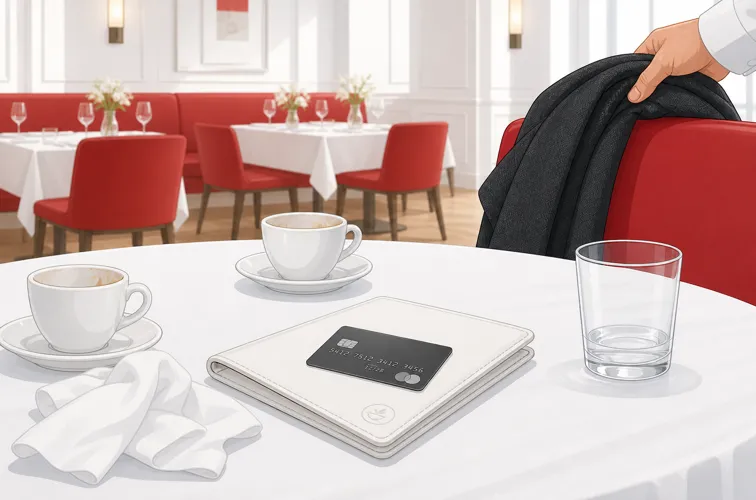
The other half of reading the floor is reading the staff. A server moving fast and talking fast is fine. A server standing still in the middle of the room is not, because that is what drowning looks like, and the host is the only person positioned to notice and stop feeding them tables for ten minutes. None of this appears in a job description and all of it is the job.
Phone, door, and screen at the same time
On a busy night the host is being interrupted by three channels at once, and the most common failure is not being bad at any one of them but having no rule for which wins.
Have the rule. The person physically in front of you outranks the phone, always. Acknowledge them, then ask the caller to hold, rather than making the guest at the door watch you take a booking. If the phone genuinely cannot wait, say so out loud to the guest in front of you, because narrating what you are doing converts rudeness into competence. And if the phone rings constantly during peak service, that is an operational problem rather than a host problem: the answer is online reservations on your own site taking the volume, not a faster host.
The related staffing point is that above roughly eighty covers in a peak two-hour window, this stops being one job. Split it. One person owns the list, the book, and the quote and does not leave the stand. A second walks parties to tables and reads the room. The second role is the one that finds you turns, and cutting it is a false economy that shows up as slower seatings and longer waits.
The handoff to the server
The moment a host walks away from a newly seated table is where information gets dropped, and dropped information becomes a complaint twenty minutes later. A proper handoff takes eight seconds and covers what the server cannot see.
Table number and party size, obviously. Then the things that change how the table should be run: an allergy, a birthday, a guest in a hurry because of a show at eight, a first-time visitor, a regular who always drinks the same thing, a high chair that still needs to arrive. Say it directly to the server rather than typing it and hoping. Where a note genuinely needs to persist, put it on the table record so it survives the shift, and use the same discipline you would for a proper shift handover.
This matters more the more the room relies on shared tools. If servers are taking orders at the table on a handheld, the host's note needs to be somewhere the server will actually look, which in practice means attached to the table rather than shouted across a section. That integration between the door and the floor is much of the point of tableside ordering.
When there is no table
Some nights the honest answer is that you cannot seat somebody in any reasonable amount of time, and how the host handles that determines whether the guest returns.
Be direct and early. "Realistically an hour and a half tonight, and I would rather tell you now than have you wait" earns more goodwill than a hopeful twenty-five that becomes fifty. Offer what you have: a seat at the bar, a drink while they decide, a table at nine, a booking for Thursday. A host who is allowed to give away a drink or hold a table next week will save relationships that a host who must fetch a manager for permission will lose. Decide in advance what they can offer, write it down, and let them use it without asking.
The large party is its own problem. A group of seven in a room where exactly one table fits seven has a queue of one, and the host should say so plainly rather than quoting an average. And the late party, arriving forty minutes after their booking, needs a rule rather than a negotiation, because the alternative is a host improvising a policy while six people stand over them. These are the moments guests write about afterward, which is worth remembering when you next read a month of restaurant reviews.
Training a host in two weeks, and what good looks like
The role is trainable, which is fortunate, because turnover in it is high. Two weeks is enough if the two weeks are structured.
Week one is shadowing with a narrow remit. The new host greets, walks parties to tables, and does the handoff, while an experienced host or a manager owns the rotation, the book, and the quote. The point is to build fluency in the guest-facing half before adding the decisions. Have them learn the floor plan by table number until they can name any table without looking, because a host who has to check which table is 22 cannot read the room. The vocabulary is worth front-loading too, and our glossary of restaurant lingo shortens that considerably.
Week two they own the door with someone standing behind them. They run the rotation and give the quotes, and the experienced person intervenes only when a decision would actually hurt the night, then explains afterward rather than in front of the guest. That correction-after-the-fact habit is what separates real training from being thrown in, and it is the same approach laid out in our staff training plan.
As for what good looks like, three numbers tell you most of it. Quote accuracy, the share of parties seated within five minutes of the number they were given, with eighty percent as a target. Cover distribution, the spread between the busiest and quietest section at the end of a shift, which should be tight. And seat-to-greet time, how long a newly seated table waits before a server acknowledges them, which should be under two minutes and which is a rotation problem when it is not. Put them with the rest of your restaurant KPIs rather than treating the door as unmeasurable.
Read next: Barback job responsibilities and what a line cook actually does, the other two roles worth understanding in this detail. And restaurant hiring and retention, since the hardest part of the host role is keeping the good one you finally trained.