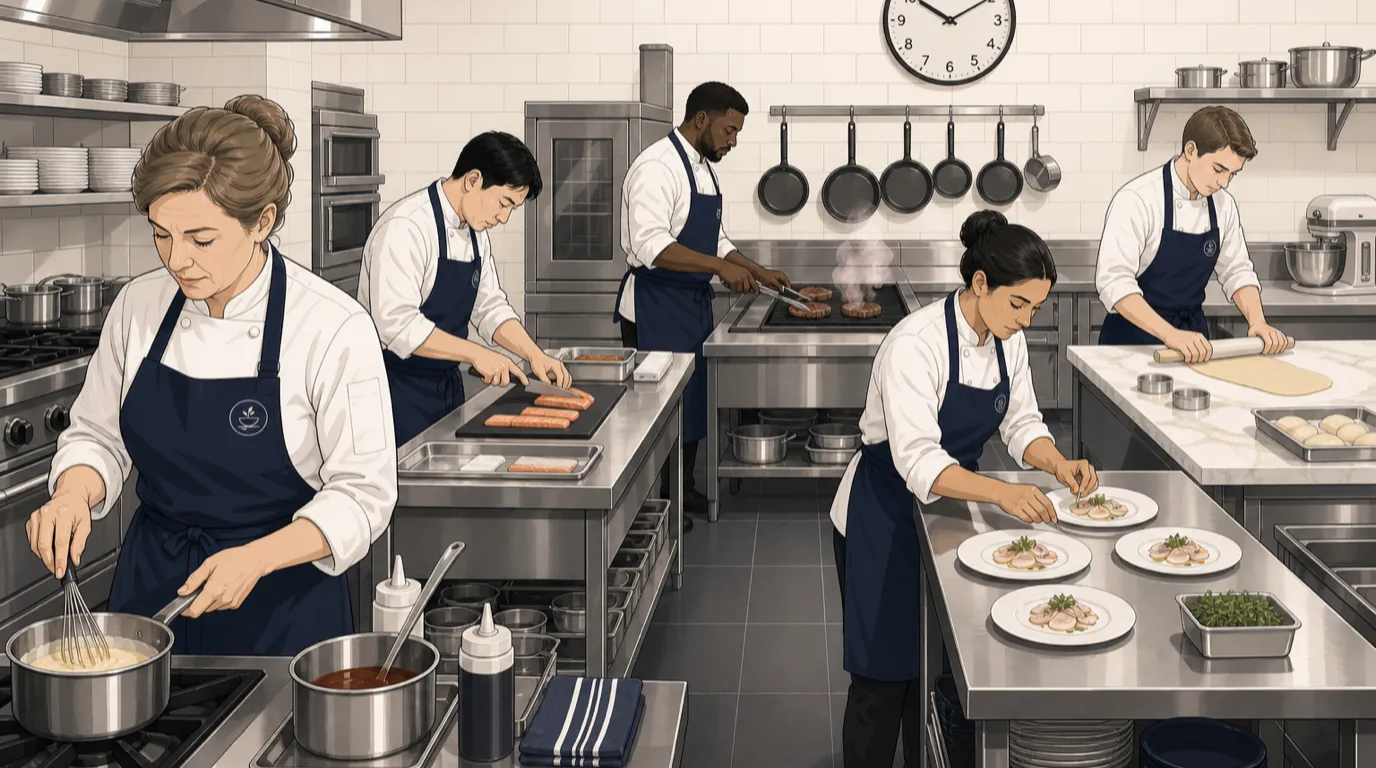
Walk into a professional kitchen and you will hear job titles that are more than a century old and mostly French. Someone is the chef de partie on fish. Someone else is a commis working under them. A demi chef covers the station on their days off. If you have ever nodded along without being entirely sure who outranks whom, you are in good company, because the system these titles come from was designed for a kitchen far larger than almost any that exists today, and what survives is a compressed version that varies from one building to the next. The logic is still visible in how work gets routed on a modern pass, which is essentially what a kitchen display system automates.
What follows is every rank explained, from the top of the kitchen down to the roles nobody puts on an org chart, plus the dining room hierarchy that mirrors it, which is the half most guides leave out. Then the part that actually matters when you are staffing a real restaurant: which of these positions a kitchen of a given size genuinely needs, and how to use the titles in a job advert without either confusing candidates or overpromising a rank you cannot pay for. Where permissions and reporting lines have to be reflected in your systems, that is a question for your restaurant POS as much as your rota. Our broader guide to restaurant positions covers the same team in modern titles.
Where the brigade came from, and why it survived
The system is called the brigade de cuisine and it is credited to Georges Auguste Escoffier, who put it in place at the Savoy in London in the late nineteenth century. Escoffier had served as a chef in the French army during the Franco-Prussian war, and the structure he built borrowed openly from military organisation: fixed ranks, a clear chain of command, and a defined territory for every person in the room.
The problem he was solving was chaos. Grand hotel kitchens of the period were large, hot, disorganised places where the same dish might be assembled by whoever was nearest. Escoffier's answer was to divide the work by type of cooking rather than by dish, put one named person in charge of each division, and make every one of them accountable upward through a single line. It worked well enough that the vocabulary outlived the kitchens it was invented for.
Two things are worth knowing before the list. A full classical brigade ran to more than twenty positions, and essentially nobody staffs that now outside a handful of large hotels and palace kitchens. And the titles have drifted, so the same word can mean slightly different things in a London hotel, a Paris bistro and a New York restaurant. Treat what follows as the standard reference rather than a rule your local kitchen is breaking. Much of this vocabulary shows up in daily service talk, which our guide to restaurant lingo covers.
How to read the hierarchy
One piece of vocabulary unlocks the rest. Chef does not mean cook. It means chief, or head. A cook is a cuisinier. So chef de partie is not "the partie cook", it is the chief of a section, and the reason a commis chef sounds like a contradiction is that it more or less is one: a junior in a system where everyone gets called chef.
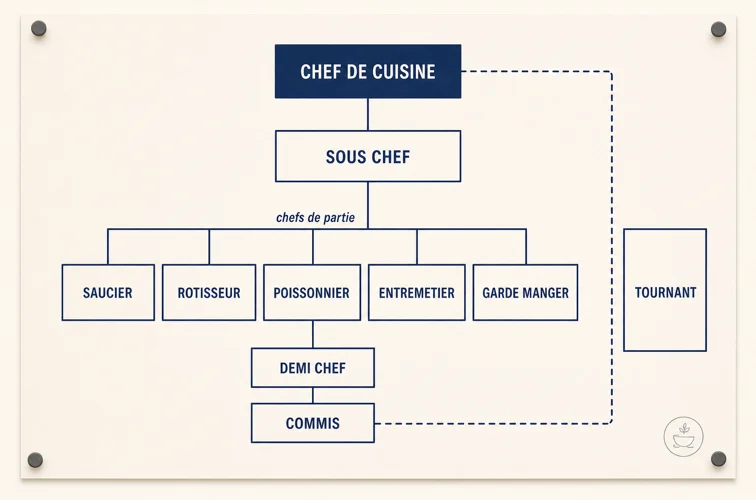
With that in place the structure is simple, and it has three layers. At the top, one person owns the kitchen as a whole, its menu, its costs and its people. In the middle, a deputy runs the day and a group of section chiefs each own one type of production. At the bottom, juniors work inside a section, learning it, under someone who is accountable for what leaves it.
The elegance is that the middle layer is horizontal. Chefs de partie do not outrank one another; they hold parallel territories and answer to the same deputy. That is what lets a kitchen scale, because adding a new type of production means adding a section rather than lengthening a chain of command, and it is why the language survives even where the titles have been anglicised. Getting these lines wrong is one of the quieter causes of the churn described in hiring and retention.
Chef de cuisine, head chef and executive chef
The chef de cuisine runs the kitchen. Menu and recipes, ordering and suppliers, food cost, hiring and training, standards, and the discipline of the room. In most independent restaurants this person is simply called the head chef, and the two terms mean the same thing.
Executive chef is the title that causes the most confusion, because it means one thing in a restaurant and another in a group. Where there is only one kitchen, executive chef and head chef are usually the same job under a grander name. Where a company runs several outlets, or a hotel runs a restaurant plus banqueting plus room service, the executive chef sets direction across all of them while a chef de cuisine runs each individual kitchen day to day. In that arrangement the executive chef is a manager who used to cook, and may not be on the line at all.
Either way the job stops being mostly cooking somewhere around this rank. It becomes numbers, people and suppliers, which is why the skills that get someone promoted here are rarely the skills that keep them here. The commercial half is closer to restaurant manager responsibilities than to a station, and the menu half runs on menu engineering. In hotels, where the full structure is most likely to survive intact, it sits inside hotel and resort food and beverage.
Sous chef
Sous means under. The sous chef is second in command and, in practice, the person who actually runs service while the head chef runs the business.
The job has two halves that pull in different directions. One is deputising: taking the kitchen when the head chef is off, which means being able to do every part of that job at short notice. The other is operational command during service, which usually means standing at the pass, checking every plate, calling the timings and holding the line together on a Saturday night. Between services it is orders, prep lists, covering gaps in the rota, and most of the day-to-day training.
Big kitchens have more than one, ranked junior and senior, and the senior sous is often the person genuinely being groomed for the top job. It is also the rank where the classical system and the modern one line up most neatly, since almost every kitchen has this position whatever it calls it. Much of the work is scheduling and cover, which is the subject of staff scheduling, and the pass discipline is the same argument made in a KDS versus a kitchen printer.
Chef de partie
This is the pivot of the whole system and the rank most job adverts are actually looking for. A chef de partie owns one station. Not a shift on it, not a task within it: the station itself.
Ownership means the prep for that section, the standard of what comes off it, the ordering or requisitioning that keeps it stocked, and the supervision of whoever works there. If the sauce is wrong, it is the saucier's problem regardless of whose hands were on the pan. A kitchen has several chefs de partie working in parallel, one per section, and they are peers rather than a chain.
The reason this rank matters commercially is that it is the first one carrying real accountability, which makes it the hardest to fill and the most expensive to lose. A chef de partie who leaves takes the knowledge of a whole section with them, and that knowledge tends to live in habits rather than documents, which is why the prep discipline described in mise en place and the routines in opening and closing checklists are worth writing down before somebody hands in their notice. In modern English-speaking kitchens the closest equivalent is the senior line cook.
Demi chef de partie
Demi means half. A demi chef de partie is the deputy of a section, and it is the rank people search for most and understand least, largely because it sits in a gap rather than owning anything outright.
The role is a genuine middle: more responsibility and more complex work than a commis, but without final accountability for the station. In practice a demi chef runs the section when the chef de partie is off, handles the harder preparations while they are on, and supervises the commis working alongside them. It is explicitly a training rank, the step where somebody is being proven capable of owning a station before being handed one.
It appears mostly in larger kitchens and in hotels, where there are enough people per section to justify a deputy. A small restaurant with one person per station simply does not have this rank, which is why plenty of very good cooks have never held it. If you are writing a progression path for your team, this is the rung that makes the jump from commis to chef de partie survivable rather than a leap, and it belongs in whatever you set out in your employee handbook.

Commis chef and apprenti
The commis is the junior. They work under a chef de partie, they execute instructions rather than setting them, and the point of the job is to learn a section from the inside.
Day to day that means prep, the simpler cooking on the station, keeping the section stocked and clean during service, and absorbing how a competent person organises their work. The classical system ranks them, and hotels still do: premier commis, second commis and so on, or commis I, II and III, with the number indicating how far along someone is rather than a different job.
Below that sits the apprenti, the apprentice, typically someone in formal training who splits time between a culinary school and a kitchen and does preparatory and cleaning work while learning. Both ranks live or die on the quality of the teaching around them, which is a real operational point rather than a sentimental one: a kitchen that does not train its commis is a kitchen that will be short a chef de partie in two years. That is the argument for treating staff training as a system rather than an induction.
The stations, one by one
Everything below this line is a chef de partie post, or a role reporting into one. This is the part of the brigade that expanded most in Escoffier's day and has compressed most since, so read it as a map of what the work is rather than a list of people to hire.
Saucier
The sauce chef, and traditionally the most senior of the sections, to the point that in large classical brigades the saucier doubled as the second of the kitchen. Responsible for sauces and for sauteed dishes, which in a French kitchen is a great deal of the menu. In modern kitchens this is usually just called the saute station and it is still where you put your strongest cook.
Rotisseur, grillardin and friturier
The rotisseur handles roasted and braised meats, and traditionally supervises two related posts that only appear once a kitchen is large enough to split them: the grillardin, who does everything grilled, and the friturier, who does everything fried. Most restaurants today collapse all three into a grill section and a fryer that whoever is nearest keeps an eye on.
Poissonnier
The fish chef: all fish and seafood, and traditionally the sauces that go with them where those sauces are part of the cooking. In a large brigade the poissonnier may be assisted by an ecailler, who opens and presents shellfish. In smaller kitchens fish is often folded into the saute station, or handled by whoever also does the butchery.
Entremetier, potager and legumier
The entremetier is the broadest and least understood of the sections: vegetables, starches, soups, egg dishes and hot starters, and in kitchens without a pastry chef, sweet courses too. Where the volume justifies it the section splits, with a potager taking soups and a legumier taking vegetables, both reporting to the entremetier. Sources differ on exactly how far the entremetier's supervision extended in the original brigade, which is a fair sign of how much these boundaries moved even at the time.
Garde manger, boucher and charcutier
The garde manger runs the cold section: cold starters, salads, pates, terrines and cold buffets, plus the preliminary preparation and storage of a lot of what other sections will cook. The name means keeper of the food, which tells you it was once as much about storage as about cooking. Larger kitchens attach a boucher for butchery and a charcutier for cured and prepared meats. This is the one classical term that has survived intact into ordinary English-language kitchens, where the cold station is still often just called garde manger.
Patissier, boulanger, glacier and confiseur
The patissier makes desserts, sweet courses and pastry-based items, and in most kitchens also anything else involving dough. A large operation separates out the boulanger for bread, the glacier for ice creams and frozen desserts, and the confiseur for confectionery and petits fours. Pastry is the section most likely to be either fully staffed or entirely absent, because it needs different equipment, different timing and often a different part of the building, which is a real consideration when working through a kitchen equipment list.
Tournant
Also called the chef de tournant, the roundsman or the swing cook. The tournant has no fixed section and instead covers whichever one is short, which means being competent at all of them. It is a genuinely senior role that reads as junior on paper, and in staffing terms it is the most useful position in the brigade, because it is the difference between a rota that survives someone calling in sick and one that does not.
Aboyeur
The expediter, and literally the barker. The aboyeur stands between the dining room and the kitchen, calls the incoming orders, controls the sequence in which things are fired, and checks plates before they leave. In most modern restaurants this is not a separate person but a job the sous chef or head chef picks up during service, and increasingly it is a job partly done by software, since routing tickets to the right section at the right moment is precisely what a kitchen display system exists to do.
Communard
The communard cooks the staff meal. It sounds like a footnote and it is a serious job in any kitchen large enough to name it, because the staff meal is what a team eats before a twelve-hour shift and it is usually built from what would otherwise be waste. In the classical structure the communard ran a small independent brigade of their own.
Plongeur, marmiton and the roles nobody lists
The brigade includes the washing-up, which most modern org charts quietly omit, and this is a mistake with operational consequences rather than only a courtesy.
The plongeur washes dishes and glassware and is often trusted with basic preparation. In larger kitchens a marmiton takes the pots and pans specifically, leaving the plongeur everything else, and both are frequently described together as kitchen porters. The work is physically hard, the turnover is the highest in the building, and a kitchen discovers exactly how essential it is the first evening nobody turns up for it, because the entire line stops within about forty minutes.
There is a wider point here about how a brigade is drawn. Escoffier's version named the cleaning as part of the structure rather than treating it as something outside the team, and kitchens that keep that framing tend to hold onto those staff longer. It is also where food safety either happens or does not, which links the role directly to food safety and HACCP.
The dining room brigade
The kitchen is only half the system. Classical service had its own hierarchy, the brigade de salle, built on exactly the same logic, and its titles are still standard in fine dining and in hotels across Europe.
Maitre d'hotel
The master of the house, running the dining room the way a chef de cuisine runs the kitchen: the standard of service, the staff on the floor, the reservation book and the difficult conversations. In larger operations a chef de salle handles the floor during service while the maitre d' owns the room overall. The greeting and pacing half of the job is covered in host responsibilities.
Chef de rang
The direct equivalent of a chef de partie, on the floor. A rang is a section of tables, and the chef de rang owns theirs completely: taking orders, serving, the timing of courses, and the guest experience at every table in it. This is the rank that has no clean English translation, because a server in most restaurants covers a section without the same formal authority over it, and a demi chef de rang deputises exactly as a demi chef de partie does in the kitchen.
Commis de rang
The junior of the section: running food, clearing, resetting, keeping the station stocked and learning the room. Sometimes called the back waiter or the runner, and it is the floor's equivalent of the commis chef, including the part where the quality of the training determines whether they are still there in a year. The service standards that go with it are in restaurant customer service.
Sommelier
The wine specialist: the list itself, buying and cellar management, pairings and recommendations, and service at the table. In large operations a chef sommelier runs a team of them. It is the one floor role that is unmistakably a specialism rather than a rank, and the closest bar equivalent, in structure if not in prestige, is the relationship between a bartender and a barback. Where the wine programme is a real part of the offer, this sits alongside the distinctions in fine dining versus casual dining.
What a real kitchen actually staffs
Now the useful part. Almost no one runs a full brigade, and the interesting question is which of these roles survive compression, because that is what you are actually deciding when you write a rota.
A small independent kitchen, perhaps three or four people on at once, has a head chef, possibly a sous, and cooks who each cover two or three of the classical sections at the same time. Nobody is a saucier; somebody does the sauces along with the fish and the vegetables. The first specialist role a kitchen of this size adds is usually pastry, and it is often part-time or bought in.
A larger restaurant, six to ten in the kitchen, starts to look like a compressed brigade: head chef, sous chef, three or four chefs de partie holding recognisable sections, commis under the busier ones, and kitchen porters. Hotels and banqueting operations are where the full structure still appears, because volume and menu breadth justify it and because a hotel kitchen must produce breakfast, lunch, dinner, room service and events at once.
Two roles are worth staffing earlier than most operators do. A tournant, or somebody explicitly cross-trained to be one, because it converts absence from a crisis into an inconvenience. And a genuine second in command, because a kitchen where only one person can run service is a kitchen that cannot let that person take a holiday. Both are labour decisions before they are culinary ones, which puts them in the same conversation as labour cost.
Using these titles when you hire
Titles do real work in a job advert, and getting them wrong is expensive in both directions.
Advertise below the actual job and you will not attract anyone capable of doing it, because an experienced chef de partie reading a commis advert will assume the pay matches the title and move on. Advertise above it and you will hire someone who arrives expecting to own a section, discovers they are effectively a commis with a better title, and leaves within the quarter. Either way you pay for it twice, once in the recruitment and once in the gap.
So write the responsibilities, not just the rank. Name the section, say who the person reports to, say who if anyone reports to them, and be explicit about whether the role owns a station or supports one, since that single distinction is what separates most of these ranks from each other. If you use the French titles, use them accurately, because candidates from a classical background read them precisely and candidates without one will need the English alongside. And keep the same structure inside the building, so that reporting lines, rota and system permissions all describe the same organisation rather than three different ones, which is the practical argument for a coherent restaurant tech stack. More in the same vein is in restaurant improvement ideas.
Read next: restaurant positions for the same team described in modern job titles, and restaurant staff training for how anyone moves from one of these ranks to the next.